
Number Sense Activities: 4 Powerful Ways to Help Children Master Quantities and How Numbers Relate
In our household, number sense activities became our quiet lifeline when printed worksheets brought tears. Rather than memorising math facts, real number sense activities give a child hands and eyes a way to feel what amounts actually mean, long before symbols on paper make sense.
When my daughters were little, numbers could be recited with rhythmic ease up to twenty, yet moments later, a plate with four crackers would trigger absolute bewilderment or tears.
When our family first moved to Melbourne, my eldest, Bella, and her younger sister, Zara, were navigating English as an additional language. At the time, I did not know that Bella had ADHD. That diagnosis would not arrive until her twenties.
Nor did I know that my own exhaustion and scattered focus were rooted in ADHD. I only came to understand my own brain in my forties, long after those intense early years had passed.
Back then, all I knew was the confusing friction. Structured worksheets made Bella withdraw into silent overwhelm, sudden tears erupted over afternoon snacks, and my own racing brain wondered why standard parenting advice felt impossible. That lived reality forced me to leave academic formulas behind and discover why low pressure, hands on number sense activities were the only thing that protected our peace.
While my background is in early childhood curriculum, lived experience taught me a far deeper truth. When a neurodivergent child struggles with early numeracy, they do not need more rote drills or clinical lectures. They need physical anchors and calm connection.
- The Afternoon Grape Debate: What My Girls Showed Me
- Rote Counting vs Number Sense: Where We Got Stuck
- Why Spacing Fooled Their Eyes (And Why That Is Okay)
- Perception vs Reality: What Was Happening Beneath the Surface
- Subitising: Helping Them See Groups Without Panicking
- 4 Grounded Number Sense Activities That Saved Our Afternoons
- The More, Less, or Equal Game: What We Kept Simple
- References
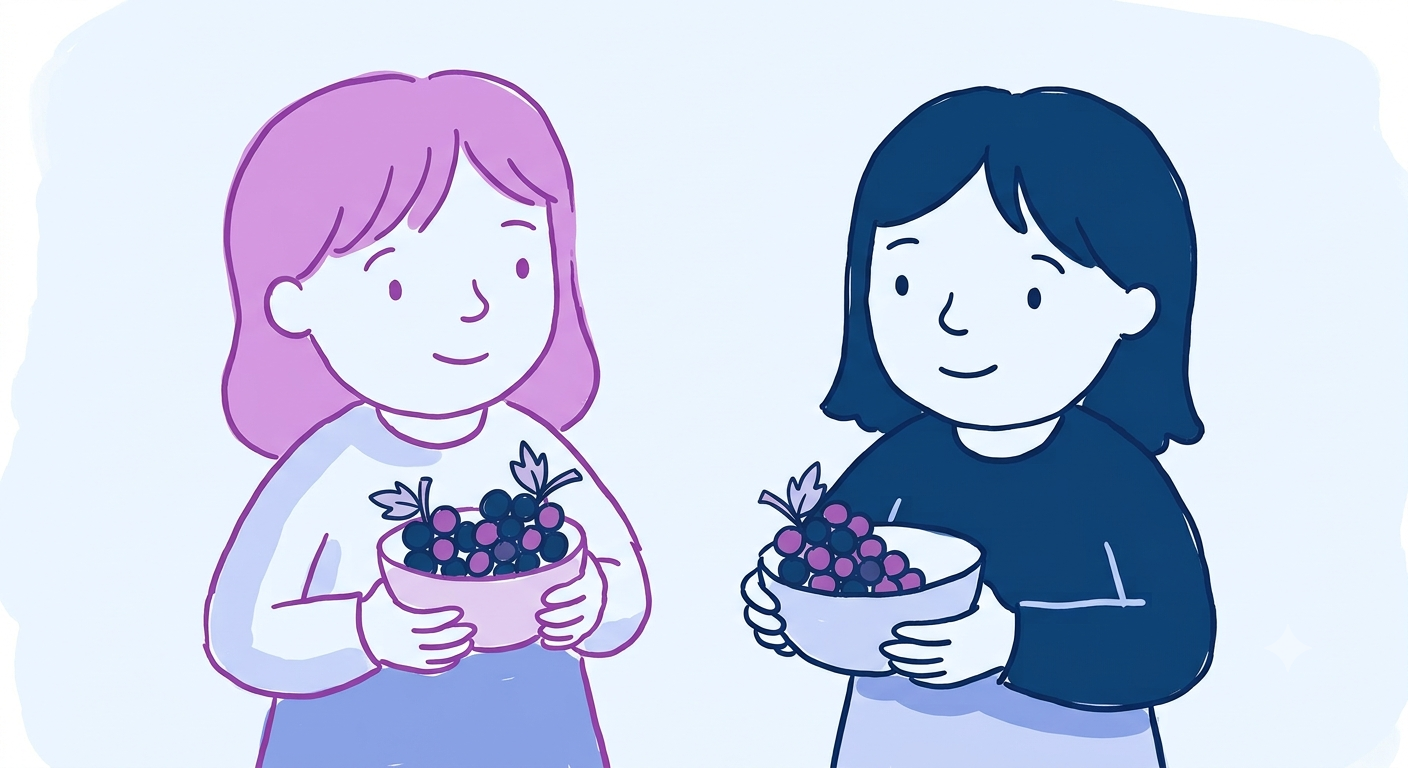
The Afternoon Grape Debate: What My Girls Showed Me
The moment that shifted everything for me happened right on our kitchen bench over a plain ceramic bowl of green grapes.
It had been a long, overstimulating day. Both girls were worn out from processing language and sensory cues outside the home, and my own undiagnosed brain was feeling completely stretched. Afternoon tea arrived, and with it, an immediate dispute.
Zara looked at Bella plate, then at her own, and dissolved into tears because she believed Bella had been given far more fruit. Neither girl had counted. They had just glanced.
My tired mother instinct wanted to rush over, point my finger, count both plates loudly to prove they each had eight, and declare the case closed. But I caught myself, sat on the floorboards next to the bench, and asked quietly: “How do you know yours is smaller, without counting?”
Zara sniffled and pointed: “Look at Bella plate. Hers goes all the way to the rim. Mine is bunched up in the middle. Hers is huge.”
Bella sat quietly, watching, her own sensitive nervous system trying to make sense of the sudden drama. Zara was reporting what her visual perception told her. Because Bella grapes were spread wide, they covered more plate area.
Neither girl was missing intelligence. They were simply experiencing conservation of number: that developmental stage where the brain has not yet separated spatial area from physical quantity.
That kitchen moment reminded me of what Australia national early childhood framework administered by ACECQA highlights: numeracy is not a mechanical performance.[3] It is curiosity, problem solving, and figuring out relationships in everyday life.
That realisation shaped every one of the number sense activities we built into our home.
Rote Counting vs Number Sense: Where We Got Stuck
For a long time, especially with Bella, I leaned heavily on verbal milestones. She could recite numbers in sequence, and when you are parenting without knowing your child has ADHD, you hold onto those visible benchmarks for reassurance.
Yet counting words can create an illusion. Chanting “one, two, three, four” is a linear memory chain, much like reciting the words to a song.
When Bella had to apply that sequence to a busy page or a group of items, her working memory would easily drop a step, leaving her feeling embarrassed and shutting down. It took me until my own late diagnosis in my forties to fully understand that internal panic: the way a linear sequence evaporates when your working memory is taxed.
Real number sense is far more forgiving. It is an internal feel for quantity: knowing that three is a small cluster you can hold in one palm, that seven is a full handful, and that if you share four crackers between two plates, nobody is left out.
When we traded rigid counting for flexible number sense activities, the performance pressure evaporated. We stopped treating numbers as a test they had to pass and started treating them as tangible things we could touch, slide, and rearrange together on the floor.
Why Spacing Fooled Their Eyes (And Why That Is Okay)
One of the greatest comforts for me as a mother was realising that my children confusion with quantity was not a learning flaw.
Young children are strongly influenced by visual appearance. Foundational cognitive insights documented in Piaget developmental theory observed generations ago that children judge amounts by their physical boundaries.[4]
If four wooden blocks are spread across the rug, a young child will naturally declare there are more blocks than if four identical blocks are touching. Knowing this kept me from lecturing them.
Instead of correcting them with “No, count them again,” I started creating low key number sense activities that let their hands prove what their eyes doubted.
We would bunch the items together, spread them wide, and let them slide the pieces back into place. Experiencing that physical constancy over and over gave their nervous systems the space to make sense of quantities without feeling wrong or pressured.
Perception vs Reality: What Was Happening Beneath the Surface
Here is what I was seeing across our living room, compared to what was actually happening beneath the surface:
| What Happened at Home | What the Children Perceived | What Their Number Sense Was Working Out |
|---|---|---|
| 1. Spreading Crackers Across a Board Snack time where biscuits were lined up far apart. |
“This board looks packed, so it must be way more food than before.” | Physical space does not change amount; items can be spread or clustered without changing the total. |
| 2. Spotting Dice Patterns Rolling a three or four during an unhurried floor game. |
Separate dots that needed to be poked one by one with a finger to count. | Subitising: learning to recognise the visual pattern of dots as a whole amount instantly. |
| 3. Adding Another Block Gently balancing one more block onto a shared tower. |
A whole new tower that felt like it had to be recounted from scratch. | Hierarchical thinking: trusting that adding one unit simply means moving to the very next quantity. |
| 4. Sharing Out Apple Slices Dividing fruit between two saucers on the rug. |
Looking for which pile stood taller or looked messier. | Part whole understanding: learning that six can be split into two groups of three and still be fair. |
Subitising: Helping Them See Groups Without Panicking
One concept that genuinely transformed our afternoons was subitising.[1]
It sounds technical, but it simply means knowing how many items are in a small cluster without having to count them one by one. When you look at three pencils on a table, you do not count them; you simply see “three.”
For an ADHD child whose working memory is already juggling language transitions and sensory noise, having to count every single item from one can cause immediate overload. If they lose focus at four, the count resets, and tears follow.
As the early childhood practice guidelines from NAEYC developmentally appropriate practice emphasise, children internalise numerical structure when learning is active, concrete, and attuned to their stage of development.[2]
So we started playing with small patterns. We would toss two or three river stones on a mat and practise “snapping” the number with our eyes.
Slowly, they began seeing groups within groups: looking at five and noticing a pair of two and a cluster of three.
4 Grounded Number Sense Activities That Saved Our Afternoons
These four low stress number sense activities grew straight out of our living room floor. They do not require printables, expensive kits, or rigid schedules:
1. Real Sharing with High Stakes
Nothing hooked my girls attention quite like making sure their afternoon snack was shared fairly without adult interference.
- What we did: I would place an even number of treats, like six strawberries or eight rice crackers, between two plates and leave the dividing entirely to them.
- What it built: Instead of enforcing rules, they experimented with moving items back and forth, matching pairs, and discovering that quantities balance without counting every crumb.
2. Guess First, Count Second
To take the sting out of being wrong, we turned estimating into a lighthearted guessing game.
- What we did: On our walks to the local park, we would spot a small collection of gum nuts on the path. I would ask: “Do you reckon that looks closer to four or twenty?”
- What it built: It took away the fear of precision. We made wild guesses together, giggled when we were off, and built an intuitive sense of scale.
3. The “One More, One Less” Toy Rhythm
Abstract arithmetic felt heavy, so we wove arrivals and departures into play on the carpet.
- What we did: While rolling toy cars, I would narrate gently: “Three cars are parked by your shoe. One drives away to the couch. Now how many are left resting?”
- What it built: It grounded addition and subtraction in physical movement. They did not have to read plus or minus signs; they could feel the change happening in their play.
4. Spaced vs Clustered Object Play
We directly played with the visual trick that had caused our grape argument in the first place.
- What we did: We took four big wooden buttons and spread them wide on a tea towel, while putting four identical buttons tight together on another towel, then moved them side by side to check.
- What it built: It gave their eyes physical evidence that spacing does not change the amount, gently untying the knot between visual size and true quantity.
The More, Less, or Equal Game: What We Kept Simple
When we needed a quick, grounding moment before dinner, this was the exact number sense activity we pulled out:
- Step 1: Grab Everyday Objects Two plain saucers and a handful of whatever was around: dry pasta spirals, river pebbles, or large buttons from the sewing tin.
- Step 2: Drop Without Counting I would drop a small, uneven handful onto each plate without saying any numbers out loud (maybe two on one, and four on the other).
- Step 3: The Quick Gaze They would look for two seconds and tell me which saucer felt like it had more, or if they seemed about the same.
- Step 4: Pairing Up We slid the pieces into matching pairs across the table. Seeing the pairs line up gave them proof without any testing or pressure.
- Explore gentle, everyday counting in Counting Activities for Kids at Home: Relational Strategies →
- Discover sequencing and predictability in Pattern Activities for Preschoolers: Building Predictability →
- Engage with play based math ideas in Math Games for Early Learners: Low Stress Play →
- Return to our family numeracy foundation on the Early Math & Number Sense Hub →
References & Readings That Helped Me
- Clements, D. H., & Sarama, J. (2014). Learning and Teaching Early Math: The Learning Trajectories Approach (2nd ed.). Routledge. [Insightful research on how subitising and quantity trajectories develop naturally].
- National Association for the Education of Young Children (NAEYC). (2010). Early Childhood Mathematics: Promoting Good Beginnings. Joint Position Statement. [Helpful guidelines on keeping early math playful and concrete].
- Australian Government Department of Education. (2022). Belonging, Being and Becoming: The Early Years Learning Framework for Australia (V2.0). [Framing early numeracy as relational problem solving in everyday family and community life].
- Piaget, J. (1952). The Child’s Conception of Number. Routledge & Kegan Paul. [Observations on how visual appearance guides young children’s early thinking].
- Gelman, R., & Gallistel, C. R. (1978). The Child’s Understanding of Number. Harvard University Press. [Exploring the difference between rote reciting and genuine counting principles].