
Maths Games for Kids: 6 Easy Ways Play Builds Number Sense
The best maths games for kids are simple ones where the numbers are part of the play itself. Moving a button along a numbered path, tossing socks into numbered baskets or flipping cards to see which is bigger all build number sense through touch, movement and talk.
This guide shares a memory from my own kitchen table and what research says about board games. You’ll find six easy games, ideas by age, and what to try when maths play brings tears. It includes a free Number Path Race printable and eleven more free maths PDFs.
My daughter Bella gave up on a counting worksheet in under two minutes. Ten minutes later, she was counting to twelve on the kitchen floor with an egg carton and a handful of beans.
- How This Guide Helps
- The Worksheet and the Egg Carton
- What Families and Educators Notice First
- What People Often Get Wrong
- Why Pressure Makes Counting Harder
- What Research Says About Board Games
- 6 Easy Maths Games for Kids
- Ideas by Age
- What Often Backfires
- Small Changes That Lower the Stress
- When Development Looks Uneven
- Free Printable: Number Path Race
- More Free Maths PDFs
- FAQs
How This Guide to Maths Games for Kids Helps
- See why games work when worksheets bring tears.
- Understand the research on simple number board games.
- Try six easy games with things you already have at home or in the room.
- Match games to age, from toddlers to early school.
- Print a free race board and start playing today.
Further down, in the research section, there’s a small detail about the shape of a game board. It changed how much children learned, and it surprised me. Keep an eye out for it.
The Worksheet and the Egg Carton
We were still living in Indonesia when Bella was four. It was a rainy afternoon, and I had set her up at the kitchen table with a counting worksheet. It had little rows of smiling ducks. All she had to do was count each row and write the number in the box.
Within two minutes, she had slid so far down her chair that her chin rested on the tabletop. Her legs kicked the chair legs in a steady rhythm. Her hands twisted her shirt into knots. Then the pencil went flying across the kitchen tiles.
My first feeling was that familiar heavy sigh. Why was counting four ducks so hard?
So I put the paper away. I grabbed an empty egg carton and a handful of dried beans and seeds from the kitchen. We sat on the floor and she tossed them into the cups, one by one, counting as she went. Her whole body changed. She counted to twelve without a single complaint.
That afternoon stayed with me. Bella hadn’t lost interest in numbers. She had lost interest in sitting still with a pencil. Once her hands and body were part of it, the counting came easily. That’s the heart of good maths games for kids: the numbers live inside something children can touch, move and enjoy.
Years later, I’d see the same pattern again and again, as a parent and as an early childhood educator.
What Families and Educators Notice First
In early learning rooms and family lounge rooms alike, number activities often start with good intentions. Then they slide into tension. A child guesses wild numbers just to make the questions stop. Another freezes when asked how many sultanas are left on her plate. A third scatters game tokens across the carpet the moment a turn doesn’t go his way.
Yet the same children can show real focus under different conditions. A child who melts down over a flashcard will happily spend twenty minutes lining up toy animals from smallest to biggest. Another will sort toy cars into pairs along the edge of the hallway rug.
From the outside, it can look like stubbornness. But this contrast tells us something useful. Children are drawn to number and pattern when they feel safe and free from testing. Our guide to regulation and behaviour explores why that feeling of safety comes first.
What People Often Get Wrong About Maths Games for Kids
A common belief is that flashcards, rote counting and worksheets are the fastest path to early maths. Many adults assume that a child who can recite one to twenty like a song understands what those numbers mean.
Reciting numbers in order is mostly a memory and language task. Number sense is different. It means knowing that five is more than three, that four blocks stay four whether they’re spread out or stacked, and that each step forward adds one.
When a child resists formal practice, adults often read it as poor focus or poor cooperation. Families are sometimes told to practise more or use stricter routines. But turning every moment into a quiz can quickly drain the joy from numbers.
Children build number sense through handling objects, moving their bodies and solving small problems. They feel the weight of four blocks compared with two. They see that moving three spaces on a board brings their button closer to the finish. Our guide to number sense activities goes deeper into these building blocks.
Why Pressure Makes Counting Harder
Turning a printed numeral into a quantity asks a lot of a young brain. A child has to hold the count in mind, track objects with her eyes and sit still, all at once.
Stress makes that harder. In one study of first and second graders, worry about maths seemed to use up the working memory children needed to solve problems.5 Those children were older than preschoolers, but the idea fits what many of us see at home. A worried child has less room left to think.
For children with ADHD, autism or sensory differences, the load can be heavier still. Background noise, bright lights or a hard chair are already taking up energy. Add the pressure of a right answer, and many children reach for silliness, refusal or shutdown. What looks like defiance is often an overloaded child protecting herself. Our guide to meltdowns and co regulation explains how to help in those moments.
This is where thoughtful maths games for kids help. When a child rolls a four, moves four steps and counts aloud, she gets instant feedback through touch, sight and sound. There’s no red pen and no wrong answer to fear, just the next turn.
What Research Says About Board Games and Early Maths
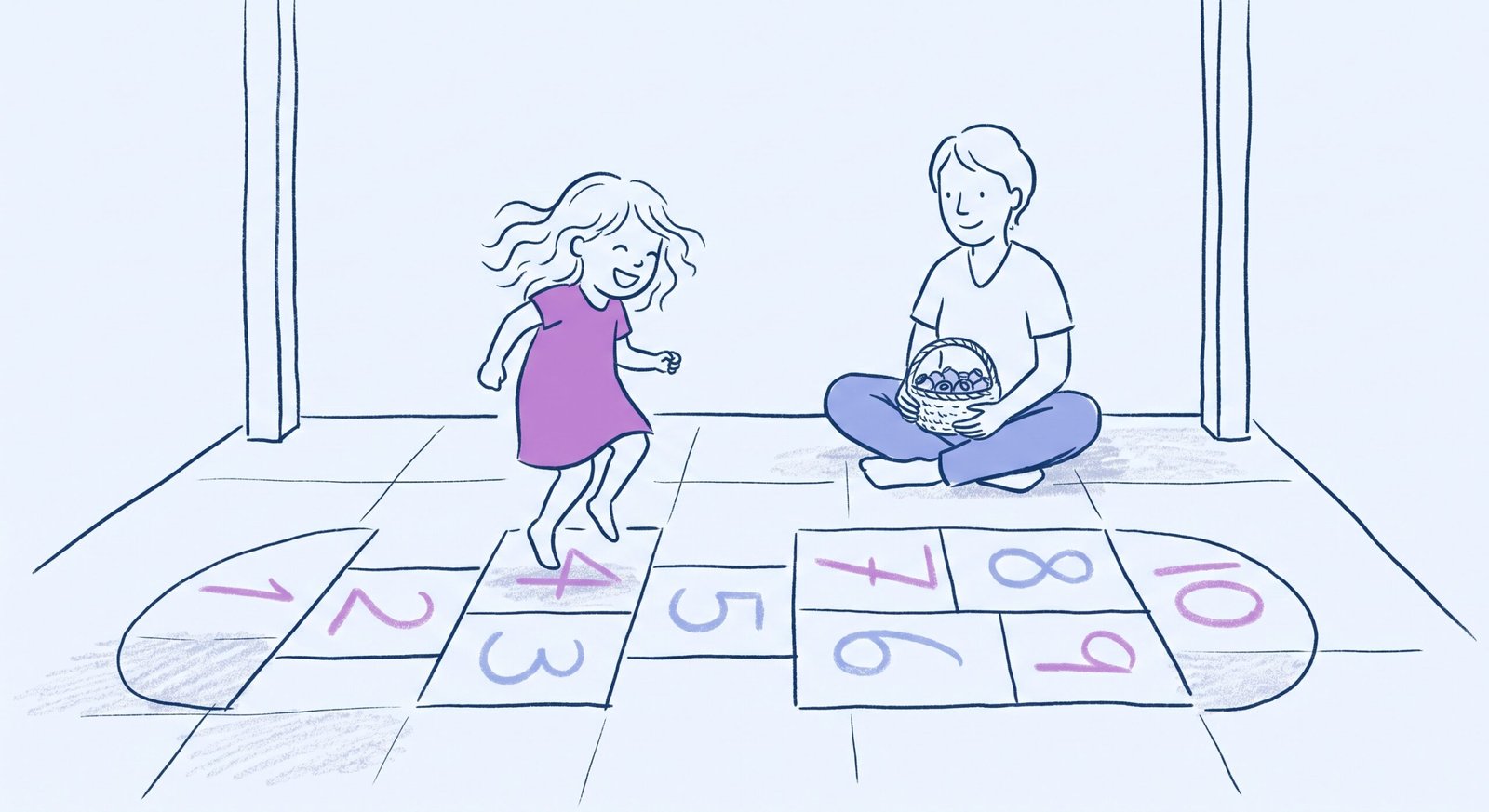
Researchers Geetha Ramani and Robert Siegler studied a very simple number board game. It was a straight row of ten squares, numbered 1 to 10. Preschoolers from low income families played it in four sessions of about fifteen minutes each.1
That small amount of play led to gains in counting, naming numerals, comparing numbers and placing numbers on a line. Nine weeks later, the gains were still there.1
This is the detail I mentioned earlier. In a follow up study, the same researchers compared the straight board with a circular one.2 Same numbers, same counting, same dice. Only the shape changed. Children who played on the straight board improved their understanding of number size. Children who played on the circular board didn’t gain in the same way.
The researchers’ explanation is that a straight path matches the mental number line children are building. Each step forward is a little further from the start, and bigger numbers sit further along. A circle hides that.
It made me think of ular tangga, the Indonesian name for snakes and ladders. My girls played it when we lived in Indonesia, counting each square out loud as they hopped their pieces along. The board winds back and forth, but each row still runs in order. I didn’t know the research then. Looking back, all that counting aloud was doing useful work.
A 2024 review of game based learning in early childhood reported moderate benefits for thinking, motivation and engagement, though the review has some reporting gaps, so it’s best read as encouraging rather than conclusive.3 UNICEF and the LEGO Foundation also describe play as one of the most important ways young children learn.4 In Australia, the Early Years Learning Framework encourages educators to build numeracy through play and everyday experiences.6
6 Easy Maths Games for Kids
Each of these games keeps the maths inside the action. None need anything you’d have to buy. Start with one that suits your child’s energy today.
The straight path race
Draw ten squares in a row on a strip of cardboard and number them 1 to 10. Take turns rolling a dot die and moving a button or pebble forward.
What to say: “You’re on 4. Count on from there: 5, 6, 7.”
Why it helps: counting on from where you are, rather than starting at one each time, builds a sense of the number line. This is the game the research is based on, and our free Number Path Race printable is ready to go.
The laundry basket toss
Roll up pairs of socks or gather soft toys. Put numbered baskets or boxes along the wall.
What to say: “Can you get three socks into basket 3? Now five into basket 5.”
Why it helps: tossing and fetching give busy bodies something to do while children match amounts to numerals. Many families find this kind of movement settling, though the research on heavy work is still limited.
Chalk number line jumps
Draw a big number line from 1 to 10 in chalk on the driveway, path or verandah. Your child becomes the game piece.
What to say: “Jump forward two. Where are you now? Now jump back one.”
Why it helps: the whole body learns that forward means more and back means less. Our guide to the number line jumping game has more ways to play, hopscotch adds balance and turn taking, and the Number Line and Estimation Jar PDF brings it inside.
Which hand has more?
Collect leaves, gum nuts, seed pods or smooth stones on a walk. At home, your child grabs a handful in each hand.
What to say: “Which hand do you think has more? Let’s tip them out and check.”
Why it helps: guessing first, then counting to check, builds estimation and the language of more, less and the same. For a sharing version, try our Fair Share Snack Mat.
Scoop and count baking
When you bake, let your child scoop the flour or oats into the bowl.
What to say: “The recipe says three scoops. Let’s count them together.”
Why it helps: numbers become useful tools with a tasty result. Children also meet measuring words like full, half and empty. Our measurement activities for preschoolers have more ideas like this.
Flip and compare cards
Take a deck of playing cards and remove the picture cards. Each player flips a card. Whoever has more wins both.
What to say: “You’ve got 7 and I’ve got 4. Who has more?”
Why it helps: the dots on low cards help children see small amounts at a glance, without counting each one. This skill is called subitising. Our Subitising Dot Cards make a gentler starting deck.
Notice that none of these maths games for kids rely on a quiet table or a red pen. When numbers are woven into ordinary, unhurried moments, children learn that numbers help them do things they care about.
Maths Games for Kids by Age
| Age | Try this | Watch for |
|---|---|---|
| 2 to 3 | Posting large objects into a box, counting “one, two” as you climb steps, the basket toss with two baskets | Joining in with counting words, even out of order |
| 3 to 4 | The straight path race to 10, which hand has more, scoop and count baking | Touching each object once while counting |
| 4 to 5 | Chalk number line jumps, flip and compare with low cards, a 1 to 20 path | Counting on from a number, not always from one |
| 5 to 6 | Snakes and ladders, adding two dice, making 10 with cards | Explaining how they worked something out |
These are rough guides only. Children move at their own pace, and many neurodivergent children show a very uneven profile. Our Number Sense Observation Checklist helps you see what your child can already do, rather than what a chart says they should do.
What Often Backfires
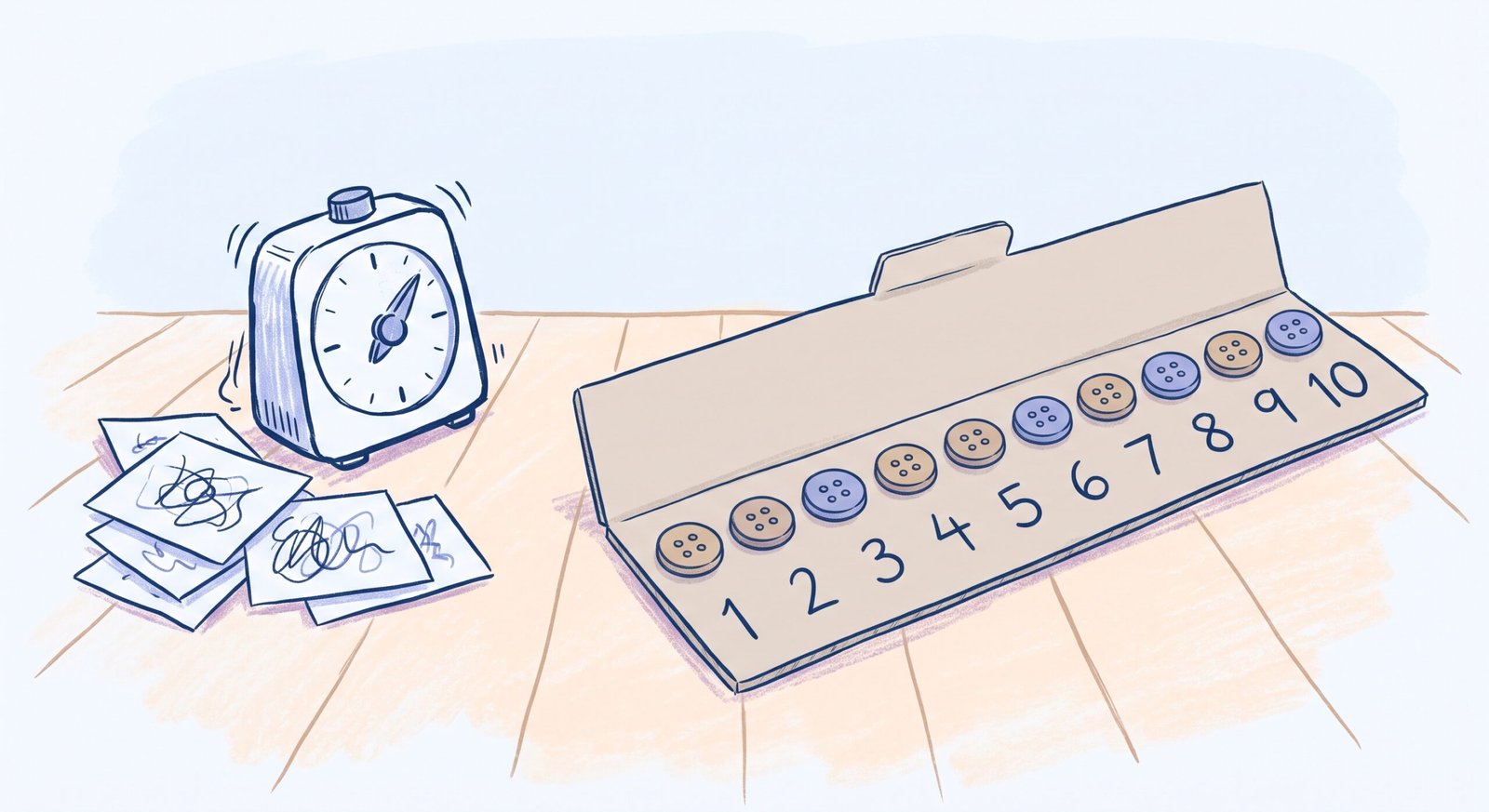
Not every idea sold as maths games for kids helps. Plenty of popular advice can raise the temperature at home without meaning to. Stepping back from these common traps protects your child’s confidence and your household’s calm.
Flashcard drills
Holding up cards and asking for fast answers is one of the most common suggestions. For children who need more processing time, it can feel like an interrogation. The fear of a wrong answer becomes the lesson.
Timers and speed challenges
Some children enjoy beating a sand timer. Many don’t. For a child who is already anxious about maths, a ticking clock adds pressure at the exact moment she needs room to think.
Busy apps sold as games
Bright animations and chimes can keep a child glued to a screen. But many apps reward fast tapping rather than thinking. Some children come away more wound up than when they started, and they miss the feel of handling objects.
| Often backfires | Try instead |
|---|---|
| Flashcards with fast answers | Flip and compare cards, with as much time as needed |
| Timed worksheets | A straight path race where turns set the pace |
| Worksheets with cartoons added | Beans or buttons in an egg carton or muffin tin |
| Loud, fast apps | Chalk jumps, baking or a basket toss |
Small Changes That Lower the Stress
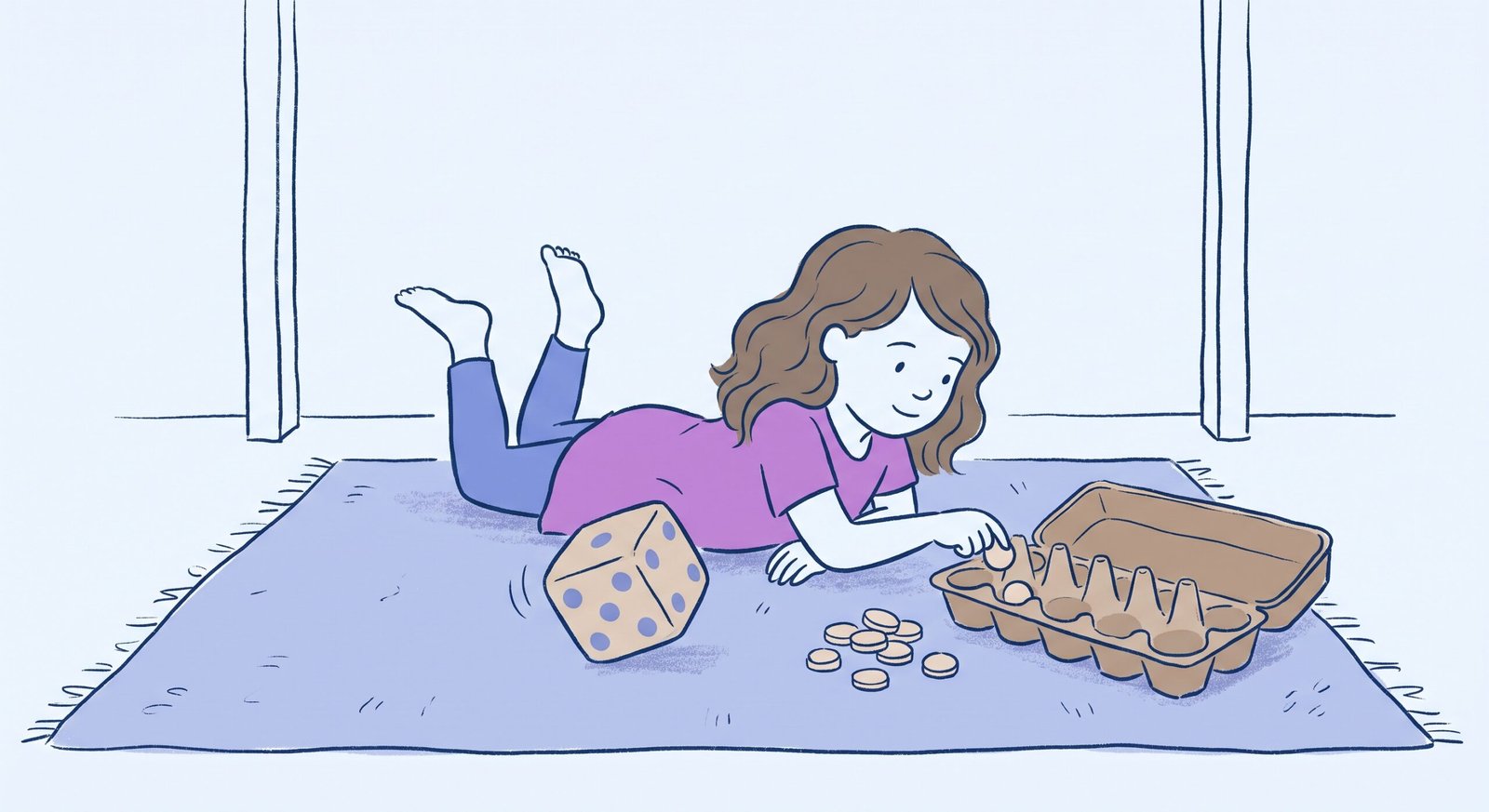
Turning maths time from a battle into a connection doesn’t need expensive programs or new maths games for kids. It starts with a few changes to the setting and to what we expect.
Take the game to the floor
Sitting at a high bench with dangling legs can leave a child feeling unsteady. Try playing on the floor instead. Lying on a tummy on a rug, or sitting cross legged beside an adult, gives the body more support. Many children settle more easily this way.
Narrate rather than quiz
When adults keep asking “What number is that?” or “How many are there?”, children can feel on trial. Try describing what you notice instead. “You rolled a five, so your button is hopping past my three.” Or, “Look, these two bowls have the same number of stones.” This models maths thinking while keeping the stakes low. Our start together task trick works well alongside this.
Keep games short
A path race doesn’t need to last forty minutes. With maths games for kids, five to ten minutes of happy, connected play does more for confidence than an hour of tears at the table. When your child’s body shows signs of tiredness, pack the pieces away and come back another day.
Make it calm when it needs to be
Some days call for a quieter version. For a calm table activity between games, try our free counting worksheets 1 to 10. Every page has the same simple layout, with movement cards for breaks between pages. The Roll and Squish Ten Frame Game adds playdough for busy hands.
Safety first. Dried beans, seeds, buttons, small stones and dice can be choking hazards for children under three, and some dried beans swell if swallowed. Use larger objects with little ones, and stay close during play. Chalk games on driveways need an adult watching for cars. If maths play regularly leads to big distress, talk with your child’s educator or GP.
When Development Looks Uneven
It’s easy to feel unsettled by tidy milestone charts. Social media shows four year olds writing sums, and we wonder if our own child is behind because she still counts on her fingers or loses track after four.
For many neurodivergent children, development is uneven, sometimes called a spiky profile. A child might build a carefully balanced block tower or a symmetrical Lego model, yet struggle to say the numbers in order. That uneven profile is common, and it isn’t a sign that maths is closed to them. Our guide to early maths and number sense for neurodivergent children looks at this more closely.
Counting on fingers is a useful strategy, not a bad habit. Learning trajectory research shows that children move through early number ideas in a fairly predictable order, but at very different speeds.7 Meeting a child where she is today matters more than where a chart says she should be.
When a child spends her early years handling objects, tossing socks and hopping along chalk lines, she builds a deep sense of how numbers work. That foundation travels with her into school. Simple, playful maths games for kids give her somewhere to start.
Guiding ideas for maths games for kids
- Keep the maths inside the action, like moving spaces or collecting tokens, not a quiz before each turn.
- Calm comes first. If tears start, pause and reconnect before worrying about the numbers.
- Choose objects over paper whenever you can.
- Narrate rather than question, so maths talk feels safe.
- Protect the relationship. No counting game is worth losing your child’s trust.
The Victorian Government’s guide to building your child’s numeracy skills also suggests board games, cards and dice as everyday ways to learn.8 For more home ideas, see our guides to counting activities for kids at home and number activities for kids at home.
Free Printable: Number Path Race for Maths Games for Kids
Two straight 1 to 10 race tracks for two players, plus a longer 1 to 20 track for children who are ready. Add a die and two buttons and you’re set.
Download the Free PDFNumber Path Race
Roll, hop and count out loud. First to the finish wins.
How to Use the Number Path Race
- Print the page and place it on the floor or a low table. Each player chooses a button, pebble or small toy as a game piece.
- Use a die with dots, or make one with 1, 2 and 3 only for younger children. Start both pieces just before square 1.
- Take turns rolling and hopping forward, saying each number out loud as the piece lands on it. Count on from where you are, not from one.
- After each turn, compare. Ask who is further along and how many squares are left. Let children check by counting the squares.
- When the 1 to 10 tracks feel easy, move to the 1 to 20 track. Play a few short games over a week, and keep each game to about ten minutes.
More Free Maths PDFs
Number Sense Observation Checklist
See what’s emerging.
Download PDFFor families and educatorsMore free tools are on our printables page.
- Hub: Early Math and Number Sense
- Counting: counting activities for kids at home
- Numbers: number activities for kids at home
- Printable: free counting worksheets 1 to 10
- Playdough: number sense playdough mats
- Patterns: pattern activities for kids at home
- Shapes: shape activities
- Outdoors: classic playground games for kids
Maths Games for Kids FAQs
What are good maths games for kids aged 3 to 5?
Simple straight path board games, tossing socks into numbered baskets, chalk number line jumps, guessing which hand has more and flipping cards to compare all work well. Keep games short and playful.
Do board games help with early maths?
Research suggests they can. In one study, preschoolers played a straight 1 to 10 board game in four short sessions. They improved in counting, naming numerals and comparing numbers, and the gains lasted nine weeks.
Why does my child cry over maths worksheets?
Worksheets ask a child to sit still, hold numbers in mind and get a right answer, all at once. That pressure can overload a young child. Hands on games with objects often lower the stress.
Is it OK for my child to count on fingers?
Yes. Fingers are a useful tool that many children use while their number sense grows. Let your child use them freely.
How long should a maths game last?
For most young children, five to ten minutes is plenty. Short, happy games played often do more than long sessions that end in tears.
Research and guidance: Ramani and Siegler’s board game studies with preschoolers from low income families; Alotaibi’s 2024 review of game based learning (read with caution); UNICEF and the LEGO Foundation on learning through play; Ramirez and colleagues on maths anxiety and working memory in first and second graders; the Early Years Learning Framework; Clements and Sarama on learning trajectories; and Victorian Government guidance for families.
Experience: Bella’s counting worksheet and the egg carton happened at home in Indonesia when she was four. My girls played ular tangga there too, counting the squares aloud. The six games come from my practice as a parent and educator. The note on heavy work reflects family experience, as research on it is still limited.
This is educational content, not a diagnosis. Talk with your child’s educator or GP if you’re worried about development. Last reviewed: 25 November 2026.
References
- Ramani, G. B., & Siegler, R. S. (2008). Promoting broad and stable improvements in low-income children’s numerical knowledge through playing number board games. Child Development, 79(2), 375-394. https://doi.org/10.1111/j.1467-8624.2007.01131.x
- Siegler, R. S., & Ramani, G. B. (2009). Playing linear number board games, but not circular ones, improves low-income preschoolers’ numerical understanding. Journal of Educational Psychology, 101(3), 545-560. https://doi.org/10.1037/a0014239
- Alotaibi, M. S. (2024). Game-based learning in early childhood education: A systematic review and meta-analysis. Frontiers in Psychology, 15, 1307881. https://doi.org/10.3389/fpsyg.2024.1307881
- UNICEF. (2018). Learning through play: Strengthening learning through play in early childhood education programmes. UNICEF and the LEGO Foundation. https://www.unicef.org/sites/default/files/2018-12/UNICEF-Lego-Foundation-Learning-through-Play.pdf
- Ramirez, G., Gunderson, E. A., Levine, S. C., & Beilock, S. L. (2013). Math anxiety, working memory, and math achievement in early elementary school. Journal of Cognition and Development, 14(2), 187-202. https://doi.org/10.1080/15248372.2012.664593
- Australian Government Department of Education. (2022). Belonging, being and becoming: The early years learning framework for Australia (V2.0). https://www.acecqa.gov.au/sites/default/files/2023-01/Belonging_Being_And_Becoming_V2.0.pdf
- Clements, D. H., & Sarama, J. (2014). Learning and teaching early math: The learning trajectories approach (2nd ed.). Routledge.
- Victorian Government. (n.d.). How to build your child’s numeracy skills from birth to Grade 2. https://www.vic.gov.au/how-build-your-childs-numeracy-skills-birth-grade-2
