
Teaching Early Math Skills With a Number Line Jumping Game
Young children do not come to understand mathematics by staring quietly at a printed page. To a three or four year old, a numeral printed in ink is entirely abstract. It is flat, static, and disconnected from the physical world they touch and explore every day. When we expect children to sit still at a table with a worksheet, we ask them to carry out a mental feat their brains are simply not wired to do yet.
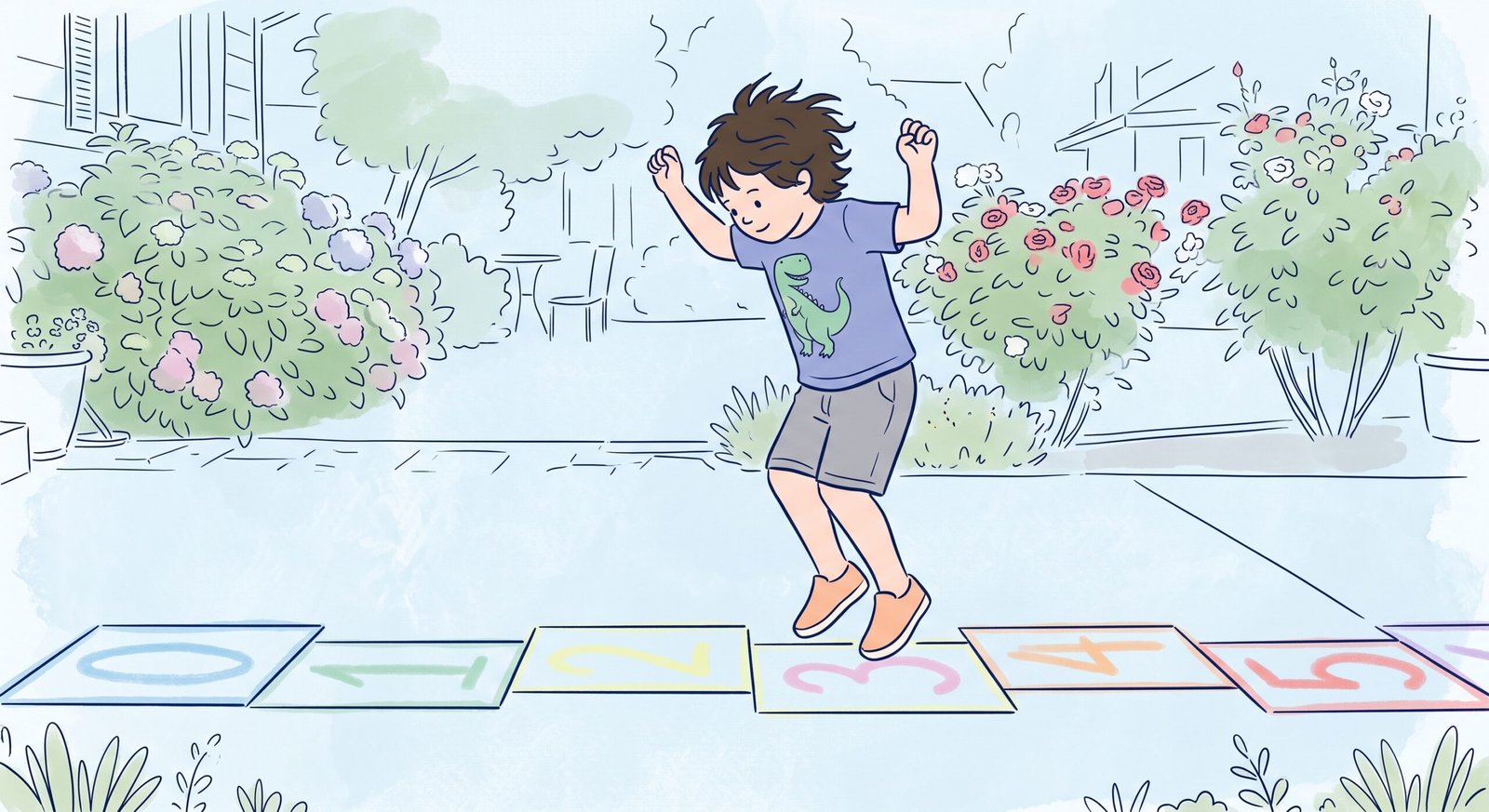
Teaching early math skills with a number line jumping game turns that abstract work into physical movement. When a child stands on three and leaps forward two spaces to land on five, addition is no longer a set of marks on paper. It becomes two big push offs through the legs, a pause in mid air, and two solid landings on the ground. The child feels that five is further away than three. They feel that two hops cover actual space. This bodily sense of number builds an intuitive foundation for arithmetic that dry pencil work simply cannot match.
Teaching Early Math Skills With a Number Line: The Quick Routine
- Lay out the track: Use chalk outside or painter tape indoors to mark numerals zero to five in a straight line with even spaces.
- Establish position: Have your child stand squarely on a chosen number so their feet anchor to that quantity.
- Practise one to one hops: Call out forward jumps one step at a time, chanting each number aloud upon landing.
- Introduce counting on: Frame addition as forward travel, such as starting on two and taking two hops forward to find four.
- Introduce taking away: Frame subtraction as backward hops, watching the numbers shrink with each landing.
- Keep rounds brief: Finish the activity after eight to ten minutes while curiosity and physical energy are still high.
Why Little Bodies Need Physical Numbers
If you hand a three year old a piece of paper with the numerals four and seven on it and ask which is bigger, the question rarely makes sense to them. The numeral seven is not physically larger than the numeral four. In fact, if the four happens to be drawn with a thicker marker, their eyes will tell them four is the bigger object. This confusion is completely normal. Early learners rely on visual mass and spatial volume to judge magnitude.
Put those same numbers on the timber floor of your hallway or draw them on the driveway with chalk, and the meaning shifts immediately. The seven is literally further down the path. Reaching seven requires more steps, more breath, and more energy than reaching four. Without anyone having to lecture them on numerical value, the child’s muscular system registers the difference between quantities.
This approach draws on what cognitive scientists call embodied cognition. Thinkers like George Lakoff and Rafael Núñez showed in their foundational work on mathematical cognition that abstract mathematical ideas are grounded in everyday physical experiences, particularly motion along a path. We understand progress in numbers because we understand walking along a track. When we engage in teaching early math skills with a number line jumping game, we honour this natural path of human development instead of forcing paper drills prematurely.
If your child enjoys games that turn basic concepts into lively physical play, you can explore similar movement games in our complete guide to classic playground games for kids, where balance, freeze prompts, and body control work hand in hand.
When to Start with Active Number Games
Parents often ask what exact month or age is right for introducing formal number lines. In early childhood, developmental readiness matters far more than the date on a birth certificate. Most children are ready to explore a floor number line between three and five years of age, though their entry points will look quite different depending on their motor control and speech.
Here are several practical signs that your child will enjoy this jumping game:
- Verbal counting in play: They can recite numbers up to five or ten while walking up stairs or stacking blocks, even if they occasionally skip an intermediate number.
- Curiosity about order: When you count out apple slices or toy vehicles, they notice when a piece is missing or ask what comes next.
- Numeral recognition: They can spot their own age or point out a familiar numeral on a front door or speed sign.
- A desire to move: They find sitting still at a desk uncomfortable and learn best when their arms, legs, and whole body are actively involved in the task.
You do not need to wait until your child knows every number perfectly. The game itself is the learning tool, not an exam. The goal is simply to give numbers an organised home outside of their head where they can see, touch, and jump on them.
Materials for Home or the Classroom
Simple Materials Checklist
- Outside surfaces: Thick sidewalk chalk in bright colours drawn on asphalt, concrete, or stone pavers.
- Inside surfaces: Low tack painter tape or masking tape placed along timber floorboards, tiles, or low pile carpet.
- Numeral cards: Sturdy card squares numbered zero to five for beginners, or zero to ten for children ready for longer tracks.
- Small markers or bean bags: Lightweight objects or soft toys your child can toss or deliver to specific targets.
Keep your materials basic. You do not need plastic gadgets or flashing electronic mats. A simple strip of painter tape on a hallway floor is less visually distracting, allowing your child to focus on the numbers themselves.
Guide to Teaching Early Math Skills With a Number Line Jumping Game
Setting up the line takes less than five minutes. Begin with a short track from zero to five. Parents often want to make long tracks stretching from zero to twenty straight away, but an overly long line overwhelms a young child. Mastering a compact range of five numbers builds genuine confidence. You can always lengthen the track later once the basic steps feel effortless.
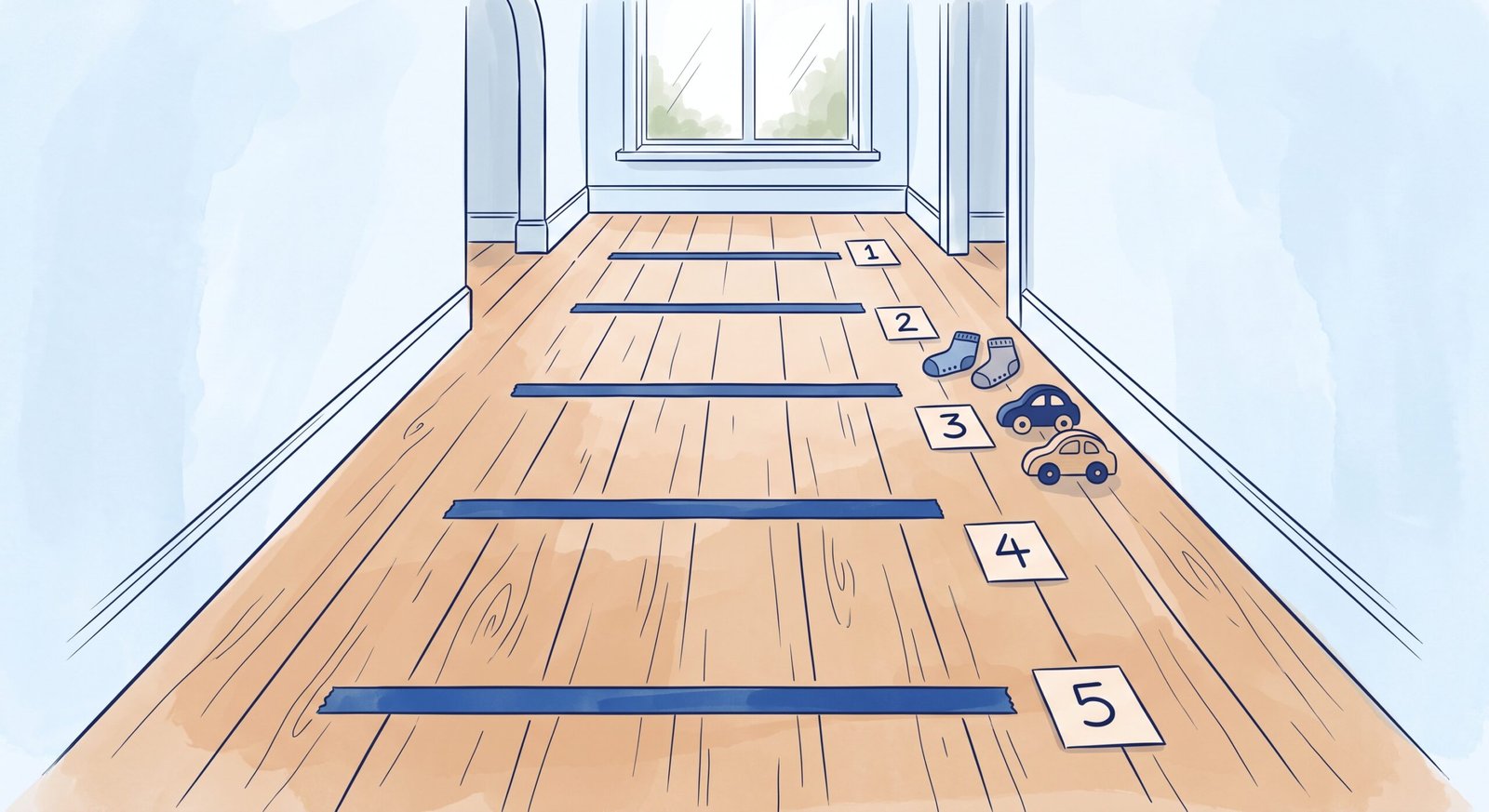
Measure out the spaces so each square or marker sits roughly thirty to forty centimetres apart. This distance allows a young child to hop comfortably from one mark to the next with both feet together without stretching or falling over. Write the numerals large and clear so they can be read easily from a standing position.
Keep your verbal instructions brief before play begins. You might say: “Each number has its own house. Walking forward makes our numbers bigger. Walking backward makes them smaller.” Avoid long explanations. Children learn through the physical movement itself, not through listening to grown ups talk about math.
How to Play Step by Step
Stand on the starting pad: Have your child place both feet on zero or one. Let them balance and look down the line to see where the track leads.
Practise single hops: Call out simple prompts like “Hop forward one space.” Have them land cleanly, pause, and call out the number under their feet. Let their muscles register that single unit of movement.
Add simple counting prompts: Once single hops feel smooth, try multi space challenges: “Start on two and hop forward two spaces. Which number did you land on?”
Introduce backward motion: Ask them to face forward while taking controlled backward hops: “You are on four. Hop back one space.” This creates an immediate physical experience of subtraction.
Wrap up after ten minutes: Conclude the activity while your child is still smiling and engaged. Short, regular play sessions build genuine long term skill without mental fatigue.
Adding Variations to Keep Play Fresh
Once the basic routine is familiar, you can vary the activity to keep it interesting. Children thrive on simple adjustments that weave their favourite toys and interests into the game.
The Toy Delivery Service
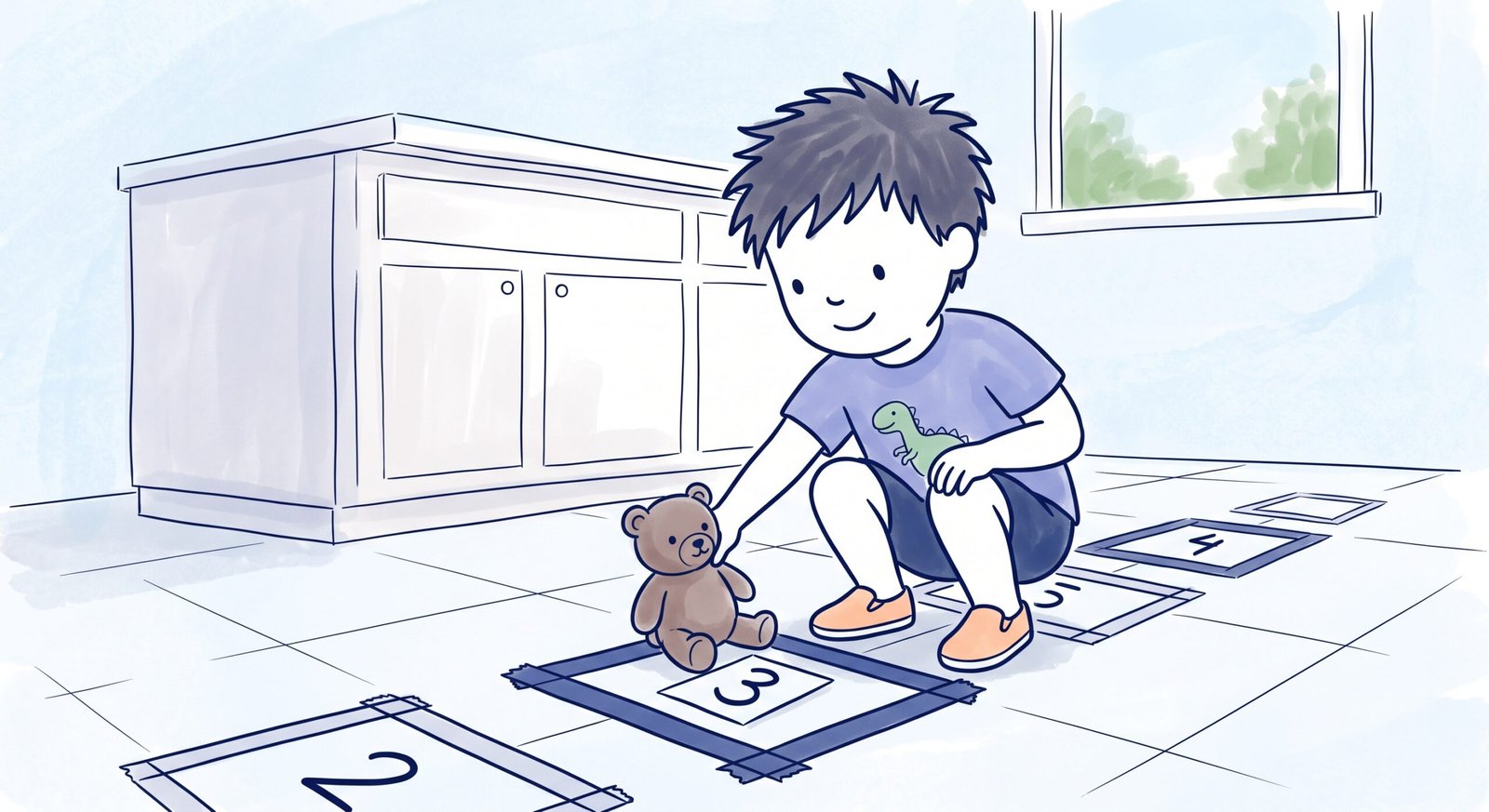
Young children love having a clear job to do. Hand your child a small stuffed animal, a wooden vehicle, or a bean bag and turn the game into a delivery service. You can call out: “The little bear needs to travel to house number four! Can you carry him there in three hops?” The physical weight of carrying a toy adds sensory feedback, which helps children who find it difficult to settle into desk tasks stay engaged.
For children who experience executive function barriers or task hesitation before structured learning, pairing gentle physical activities with clear visual boundaries makes a world of difference. You can read our detailed discussion of this in our guide to neurodivergent literacy task initiation, where we break down low demand entry points that help calm nervous systems.
Auditory Beats and Rhythms
You can also bring music and rhythm into the game. Clap your hands or tap a wooden spoon against a pot in steady time, asking your child to jump to the beat: one clap, one jump forward. This combines auditory processing with gross motor coordination, strengthening the neural pathways that support rhythmic number sequences.
Patterned Stepping
If your child is beginning to grasp patterns, you can colour code the squares on your track using alternating chalk colours or coloured tape strips. For example, make odd numbers blue and even numbers yellow. Have your child jump only on the yellow squares to explore skip counting by twos. For more hands on ways to explore sequences using household items, see our practical guide to pattern activities for kids at home.
What This Movement Actually Builds in the Brain
When you observe a child hopping down a number track, it might look like pure energetic play. Beneath the surface, however, their brain is carrying out several developmental tasks at the same time.
| Cognitive Skill | What the Child Experiences | Long Term Academic Impact |
|---|---|---|
| One to One Correspondence | Matching one physical hop to exactly one spoken number word. | Prevents rushed miscounting and builds accurate tallying skills. |
| Numerical Magnitude | Feeling that eight is much further away than two. | Establishes an intuitive sense of quantity, estimates, and scale. |
| Mental Number Line | Moving left to right along a continuous spatial path. | Builds the internal visual framework needed for primary school arithmetic. |
| Inhibitory Control | Stopping their body cleanly on a called target number. | Strengthens executive function and self regulation across all learning. |
The link between motor skills and mathematical reasoning is well established in early childhood research. When children use their whole body to navigate space, the parietal cortex, which processes spatial orientation, coordinates directly with the frontal systems that manage executive planning. Far from being a distraction from math, physical movement provides the scaffolding that makes formal mathematics make sense.
If you find yourself stuck inside on a rainy day, you can build full obstacle courses and counting tunnels out of recycled cardboard packaging. Take a look at our favourite cardboard box activities at home for simple ways to repurpose delivery boxes into active learning stations.
Where This Idea Comes From: The Research Evidence
This jumping game is grounded in research from developmental psychology. In a study published in Developmental Science, researchers Robert S. Siegler and Geetha B. Ramani examined how linear numerical games influence young children’s numerical knowledge.
The Siegler and Ramani Findings
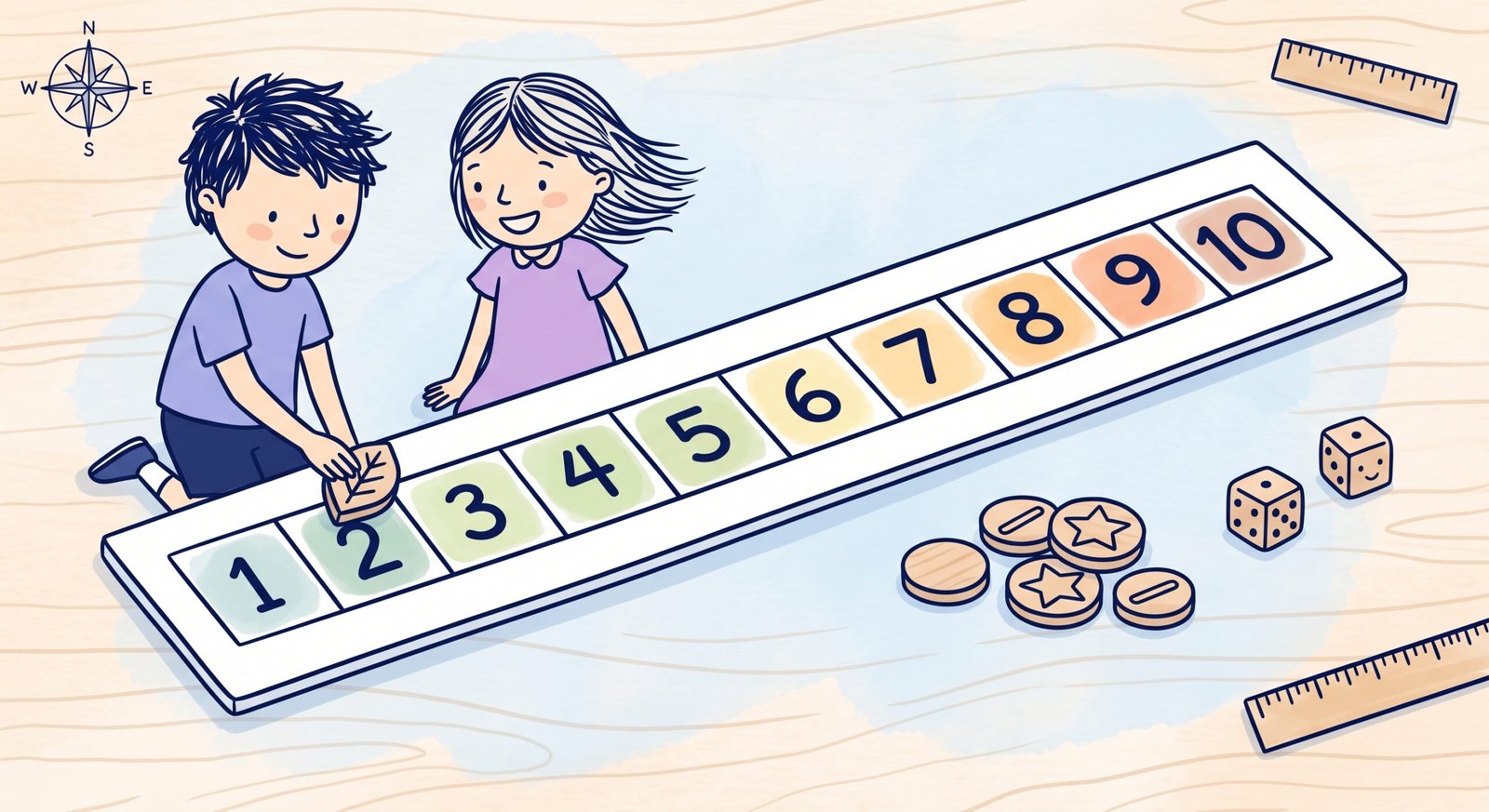
Siegler and Ramani worked with preschool children who played simple number board games for just four short sessions of fifteen to twenty minutes each. Half of the children played a game with a straight, linear track numbered one to ten, while the other half played an identical game where the track was circular or colour coded without numbers.
The results were striking. Children who played on the straight linear number board made substantial gains across four fundamental numerical measures:
- Recognising printed digits
- Counting accurately
- Comparing numerical magnitudes (judging which number is bigger)
- Estimating positions on a blank number line
Crucially, children who played the circular version showed none of these gains. Why? Because a circular board brings the highest numbers right back next to the starting square, distorting the child’s understanding of scale. A straight line, by contrast, gives the brain an accurate spatial picture: larger numbers are always further along the track.
When you draw a straight chalk line on your driveway, you are giving your child this exact spatial structure. You do not need to buy specialised educational kits. An inexpensive roll of painter tape or a stick of chalk provides the same linear framework that developmental psychologists use to build early numeracy.
Common Traps and How to Avoid Them
Even with simple activities, parents can run into a few common pitfalls that turn what should be an enjoyable game into a frustrating struggle. Here is how to keep things running smoothly:
1. Making the Line Too Long
It is tempting to draw a number line all the way to twenty to see how far your child can go. For a preschooler, however, a twenty space track looks vast and intimidating. If they lose count midway through, they often feel defeated. Stick to numbers zero through five until they can hop forward and backward without hesitation. Once that range feels easy, expand to ten, and only later move beyond.
2. Correcting Too Quickly
When an adult interrupts every misstep with a quick correction, children stop exploring. If your child lands on four when they should have landed on five, pause for a moment. Often, as they steady themselves, they will look down, notice the numeral, and realise their own error. Allowing them that quiet pause gives them a chance to self correct, which builds true self reliance.
3. Over Explaining
Avoid turning the game into a formal lecture on addition. Children do not need to hear long explanations about mathematical symbols. Keep your language centered on real action: “Hop forward two houses” or “Hop back one spot.” Let their physical movements carry the math lesson.
4. Pushing Past the Engagement Window
Ten minutes of joyful, focused jumping does far more for early learning than thirty minutes of reluctant drills. As soon as your child begins looking around, sitting on the floor, or wandering off, wrap the game up with a high five. Leaving them wanting more ensures they will be enthusiastic to play again in a few days.
Making Active Math Part of Your Weekly Rhythm
You do not need to schedule active math games as formal lessons. The beauty of teaching early math skills with a number line jumping game lies in how easily it weaves into everyday family routines.
Keep a roll of blue painter tape in a kitchen drawer or a bucket of chalk near the back door. On a sunny morning, spend five minutes drawing a line before heading to the park. On a wet afternoon when energy is running high inside, run a strip of tape down the hallway while dinner is cooking. These small, low stress encounters revisited every few days build lasting competence far better than occasional marathon tutoring sessions ever could.
Once a floor number line feels familiar, the same embodied understanding carries into other activities. Your child will use that same mental line when they count out blocks, arrange cutlery on the kitchen table, or measure ingredients while baking. The numbers in their head now have a clear, reliable order because their feet have walked the path before.
When Math Play Triggers Task Avoidance or Overwhelm
For many young children, especially those with ADHD or sensory sensitivities, sitting down for structured learning games can trigger rapid resistance or emotional overwhelm. If transitions to table activities routinely turn into power struggles, the challenge is often task initiation, not math capability.
- Struggling to begin? Read our practical educator guide on Helping an ADHD Child Who Won’t Start Tasks to break down multi-step demands without escalation.
- Combine movement with learning: Explore how to structure Neurodivergent Literacy & Math Task Initiation using movement breaks and predictable visual cues.
Frequently Asked Questions
How does teaching early math skills with a number line jumping game work?
It connects abstract numerals to physical distance. Children stand on numerals and physically hop forward for addition or backward for subtraction, turning arithmetic into real bodily movement and spatial memory.
What age is best for a number line jumping game?
Children between three and six years of age benefit most. Three-year-olds focus on one-to-one stepping and recognizing numbers up to five, while five and six-year-olds can calculate simple addition and subtraction facts.
Why is a straight line better than a circular board game for early numbers?
Research by Siegler and Ramani shows that straight linear lines mirror how human brains represent numerical magnitude. Circular tracks curve back toward the start, confusing children about whether larger numbers are truly further away.
What should I do if my child keeps miscounting their hops?
Avoid calling out errors immediately. Instead, jump alongside them and count the hops out loud together, matching each verbal number to the physical landing on each square.
We are building a full story based Numbers 1 to 20 bundle to go alongside this kind of activity, using the same story first approach as our tracing worksheets.
See What is ComingReferences and Solid Research
Lakoff, G., & Núñez, R. E. (2000). Where Mathematics Comes From: How the Embodied Mind Brings Mathematics into Being. Basic Books.
Ramani, G. B., & Siegler, R. S. (2008). Promoting broad and stable improvements in low-income children’s numerical knowledge through playing numerical board games. Child Development, 79(2), 375–394.
Siegler, R. S., & Ramani, G. B. (2008). Playing linear numerical board games promotes low-income children’s numerical development. Developmental Science, 11(5), 655–661. Available at: Columbia University Study PDF.
Siegler, R. S., & Booth, J. L. (2004). Development of numerical estimation in young children. Child Development, 75(2), 428–444.
Hi, this is a comment.
To get started with moderating, editing, and deleting comments, please visit the Comments screen in the dashboard.
Commenter avatars come from Gravatar.