
How to Connect With Parents: 4 Powerful Ways Without Endless Meetings
In early childhood education, learning how to connect with parents began with an honest realisation: long conferences often exhaust already stretched families. Real trust is built in micro-moments at the doorway, where a single specific sentence proves a child was truly seen and valued.
Rethinking how to connect with parents transformed my practice from chasing unanswered calendar invites to sharing thirty seconds of authentic observation at the pickup door.
During my two years working across early learning centres in Melbourne’s east, I ran into a dilemma that had very little to do with early learning pedagogy.
I was often the newest educator in the room, sometimes casual, sometimes rotating between rooms every few months. Formal parent-teacher conferences, the kind that get neatly scheduled into thirty-minute evening calendar blocks, were genuinely hard to arrange.
Working parents do not always have a free half-hour to sit down with an educator they have only met twice. Some were juggling shift work or multiple casual jobs, a relentless timetable I understood from my own doctoral study years.
Other families were newer to Australia, speaking English as an additional language. An invitation asking for “a formal chat about your child’s progress” could sit unanswered for weeks, not because parents were uninvested, but because a formal summons often sparked quiet anxiety that something had gone wrong.
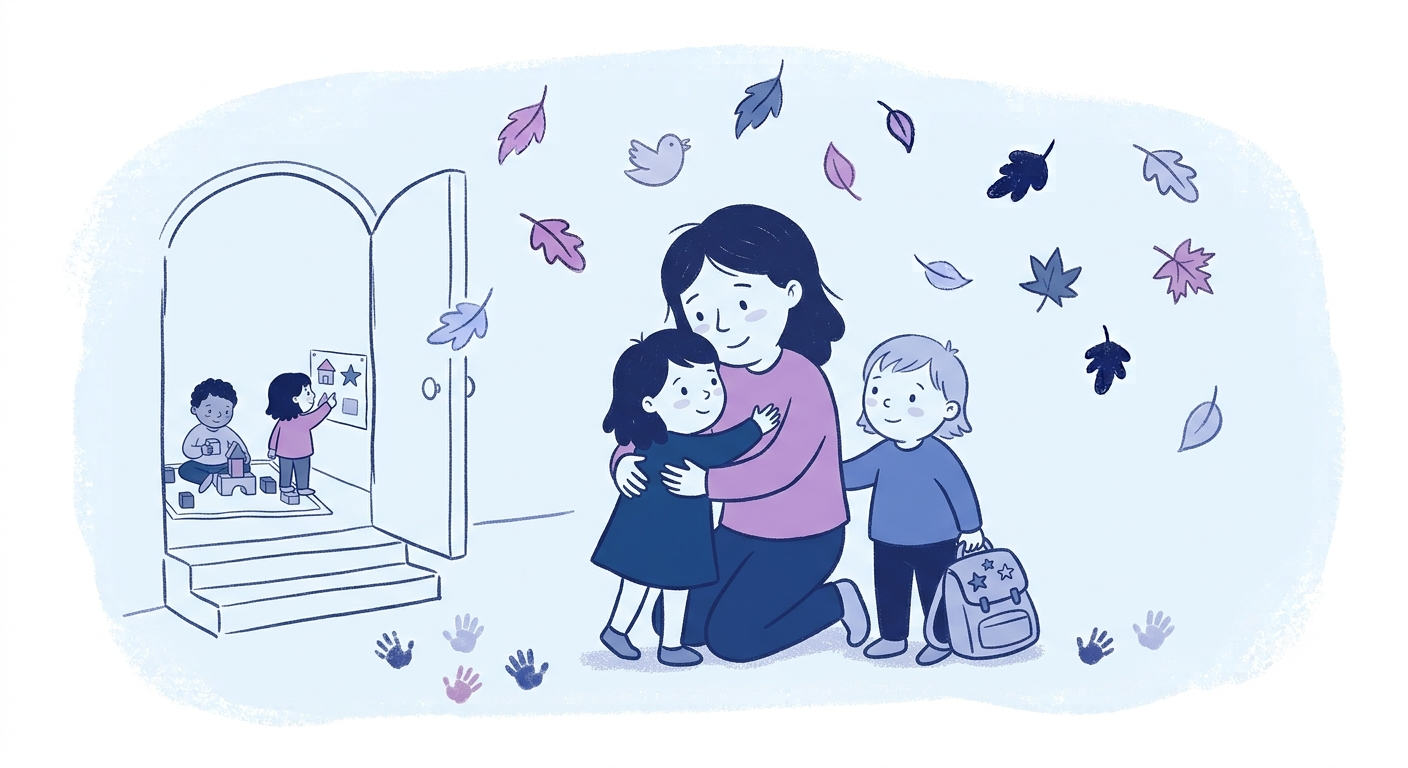
I initially treated those unreturned conference notes as a personal failure, worrying I was falling short of building genuine family partnerships. Learning how to connect with parents through simpler routines took the weight off everyone.
It took months of pickup duty to realise that formal meetings were rarely the vehicle that made relationships work in the first place.
In this honest reflection and guide:
The Thirty-Second Shift: What the “Boss Block” Taught Me
The turning point happened while watching a seasoned educator greet a father at the doorway.
Instead of delivering the generic “he had a great day,” she smiled and gave him one specific story: his four-year-old had spent forty minutes building a tower, declaring that a wide rectangular brick was the “boss block” that kept the entire structure upright.
The father’s shoulders relaxed immediately. His eyes lit up, and he chuckled, mentioning that his son used that exact same phrase when building train tracks with his grandfather on Sundays.
That interaction took less than thirty seconds. It was not a scheduled meeting, yet it established more visible warmth and trust than any formal conference I sat through that term. It showed that when educators rethink how to connect with parents, communication stops feeling like an administrative hurdle.
Watching that scenario repeat across different rooms, the pattern was unmistakable.
The families who felt most connected to their child’s daily care were not the ones attending formal evening reviews. They were the parents receiving specific, unhurried snippets of lived experience at the doorway, week after week.
Under Australia’s early years learning framework administered by ACECQA, building collaborative partnerships with families is vital. Reaching that standard is about cultivating relational trust in daily rhythms, not logging calendar hours.
Real Obstacles: Pickup Chaos, Time Constraints, and Language Barriers
Knowing that brief touchpoints matter more than formal meetings did not make the practice easy to pull off immediately.
Pickup time in an early learning centre is noisy. Several families arrive in the same twenty-minute window, bags get misplaced, and toddlers transition between activities.
Spending five minutes chatting with one parent meant three others were left waiting by the sign-in iPad. Early on, I either rushed the handover so badly it felt clipped, or talked for too long and left families feeling ignored.
Language was another consideration. Melbourne’s early childhood sector is richly diverse.
As I observed when reflecting on how a multilingual child processes their expanding world, rushed verbal explanations can feel confusing for parents still gaining confidence in English. Understanding how to connect with parents who speak English as an additional language requires visual anchors and cultural sensitivity.
I had to learn to strip away educational jargon, keeping the core observation vivid and simple.
Taking a quick photo of a child mid-activity and showing it at the door bridged the gap effortlessly, proving that discovering how to connect with parents works best when educators lean into everyday visual cues.
What Research Reveals About Frequent Micro-Touchpoints
Educational research strongly supports swapping high-stakes formal conferences for regular micro-interactions.
Dr Joyce Epstein at Johns Hopkins University developed the widely cited Framework of Six Types of Involvement, identifying communication as an ongoing, multi-directional partnership rather than an isolated annual event.[1]
Epstein’s research demonstrates that family engagement distributed across small, regular touchpoints creates deeper institutional trust than infrequent formal conferences.
This aligns with findings by researchers Matthew Kraft and Shaun Dougherty, published through ASCD on parent communication systems.[2]
Their studies showed that frequent, individualized touchpoints produced measurable increases in student engagement and family satisfaction, while reducing parental defensiveness during later developmental reviews. Knowing how to connect with parents through short, regular touchpoints strengthens relational safety across the entire school year.
Formal Term Conferences vs Daily Micro-Handovers
Here is how formal meetings compare to consistent doorstep communication in everyday early childhood practice:
| Communication Factor | The Scheduled 30-Minute Conference | The 30-Second Specific Handover |
|---|---|---|
| 1. Family Accessibility Overcoming time and work constraints. |
Requires parents to take time off work or arrange evening childcare, increasing pressure on overstretched homes. | Takes place right at the pickup door, meeting parents where they already are during routine pick-ups. |
| 2. Emotional Safety How families perceive the contact. |
Can feel like a performance review, triggering defensive posturing or anxiety around perceived developmental deficits. | A relaxed, positive touchpoint celebrating small daily joys, removing threat for neurodivergent and EAL families. |
| 3. Educator Load Managing documentation and energy. |
Demands hours of out-of-hours preparation, written summaries, and emotional exhaustion after a full teaching shift. | Requires keeping one genuine mental or clipboard note during play, preventing administrative burnout. |
| 4. Relational Follow-Through Impact on the home evening routine. |
Parents receive broad curriculum goals that feel disconnected from tonight’s dinner table conversations. | Gives parents a concrete topic to ask about on the drive home, encouraging authentic serve-and-return dialogue. |
4 Powerful Ways: How to Connect With Parents in Daily Practice
To make pickup handovers genuinely effective, these four practical shifts turn thirty seconds into lasting trust:
1. Swap Generic Summaries for One Concrete Story
Saying “she had a great day” tells a family nothing and slips out of mind within five paces.
What this sounds like in practice:
Too vague to matter: “She had a lovely day, ate all her lunch, and played outside nicely.”
Specific enough to land: “She spent forty minutes working out how to balance river pebbles on our wooden plank, and when the tower fell, she asked her friend to hold the base so they could try again. She was so proud when it stayed up.”
The second version takes thirty seconds to say, but proves to the parent that their child was observed with genuine care. For teachers asking how to connect with parents authentically, specific micro-stories outshine general praise every single time.
2. Show the Tablet Screen for Ten Seconds
When language barriers or evening fatigue make conversational processing difficult, let a visual snapshot do the heavy lifting.
- What to do: Hold up the classroom tablet or photo printout showing the child mid-construction, pointing out what they were exploring.
- Why it works: As we explore in our guide on visual storytelling in early childhood, images transcend vocabulary barriers and spark immediate shared joy between parent and child.
3. Batch Observations and Release the Queue
Pickup chaos causes educators to panic and retreat into silence.
- What to do: Keep a mental note of two or three specific children each afternoon rather than trying to craft novel essays for twenty families in twelve minutes.
- Why it works: Rotating your focus ensures every family receives deep, specific contact over the course of the week while protecting your own boundaries against parent-teacher burnout in early childhood care. This structured pacing demonstrates how to connect with parents sustainably over the course of a long term.
4. Reserve Formal Sit-Downs Exclusively for Complex Care
When you eliminate meetings for routine updates, scheduled sit-downs regain their intended purpose.
- What to do: Schedule formal conferences only when discussing developmental variations, addressing why a child can do tasks some days and not others, or coordinating neurodivergent care plans.
- Why it works: Parents no longer view an invitation as a chore; they recognise it as dedicated, collaborative advocacy.
Making Handover Communication Sustainable Day to Day
How do you know this lighter-touch approach is taking root?
First, parents arrive at pickup looking for your eye, rather than grabbing bags and heading straight for the car park.
Second, families start volunteering their own observations: “He told us about that dinosaur bridge in the bath last night!”
This exchange creates the reciprocal partnership Epstein’s framework describes.
When working alongside neurodivergent learners or supporting daily routines for neurodivergent children, these small exchanges become invaluable.
A parent can whisper that their child had poor sleep, allowing educators to adjust sensory expectations before a meltdown occurs. Learning how to connect with parents at this quiet level creates a true partnership around the child.
If you are an educator feeling buried under conference schedules and unread emails, take a deep breath.
You do not need an evening meeting to prove you care about a child’s learning.
Share one true, specific detail at the door tonight. It takes thirty seconds, and it builds the foundation for everything else you do together.
Free Printable: Quick Parent Communication Checklists
Download our simple, prompt-based family communication sheet, designed to help educators capture meaningful daily observations without paperwork overload.
Download the Free 3-Page Sampler- Protect educator capacity in Parent-Teacher Burnout in Neurodivergent Care: Protecting Relational Energy →
- Reflect on neurodivergent profiles in Spiky Profiles in Neurodivergent Learners: Understanding Uneven Skills →
- Address sensory demands using Classroom Noise Sensory Overload: 4 Powerful Ways Sound Triggers Meltdowns →
- Streamline pedagogical records with Assessment Strategies in Early Childhood Education Without Busywork →
- Explore family connection rituals in Mother Daughter Bonding Activities for Busy Moms: 4 Powerful Ways to Connect →
References & Readings That Guided Me
- Epstein, J. L. (2018). School, Family, and Community Partnerships: Preparing Educators and Improving Schools (2nd ed.). Routledge. [The foundational six-type model defining family engagement as relational touchpoints rather than isolated formal events].
- Kraft, M. A., & Dougherty, S. M. (2013). The effect of teacher-family communication on student engagement: Evidence from a randomized field experiment. Journal of Research on Educational Effectiveness, 6(3), 199–222. [Empirical evidence demonstrating the superior efficacy of frequent, personalized, low-friction outreach].
- Australian Government Department of Education. (2022). Belonging, Being and Becoming: The Early Years Learning Framework for Australia (V2.0). [Mandating collaborative partnerships with families through open, daily communication].
- Harvard Family Research Project. (2014). Redefining Family Engagement: Moving from Compliance to Relational Practice. Harvard Graduate School of Education. [Framework emphasizing brief, reciprocal dialogue over formal meetings].