
First Then Regulation Reset Mats: 3 Simple, Gentle Steps to Ease Transitions (With a Built In Reset)
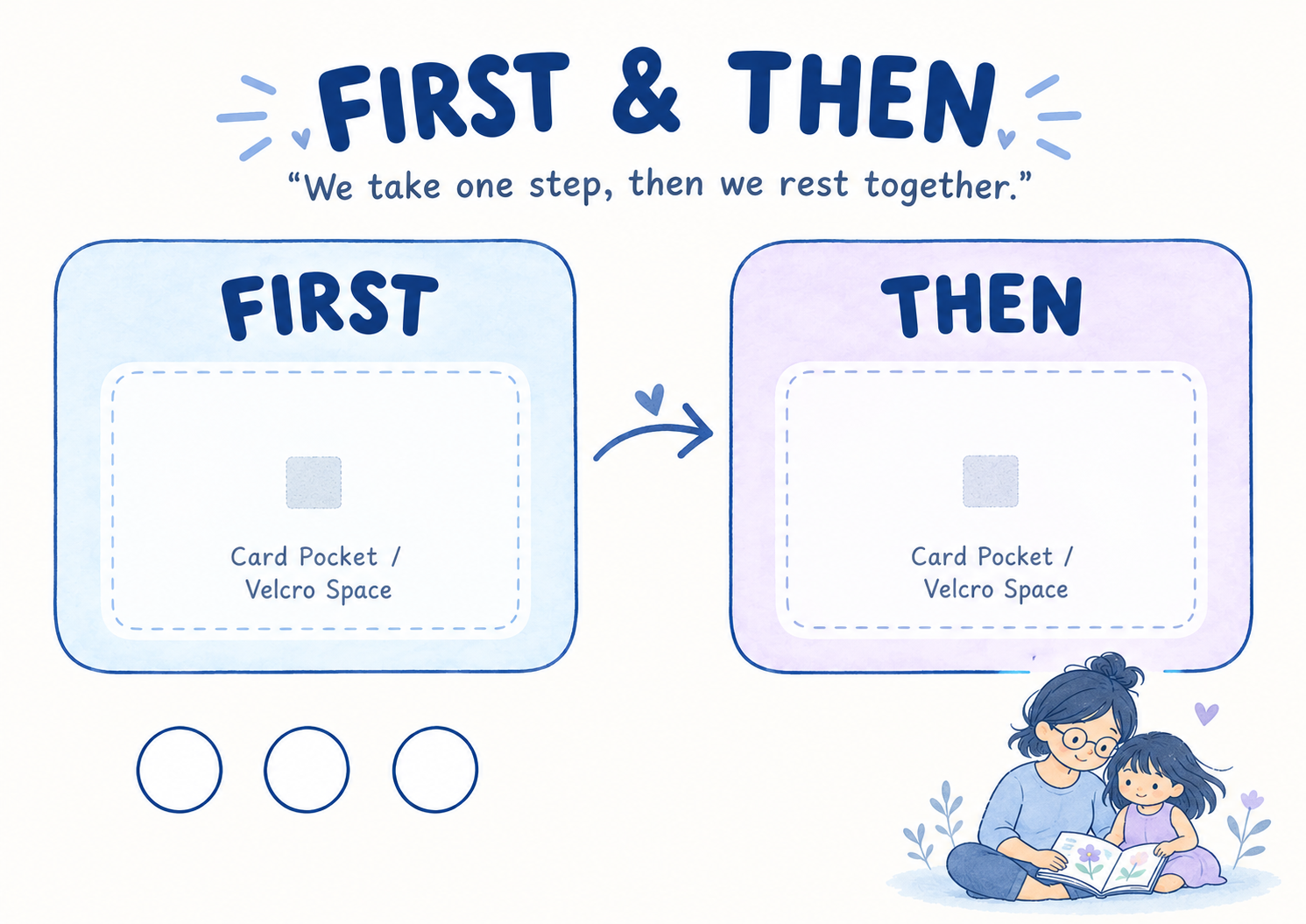
First then regulation reset mats are a printable twist on the classic first then board. The top shows one small “first” step and a predictable “then”. The bottom adds a reset strip with two handprints to press and a wave to trace with a finger, so when a child gets stuck, there’s a calm way back instead of more pushing.
This guide covers why ordinary first then boards sometimes turn into battles, what’s on the mat, what research says about visual supports, three steps to start, everyday examples, tips for neurodivergent children, safety notes on magnets and small parts, the free mats PDF, new First Then Starter Tiles and Countdown Cards and twelve more free PDFs.
“First shoes, then park” sounds simple. But for a child who’s already overwhelmed, it can sound like a demand with no way out. A reset changes that.
- How This Page Helps
- A Hallway Many Families Know
- Why First Then Boards Sometimes Backfire
- What the Research Says
- What’s on the Mat
- 3 Steps to Start
- Everyday Examples
- Common Mistakes
- Making Your Own Tiles
- Growing Out of the Mats
- For Neurodivergent Children
- Pairing With Other Tools
- Safety: Magnets, Small Parts and Laminate
- For Educators
- Download the Free Mats
- New: Starter Tiles and Countdown Cards
- More Free PDFs
- FAQs
How This First Then Regulation Reset Mats Page Helps
- Make transitions calmer by showing one small step at a time.
- Add a way back when your child gets stuck, instead of repeating yourself louder.
- Use the free mats with three simple steps and plenty of examples.
- Keep it safe, with clear notes on magnets and small tiles.
- Get new starter tiles and countdown cards so you’re not drawing every card yourself.
There’s one small change in how you use a first then board that makes the biggest difference of all. It’s step 2 below, and it involves saying less, not more.
A Hallway Many Families Know
An illustration, not a family memory. This scene is a composite of what many parents describe.
It’s 8.20 on a wet Thursday morning. A four year old sits on the hallway floor, staring at her gumboots. Her parent has already said “shoes on” five times, each time a bit louder. There’s a first then board on the wall: “First shoes, then car.”
The parent points at it and says, “Look, first shoes!” The child kicks a boot across the hallway and crawls behind the couch, crying. The board was supposed to help. Instead, it’s become one more way of saying “do it now”.
Now imagine the same moment with a reset strip at the bottom of the board. The parent stops talking about shoes, sits down beside the couch and presses both hands flat onto the handprints, breathing slowly. After a while, small hands come out and press down too. A few quiet breaths later, the boot goes on.
That’s the idea behind first then regulation reset mats: the board isn’t an enforcer. It’s a bridge, with a calm place to pause when a child’s body needs it.
Why First Then Boards Sometimes Backfire
First then boards are based on a simple, well known idea: do the less preferred thing first, then the more preferred thing. Psychologist David Premack described this pattern in 1959, and it’s often called the Premack principle.1 Used well, it gives children predictability: “I know what’s happening now, and what comes next.”
But in a tense moment, a first then board can turn into an ultimatum: “First finish your work, then you get playdough.” For children who are already overwhelmed, or who find demands very hard, that can feel like pressure with no exit. Some children are especially sensitive to demands. This is sometimes described as a demand avoidant or “PDA” profile. It isn’t a formal diagnosis, but many families recognise it.
A first then board used as pressure
The “then” becomes a prize to earn. No help when a child freezes. The adult repeats the demand louder, and things escalate.
A first then regulation reset mat
One small step at a time. The “then” is a predictable next step, not a bribe. A reset strip gives everyone a calm pause when it’s too much.
What the Research Says About First Then Boards and Visual Supports
Visual Schedules Are an Evidence Based Practice
A review by Victoria Knight, Emily Sartini and Amy Spriggs concluded that visual activity schedules meet the criteria for an evidence based practice for autistic people, helping with on task behaviour, transitions and finishing tasks, especially when they’re taught step by step.2
Visual Schedules Help With Transitions
Studies by Dettmer and colleagues, and by Bryan and Gast, found that picture schedules helped autistic children move between activities and stay on schedule with less prompting from adults.34
Less Talking Can Help
Pictures stay put. Words disappear as soon as they’re said. For children who find listening and remembering instructions hard, a picture they can look at again and again often helps more than repeated reminders.
A note on the evidence: research supports visual schedules and first then supports, especially for autistic children. The reset strip, with handprints and a breathing wave, is our own addition based on early childhood practice. There isn’t research testing it specifically, and claims that pressing hands “activates the vagus nerve” aren’t well supported. Treat the reset as a calm, simple pause, and watch what helps your child.
What’s on the First Then Regulation Reset Mat
| Part | What it shows | Why it helps |
|---|---|---|
| First box | One small step, like “socks on” | One thing to hold in mind, not a whole list |
| Then box | What comes next, like “breakfast” or “car” | Predictability: “I know what happens next” |
| Reset strip | Two handprints and a wave line | A calm pause: press hands down, trace the wave slowly with a finger |
Keep the First Step Tiny
“Get ready for kinder” is too big. “Socks on” is a step. If your child freezes, the step is probably still too big. Break it down again.
Make the Then Predictable, Not a Bribe
The “then” works best as the natural next part of the day, like breakfast, the car or a story, rather than a treat to be earned. That keeps the board about “what’s next”, not “what you’ll lose”.
Use the Reset Strip Early
The reset is for the early signs, like stiff shoulders, hiding or tears starting, not just full meltdowns. Press, trace, breathe, then come back to the first step when your child is ready.
3 Steps to Start With First Then Regulation Reset Mats
Introduce It on a Calm Day
Never introduce a new tool in the middle of a meltdown. On a calm afternoon, sit on the floor together. Put two enjoyable cards on the mat: “First story, then afternoon tea.” Let your child stick the cards on, press the handprints and trace the wave. You want the mat to feel safe and familiar.
Point, Don’t Repeat
Here’s the change that makes the biggest difference: say less. Instead of calling “shoes on!” from the kitchen, walk over, get down to your child’s level and quietly point to the “first” card. Pictures stay. Repeated words often just add pressure.
Use the Reset Before Things Blow Up
If you see early signs of overwhelm, pause the task. Point to the reset strip and press your own hands down beside your child’s.
Trace the wave slowly with a finger while breathing out. Then, when your child seems calmer, point back to the first card without fuss.
The free First Then Starter Tiles and Countdown Cards PDF gives you ready made cards for these steps, or you can print it from this page.
Everyday First Then Regulation Reset Mats Examples
| Time | First | Then |
|---|---|---|
| Morning | Socks on | Breakfast |
| Leaving the house | Shoes on | Car |
| After kinder | Bag on hook | Snack |
| Play to tidy | Blocks in tub | Story |
| Bath time | Clothes in basket | Bath toys |
| Bedtime | Teeth | Book in bed |
| Screens off | Tablet on the shelf | Outside play |
Notice that many “thens” are just the next part of the day. That’s on purpose. Predictability is the reward.
Common First Then Board Mistakes
| Mistake | What happens | Try instead |
|---|---|---|
| “First” step too big | Child freezes or refuses | Break it into a smaller step |
| “Then” used as a bribe or taken away | Board becomes a power struggle | Keep “then” predictable |
| Introducing it during a meltdown | Board feels like pressure | Practise on calm days first |
| Pointing and talking at the same time | Too much input | Point and wait quietly |
| Skipping the reset | No way back when it’s too much | Use the reset at early signs |
Making Your Own First Then Tiles
The starter tiles below cover common routines, but the most useful tiles are often the ones that match your child’s real day. You don’t need to be good at drawing.
- Use photos. A photo of your child’s own shoes, toothbrush or car seat is often clearer than a drawing, especially for younger children.
- Keep one idea per tile. “Shoes” not “shoes and jacket and bag”.
- Use the same words every time. If the tile says “teeth”, say “teeth”, not “brush your teeth now please”.
- Add home language words. For multilingual families, write both words on the tile.
- Let your child help. Children who help make tiles often feel more ownership of the routine.
Growing Out of First Then Regulation Reset Mats
First then regulation reset mats aren’t meant to be forever. As routines become familiar, many children need them less. Fading slowly keeps the calm without the board.
- Move from pointing to glancing. Once your child knows the routine, a quick look at the mat may be enough.
- Let your child set it up. They choose and stick the tiles. You just check in.
- Keep the reset. Even when the tiles aren’t needed, the habit of “press, breathe, then try” is worth keeping.
- Bring it back on hard days. Illness, holidays, a new sibling or starting school can make old supports useful again. That’s not going backwards.
Many families move from the first then mat to a whole morning routine, like the Daily Routine Chart, as children grow. The aim is always the same: predictability, small steps and a calm way back when things feel too much.
First Then Regulation Reset Mats for Neurodivergent Children
- Autistic children: Visual supports often help a lot. Use the same mat in the same place, and teach it step by step on calm days.
- ADHD: Keep the “first” step tiny and quick. Add movement to the reset, like wall pushes from the Pocket Heavy Work Cards.
- Demand sensitive children: Offer choices: “Which first, socks or jumper?” Let them put the card on the mat. Keep your tone light and low pressure.
- Children learning English: Pictures and single words help. Say the word in your home language too.
- Sensory sensitive children: Some don’t like pressing hands. Offer the wave trace or a slow breath instead.
Pairing First Then Mats With Other Tools
- For the whole morning: visual routine cards for ADHD kids show the bigger picture, and the 8 Card Routine Sheet puts it on one page.
- For days that change: the Today Is Different Card.
- For after school crashes: pocket heavy work cards.
- For big feelings: the Fight, Flight or Freeze Spotter Card and the Storm Plan.
- For calm table time: number sense playdough mats.
Safety: Magnets, Small Parts and Laminate
Magnets. Don’t put magnet strips or small magnets on the back of cards if you have babies, toddlers or children who mouth things. The ACCC warns that small, high powered magnets can cause life threatening internal injuries if swallowed, because they can stick together inside the gut.5 If you think your child has swallowed a magnet, seek urgent medical help straight away. Use Velcro dots or a pocket chart instead.
Small parts. Keep tiles large, and store spares in a sealed pouch out of reach. The ACCC’s free Choke Check tool helps you test whether an object could be a choking hazard for children under 3.6
Laminate corners. Trimmed laminate can leave sharp points. Round every corner with a corner punch or scissors.
First Then Regulation Reset Mats for Educators
- Keep a mat near transition hot spots: the bag area, the bathroom, the door to outside.
- Use the same “first” and “then” language across the team.
- Teach the reset strip to the whole group on calm days, so it’s familiar for everyone.
- Share the mat with families so home and kinder match.
- For whole group transitions, see sensory micro transitions.
Download the Free First Then Regulation Reset Mats
An A4 base mat with First and Then boxes and the reset strip, plus starter transition tiles.
Download the Free Mats PDF (A4)How to Use the First Then Regulation Reset Mats
- Print the base mat on card, laminate it, and round off the corners. Add a Velcro dot to the middle of the First box and the Then box.
- Print and laminate the tiles, add Velcro dots, and keep them in a pouch out of reach of little ones. Don’t use magnets if young children are around.
- Introduce the mat on a calm day with two fun cards, and let your child press the handprints and trace the wave.
- For real transitions, put one tiny step in First and the natural next part of the day in Then. Point to the card instead of repeating instructions.
- At the first signs of overwhelm, pause and use the reset strip together: three firm hand presses and a slow finger trace along the wave. Then go back to the first step when your child is ready.
New Free Printable: First Then Starter Tiles and Countdown Cards
Twelve ready to cut tiles for common firsts and thens, four blank tiles to draw your own, and a countdown strip to warn before transitions.
Download the Free PDFFirst Then Starter Tiles
Cut out. Laminate. Round the corners. Use Velcro, not magnets.
How to Use the Starter Tiles and Countdown Cards
- Print on card, laminate, then cut out each tile and the countdown cards. Round every corner. Add a Velcro dot to the back of each one.
- Sort them: blue tiles are “first” steps, purple tiles are “thens”. Draw your child’s own routines, favourite things or home language words on the blank tiles.
- Before a transition, show the countdown cards in order: “5 more minutes”, “2 more minutes”, “1 more turn”, then “Time to change”. Point rather than call out.
- At “Time to change”, put one blue tile in the First box and one purple tile in the Then box on the reset mat. If your child is wobbly, hold up “Reset first?” and use the handprints together before starting.
- Keep the tiles in a labelled pouch near where transitions happen. Swap in new tiles as routines change, and let your child choose and stick the tiles on when they’re ready. That small bit of control helps many children.
More Free PDFs for Transitions and Regulation
Starter Tiles and Countdown Cards
Ready made firsts, thens and countdowns.
Download PDFUse with: the matMore free tools are on our printables page.
The Heart of It
A first then board can be a helper or an enforcer. The difference is often whether there’s a way back when a child’s body says “not yet”. First then regulation reset mats keep the predictability that makes first then boards work, and add the pause that makes them kind: one small step, a predictable next thing, and a calm place to press, breathe and try again.
- Hub: regulation and behaviour
- Big reactions: fight, flight and freeze
- Meltdowns: child meltdown co regulation
- Routines: free daily routine template
- Starting tasks: when an ADHD child won’t start tasks
- Calm spaces: calm corner design
First Then Regulation Reset Mats FAQs
What are first then regulation reset mats?
They’re printable first then boards with an added reset strip. The top shows one small “first” step and a predictable “then”. The bottom has handprints to press and a wave to trace, giving children a calm pause when a transition feels too hard.
Do first then boards work?
Visual schedules, including first then supports, are considered an evidence based practice for autistic children, helping with transitions and finishing tasks. They work best when introduced on calm days and taught step by step.
Should the “then” be a reward?
It works best as the natural next part of the day, like breakfast or the car, rather than a prize to earn. Using it as a bribe or taking it away often turns the board into a power struggle.
Can I use magnets on the cards?
Not if babies, toddlers or children who mouth things are around. Swallowed small magnets can stick together inside the gut and cause life threatening injuries. Use Velcro dots or a pocket chart instead, and seek urgent medical help if a magnet is swallowed.
What age are first then mats for?
Many children from about 2 to 7 benefit, and older children who find transitions hard can use them too. Use photos or simple pictures for younger children and words for older ones.
Research and safety: Premack on the first then principle, Knight and colleagues’ review of visual activity schedules, Dettmer and colleagues and Bryan and Gast on visual schedules and transitions, and the ACCC on magnets and choking hazards.
Experience: the hallway scene is a clearly labelled composite illustration, not a family memory. The mats were designed by EarlyChildhoodEduNet. The reset strip, steps and tips come from early childhood practice rather than a single study.
This is educational content, not a substitute for advice from an occupational therapist, psychologist or paediatrician. Supervise young children around small or laminated parts. Last reviewed: 10 November 2026.
References
- Premack, D. (1959). Toward empirical behavior laws: I. Positive reinforcement. Psychological Review, 66(4), 219-233.
- Knight, V., Sartini, E., & Spriggs, A. D. (2015). Evaluating visual activity schedules as evidence based practice for individuals with autism spectrum disorders. Journal of Autism and Developmental Disorders, 45(1), 157-178. https://doi.org/10.1007/s10803-014-2201-z
- Dettmer, S., Simpson, R. L., Myles, B. S., & Ganz, J. B. (2000). The use of visual supports to facilitate transitions of students with autism. Focus on Autism and Other Developmental Disabilities, 15(3), 163-169.
- Bryan, L. C., & Gast, D. L. (2000). Teaching on task and on schedule behaviors to high functioning children with autism via picture activity schedules. Journal of Autism and Developmental Disorders, 30(6), 553-567.
- Australian Competition and Consumer Commission. (2026, June 2). ACCC issues takedown requests to Amazon, eBay, Kogan and Fruugo for toys and games containing potentially deadly small magnets. https://www.accc.gov.au/media-release/accc-issues-takedown-requests-to-amazon-ebay-kogan-and-fruugo-for-toys-and-games-containing-potentially-deadly-small-magnets
- Australian Competition and Consumer Commission. (2022). Choke check: The DIY safety tool. https://www.accc.gov.au/about-us/publications/choke-check-the-diy-safety-tool
