
Free Weekly Lesson Plan Template: Plan the Week Without Losing Your Sunday Night
A simple Monday to Friday grid for early childhood educators and homeschoolers. Print it, fill it in by hand, and walk into Monday knowing roughly what the week holds, with plenty of room for the children to change your mind.
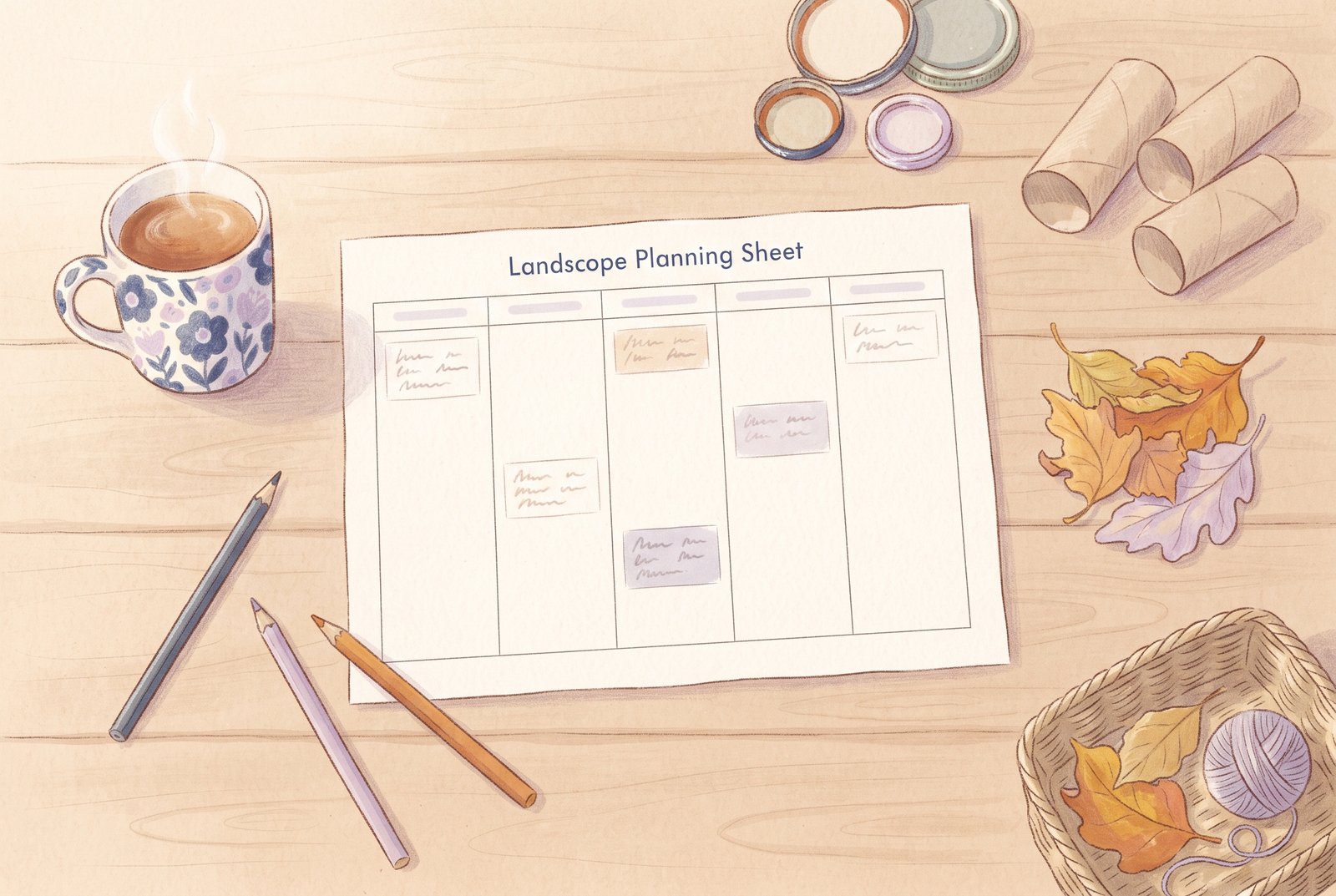
I built this after one too many Sunday evenings spent overengineering a lesson plan nobody but me was ever going to read closely. It’s five columns, Monday to Friday, with room for a focus experience, a learning intention, materials, ways in for different children, and a spot to tick off once it’s actually happened. That’s it.
It works for a classroom week or a homeschool week. Whether you’re planning for one child or twenty-five, the boxes are the same. What makes the plan useful is the thinking behind it, and that’s what the rest of this page is about.
A quick look at the layout
- What’s in the free weekly lesson plan template pack
- Good planning isn’t about filling every box
- How to use the weekly lesson plan template
- Planning with a learning intention
- Plan from observation, not assumption
- Making plans flexible and inclusive
- Leave room for play
- Reflection after the activity
- A worked example
- FAQs
What’s in the Free Weekly Lesson Plan Template Pack
Each page matches one part of the planning cycle on this page, so you can use as many or as few as you like. Most weeks, the first page is all you’ll need.
Weekly lesson plan template
Monday to Friday, with rows for a focus experience, learning intention, materials, ways in, and a done box. Space for this week’s one or two priorities, what you noticed and ideas for next week.
Example week, filled in
A real-looking week built around comparing and describing, including the slater that took over Wednesday. It shows how few words you actually need.
Observation to plan
What I saw, what it might suggest, a possible follow-up, and what to watch next. Two observations per page.
One open task, many ways in
Plan one experience every child can start, then tick adjustments to materials, steps, ways to respond, choice and time.
Weekly reflection
Five minutes on Friday: what went to plan, what was harder, what got interrupted, what worked once adapted, and next week’s priorities.
Made to print
Landscape A4 and US Letter, clean in black and white, and roomy enough to write in by hand.
Good planning isn’t about filling every box
A weekly lesson plan template is a thinking tool, not a test of how busy you can make a page. The useful decisions are small ones: what the children might explore this week, what support some of them may need, what you want to watch for, and how tomorrow’s experience could respond to what actually happened today.
A basic weekly overview takes away the daily scramble of deciding what to set out, while still leaving room for children’s interests, unexpected discoveries and changes in how individual children are going. That balance matters more than which planning method you follow.
How to Use the Weekly Lesson Plan Template
If you’d like the broader version of this, with more on starting from the big picture and staying flexible once the week begins, I’ve written about planning engaging lessons without the stress. For the template itself, this sequence keeps things manageable:
- Pick one or two priorities for the week. Not ten. Maybe it’s building language for describing things, or practising taking turns.
- Start from what you’ve noticed. What have the children been drawn to, asking about or returning to? That’s often a better starting point than a theme picked in advance.
- Choose one manageable focus experience a day. Write it in a few words. The rest of the day still happens; this is just the thing you’ve prepared for.
- List only the essential materials. If it doesn’t need gathering or setting up ahead of time, leave it off.
- Think briefly about participation. Is there a child who might need a different way in? A word or two in the margin is enough.
- Leave room to notice. The tick box shows it happened. A line on the back of the sheet about what you saw is what shapes next week.
Planning with a learning intention, not just an activity
Choosing an activity and deciding what children might learn through it are two different decisions. “Cardboard tubes and lids on the mat” is an activity. The learning intention is what you’re hoping it opens up, and that changes how you set it out and what you say.
The same loose parts could support comparing heights (“Whose tower is taller? How could we check?”), descriptive language (“Tell me how you made it stand up”), problem-solving when something keeps toppling, working alongside a friend, or fine motor practice fitting lids onto tubes. You don’t need to chase all of those at once. Pick the one that fits this week’s priority, and let the others happen if they happen.
Plan from observation, not assumption
The best ideas for next week usually come from paying attention this week. Here’s how one ordinary moment can lead somewhere:
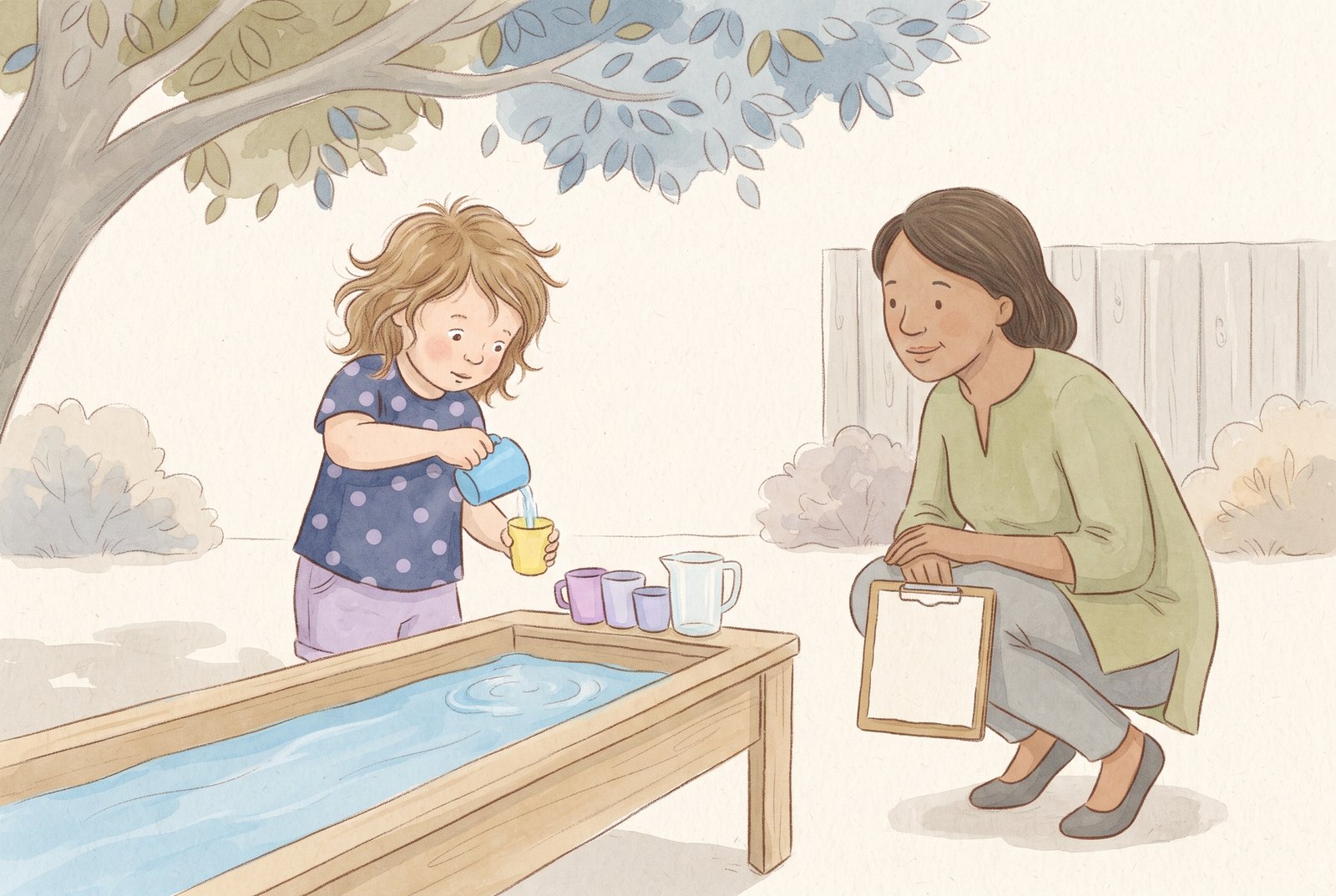
A child spends ten minutes at the water trough pouring between cups, stopping to look each time one fills up.
Possibly an interest in “full” and “how much fits”. Or simply enjoying the feel of the water. You don’t know yet.
Offer two containers of different shapes and ask, “Which one do you think holds more? How could we find out?”
Does she predict, compare or use words like full, empty and more? Or does she go back to pouring for the joy of it?
The Observation to Plan sheet in the free pack follows exactly these four steps, so a moment like this can go straight into next week’s weekly lesson plan template.
One observation is a clue, not a conclusion. It isn’t evidence of a child’s ability, a difficulty or a developmental concern on its own, and many children can do something one day and not the next for reasons that have nothing to do with the skill. I’ve written about why a child can do something some days and not others if that pattern feels familiar. For keeping observation notes short and genuinely useful, there’s more in my piece on practical assessment strategies in early childhood education.
Making plans flexible and inclusive
A planned experience can stay meaningful even when children take part in very different ways. Children differ in how they communicate, what sensory input they seek or avoid, how they move, how long they stay with something, how easily they get started, which languages they’re using and how confident they feel. Two children with the same diagnosis may need completely different things, so plan from the child in front of you rather than a label.
Small adjustments tend to go a long way:
- Change the materials, such as bigger pieces, tongs instead of fingers, or something dry instead of something wet.
- Cut steps that aren’t the point of the activity.
- Accept different ways of responding: pointing, showing, drawing, home language, or doing it rather than saying it.
- Offer a choice about how, or whether, to join in, including watching first.
- Allow more time, or come back to it later.
Rather than writing a separate version for every child, it often helps to design one open task that every child can start and some can take much further. The One Open Task, Many Ways In sheet in the pack is built for exactly this. I’ve explained the approach in more detail in how to stop writing a separate plan for every kid. If getting started is the sticking point, shrinking the first step when a child won’t start a task can help. And if the hard part is the move from one activity to the next, rather than the activity itself, have a look at movement-based ideas for sensory micro-transitions in preschool.
Success doesn’t have to look like sitting still, joining in immediately or finishing every step. A child who watched from the edge and then had a go on Thursday has taken part.
Leave room for play and unexpected learning
The plan gives the week a direction. It doesn’t have to dictate how each experience unfolds. Often the most useful structure is a single light challenge dropped into open play, then stepping back, an idea I’ve written about in bringing in play-based learning without losing structure.
Say you’ve planned a leaf-sorting activity, and a child lifts a leaf and finds a slater underneath. The sorting stops. Everyone wants to see it. You could steer them back to the leaves, or you could follow it: How many legs? Where do you think it lives? What happens if we put the leaf back? That might lead to careful looking, new words, gentle handling of living things and a lot of questions. None of that was on Wednesday’s plan, and it was still worth the time. Note it down, and maybe it becomes Thursday’s focus.

Reflection: what to do after the activity
An activity doesn’t have to be completed for you to learn something useful from it. A quick look back on Friday, or at the end of each day, usually falls into one of these:
Great. What could stretch it a little next time, or who might enjoy a different way in?
Which part was hard? Often it’s one step, the materials or the timing rather than the whole idea.
That’s information too. What were they doing instead? That may be next week’s starting point.
Move it to another day or let it go. The grid is a guide, not a contract.
Write down what you changed. That adaptation is often the most useful note of the week.
A worked example: one day of a nature collection
Here’s how one day on the template might look, using an everyday, low-cost experience. It builds on ideas from my nature scavenger hunt for kids, which works on an ordinary footpath or a small concrete yard.
- Focus activity (Tuesday)
- Collect fallen leaves on a short walk or in the yard, then lay them out in a line from lightest to darkest.
- Learning intention
- Comparing and describing: noticing differences and using words like lighter, darker, bigger and crunchier.
- Materials
- A basket or paper bag, plus a tray or a large sheet of paper to sort on.
- Possible adaptations
- A child who doesn’t want to touch damp leaves can point while you place them, or use tongs. If going outside is hard that day, bring a basket of leaves in. A child learning English can show rather than tell, and you can name the words as they sort. A child who needs to move can be the one carrying the basket.
- What to notice afterwards
- How do they sort: by colour, size, or a rule of their own? What words do they use? Who wanted to keep going? One line on the back of the sheet is plenty.
You can see this exact week, slater and all, on the filled-in example page in the free pack. On the template itself, that might simply read: “Leaf line-up, light to dark” in the focus box and “basket, tray” under materials. The thinking above lives in your head, or in a few words in the margin.
Weekly Lesson Plan Template FAQs
Is this weekly lesson plan template free?
Yes. The five-page planning pack is free to download and print for your own room, family or single classroom, with no email sign-up.
Who is this weekly lesson plan template for?
It’s designed for early childhood educators, kindergarten and preschool teachers, family day care educators and homeschooling families planning for children aged around 2 to 6.
How long should weekly planning take?
About 15 minutes is a realistic aim for the overview once you stop trying to make it perfect. Some weeks will take longer, especially when you are planning from new observations.
Does this template meet EYLF or NQF documentation requirements?
It isn’t a compliance document on its own. It’s a weekly overview you can use alongside your service’s own program documentation, which should follow your approved learning framework and service policies.
Can I use the weekly lesson plan template for homeschooling?
Yes. The grid works the same for one child or a whole group. Check what your state or territory asks for in home education planning and records, and use the template as your weekly overview.
What This Template Is, and What It Isn’t
This is a weekly overview to make planning lighter. It isn’t a complete curriculum, an individual learning plan, a formal observation or assessment record, or a compliance document.
If you work in an approved education and care service in Australia, your service will have its own requirements for documenting the educational program and children’s assessments or evaluations. ACECQA’s information sheet on educational program documentation sets these out, and the approved learning frameworks, including the Early Years Learning Framework V2.0, describe planning as an ongoing cycle of observing, assessing, planning, implementing and reflecting. Use this grid alongside your service’s documentation, not instead of it.
If you’re registered for home education, check what your state or territory asks for in planning and records. If you’re ever worried about a child’s development, talk with the family, or with your GP or child health nurse if you’re the parent.
What it is built for is the person who just wants Monday morning to feel less chaotic than it usually does.
Ready for Monday?
Five free planning pages. No email required. Prints fine in black and white.