
Free Daily Routine Template for Kids Aged 3 to 6: An Easy Picture Chart for Home and the Classroom
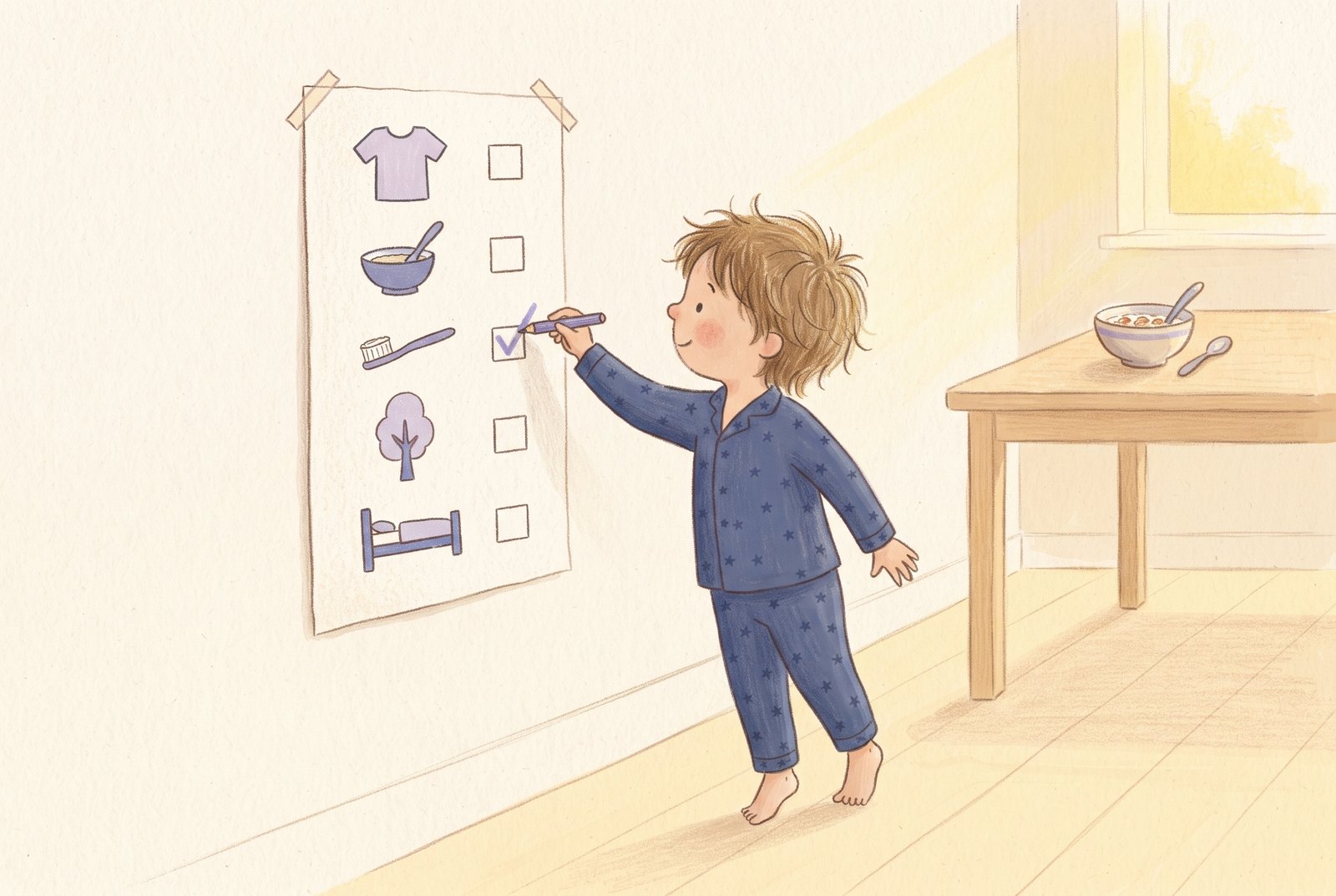
This free daily routine template is a simple picture chart for children aged 3 to 6. It has big blocks, a clear order and room to draw or stick your own pictures, so your child can check “what’s next?” for themselves instead of asking you every five minutes.
Below you’ll find the free A4 and US Letter downloads, why routine charts help young children, how to set one up, example routines for home and the classroom, tips for ADHD, autism, sensory differences and children learning English, what to do on rough days, a free printable “Today Is Different” card and twelve more free PDFs.
Most routine charts try to fit in too much. Twelve time slots, colour coded categories, an icon for every snack. Children under six glance at a chart like that for two seconds and walk away.
This daily routine chart is deliberately simpler. Big blocks, a clear order and space to add your own picture next to each step. The point isn’t the paper. It’s giving your child something they can check for themselves.
A quick look at the chart
- Why We Needed a Chart in Melbourne
- Why a Free Daily Routine Template Helps
- What to Put on Your Chart
- How to Set Up Your Free Daily Routine Template
- Example Routines for Home and Classroom
- Three Mini Routines for the Hardest Moments
- Routine Charts by Age
- Tips for ADHD, Autism and Sensory Differences
- Routine Charts for Children Learning English
- For Educators
- When the Routine Falls Apart
- What Tends to Backfire
- Free Printable: Today Is Different Card
- More Free PDFs
- FAQs
Why We Needed a Routine Chart in Melbourne
We moved from Indonesia to Melbourne in October 2010, when I started my PhD at Deakin. Bella was seven and Zara was nearly five. Zara hadn’t been to kinder here, and she started Prep in February 2011 still learning English.
Those years were full. Alongside the PhD I worked three casual jobs: VCE marking, cleaning and newspaper delivery. On paper run mornings I was out from 3am to 6am, then home to get two girls dressed, fed and off to school. Melbourne winters meant layers and more layers. Zara had a brand new Prep uniform to work out, and Bella’s mornings, with the ADHD we didn’t yet have a name for, could swing between drifting off mid task and getting completely stuck.
That is part of why a picture routine chart went up on Zara’s bedroom wall in those Melbourne years. She was new to Prep, new to the country and still learning English, and the chart was right there in her own room. It was one way of putting the order of the day somewhere other than in my voice.
No chart fixes every morning, and I’m not promising that. But a free daily routine template is most useful exactly when the adults are stretched thin. When you are tired, a chart keeps saying “next is shoes” so you don’t have to.
Why a Free Daily Routine Template Helps Children Aged 3 to 6
Young children feel calmer when they know what’s coming. A predictable day usually means fewer surprises, fewer battles over transitions and less need for an adult to keep giving instructions.
Routines Are Linked With Healthier, Calmer Children
A review of 50 years of research on family routines by Barbara Fiese and colleagues found that predictable routines were linked with children’s health and with better behaviour regulation, especially in the preschool years. Regular bedtime routines were linked with children falling asleep sooner.1 A later paper by Spagnola and Fiese describes routines as an everyday setting where young children practise language, self regulation and social skills.2
A Chart Does the Remembering
Working memory, the brain’s “sticky note”, is still developing in the early years. The Center on the Developing Child at Harvard describes working memory, flexible thinking and self control as skills that grow slowly through childhood with lots of adult support.3 A free daily routine template on the wall holds the list so your child’s sticky note doesn’t have to. Pictures do the remembering for them.
Visual Reminders Are Easy to Follow
Raising Children Network, the Australian parenting website, suggests illustrated posters of routine steps as a way to help children follow routines without constant reminders, along with specific praise when they do it themselves.4
Ticking It Off Builds Independence
When a child checks the chart, they are practising being in charge of their own day. “What’s next? Oh, shoes!” is a small moment of independence, and those moments add up.
A note on the evidence: research shows that predictable family routines are linked with good outcomes for children. Studies on picture routine charts in ordinary homes are fewer, so most of the “how to” in this guide comes from practice and family experience rather than trials.
What to Put on Your Free Daily Routine Template
The best routine chart is one your child can read at a glance. Five to seven big steps is plenty for most children aged 3 to 6. Here are picture ideas that are easy to draw or find.
| Step | Simple picture idea | Word underneath |
|---|---|---|
| Wake up and get dressed | A T shirt and shorts, or a jumper in winter | Dress |
| Breakfast | A bowl and spoon | Eat |
| Teeth | A toothbrush | Teeth |
| Shoes and bag | A pair of shoes beside a backpack | Shoes |
| Kinder, school or childcare | A small building or a photo of the gate | Kinder |
| Play | Blocks, a ball or a favourite toy | Play |
| Lunch or dinner | A plate | Lunch |
| Quiet time | A book or a cushion | Rest |
| Bath | A bath tub with bubbles | Bath |
| Story and bed | A moon or a bed | Bed |
Photos of your own child doing each step are often the clearest pictures of all. Our visual routine cards for ADHD kids break the morning into even smaller picture steps if you need more detail than a whole day chart gives.
How to Set Up Your Free Daily Routine Template
Setting up a free daily routine template takes about twenty minutes. These six steps make it far more likely your child will actually use it.
Pick Five to Seven Big Steps
Wake up, breakfast, play, lunch, quiet time, bath, bed. If you have more than seven, combine some. “Teeth, toilet and wash” can be one step called “bathroom”.
Add a Picture to Every Step
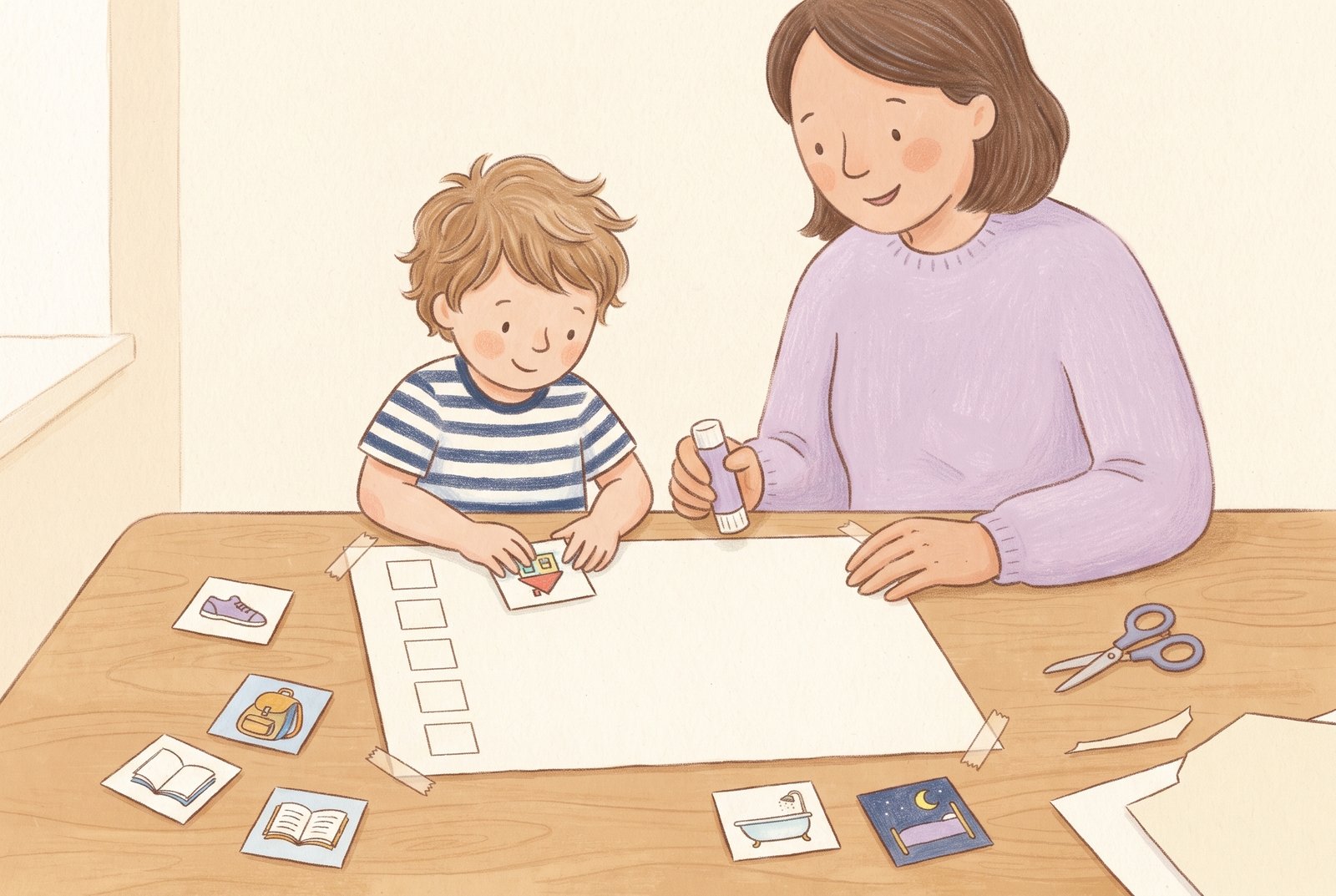
Draw a simple icon, glue in a picture, or use a photo of your child. Children who aren’t reading yet learn the order from pictures long before words. Put a short word underneath for early print awareness, as we talk about in emergent literacy in preschoolers.
Put It at Your Child’s Eye Level
On the fridge, the back of a door or beside their bed, wherever they will naturally pass it. Kneel down and check. A chart that sits at adult height is a chart for adults.
Let Your Child Mark It Off
A tick, a sticker, a magnet or a peg that moves down the chart. Doing it themselves is what turns a poster into a habit.
Go Through It Together at First
For the first week or two, look at the chart together each morning.
Then start asking instead of telling: “Can you check what’s next?”
Laminate or Reprint
Laminate it and use a whiteboard marker if you use it daily, or print a fresh copy each Monday. Clear contact from the supermarket works too.
Example Routines From a Free Daily Routine Template: Home and Classroom
Every family and every room is different, so treat these as starting points. Use the blank page of the free daily routine template to write your own.
| Home: kinder or childcare day | Home: at home day | Classroom or early learning room |
|---|---|---|
| Wake up and get dressed | Wake up and breakfast | Arrive and hang up bag |
| Breakfast | Play outside | Free play |
| Shoes and bag | Morning tea | Group time |
| Kinder or childcare | Play inside | Morning tea |
| Home and snack | Lunch | Outdoor play |
| Bath and dinner | Quiet time | Lunch and rest |
| Story and bed | Dinner, bath, story and bed | Pack up and home time |
For building routines around how a child is feeling, not just the clock, see our guide to a daily routine for neurodivergent children. Educators planning the week might also like the free weekly lesson plan template.
Three Mini Routines for the Hardest Moments
Most families don’t struggle with the whole day. They struggle with two or three tricky stretches. You can use your free daily routine template as a whole day chart and still make a small “mini chart” for these moments.
Getting Out the Door
- Toilet
- Shoes
- Jumper or jacket
- Bag
- Car or footpath
Lay clothes out the night before. If dressing is the hardest part, our guide to buttoning, zipping and self dressing skills has a step by step getting dressed chart.
After Kinder or School
- Bag on the hook
- Snack and drink
- Quiet play or outside
- Then talk about the day
Many children come home with nothing left in the tank. Food and quiet first, questions later. A calm corner can help.
Bedtime
- Bath
- Pyjamas
- Teeth
- Two books
- Lights out
Keep the order the same every night. Fiese’s review linked regular bedtime routines with children falling asleep sooner.1 If bedtime is a battle, read toddler sleep resistance and ADHD.
Using a Free Daily Routine Template at Each Age
| Age | What usually works | What the adult does |
|---|---|---|
| Around 3 | Three to five steps, photos or very simple pictures, one step at a time | Walks to the chart with the child and points to each step |
| Around 4 | Five or six steps, moving a peg or sticker | Asks “what’s next?” and waits |
| Around 5 | Six or seven steps, ticking off, starting to read a word or two | Lets the child lead and steps in only when stuck |
| Around 6 | Whole day chart plus a mini chart for mornings, helping design their own | Hands over the pen and lets them redraw it |
These ages are rough. Some four year olds run their whole morning from the chart, and some six year olds still need an adult to walk them through it. Both are fine. Our post on spiky profiles explains why skills can be uneven.
Free Daily Routine Template Tips for ADHD, Autism and Sensory Differences
For many neurodivergent children, a picture routine chart is one of the most useful supports at home. Research on visual activity schedules for autistic children is fairly strong: a review by Knight, Sartini and Spriggs found visual schedules met the criteria for an evidence based practice for autistic individuals.5 For ADHD the research on charts themselves is thinner, but many families find pictures easier than spoken reminders.
Fewer steps
Start with three or four if seven feels like too much. Add steps once the first few are easy.
Show first, then
For tricky moments, a smaller card helps: first shoes, then car. The free first then regulation reset mats work well alongside the chart.
Warn before changes
Point to the chart a few minutes before a transition, not just at the moment it happens.
Build in movement
A short movement break between steps can make the next one easier. See sensory micro transitions and the pocket heavy work cards.
Mark changes clearly
If the day will be different, change the chart together beforehand. The free Today Is Different card is made for this.
Help with starting
If a child knows the next step but can’t get going, try starting the task together. It’s common, as we explain in when your ADHD child won’t start tasks.
A routine chart works best when your child’s body is calm enough to use it. If the morning is falling apart in a meltdown, the chart can wait. Regulation before learning and co regulation strategies come first.
And if you have ADHD yourself, as I do (I was diagnosed in my forties), a chart helps the grown up too. The order of the day lives on the wall instead of in your head. You might like a parent with ADHD and ADHD and forgetfulness.
A Free Daily Routine Template for Children Learning English
When Zara started Prep in Melbourne, she was still learning English, and her routine chart hung in her bedroom. For any child in that position, pictures say what words can’t yet. A free daily routine template with a picture and one English word under each step gives a child the same daily words again and again: shoes, bag, lunch, bath, bed.
- Say each step in your home language and in English as you point.
- Add the home language word under the English one if that helps your family.
- Let your child teach you the English words they’ve learnt at kinder or school.
Daily routines are one of the richest places to learn a new language. Read more in learning English through daily routines and supporting a child learning English as a second language.
Using a Free Daily Routine Template in Early Learning Rooms
Many early learning rooms already use a picture timetable. A few small changes make it work better for every child:
- Hang it at child height, not on the staff noticeboard.
- Use real photos of your room: the mat, the sandpit, the lunch table.
- Move a marker as the day goes, and invite a child to be the “chart helper”.
- Show changes in advance, like an incursion or a fire drill, with a “different today” card.
- Give children who need it a small personal chart on a lanyard or table card.
- Point to the chart at group time, especially before transitions like circle time.
Sending a copy of the room’s routine chart home helps families talk about the day. The Home and Kinder Snapshot is a simple way to share what each child’s day looks like in both places.
When the Routine Falls Apart
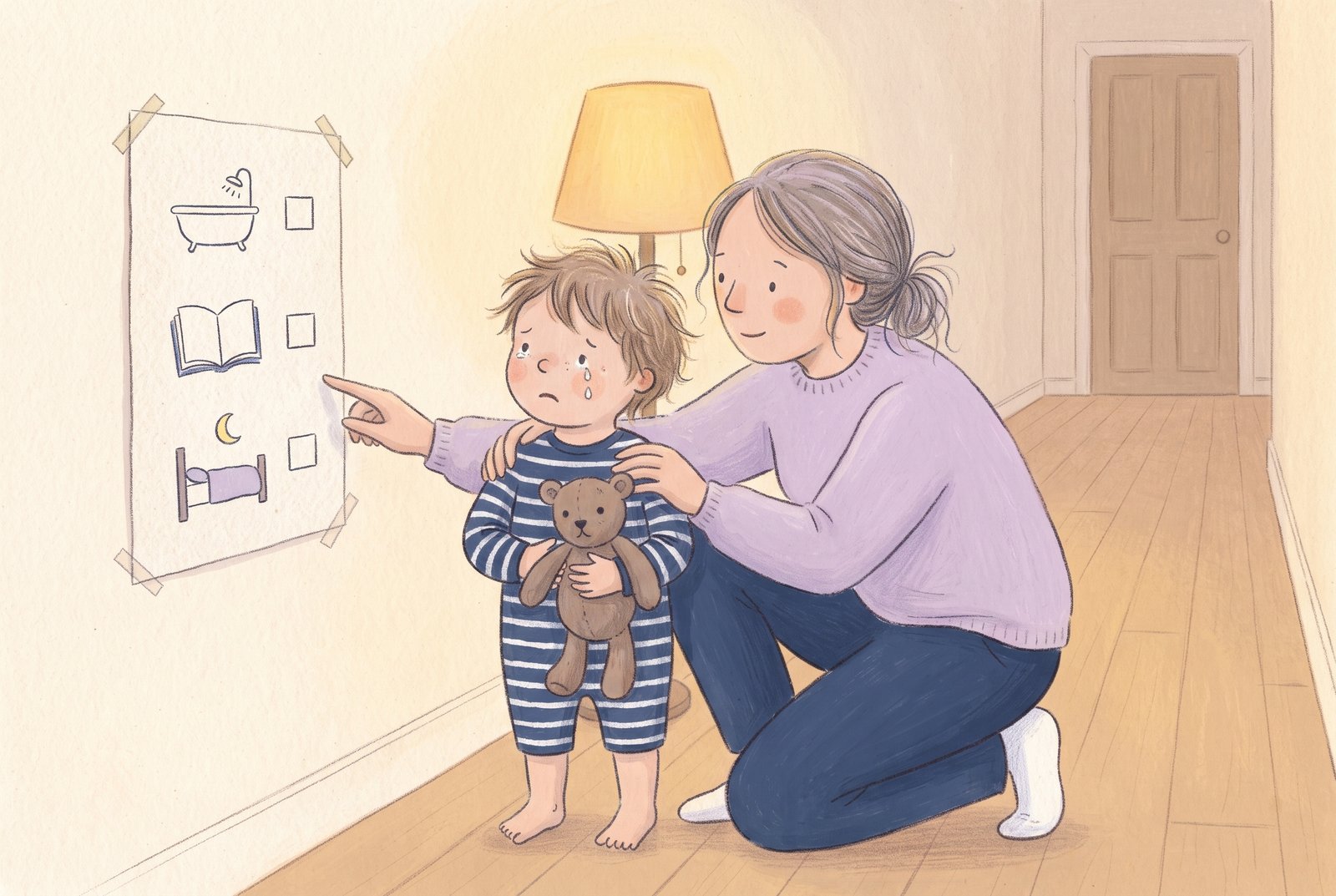
It’s worth saying plainly: routines fall apart sometimes, and that’s fine. A chart doesn’t fix a rough day. It just makes good days a bit smoother and gives you something calm to point back to on tricky ones. Being mostly consistent does more than any amount of laminating.
- Skip steps on sick days and holidays. The chart is a guide, not a rule book.
- Go back to the chart the next morning, without a lecture about yesterday.
- If your child can follow it some days but not others, that’s very common. Read why your child can do it some days and not others.
- If you are the one running out of steam, look after yourself too. Parent and teacher burnout is real.
What Tends to Backfire With a Routine Chart
- Too many steps. If it doesn’t fit on one page in big pictures, it’s too long.
- Using the chart as a test or a punishment (“you didn’t do your chart, so no park”).
- Adding times like 7:15 for children who can’t read a clock yet.
- Changing the order every week, so the chart never becomes familiar.
- Putting it up and never pointing to it again.
- Reward charts stuck onto the routine chart, so every step becomes a negotiation.
Free Printable: “Today Is Different” Card for Your Free Daily Routine Template
Use this card when the day changes: a doctor visit, a relief teacher, a birthday, a holiday. Draw the usual steps on one side and today’s steps on the other, then talk it through together.
Download the Free PDFToday Is Different
Usually we do this. Today we do this. It’s okay. We’ll go back tomorrow.
How to Use the Today Is Different Card
- Print the card and keep a few copies near your routine chart.
- The night before a change, draw or stick the usual three steps in the “Usually” box.
- In the “Today” box, draw what will happen instead, like a doctor visit, a birthday or a relief teacher.
- Fill in what’s different and one thing that will stay the same. That one familiar thing helps a lot.
- Talk it through together in the morning, then point to it again just before the change happens.
More Free PDFs to Use With Your Free Daily Routine Template
These free PDFs from this site work well alongside a routine chart at home or in the room.
Daily Routine Chart (A4)
The full chart, blank chart and picture cards.
Download A4 PDF For families and roomsDaily Routine Chart (US Letter)
The same chart sized for US Letter paper.
Download PDF For families and rooms8 Card Routine Sheet
Smaller picture cards for a morning or bedtime mini chart.
Download PDF For familiesFirst Then Reset Mats
“First shoes, then car.” Small steps for tricky moments.
Download PDF For home and roomsPocket Heavy Work Cards
Quick movement breaks between routine steps.
Download PDF For home and roomsCalm Shapes Breathing Cards
A calm moment before bed or after kinder.
Download A4 PDF For home and roomsCalm Counting Worksheets
Gentle quiet time counting, 1 to 10.
Download A4 PDF For home and rooms“All About Me” Storybook
Add “my day” pages with photos of each routine step.
Download A4 PDF For familiesHome and Kinder Snapshot
Share routines between home and the room.
Download PDF For parents and educatorsWeekly Lesson Plan Pack
Plan the room’s week around a steady routine.
Download A4 PDF For educatorsWeekly Battery Check In
Notice which days need a simpler routine.
Download PDF For parents and educatorsToday Is Different Card
Show what’s usual and what’s changing today.
Download PDF For families and roomsMore free tools are on our printables page.
Looking Back
Those Melbourne mornings, between a 3am paper run and the school gate, taught me that the best routine is the one a tired adult can actually keep. A free daily routine template won’t make you a calmer parent overnight. But it can quietly hold the order of the day, so you and your child can spend a little less energy on “what’s next?” and a little more on each other.
- Morning pictures: visual routine cards for ADHD kids
- Feelings first: daily routine for neurodivergent children
- Small changes: sensory micro transitions
- Behaviour support: ADHD behaviour strategies
- Real jobs: practical life activities at home
- Playing alone: how to encourage independent play
- The bigger picture: child development
- About me: how this began
Free Daily Routine Template FAQs
What should be on a free daily routine template for kids?
Five to seven big steps in the order they happen, each with a simple picture: for example, get dressed, breakfast, play, lunch, quiet time, bath and bed. Fewer, clearer steps work better than a long list.
At what age can a child use a routine chart?
Many children can start using a simple picture routine chart from around age 3, with an adult going through it with them. By 4 to 6, many can check it and tick off steps more independently.
Do routine charts help children with ADHD?
Many families find them helpful, because a picture chart shows what comes next without the child having to remember a spoken instruction. Keep steps few, use pictures, and expect some days to be harder than others.
Should I use pictures or words on a routine chart?
For children aged 3 to 6, pictures work best, with a word underneath. Photos of your own child doing each step can be especially clear.
What if my child ignores the routine chart?
Go through it together for a while, let your child tick or move a marker themselves, cut the number of steps, and check the chart is at their eye level. Point back to it calmly rather than using it as a test.
Research and guidance: Fiese and colleagues, and Spagnola and Fiese, on family routines; the Center on the Developing Child at Harvard on executive function; Raising Children Network on routines; Knight, Sartini and Spriggs on visual schedules for autistic individuals.
Experience: our move to Melbourne, my three casual jobs during the PhD, Zara starting Prep while learning English, Bella’s mornings and Zara’s routine chart on her bedroom wall are from our family’s Melbourne years. The setup steps, mini routines, age table and tips come from family life and my work in early childhood education, not from a single study.
This is educational content, not medical or psychological advice. Last reviewed: 9 November 2026.
References
- Fiese, B. H., Tomcho, T. J., Douglas, M., Josephs, K., Poltrock, S., & Baker, T. (2002). A review of 50 years of research on naturally occurring family routines and rituals: Cause for celebration? Journal of Family Psychology, 16(4), 381-390. https://doi.org/10.1037/0893-3200.16.4.381
- Spagnola, M., & Fiese, B. H. (2007). Family routines and rituals: A context for development in the lives of young children. Infants and Young Children, 20(4), 284-299. https://doi.org/10.1097/01.IYC.0000290352.32170.5a
- National Scientific Council on the Developing Child. (2011). Building the brain’s “air traffic control” system: How early experiences shape the development of executive function (Working Paper No. 11). Center on the Developing Child at Harvard University. https://developingchild.harvard.edu/resources/building-the-brains-air-traffic-control-system/
- Raising Children Network. (n.d.). Routines: Why they work as a positive behaviour strategy. https://raisingchildren.net.au/preschoolers/behaviour/behaviour-management-tips-tools/routines
- Knight, V., Sartini, E., & Spriggs, A. D. (2015). Evaluating visual activity schedules as evidence based practice for individuals with autism spectrum disorders. Journal of Autism and Developmental Disorders, 45(1), 157-178.