
Coregulation Strategies in Early Childhood: 4 Simple Steps for Calmer Days
Co-regulation is the way a calm, caring adult helps a child settle when big feelings take over. Through a warm relationship, a predictable space and gentle coaching, we lend children our calm until, bit by bit, they learn to find it for themselves.[1]
The best coregulation strategies in early childhood aren’t clever words or reward charts. They’re mostly about what our own bodies are doing: how close we sit, how we breathe, how fast we talk, and whether we can stay steady while a little person falls apart.
- Why Co-regulation Comes Before Self-Regulation
- How Our Bodies Talk to Each Other
- Why Children Need Us Close When Things Go Wrong
- What to Expect at Each Age
- Coregulation Strategies Before the Storm
- 4 Simple Coregulation Strategies for the Big Moment
- What to Say: Short Co-regulation Scripts
- Coregulation Strategies After the Storm
- Coregulation in the Classroom vs at Home
- Co-regulating Without Running on Empty
- Coregulation Strategies for Neurodivergent Children
- Coregulation Strategies Through Play
- A Week of Coregulation Practice
- How Co-regulation Builds Self-Regulation Over Time
- Free Coregulation Printables
- Coregulation Strategies FAQs
- Related Guides
- References
Why Coregulation Strategies in Early Childhood Come Before Self-Regulation
We often expect young children to “calm down” on their own. But self-regulation isn’t something that switches on at a certain birthday. It grows slowly, through thousands of small moments where an adult helped a child come back from a big feeling. Researchers who study this describe co-regulation as three kinds of support working together: a warm relationship, a calm and predictable environment, and gentle teaching of skills in the moment.[1]
Harvard’s Center on the Developing Child talks about this as “serve and return”. A child reaches out with a look, a sound or a meltdown, and an adult responds. Over and over, those back and forth moments help build the foundations children later use to manage their feelings, attention and behaviour.[2] When a child is truly overwhelmed, that connection matters far more than any lesson we were trying to teach.
Australia’s Early Years Learning Framework says the same thing in its own words. Secure, respectful and reciprocal relationships are one of its core principles, and it’s very clear that children learn best when they feel safe and connected.[3] When we see a meltdown as a child asking for help rather than being naughty, it changes how we show up.
This is personal for me. As an educator, and as a mum who only understood my own ADHD after a late diagnosis in my forties, I know how easy it is to demand compliance when your own tank is empty. Any approach to regulation has to think about the adult’s nervous system as carefully as the child’s. I’ve written more about that side of things in being a parent with ADHD.
How Our Bodies Talk to Each Other
Children are incredibly good at reading us. Long before they understand our words, they pick up on our faces, our tone of voice and the tension in our bodies. If we come towards an upset child with tight shoulders, a sharp voice and fast movements, our words can say “please calm down, sweetheart” while everything else says “something is wrong”.
There’s lovely research showing just how connected we are. In one study, mothers and their three month old babies had heart rhythms that lined up with each other during moments of face to face play, especially when they were sharing smiles and sounds.[4] That’s with babies, not preschoolers, but it gives a sense of how much a child’s body is tuned in to ours.
You’ll often hear this explained through polyvagal theory and the idea of “neuroception”, our body’s quiet, automatic sense of whether we’re safe.[5] Many educators and parents find it a helpful way to think about meltdowns, and I’ve written about it in polyvagal theory and early childhood meltdowns. It’s worth knowing, though, that a number of scientists question parts of the theory’s biology.[6] I find the everyday message useful, that children settle more easily when they feel safe with us, without needing to treat every detail as settled science.
Some people worry that co-regulation means giving up on structure. It’s actually the opposite. A steady adult is what makes structure possible. Without that sense of safety, many children spend their day braced for the next hard thing, and very little learning can happen. That’s the heart of regulation before learning.
Why Children Need Us Close When Things Go Wrong
Humans are social creatures. For most of our history, being close to our people meant being safe, so it makes sense that young children look to a trusted adult when they’re overwhelmed.
When a child is flooded by noise, a sudden change or a fight with a friend, calling out instructions from across the room rarely helps. Neither does sending them off to sit alone, which can feel like being pushed away right when they need us most. A calm corner works best when it’s a place a child goes to with us, or chooses for themselves, rather than a place they’re sent.
Moving closer, softening our face and slowing our own breathing all send the same simple message: You’re safe. I’m here. You don’t have to sort this out on your own. As I explain in my overview of regulation and behaviour in early childhood, seeing things this way stops us reading every meltdown as defiance.
When our family moved to Melbourne, my eldest was seven and new to primary school, her little sister was nearly five and waiting to start Prep, and I didn’t yet understand the ADHD in our family. Looking back, every time we chose to stay close instead of punishing, we were giving them exactly this kind of safety, even if I couldn’t have explained it then.
Coregulation by Age: What to Expect
Knowing how regulation develops helps us keep our expectations kind and realistic. The parts of the brain that help us pause, plan and put on the brakes keep developing right through childhood and into early adulthood. So a preschooler’s big feelings often arrive much faster than their ability to manage them. A lot of parents like the picture of a strong engine with brakes that are still being built.
| Age | What it often looks like | What helps most |
|---|---|---|
| Babies | Almost all calming comes from the adult: holding, rocking, feeding, soothing voices. | Responding warmly and quickly. You can’t spoil a baby with comfort. |
| Toddlers (1 to 3) | Huge feelings, few words, lots of frustration. Hitting, biting or hair pulling can happen when words won’t come. | Staying close, naming feelings simply, keeping them safe, and routines they can predict. |
| Preschoolers (3 to 5) | Starting to use simple strategies with help, like squeezing a toy or taking a breath, but still swamped easily when tired or overwhelmed. | Practising calming tools when calm, then using them together in the hard moment. |
| Early school years | More able to wait, talk about feelings and use strategies, but transitions and long days can still tip them over. | Co-regulation still, plus talking things through once everyone’s calm again. |
Expecting a young child to sit quietly when frustrated or use calm words in the middle of a big disappointment asks a lot of a brain that’s still growing. That’s where we come in. In those moments, we’re the brakes. If your toddler’s feelings come out through their hands, my posts on toddler hair pulling and frustration and toddler sleep resistance look at two common flashpoints. And if your child can manage one day and not the next, why your child can do it some days and not others explains why that’s so normal.
With lots of repetition, children slowly take in what we do for them and start doing more of it themselves. Harsh punishment can’t speed that up. More often it just adds fear, which makes the next big feeling harder to manage.
Coregulation Strategies Before the Storm: Everyday Connection
Most of the work of co-regulation happens on ordinary days, long before anyone melts down. When a child already feels connected and knows what’s coming next, the hard moments tend to be smaller, shorter and easier to come back from. Think of it as filling the tank so there’s something to draw on later.
Make the Day Predictable
Surprises use up a lot of a young child’s energy. A simple picture routine, the same goodbye ritual each morning, and a warning before every transition all lower the load. “Two more slides, then we’re going inside” gives a child time to get ready in their body, not just their ears. Our visual routine cards and daily routine chart make this easy to set up at home or in a room.
Give Small Doses of Undivided Attention
Ten minutes a day where the child leads the play and you follow, with no phone, no teaching and no correcting, can do a lot for connection. Children who feel seen on calm days often reach for us more readily on hard ones. In an early learning room, even two minutes of one to one play with a child who finds the day hard can make a difference to how they experience you.
Practise Calming Tools When Everyone Is Calm
Nobody learns a new skill in the middle of a fire. Breathing, squeezing, counting and rocking are much easier to use in a big moment if they’ve been played with on easy days. Make them games, not lessons. Blow feathers across the table, trace shapes while breathing slowly with the Calm Shapes Breathing Cards, or count slowly together with the Calm Counting 1 to 10 pages.
Learn a Child’s Early Warning Signs
Most children show small signs before a big feeling arrives: louder voices, faster movement, going quiet, chewing sleeves, drifting to the edge of the room. If you can spot these early, a little co-regulation, like moving closer or offering a movement break, often works far better than a lot of it later. Jotting down what you notice for a week or two with the What I’m Noticing Diary can show patterns you’d never spot in the rush of the day.
4 Simple Coregulation Strategies for the Big Moment
When a room tips into chaos, talking and reasoning usually stop working. These four coregulation strategies are mostly about what you do with your body, which is why they still work when words don’t.
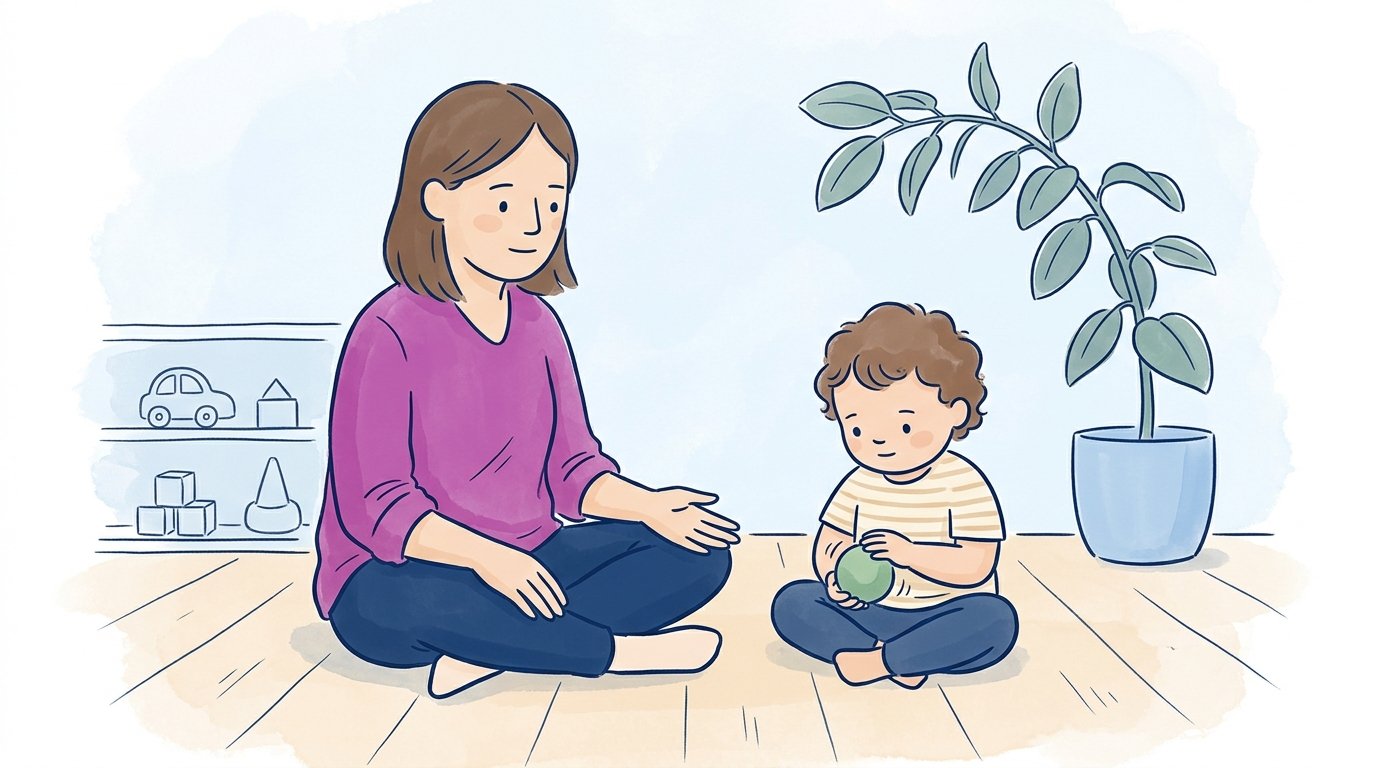
1. Come Down to Their Level and Sit Alongside
Towering over an upset child, even with the kindest intentions, can feel intimidating to them. Getting lower and a little to the side usually feels much less confronting.
- Get down low: Kneel or sit so you’re at or a little below their eye level.
- Sit a bit side on: Rather than facing them square on, angle your body slightly so you’re beside them, looking out at the room together. It feels more like “we’re in this together” than “you’re in trouble”.
- Relaxed hands: Keep your hands open and resting loosely, so your body looks as calm as you’re trying to feel.
2. Lower and Slow Your Voice, Then Use Fewer Words
When we’re stressed, our voices naturally get higher, faster and sharper. A slower, warmer voice tends to feel much safer to an overwhelmed child.
- Warm, not flat: Let your voice drop a little lower and softer, with the gentle, sing-song warmth you might use with a baby, rather than a flat monotone.
- Slow right down: Speak more slowly than usual and leave space between your words.
- Let quiet do some work: Say one short, calm phrase, then pause. Give their body time to take it in before you add anything else. Silence that feels warm is often more settling than more talking.
3. Slow Your Own Breathing Where They Can See and Hear It
Children often follow our lead without being told. Slowing your own breathing calms you first, and many children start to settle alongside a calm adult.[4]
- Try a long sigh: Take a breath in through your nose, add a little top up sniff, then let out a long, slow breath through your mouth. In a study with adults, five minutes a day of this kind of sighing breath lifted mood more than the same time spent on mindfulness meditation.[7]
- Model rather than instruct: Try not to say “take a deep breath” in the middle of a meltdown. To many children it feels like one more demand. Just breathe slowly yourself and let them notice.
- Practise when calm: Breathing games like blowing bubbles or pretending to blow out birthday candles are easier to use in a hard moment if you’ve played them on good days.
4. Offer Something Soothing Without Forcing It
When children are overwhelmed, something to squeeze, hold or move can help them feel more grounded in their bodies, without needing any words.
- Offer, don’t push: Place a soft toy, a squishy ball, a cushion or a cold water bottle near the child, not in their hands. Let them choose.
- Move alongside them: Roll a soft ball slowly back and forth between your own hands, or squeeze a cushion yourself. A steady, gentle rhythm gives them something calm to watch and join if they want to.
- Heavy work helps some children: Pushing, pulling and carrying can be very settling for children who seek lots of movement. My pocket heavy work cards and first then regulation reset mats have ideas, and sensory seeking and proprioception explains why.
Many educators find that when they put these four steps together, the whole room starts to feel calmer. It doesn’t always happen straight away, and some days nothing seems to work, but over time the space starts to feel safer for everyone.
What to Say: Short Co-regulation Scripts
When a child is really overwhelmed, language gets hard. Most of us have felt that ourselves: when we’re very upset, the words just won’t come. There’s a well-known brain imaging study of adults with PTSD where activity in Broca’s area, a key speech region, dropped while they relived a traumatic memory.[8] We can’t map that straight onto a preschooler having a meltdown, but it fits what we see every day. Long explanations, “why” questions and big choices are too much in the moment.
So keep it short. A few calm, predictable words are plenty:
“Hands down. Floor is safe.”
“I’m right here with you.”
“No big jobs right now.”
“Sit here together.”
“You don’t need to talk.”
“We can sit quietly.”
For a step by step guide to the meltdown itself, see my child meltdown co-regulation post. If you want to understand those three reactions better, fight, flight and freeze in children explains what’s going on.
| What We Often Say | Why It Can Backfire | What to Try Instead |
|---|---|---|
| “Use your words, why did you do that?” | Asks a flooded child to explain and reflect, which is very hard in the middle of a big feeling. | “Your body feels big. I’m right here.” |
| “If you don’t pack away now, you lose playground time.” | A threat adds pressure and worry, and often makes the meltdown bigger. | “We can put the red blocks in together.” |
| “Look at me when I’m talking to you!” | Eye contact can feel intense or uncomfortable for an upset child, and for many autistic children at any time. | “I’m looking at the carpet with you.” |
Coregulation Strategies After the Storm: Repair and Reconnect
What happens after a meltdown matters as much as what happens during it. Once a child’s body has settled, they often feel tired, embarrassed or worried about whether you still like them. This is the moment to reconnect, not to lecture.
- Reconnect first: A cuddle, a drink of water, sitting together quietly. Let their body know the storm is over and you’re still there.
- Talk later, and keep it short: When everyone is properly calm, maybe hours later, a few simple words help. “That was a big feeling. Your body got really upset when the tower fell. Next time, we could try squeezing the cushion together.”
- Make things right gently: If something broke or someone was hurt, help the child repair it with you, like rebuilding the tower together or getting an ice pack for a friend. That’s more meaningful to a young child than a forced “sorry”.
- Use stories: Children often understand their feelings best at a distance. Making a little book together on a calm day, like our “Big Feelings” storybook, gives them words and pictures to come back to.
When the Adult Loses It Too
Every parent and every educator snaps sometimes. It doesn’t undo all the good. What matters is coming back. Get down to their level and say something simple and honest: “I shouted, and that was scary. I’m sorry. I was feeling really frazzled, and it wasn’t your fault.” Repair like this teaches children that relationships can bend without breaking, which is one of the most useful things they can learn.
Coregulation Strategies in the Classroom vs at Home
Co-regulation looks a bit different in a busy early learning room than it does in a noisy family lounge room. Here’s how the same ideas play out in each place.
| What Matters | In an Early Learning Room | At Home |
|---|---|---|
| Calming the space | Quietly move the rest of the group to another play area or outside to give the child some privacy and room. | Turn off the TV, music or noisy appliances so there’s less going on. |
| Other children | Agree on simple signals with co-educators: one stays close to the upset child while another looks after the group, always keeping ratios and supervision covered. | Settle siblings somewhere nearby with something easy, like an audiobook or a sensory bin. |
| Time pressure | Flexible routines mean an educator can sit with a child for a while when there’s enough staff to cover the room. | Leaving the house is often the hardest part. Drop anything that isn’t essential, like putting shoes on in the car. |
| Your own reserves | Educators can swap out with a colleague when their own patience is wearing thin. | Parents often have no backup. Be kind to yourself and cut every demand that isn’t about safety. |
Neither setting is easier, just different, and it helps to stop holding ourselves to impossible standards in either. For educators, setting up the room so fewer children tip over in the first place makes a big difference. My posts on classroom noise and sensory overload, fluorescent lighting and ADHD and sensory micro transitions are good places to start. Predictable days help too, and visual routine cards and a daily routine for neurodivergent children take a lot of the surprise out of transitions.
And when educators and families share what’s working, children get the same calm message in both places. Connecting with parents without endless meetings has some simple ways to do that.
Coregulation Without Running on Empty: Looking After the Adult
We can’t talk about coregulation strategies without talking about the adult. Staying calm while a child screams, hits or shuts down takes a lot out of you.
Burnout doesn’t happen because parents or educators don’t care. It happens when we try to co-regulate from an empty battery. If you’re carrying chronic stress, your own sensory sensitivities or your own neurodivergence, staying steady can feel like swimming upstream. I know that feeling well, and I write about it in parent and teacher burnout in neurodivergent care and alexithymia in ADHD mothers, for anyone who finds it hard to even notice their own feelings rising.
Protecting Your Own Battery
- A 10 second check: Before you step towards an upset child, press both feet into the floor, unclench your jaw and let your shoulders drop. Steady yourself first.
- Lower the bar to safety: When you’re running on empty, let everything else go. Tidying, manners and learning can wait. Right now, the only goal is getting everyone safe and calm again.
- Tag team: In early learning settings, agree as a team that anyone can tap a colleague on the shoulder and say “I’m swapping with you”, with no shame and no explanation needed.
- Notice your own battery: The Weekly Battery Check-In takes one line a day, and the Small Refills Menu gives you quick ways to top up, written down before you need them.
Capacity swings from day to day for adults too. If your own ADHD makes the afternoons harder, ADHD work environments looks at why the setting around us matters so much.
And setting up a calmer space in the first place stops a lot of overload before it starts. You’ll find practical layouts in the sensory environment in early childhood.
Coregulation Strategies for Neurodivergent Children
The basics of co-regulation work for every child, but some children need us to adjust how we offer it. Children with ADHD, autistic children and children with sensory differences often experience the world more intensely, and what calms one child can overwhelm another.
Think Sensory First
Before working on the feeling, check the environment. Is the room loud, bright, crowded or smelly? Sometimes the most effective co-regulation is simply moving somewhere quieter, turning off a light or lowering your voice even further. A child who is overwhelmed by input can’t take in more input, even kind words.
Go Easy on Eye Contact and Touch
Many autistic children find eye contact uncomfortable or tiring, and plenty of neurodivergent children dislike unexpected touch, especially when upset. Sitting side by side, looking at the same thing, and asking before touching (“Would a squeeze help, or would you like space?”) respects how their body works. Some children love a firm hug, others need you a metre away. Both are fine.
Let Bodies Move
Many children with ADHD regulate through movement. Asking them to sit still to calm down can make things harder. A walk together, carrying something heavy, jumping on the spot or rocking may settle them faster. Our Pocket Heavy Work Cards have simple ideas you can use anywhere, and sensory seeking and proprioception explains why movement helps.
Give More Time
Many neurodivergent children need longer to process words, especially when stressed. Say one short thing, then wait, and wait some more. Repeating yourself quickly, or rephrasing again and again, can feel like a flood. If your child can manage beautifully some days and not others, spiky profiles in neurodivergent kids explains why that’s so common. And if you’re wondering about ADHD in a quiet, people pleasing little girl, signs of ADHD in girls is worth a read.
Coregulation Strategies Through Play
Play is where so much co-regulation quietly happens. When children play with a warm adult, they practise speeding up and slowing down, getting excited and settling again, all inside a safe relationship. These games build regulation without anyone calling it that.
- Fast and slow games: March fast, then in slow motion. Drum loudly, then softly. Freeze like statues, then melt. Children practise moving between high and low energy with you as their guide.
- Rhythm and song: Rocking songs, clapping rhymes and slow lullabies help bodies find a shared rhythm. With babies, gentle rocking and singing are co-regulation in its simplest form.
- Squeezing play together: Rolling and squashing playdough side by side, or pushing against each other’s hands, offers calming pressure and connection at once.
- Animal moves: Bear crawls, frog jumps and slow tortoise walks give energy somewhere to go and then help it settle. Try the ideas in animal walks for gross motor play.
- Following their lead: Joining a child’s play on their terms, the heart of DIR Floortime at home, builds the trust that co-regulation rests on.
A Week of Coregulation Practice
If you’d like a simple place to start, try one short practice a day for a week, at a calm time. Five minutes is enough. The point is to make calming tools feel familiar and fun, so they’re easier to reach for later.
| Day | Five Minute Practice | Works for |
|---|---|---|
| Monday | Blow bubbles or feathers slowly, and notice how your tummy moves. | Home and rooms |
| Tuesday | Trace a breathing shape card together, in slowly, out slowly. | Home and rooms |
| Wednesday | Fast and slow game: run on the spot, then move in slow motion. | Home and rooms |
| Thursday | Heavy work: push the wall, carry books, or wheelbarrow walks. | Home and rooms |
| Friday | Make one page of a feelings book together. | Home and rooms |
Educators can slot these into group time or transitions and record them in the Weekly Lesson Plan Template Pack. If you’re keen to keep home and the room on the same page, the Home and Kinder Snapshot is a quick way to share what’s working.
How Coregulation Strategies Build Self-Regulation Over Time
When adults keep coming back to these coregulation strategies, early childhood rooms and homes slowly change. Less policing, more connection. Over months and years, children learn something really important from all those moments of being helped back to calm.
They learn that big feelings are survivable. They learn that the adults around them are reliable and won’t punish them for struggling. And bit by bit, they start to take on the rhythm of calming down themselves, which carries them into primary school and beyond.
Co-regulation even helps with learning. Reading together is a lovely example, and I explain how in co-regulation and reading with neurodivergent children and emotional regulation in literacy. For relationship based play that builds this connection, DIR Floortime at home is worth a look.
Being consistent doesn’t mean being perfect. It means coming back to connection after every storm, repairing things when they go wrong, and showing your child that however hard the day was, safety always comes back.
Free Coregulation Printables for Parents and Educators
These free PDFs from this site support co-regulation before, during and after the hard moments, and a few are just for the grown ups. Choose one or two that fit your child or your room, and practise with them on calm days first.
Calm Shapes Breathing Cards
Trace a shape and breathe slowly together. Practise on good days.
Download A4 PDF For home and roomsCalm Counting 1 to 10
Slow, low demand counting pages for winding down side by side.
Download A4 PDF For home and roomsPocket Heavy Work Cards
Movement breaks for bodies that need to move before they can settle.
Download PDF For home and roomsFirst Then Reset Mats
“First we calm down together, then we go back to play.” Clear and gentle.
Download PDF For home and roomsVisual Routine Cards
Show what’s coming next, so transitions feel less like surprises.
Download PDF For home and roomsDaily Routine Chart
A simple picture of the family day, with space for quiet time.
Download A4 PDF Best for families“Big Feelings” Storybook
Make a little book together on a calm day, then read it after a storm.
Download A4 PDF For home and roomsWhat I’m Noticing Diary
Track when hard moments happen and what helped, to spot early signs.
Download PDF For home and roomsHome and Kinder Snapshot
Share what’s working at home and in the room, so the child gets one calm message.
Download PDF For families and educatorsSensory Space Audit Checklist
Check noise, light and clutter so fewer children tip over to begin with.
Download PDF Best for educatorsWeekly Battery Check-In
One line a day to notice your own energy before it runs out.
Download PDF For parents and educatorsSmall Refills Menu
Quick ways to top yourself up, written down so you don’t have to think on a bad day.
Download PDF For parents and educatorsYou’ll find more free tools on our printables page. One tip: never make a printable a task a child has to finish before they’re allowed to rejoin the group. They’re there to help, not to test.
Coregulation Strategies FAQs
What is co-regulation in early childhood?
Co-regulation is the way a calm, caring adult helps a child settle when big feelings take over. Through a warm relationship, a predictable environment and gentle coaching, the adult lends the child their calm until the child slowly learns to do more of it on their own.
What is the difference between co-regulation and self-regulation?
Co-regulation happens with an adult’s help. Self-regulation is when a child can manage their feelings, attention and behaviour more independently. Self-regulation grows out of many, many experiences of co-regulation, and even older children and adults still lean on others when things get hard.
What are some simple co-regulation strategies for preschoolers?
Get down to the child’s level at a safe distance, slow down your voice and use very few words, breathe slowly yourself where they can hear and see it, and offer something soothing to hold or squeeze without forcing it. Calm yourself first, then stay close.
At what age can children self-regulate?
There’s no single age. Self-regulation develops gradually from infancy through childhood and well into the teenage years. Preschoolers can start using simple strategies like squeezing a toy or taking a breath, but they still need a lot of adult support, especially when tired, hungry or overwhelmed.
How can educators use co-regulation in a busy classroom?
Agree on simple signals with your co-educators so one person can stay close to the upset child while another looks after the group. Keep a calm corner set up before you need it, lower noise and light where you can, and give staff permission to swap out when their own patience is running low. If group time itself is often where things fall apart, my guide to when a child won’t sit for circle time looks at what to change in the activity.
Does co-regulation reward bad behaviour?
No. Helping a child calm down isn’t the same as giving in. You can stay warm and close while still holding a limit, like keeping everyone safe or not buying the lolly. Children learn far more about behaviour once they’re calm, so co-regulation usually comes first and the teaching comes later.
What if I lose my temper with my child?
Every parent and educator does sometimes. What matters most is repair. Once you’re both calm, get down to their level, name what happened, say sorry and let them know it wasn’t their fault. Repair shows children that relationships can survive hard moments.
Do coregulation strategies work for autistic children and children with ADHD?
The core ideas of safety, calm and connection help all children, but neurodivergent children may need adjustments. Think about the sensory environment first, go easy on eye contact and touch, let children move, and give extra time to process words. An occupational therapist or psychologist can help tailor strategies for your child.
Research and guidance: a US practice brief on co-regulation, Harvard’s Center on the Developing Child, the Early Years Learning Framework, a study of heart rhythms in mothers and babies, an adult breathing study and an adult brain imaging study. Contested: polyvagal theory, which is widely used but disputed. Experience: the four steps, the scripts, the play ideas, the practice week and the family story come from my own life and practice. This is educational content, not clinical advice. If you’re worried about your child’s emotions or behaviour, talk with your GP, a paediatrician or a psychologist. Last reviewed: 7 November 2026.
- The meltdown itself: child meltdown co-regulation
- Why sticker charts often fall flat: ADHD behaviour strategies
- Three stress reactions: fight, flight and freeze in children
- Why calm comes first: regulation before learning
- The theory and its critics: polyvagal theory and early childhood meltdowns
- A safe place to settle: calm corner design in early childhood
- Getting started on tasks: the ADHD start together task trick and when an ADHD child won’t start tasks
- The bigger picture: regulation and behaviour in early childhood
- All our free tools: printables page
References
- Rosanbalm, K. D., & Murray, D. W. (2017). Caregiver Co-regulation Across Development: A Practice Brief. OPRE Brief #2017-80. Office of Planning, Research, and Evaluation, US Department of Health and Human Services. Read the brief.
- Center on the Developing Child, Harvard University. Serve and Return and Executive Function & Self-Regulation. developingchild.harvard.edu.
- Australian Government Department of Education. (2022). Belonging, Being and Becoming: The Early Years Learning Framework for Australia (V2.0). Australian Government Department of Education for the Ministerial Council. Available via ACECQA.
- Feldman, R., Magori-Cohen, R., Galili, G., Singer, M., & Louzoun, Y. (2011). Mother and infant coordinate heart rhythms through episodes of interaction synchrony. Infant Behavior and Development, 34(4), 569-577. https://doi.org/10.1016/j.infbeh.2011.06.008
- Porges, S. W. (2017). The Pocket Guide to the Polyvagal Theory: The Transformative Power of Feeling Safe. W. W. Norton & Company.
- Grossman, P. (2023). Fundamental challenges and likely refutations of the five basic premises of the polyvagal theory. Biological Psychology, 180, 108589. https://doi.org/10.1016/j.biopsycho.2023.108589
- Balban, M. Y., Neri, E., Kogon, M. M., Weed, L., Nouriani, B., Jo, B., Holl, G., Zeitzer, J. M., Spiegel, D., & Huberman, A. D. (2023). Brief structured respiration practices enhance mood and reduce physiological arousal. Cell Reports Medicine, 4(1), 100895. https://doi.org/10.1016/j.xcrm.2022.100895
- Rauch, S. L., van der Kolk, B. A., Fisler, R. E., Alpert, N. M., Orr, S. P., Savage, C. R., Fischman, A. J., Jenike, M. A., & Pitman, R. K. (1996). A symptom provocation study of posttraumatic stress disorder using positron emission tomography and script-driven imagery. Archives of General Psychiatry, 53(5), 380-387. https://doi.org/10.1001/archpsyc.1996.01830050014003
- Shanker, S. (2016). Self-Reg: How to Help Your Child (and You) Break the Stress Cycle and Successfully Engage with Life. Penguin Random House.
- Delahooke, M. (2019). Beyond Behaviors: Using Brain Science and Compassion to Understand and Solve Children’s Behavioral Challenges. PESI Publishing & Media.
