Free Personalised Storybook Template: Make a Book Where Your Child Is the Hero
Four free printable storybooks with your child as the main character. Add their name, ask a few questions, and let them draw the pictures. By the end, they’ve written their very own book.
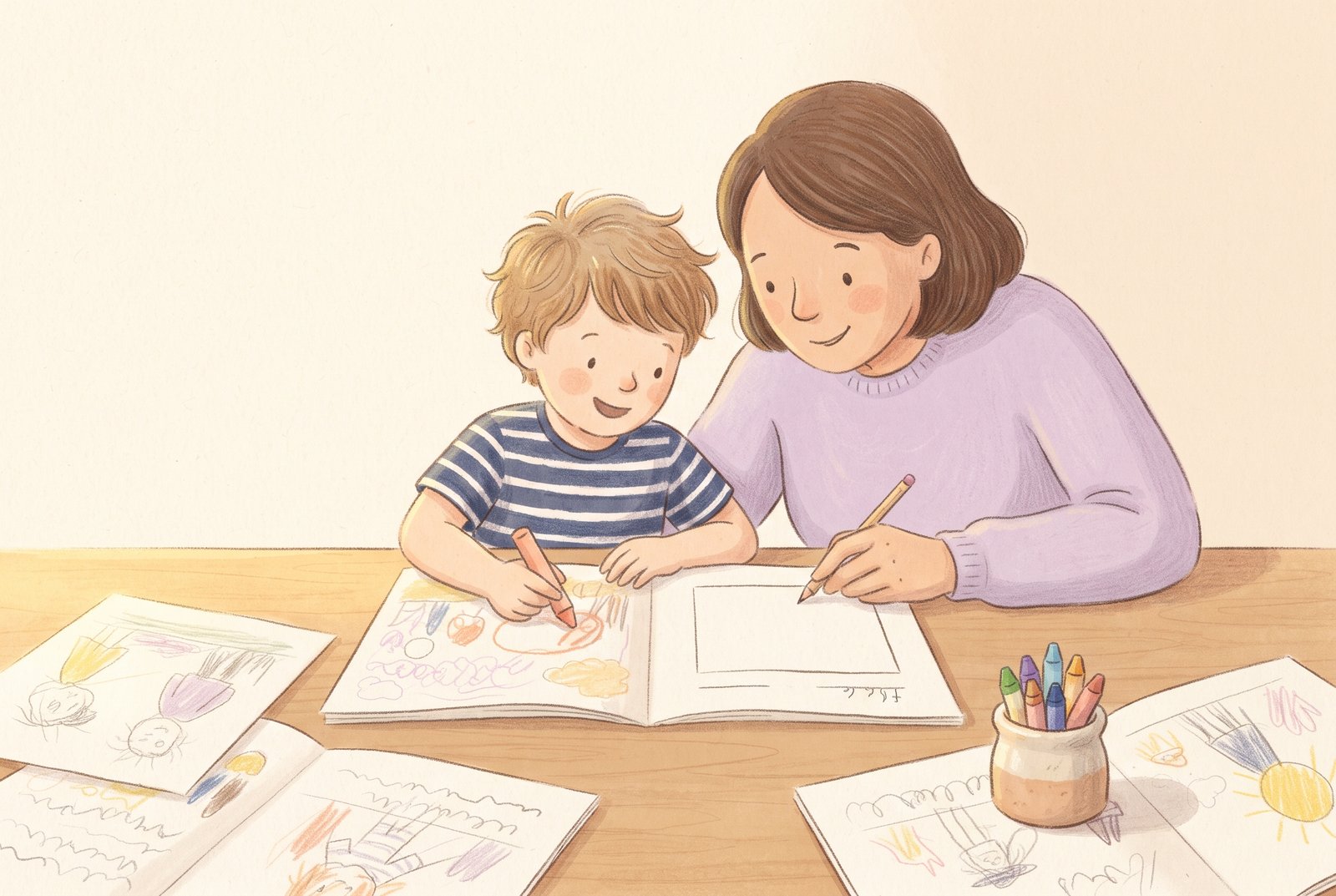
Each personalised storybook template has a cover, six story pages with a big drawing box and a few short sentences to finish, and an “About the author” page at the end. You write your child’s name on the lilac lines and their answers on the dashed lines. They do the pictures. No design skill needed, just a pencil and a bit of time together.
Stories about themselves tend to pull children in, because there’s something familiar right there on the page: their own name, their own ideas, their own drawings. It’s a simple idea that works well for early literacy, and it’s especially useful for children who find ordinary books hard to sit with.
“Once upon a time, there was a brave explorer called Emma. One morning, Emma found a map hidden under the trampoline.”
“On the way, Emma met a friendly wombat. They became friends and walked along together.”
Choose Your Free Personalised Storybook Template
Every book follows the same layout, so once your child has made one, the next feels familiar. Start with whichever fits what’s happening in your child’s life right now.
My Big Adventure
Your child is a brave explorer who finds a map, meets a new friend, gets past a tricky part and discovers treasure. A simple beginning, middle and end.
All About Me
Age, family, favourite food, favourite games, what they’re good at and what they might be when they grow up. A lovely keepsake to redo each year.
My Big Feelings
What makes your child happy or worried, how their body feels when they’re cross, a tick list of things that help them calm down, and who they can ask for help.
My Big New Step
For starting kinder, childcare or school. The new place, the teacher, what happens first, what to play with, what to do if it feels hard, and who picks them up.
Each book has nine pages: a grown-up guide, a cover, six story pages and an “About the author” page. Prints well in black and white.
How to Make a Personalised Storybook With Your Child
- Print single-sided. The first page is a guide for you, so leave it out of the book.
- Add the name. Write your child’s name on every lilac line, or let older children write it themselves. Seeing their name over and over is part of the magic.
- Ask, then write their words. Read each sentence aloud, pause at the gap, and write down exactly what your child says. Silly answers make the best stories.
- Let them draw. Scribbles count. If drawing is hard work today, glue in a photo, a sticker or a picture cut from a magazine.
- Go slowly. One or two pages at a time is plenty. A storybook can take a week to make, and that’s fine.
- Bind it. Staple down the left side, or punch holes and tie with ribbon or wool.
- Read it again and again. Put it on the bookshelf with their other books. Many children will “read” their own book back to you long before they can read the words.
Why Personalised Stories Help Young Children
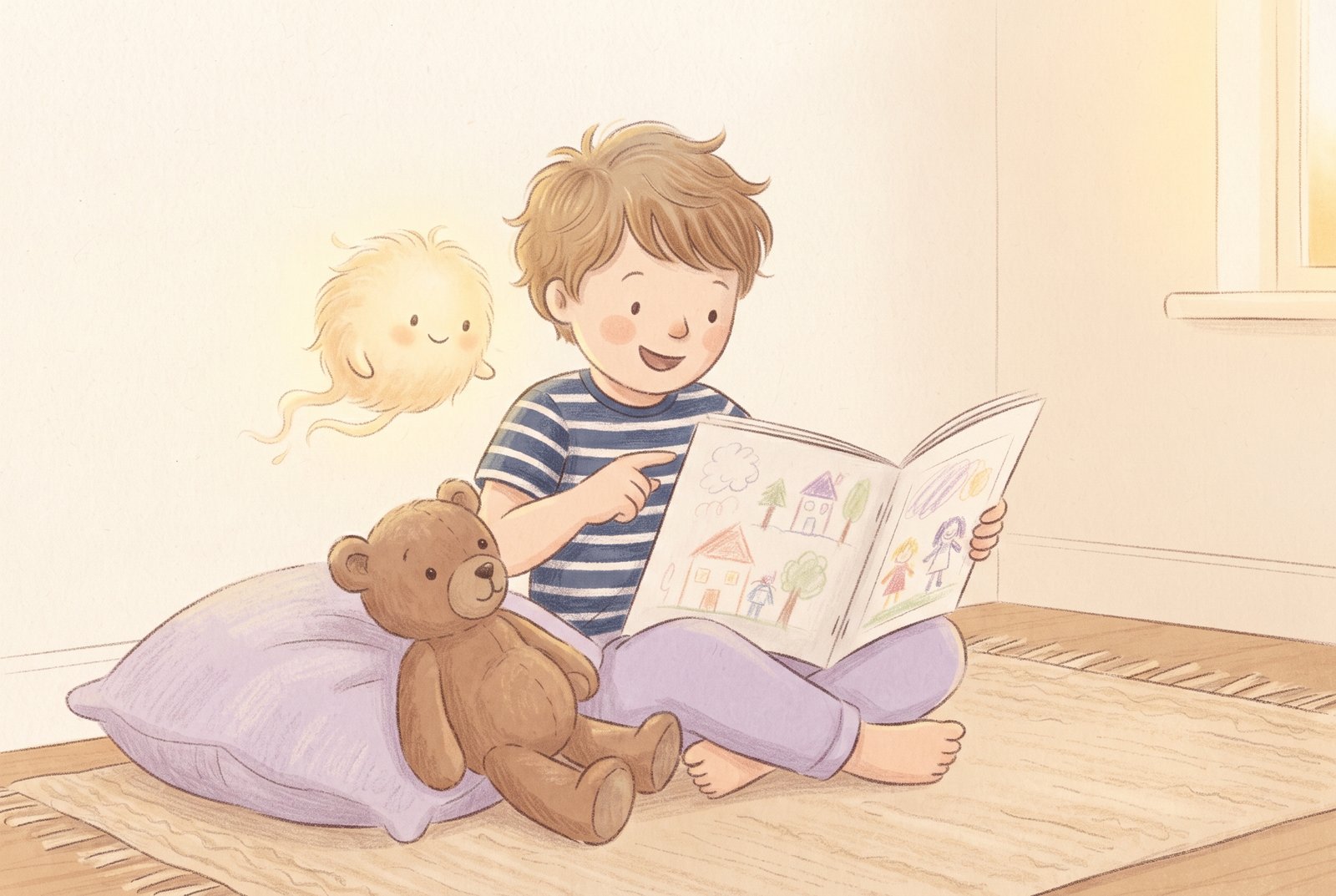
Children are naturally interested in themselves, and personalised books use that. In one study, preschoolers aged around three to four learned new words better from the parts of a picture book that were personalised to them than from the parts that weren’t [1]. It was a small study, but it fits what many parents and educators see: a child’s own name on the page gets their attention.
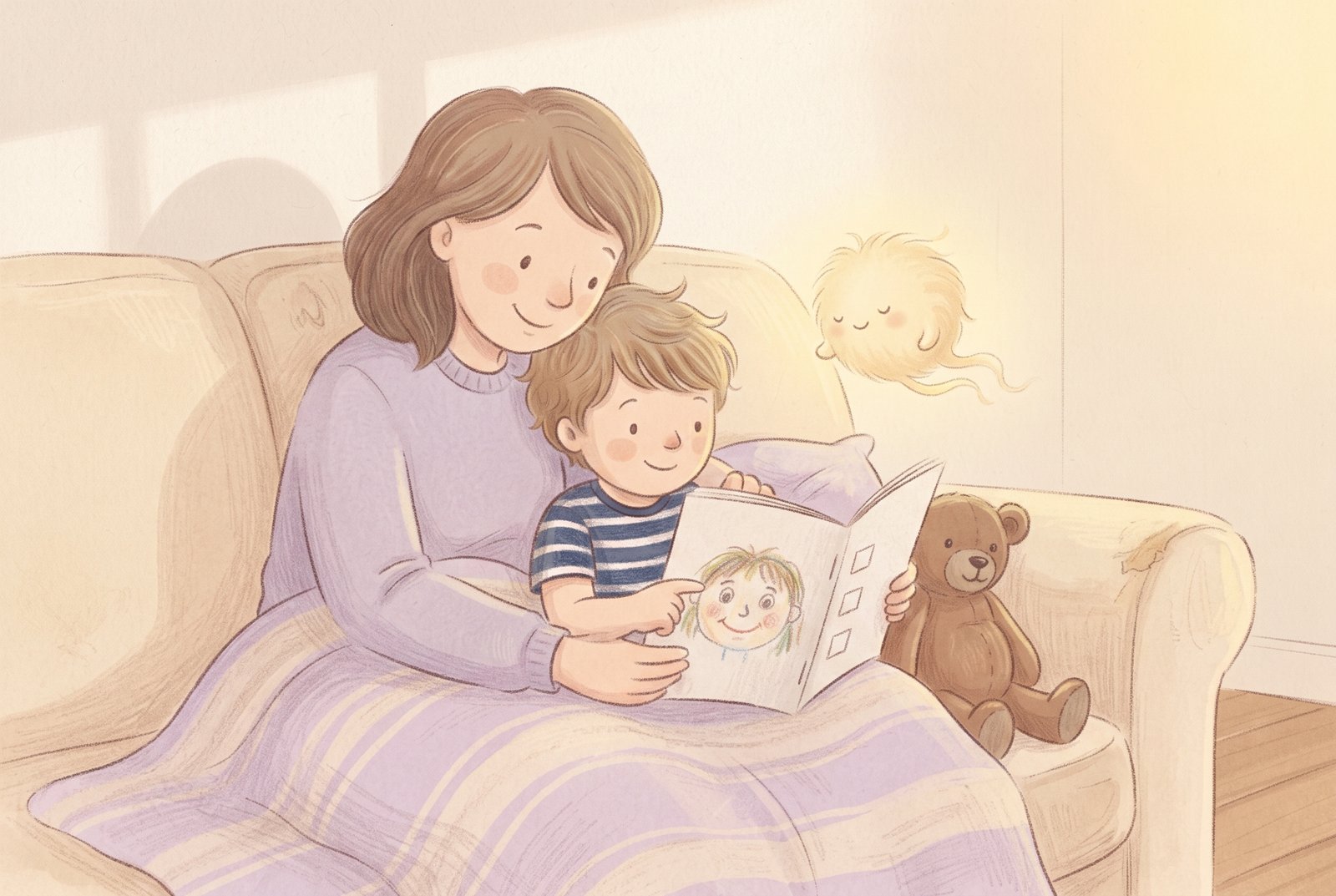
Making the book together adds more. Your child practises putting ideas into words, telling events in order, and seeing that spoken words can be written down and read back. That link between talk and print is one of the foundations of early reading. For more ways to use pictures and stories together, see my guide to visual storytelling.
Personalised Storybooks for Neurodivergent Children
I have ADHD myself and I’m raising a daughter with ADHD, so I think a lot about what makes a reading activity doable rather than a battle. Personalised storybooks have a few things going for them.
- Predictable structure. Every page has the same layout: picture box on top, short sentence below. Once a child knows the pattern, there’s less to work out.
- Practising change before it happens. My Big New Step works a bit like a social story. Reading about the new place, the teacher and the routine before the first day can make the unknown feel more familiar. Real photos make it even clearer.
- Words for feelings. My Big Feelings helps children name feelings and notice what happens in their body, then make a calm-down plan with you. It pairs well with my post on emotional regulation in literacy.
- Many ways to answer. Children can say, point, sign, choose between two options you offer, or show you with a toy. Speech isn’t required.
- Short bursts. One page is a complete task. For children who struggle to sit with a book, see my tips on ADHD reading routines.
Make the feelings book on a calm day. Not in the middle of a meltdown. Then read it together often, so the calming ideas are familiar when feelings get big. My post on co-regulation during meltdowns covers what helps in the moment.
Ideas by Age
A rough guide only. Follow your child, not the number.
| Age | How it might look |
|---|---|
| 3 | You read each line and write their answer. They scribble or colour in the boxes, or you glue in photos. Two pages at a time is plenty. |
| 4 | They give longer answers and draw recognisable pictures. They may trace over their name if you write it lightly first. |
| 5 | They start writing their own name and some letters. Let them copy a short word or two from your writing. |
| 6 to 7 | They write some answers themselves using their best spelling. Invented spelling is fine. Encourage extra details and labels on their pictures. |
Personalised Storybook Template FAQs
Is this personalised storybook template really free?
Yes. All four storybooks are free to download and print for your family or a single classroom, with no email sign-up required.
What age is a personalised storybook template for?
Children aged about 3 to 7. Younger children dictate their answers and draw while an adult writes. Older children can write their own name and some answers themselves.
Can I type my child’s name into the PDF?
Not in this version. The books are designed to be filled in by hand, because writing the name together is part of the activity. Older children often like writing their own name on every page.
Can I use these storybooks in my classroom?
Yes, for a single classroom. All About Me works well at the start of the year, and My Big New Step is useful for children starting kinder or school or moving to a new room.
Do personalised storybooks help autistic children or children with ADHD?
Many families find them helpful, because they are short, predictable and about something the child cares about. My Big New Step can help prepare for changes, and My Big Feelings gives words and a plan for big emotions.
If this one’s useful, these probably will be too
- Kucirkova, N., Messer, D., & Sheehy, K. (2014). Reading personalized books with preschool children enhances their word acquisition. First Language, 34(3), 227–243. https://doi.org/10.1177/0142723714534221