
Preschool Activities for Home: 14 Easy, Calm Play Ideas for Busy Parents
The best preschool activities for home are short, low prep and use things you already have: cushions, water, cardboard, the kitchen and the backyard. You don’t need a lesson plan or a craft cupboard. You need a handful of go to ideas, matched to how your child is feeling today.
This page is your starting point. It explains why everyday play at home matters, how to choose the right activity for your child’s mood and your energy, all 14 of our detailed activity guides in one place, a sample week, tips for busy and neurodivergent children, safety notes, a free printable Weekly Home Play Planner and twelve free PDFs to pair with the activities.
Some days you have energy for a mud kitchen. Some days you have energy for a bowl of water at the sink. Both count.
- Why This Page Exists
- Why Preschool Activities for Home Matter
- What Makes a Good Home Activity
- How to Use This Page in Four Steps
- Choose by Your Child’s Mood
- The 14 Preschool Activities for Home
- Activities by Time You Have
- A Sample Week
- The Learning Hiding Inside Play
- Busy, Sensory and Neurodivergent Children
- Safety Notes
- When You’re Running on Empty
- Free Printable: Weekly Home Play Planner
- Free PDFs to Pair With Activities
- FAQs
Why This Page Exists
Most tired parents don’t need more ideas. They need fewer, better ones, and a quick way to pick the right one at 4pm when everyone is tired. That is what this page is for.
I’ve been the tired parent too. In Indonesia, while the girls were small, I lectured in early childhood teacher education by day and came home to two little ones. There were no phones or tablets to hand them. Play was cushions, water, paper, the garden and whatever was in the kitchen.
Later in Melbourne, during my PhD, I worked three casual jobs: VCE marking, cleaning and newspaper delivery from 3am to 6am, then the school run. On days like those, the activities that work are rarely the elaborate ones. They are the ones that take five minutes to set up.
Many of the 14 guides below grew from real moments in our family: Zara doing a bear walk down the hallway in Indonesia, a rainy afternoon with a shoebox, Bella turning our Melbourne lounge room into a wind tunnel, a porridge morning, and Zara and Bella’s backyard mud kitchen. Each guide tells its own story. This page brings them together so you can find what you need quickly.
Why Preschool Activities for Home Matter
Home is where young children spend most of their waking hours, and ordinary days are where most learning happens. Preschool activities for home don’t need to look like school to be valuable. In fact, the research points the other way.
Play Is How Young Children Learn
The American Academy of Pediatrics published a clinical report on the role of play, led by Michael Yogman. It describes play as central to children’s development, supporting language, problem solving, self control, social skills and the relationship between child and parent.1 Australia’s Early Years Learning Framework also puts play based learning at the centre of the early years.2
Moving Bodies Need Active Play
The Australian 24 hour movement guidelines suggest children aged 3 to 5 spend at least 180 minutes a day in physical activity, including at least 60 minutes of energetic play, and no more than one hour of sitting screen time.3 Active preschool activities for home, like animal walks and obstacle courses, make those minutes easy to reach on days you can’t get outside.
Talk During Play Builds Language
A study led by Rachel Romeo found that back and forth conversation between adults and young children was linked with stronger language skills, more than the number of words a child simply heard.4 Chatting while you cook, pour, build and dig is exactly that kind of talk.
Predictable Routines Help Children Feel Safe
A review of 50 years of research by Barbara Fiese and colleagues linked predictable family routines with children’s health and better regulated behaviour.5 A few familiar activities, repeated each week, become part of that routine. Our free daily routine template can help you build them in.
What Makes Good Preschool Activities for Home?
Every activity linked on this page was chosen with five questions in mind. You can use the same questions to judge any idea you find online.
| Question | Why it matters | What it looks like |
|---|---|---|
| Can I set it up in five minutes? | If it takes longer, it won’t happen on a tired day | A bowl of water and cups, a box and some textas |
| Does it use what we already have? | No shopping, no special kits | Cushions, pegs, pots, leaves, cardboard |
| Is it open ended? | Children can play it many ways, so it lasts longer | “Make something” rather than “copy this” |
| Does it suit my child’s body today? | A busy body and a tired body need different play | Big movement for wiggles, slow water play for overwhelm |
| Is cleanup manageable? | A mess you dread is a mess you’ll avoid | A tray, a towel, outdoors, or tidying as part of the game |
How to Use This Page: Four Easy Steps
Notice Your Child’s Mood and Energy
Is your child bouncing off the walls, flat and clingy, overwhelmed, or simply bored? The mood table below points you to the right kind of activity.
Be Honest About Your Own Energy
If you have five minutes and nothing left, choose a five minute activity. A small activity that happens beats a big one that doesn’t.
Pick One Activity and Set It Up Together
Let your child help carry the cushions or fill the water. Setting up is part of the play, and it builds the sense that this is their activity too.
Stop While It’s Still Fun
Ten to twenty minutes is plenty. Finish before tears, pack up together, and write it on your Weekly Home Play Planner if you want to remember what worked.
Choose Preschool Activities for Home by Your Child’s Mood
| If your child is… | Try | Free PDF to pair |
|---|---|---|
| Bouncing off the walls | Animal walks, an indoor obstacle course, hopscotch | Pocket Heavy Work Cards |
| Overwhelmed or teary | Sink water play, a low mess sensory bin | Calm Shapes Breathing Cards |
| Bored and looking for trouble | Cardboard box play, kitchen science, colour mixing | Shape Hunt |
| Clingy and wanting you | Practical life jobs side by side with you | Daily Routine Chart |
| Needing to play alone for a bit | Independent play invitations | Three Picture Story |
| Stuck inside on a wet day | Rainy day activities | Sound Hunt Cards |
| Craving the outdoors | Mud kitchen, classic playground games | Letter Spotting Walk |
The 14 Preschool Activities for Home
Each card links to a full guide with step by step instructions, safety notes and printables. They are grouped into four kinds of preschool activities for home, so you can find a fit quickly.
Movement and Active Play
For bodies that need to move. These give children big movement, pushing, pulling and jumping, which many children find settling.
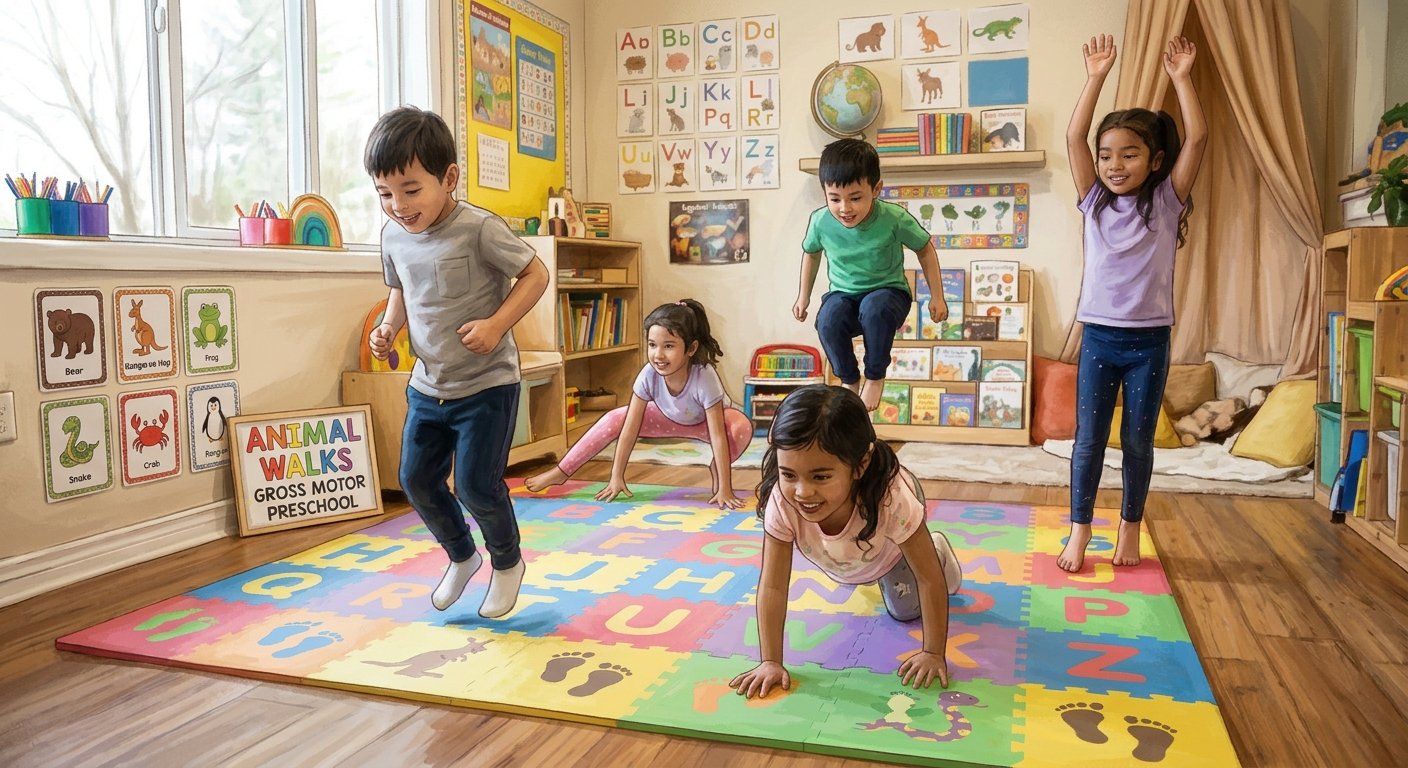
1. Animal Walks
Bear walks, crab walks and kangaroo hops down the hallway. No equipment, five minutes.
2. Indoor Obstacle Course
Cushions, chairs, a blanket tunnel and painter’s tape on the floor make a course in minutes.
3. Classic Playground Games
Tiggy, Simon says, What’s the time Mr Wolf. Games that teach turn taking without any gear.
4. Hopscotch
A chalk grid on the driveway for jumping, balance and early number sense.
Sensory and Water Play
For children who need to slow down, or who learn best through their hands.
5. Sink Water Play
A chair at the sink, a few cups, a funnel and a towel. Pouring and splashing are often calming.
6. Low Mess Sensory Bins
A tub, a filler like rice or pasta, and a few scoops. Clear limits keep the mess in the tub.
7. Mud Kitchen
Old pots, spoons, dirt, leaves and water. Outdoor pretend cooking that can last all afternoon.
8. Colour Mixing
A simple colour chart and two or three paints, so toddlers and preschoolers can see what happens.
Making, Building and Discovering
For curious children who want to make something happen.
9. Cardboard Box Play
A delivery box becomes a car, a cubby, a tunnel or a shop. The cheapest toy in the house.
10. Kitchen Science
Bicarb soda and vinegar, sinking and floating, ice melting. Simple experiments with pantry staples.
11. Rainy Day Activities
Indoor ideas for long wet days when everyone is getting cabin fever.
12. Everyday Weekend Moments
How to fit learning into ordinary weekends without planning big outings.
Real Jobs and Independence
For children who want to help, and for parents who need a few minutes to themselves.
13. Practical Life Activities
Pouring, spreading, wiping, sorting washing and watering plants. Real jobs, child sized.
14. Independent Play
How to set up simple invitations to play so your child can play alone for a while, and why it takes practice.
Preschool Activities for Home by Time You Have
| Time | Activities |
|---|---|
| 5 minutes | Animal walks, a bowl of water at the sink, one practical life job, a breathing card |
| 15 minutes | Sensory bin, colour mixing, a quick obstacle course, a kitchen science experiment |
| 30 minutes or more | Mud kitchen, cardboard box building, hopscotch and playground games, a rainy day plan |
A Sample Week of Preschool Activities for Home
This is just an example. One planned activity a day is plenty, and free play fills the rest. Swap days around to fit kinder, childcare and your work.
| Day | Morning | Afternoon |
|---|---|---|
| Monday | Animal walks before kinder | Sink water play before dinner |
| Tuesday | Practical life: help make breakfast | Cardboard box play |
| Wednesday | Free play | Indoor obstacle course |
| Thursday | Sensory bin while you tidy | Kitchen science |
| Friday | Colour mixing | Playground games at the park |
| Saturday | Mud kitchen | Rest and free play |
| Sunday | Hopscotch on the driveway | Everyday weekend moments: shopping, cooking, a walk |
Use the free Weekly Home Play Planner PDF to write your own week, or the Two Week Literacy Play Planner if you’d like to weave in more stories and sounds.
The Learning Hiding Inside Preschool Activities for Home
Parents sometimes worry that play at home isn’t “real learning”. It is. Here is what’s going on underneath some of these activities.
| Area | Where it shows up | Go deeper |
|---|---|---|
| Maths | Counting cups at the sink, numbers on hopscotch, measuring in the mud kitchen, sorting washing | Early maths hub, number sense activities, counting activities |
| Literacy | Menus in the mud kitchen, labels on boxes, telling the story of an obstacle course, chatting while you cook | Early literacy hub, emergent literacy, visual storytelling |
| Fine motor | Pouring, pegging, scooping, spreading, tearing cardboard | Hand strength, pincer grasp, scissor skills by age |
| Gross motor | Animal walks, obstacle courses, hopscotch, playground games | Animal walks |
| Science and thinking | Kitchen science, colour mixing, sinking and floating | Shapes and colours, Vygotsky’s play theory |
| Independence | Practical life jobs, independent play, getting dressed | Self dressing skills |
If your child enjoys pencil work, the alphabet tracing worksheets are a gentle extra. But for most preschoolers, the activities above do more for later reading, writing and maths than worksheets do.
Preschool Activities for Home for Busy, Sensory and Neurodivergent Children
Bella showed signs of ADHD from babyhood, long before her diagnosis in her twenties, and I have ADHD too. So I know that the “right” activity can change hour by hour. A few things tend to help:
- Start with movement before anything that needs sitting still. Our sensory seeking and proprioception guide explains why.
- Offer two choices, not ten. Too many options can overwhelm.
- Use a first then mat for transitions: first animal walks, then lunch.
- Warn before an activity ends, and use the Today Is Different card when plans change.
- Keep a calm option ready, like water play or a calm corner.
- Remember that regulation comes before learning. Read regulation before learning and sensory micro transitions.
If your child can do an activity happily one day and not at all the next, that is very common. Our post on why your child can do it some days and not others explains what’s going on.
Safety Notes for Preschool Activities for Home
Home play is safest with a few simple rules:
- Water: always stay within arm’s reach of young children around water, including buckets, tubs and the sink. Empty containers straight after play.
- Small items: choose fillers and objects too big to swallow for children who still mouth things.
- Kitchen: keep children away from hot stoves, kettles and sharp knives. Give them child safe tools and cold tasks.
- Potting mix: use garden soil rather than bagged potting mix in a mud kitchen, and wash hands after. Our mud kitchen guide explains why.
- Furniture: check chairs and cushions in an obstacle course won’t tip or slide.
When You’re Running on Empty
Some days, the best of all preschool activities for home is the one that asks the least of you. That is not failure. Children do not need entertaining every minute. A bit of boredom often sparks their own play.
If you are stretched thin most days, please look after yourself too. Our post on parent and teacher burnout may help, along with the free Weekly Battery Check In and Small Refills Menu. If you have ADHD yourself, a parent with ADHD is written for you.
Free Printable: Weekly Preschool Activities for Home Planner
Write one activity a day, tick what you did, and circle the ones your child loved. By the end of a month, you’ll have your own list of go to ideas.
Download the Free PDFOur Week of Home Play
One small activity a day is plenty. Free play fills the rest.
How to Use the Weekly Home Play Planner
- Print a planner on Sunday night or Monday morning.
- Write one small activity under each day, using the mood table and the 14 activities on this page. Leave some days for free play.
- Stick it on the fridge so your child can see what’s coming.
- Tick “Did it” when it happens and colour the heart if your child loved it.
- At the end of the month, look back at the hearts. That’s your family’s own list of go to activities.
Free PDFs to Pair With Preschool Activities for Home
These free PDFs from this site work alongside the activities above. Print one or two, not all twelve.
Pocket Heavy Work Cards
Push, pull and carry ideas for busy bodies.
Download PDF Pairs with: animal walks, obstacle courseCalm Shapes Breathing Cards
Slow breathing with shapes for overwhelmed moments.
Download A4 PDF Pairs with: sink water play, sensory binsDaily Routine Chart
A picture chart so your child knows when play happens.
Download A4 PDF Pairs with: practical life, the sample weekToday Is Different Card
For days when plans change.
Download PDF Pairs with: any activity swapFirst Then Reset Mats
“First play, then pack up.” Small steps for tricky moments.
Download PDF Pairs with: ending activitiesShape Hunt
Find shapes around the house and garden.
Download A4 PDF Pairs with: cardboard box play, walksNumber Hunt
Spot numbers on letterboxes, signs and hopscotch.
Download A4 PDF Pairs with: hopscotch, mud kitchenWays to Make 5 and 10
Hands on counting with pegs, cups or stones.
Download PDF Pairs with: sink water play, sensory binsSound Hunt Cards
Listening games for rainy days and car trips.
Download PDF Pairs with: rainy day activitiesLetter Spotting Walk
Hunt letters and signs on a walk.
Download PDF Pairs with: outdoor play, weekend momentsThree Picture Story
Draw the story of today’s play in three boxes.
Download PDF Pairs with: independent play, mud kitchenWeekly Home Play Planner
One small activity a day, ticked and loved.
Download PDF Pairs with: the sample weekMore free tools are on our printables page. Educators setting up a room on a budget might like low cost sensory classroom setup, and families who love the outdoors can try the nature scavenger hunt.
Looking Back
Look at the family moments behind these guides, in Indonesia and later in Melbourne, and very little of it needed planning. It was a hallway, a shoebox, a backyard, a bowl of porridge and a parent nearby. That is the heart of good preschool activities for home: ordinary things, a little time and someone who notices.
- Routines: free daily routine template and daily routine for neurodivergent children
- Calm: co regulation strategies
- Behaviour: ADHD behaviour strategies
- Two languages: learning English through daily routines
- Stories: storytelling wheel and personalised storybook template
- Pencil skills: fine motor pencil control activities
- The bigger picture: child development
- About me: how this began
Preschool Activities for Home FAQs
What are good preschool activities for home?
Good preschool activities for home are short, low prep and open ended: animal walks, an indoor obstacle course, water play at the sink, sensory bins, a mud kitchen, cardboard box play, simple kitchen science and real household jobs. They use what you already have and let your child lead.
How much time should I spend on activities with my preschooler each day?
There is no set number. A few short, warm moments of play and conversation spread through the day matter more than one long planned session. Ten to twenty minutes is plenty for most planned activities, and everyday jobs count too.
Do I need to plan preschool activities for home every day?
No. Children also need time to play on their own and to be bored now and then. Keep a short list of go to activities, set one out when the day needs it, and let free play fill the rest.
What activities help a preschooler who is bouncing off the walls?
Big movement usually helps: animal walks, an indoor obstacle course, carrying heavy things, jumping games and outdoor play. Australian guidelines suggest children aged 3 to 5 spend at least three hours a day being physically active, including an hour of energetic play.
What can I do when my preschooler is overwhelmed?
Try something calm and sensory with you nearby: water play at the sink, a simple sensory bin, slow breathing cards or a quiet corner. Many children settle with gentle, repetitive play and a calm adult close by.
Research and guidance: Yogman and colleagues for the American Academy of Pediatrics on play, the Early Years Learning Framework, the Australian 24 hour movement guidelines, Romeo and colleagues on conversation, and Fiese and colleagues on family routines.
Experience: my years lecturing in Indonesia, the three casual jobs during my PhD in Melbourne, and the family moments mentioned (Zara’s bear walk, the rainy shoebox, the wind tunnel lounge room, the porridge morning and the backyard mud kitchen) are real, and each is told in full in its own guide. The mood table, time table, sample week and planner come from family life and my work in early childhood education.
This is educational content, not medical or psychological advice. Last reviewed: 10 November 2026.
References
- Yogman, M., Garner, A., Hutchinson, J., Hirsh Pasek, K., Golinkoff, R. M., Committee on Psychosocial Aspects of Child and Family Health, & Council on Communications and Media. (2018). The power of play: A pediatric role in enhancing development in young children. Pediatrics, 142(3), e20182058. https://doi.org/10.1542/peds.2018-2058
- Australian Government Department of Education. (2022). Belonging, being and becoming: The Early Years Learning Framework for Australia (V2.0). Australian Government Department of Education for the Ministerial Council. https://www.acecqa.gov.au/nqf/national-law-regulations/approved-learning-frameworks
- Australian Government Department of Health. (2017). Australian 24 hour movement guidelines for the early years (birth to 5 years). Commonwealth of Australia.
- Romeo, R. R., Leonard, J. A., Robinson, S. T., West, M. R., Mackey, A. P., Rowe, M. L., & Gabrieli, J. D. E. (2018). Beyond the 30 million word gap: Children’s conversational exposure is associated with language related brain function. Psychological Science, 29(5), 700-710. https://doi.org/10.1177/0956797617742725
- Fiese, B. H., Tomcho, T. J., Douglas, M., Josephs, K., Poltrock, S., & Baker, T. (2002). A review of 50 years of research on naturally occurring family routines and rituals: Cause for celebration? Journal of Family Psychology, 16(4), 381-390. https://doi.org/10.1037/0893-3200.16.4.381