
Indoor Obstacle Course for Preschoolers (Using Couch Cushions, Tape, and Everyday Items)
Transform frantic living room crashing into purposeful, calming motor movement with an indoor obstacle course for preschoolers that uses household items to ground restless nervous systems.
Table of Contents
- The Living Room Crash Hour: When Movement Turns Manic
- Why an Indoor Obstacle Course for Preschoolers Actually Works
- Why “Just Letting Them Run” Usually Makes Things Worse
- Indoor Obstacle Course for Preschoolers Setups That Regulate the Body
- What Children Actually Gain From Organised Movement
- What Happened on My Own Living Room Rug
- What Does Not Work: Traps That Add More Chaos
- How to Keep the Course Calm, Not Chaotic
- When to Deploy an Obstacle Course in Daily Life
- Expanding Your Calming Home Play Toolkit
- References & Research Foundations
- Safety & Editorial Disclaimer
The sound that finally broke through my concentration was the dull, reverberating shudder of our three-seater sofa hitting the skirting board.
Again.
My four-year-old daughter was standing on the backrest, socks half-falling off her heels, eyes wide and glassy with that unmistakable, wild buzz of complete physical dysregulation. She launched herself diagonally across the living room, landing chest-first into a pile of decorative floor pillows, rolling violently onto the timber floorboards, bouncing up, and slamming her shoulders directly into the side of the armchair.
“Look at me! Look how high I jump! Mummy, watch! Watch me smash!”
“Sweetheart, stop,” I said, putting both hands flat against the laminate kitchen bench. “Feet on the floor, please. You are going to hurt yourself or crack the window.”
She didn’t stop. She couldn’t stop.
She wasn’t being rebellious or deliberately destructive. Her central nervous system was redlining, starved of the heavy physical resistance that normally kept her grounded. We had been stuck indoors all morning, the weather outside was miserable, and her body was practically vibrating with unmet sensory hunger.
My own adult ADHD brain was fraying under the acoustic assault of repeated thuds and frantic shrieks. My immediate impulse was to shout, to mandate a harsh timeout, to pull her down and force her to sit still on the sofa. But I knew with absolute certainty what that would produce: an immediate, volcanic meltdown. You cannot mandate stillness in a child whose body feels like it is on fire with unspent kinetic energy.
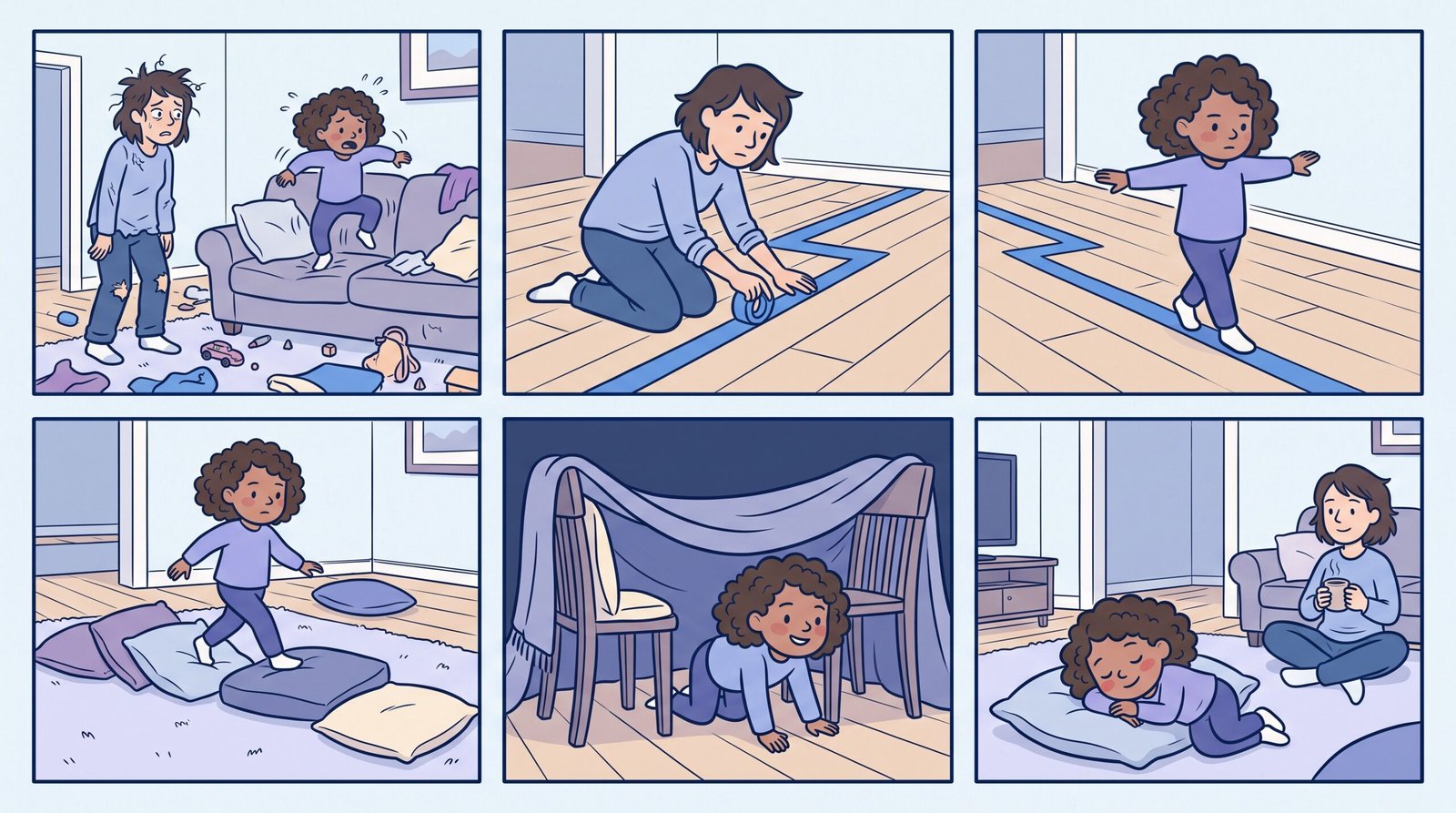
I looked at the stripped couch cushions. I looked at the hallway runner. Then I reached into the junk drawer and pulled out a roll of blue painter’s masking tape.
I didn’t yell. I didn’t offer a lecture. I dropped to my knees on the living room rug, tore off a long strip of blue tape, and pressed it flat against the floorboards in a sharp, crisp line.
She stopped mid-leap, one foot still balanced on the sofa edge.
“What is that?” she asked, her breathing shallow and fast.
“This is a tightrope over crocodile water,” I said quietly, without looking up. “You can only cross it if you walk heel-to-toe without touching the wood. If your body falls off, you have to crawl under the dining table to safety.”
She stared at the tape. Her eyes focused. The frantic, manic edge in her posture snapped into sharp, intentional alignment. She climbed down carefully, placed one bare foot on the tape, extended both arms out wide for balance, and went completely silent. That simple intervention proved that an intentional indoor obstacle course for preschoolers turns frantic indoor crashing into purposeful, calming physical regulation.
Why an Indoor Obstacle Course for Preschoolers Actually Works Proprioceptive resistance, vestibular calibration, and autonomic down-regulation
When parents see a preschooler throwing themselves against sofa cushions, diving onto the carpet, or running aimlessly between rooms, our culture teaches us to label the child as “hyperactive” or “unruly.”
In developmental reality, the child is engaging in sensory-seeking behaviour. They are attempting to self-medicate their nervous system through physical impact:
- The Proprioceptive System: Located in our muscles, tendons, and joints, this internal sense tells our brain where our limbs are without us having to look at them. When muscles push, pull, lift, or bear weight (known clinically as “heavy work”), proprioceptors send powerful, calming signals directly to the central nervous system.
- The Vestibular System: Located in the inner ear, this system processes balance, gravity, and spatial motion. When movement is linear and purposeful (like balancing along a tape line), it soothes the brain. When movement is rotary, erratic, and uncontrolled, it revs the nervous system into overdrive.
- Brain Architecture and Motor Planning: As documented by the American Academy of Pediatrics (AAP), active physical play is not just recreation; it is the fundamental mechanism through which children build emotional self-regulation, attention control, and physical competence. Furthermore, foundational neurodevelopmental frameworks from the Harvard Center on the Developing Child demonstrate that physical exploration builds brain architecture by reinforcing synaptic pathways related to motor planning and executive function.
When you build a structured indoor obstacle course for preschoolers, you are not just burning energy. You are providing the specific, heavy sensory feedback their brain needs to settle down.
Why “Just Letting Them Run” Usually Makes Things Worse The critical difference between wild acceleration and organised movement
The most common advice given to parents of wild, bouncing preschoolers is: “Just let them run around the house to tire them out.”
Every parent who has tried this knows the predictable result. The child does not tire out; they become manic. They sprint down the hallway, skid on a rug, bang their elbow, scream, laugh hysterically, knock over a laundry basket, and eventually dissolve into an uncontrollable puddle of tears.
Unstructured Indoor Sprinting
Provides erratic vestibular stimulation without muscle resistance. The child accelerates, losing body awareness and spiking adrenaline, which triggers emotional meltdowns.
Organised Obstacle Movement
Introduces deliberate cognitive and motor friction. Stepping between cushions and crawling under chairs forces the brain to plan, calibrate force, and down-shift into calm focus.
Unstructured sprinting through a home provides vestibular stimulation without sufficient proprioceptive resistance. The child moves fast, but their joints and muscles do not receive the heavy, grounding feedback needed to tell the brain: You are safe, you are grounded, you can slow down now.
A thoughtfully designed indoor obstacle course for preschoolers introduces deliberate cognitive and motor friction. The child must stop at the line. They must calibrate how far to stretch their leg to reach the next cushion. They must bear their own weight while crawling under a dining chair. This requirement to plan, sequence, and execute movement transforms frantic hyperactivity into deep, meditative focus.
Indoor Obstacle Course for Preschoolers Setups That Regulate the Body Four essential living room stations using tape, cushions, chairs, and laundry baskets
You do not need to purchase expensive foam balance beams, plastic play tunnels, or sensory stepping stones. The most effective sensory tools are already sitting in your cupboards, linen press, and lounge room.
Here are four essential movement stations for an indoor obstacle course for preschoolers that use everyday household items to systematically ground high-energy children.
1. Masking Tape Balance Beams: Precision and Vestibular Settling
When an active child is moving too fast, you must narrow their physical visual field. A line on the floor acts like a cognitive magnet.
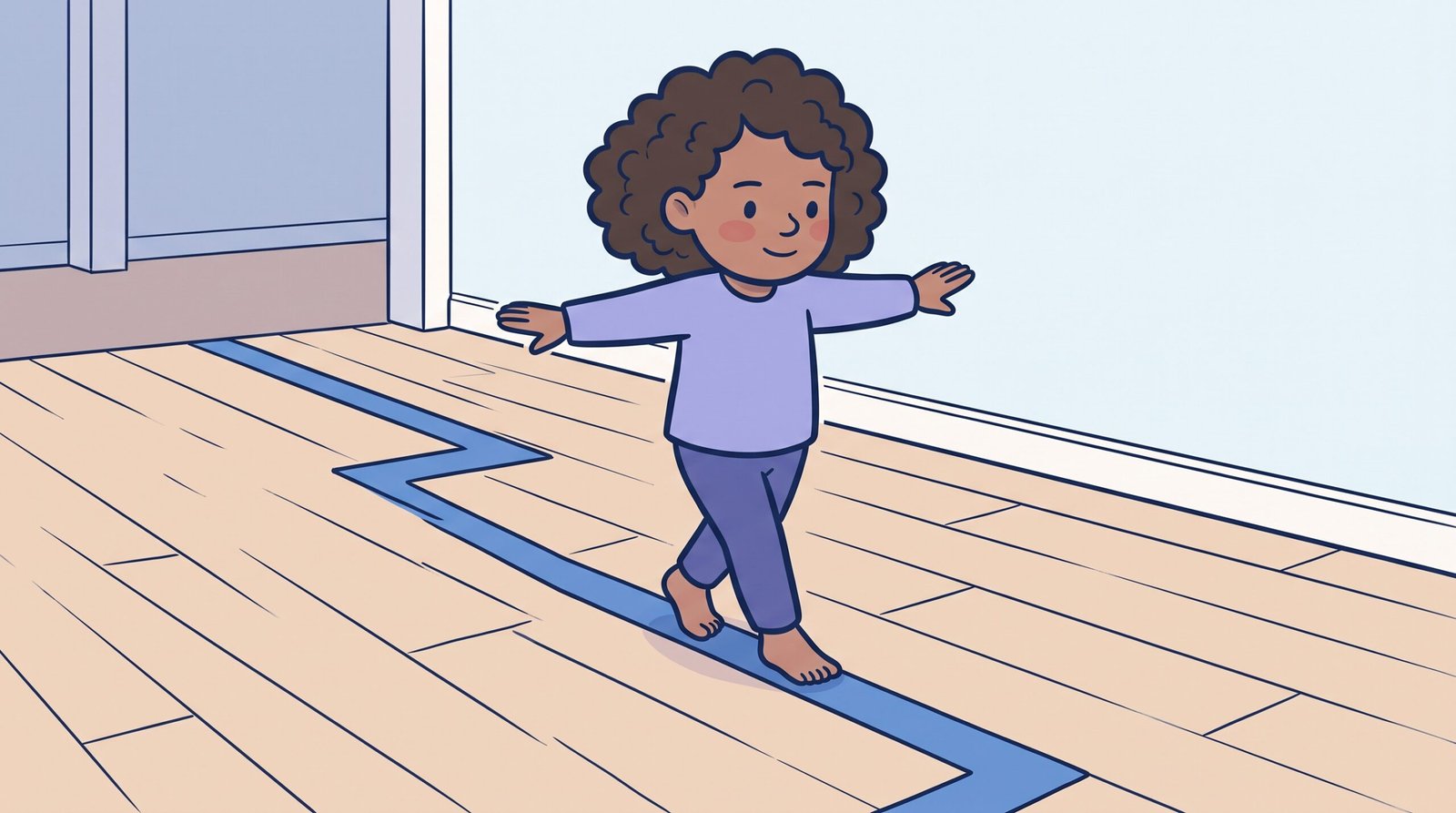
- The Setup: Grab a roll of low-tack painter’s masking tape. Lay down a straight two-metre line, followed by a sharp zig-zag pattern, ending in a wide gentle curve. Ensure the path is clear of stray shoes or furniture corners.
- The Movement Challenge: Instruct your child to navigate the line using specific bodily constraints: “Can you walk like a tightrope walker, putting your heel directly against your toes?” or “Can you tiptoe along the zig-zag without letting your heels touch the floor?”
- The Sensory Science: Balance requires continuous micro-adjustments from the vestibular system and the small intrinsic muscles of the feet and ankles. When a child slows down to balance on a narrow line, their gaze locks forward, their core engages, and their breathing naturally deepens. Early childhood motor frameworks from the National Association for the Education of Young Children (NAEYC) highlight that balance tasks lay the groundwork for spatial orientation, postural control, and the focused attention required for classroom learning.
2. Cushion Stepping Stones: Spatial Mapping and Landing Force
Instead of fighting your child’s urge to jump off furniture, give their landings a defined, safe target that requires physical calibration.
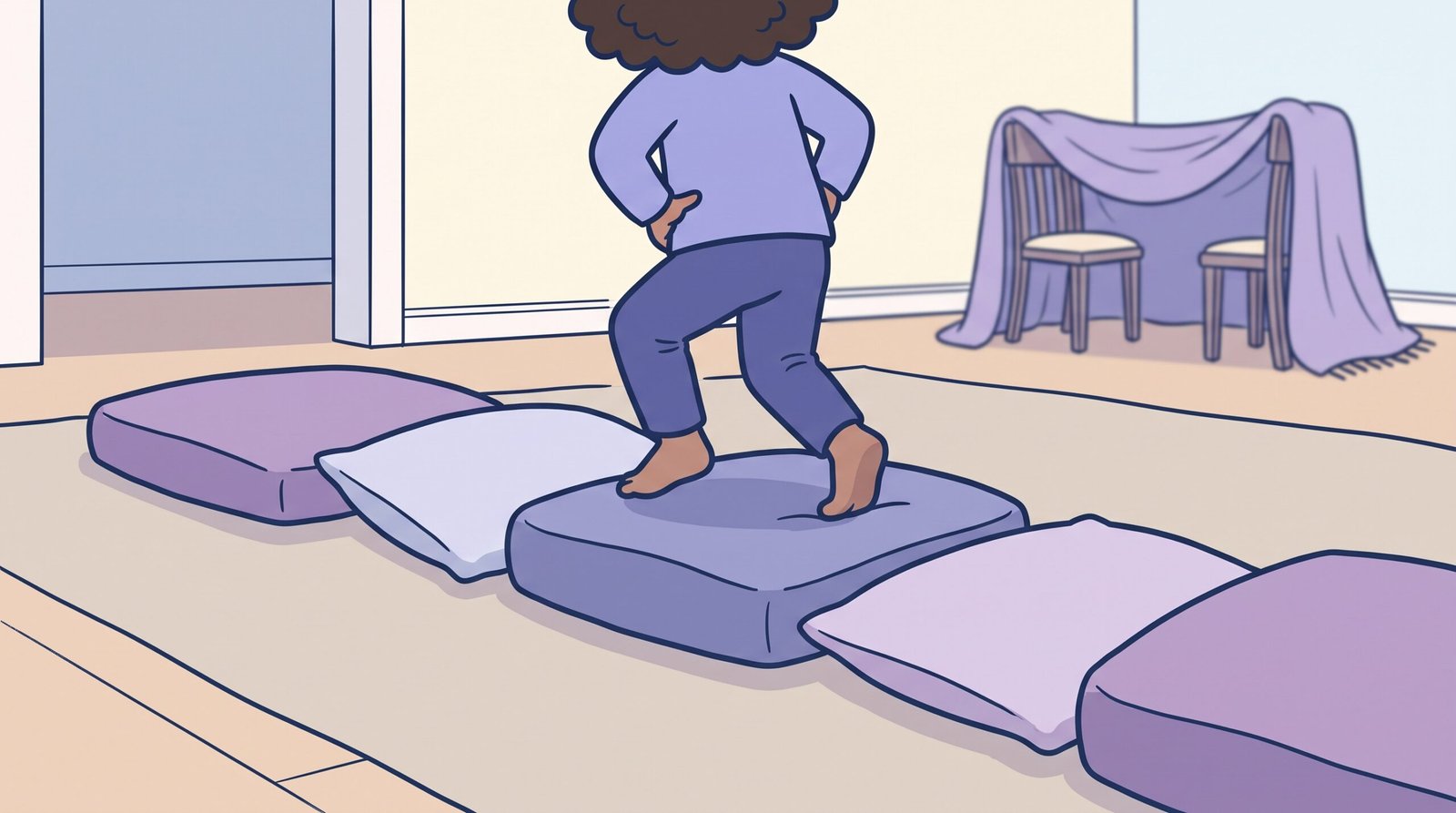
- The Setup: Pull the seat cushions off your sofa and gather two or three firm bed pillows. Lay them out across the carpet with gaps of twenty to thirty centimetres between each cushion. Make sure they are laid on a non-slip rug or carpeted area rather than slick timber or tile floors.
- The Movement Challenge: “The floor is hot lava. You can only step on the cushions to reach the other side.” Challenge them to leap with two feet glued together, landing softly on the centre of a cushion like a quiet tree frog, or balance on one leg on a squishy cushion for five seconds before stepping to the next.
- The Sensory Science: A squishy, uneven surface provides unstable support. As the cushion compresses under the child’s weight, their ankles, knees, and hips recruit deep stabilising muscles to keep them upright. This compression delivers rich proprioceptive input. Because the surface is soft and irregular, the child cannot simply charge across it; they must calculate their trajectory, evaluate distance, and modulate their landing force.
3. Tunnel Crawls: Deep Pressure and Spatial Resistance
Crawling is one of the most neurologically restorative movement patterns in human development, yet preschoolers rarely crawl once they master upright running.
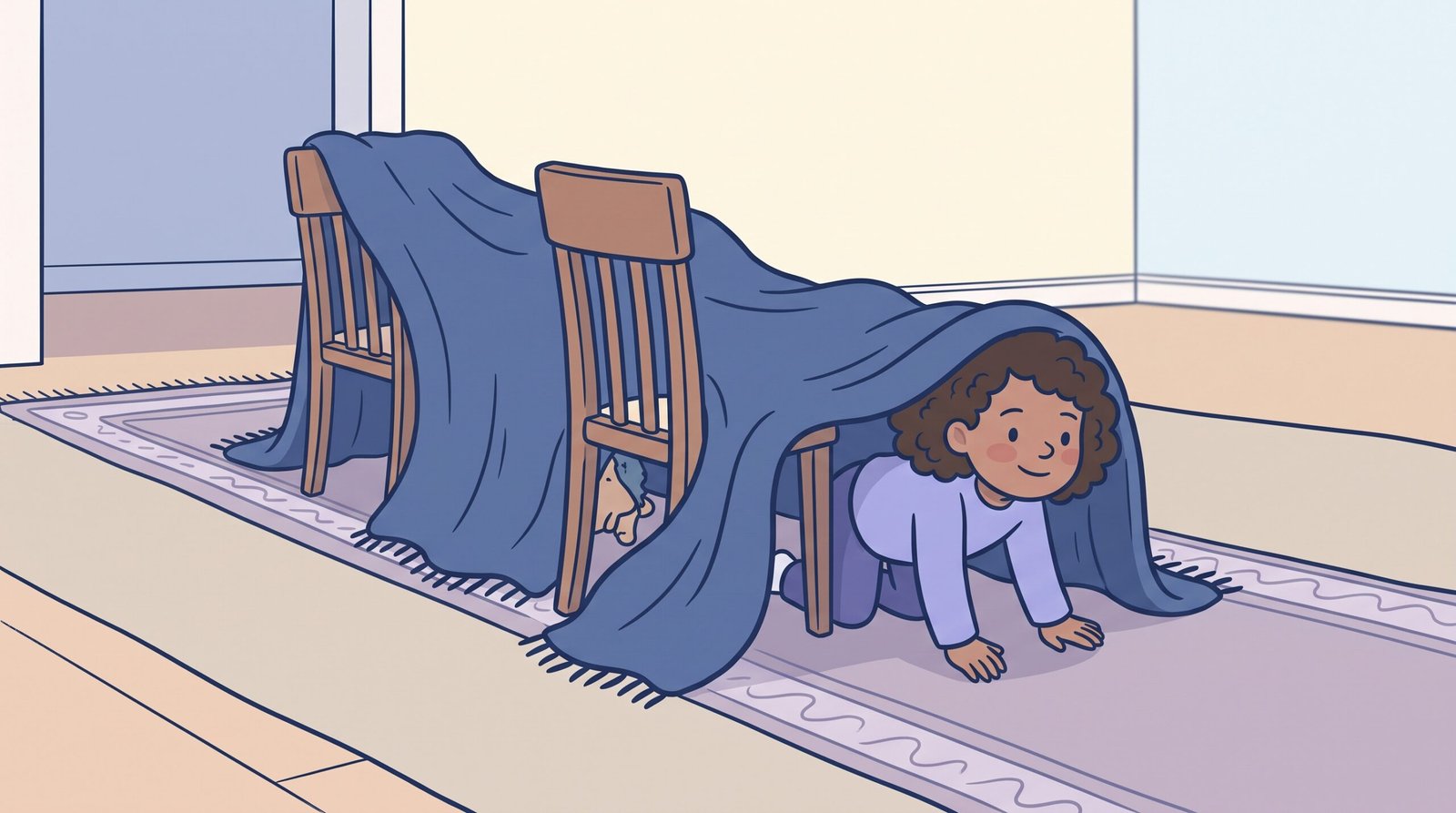
- The Setup: Line up three or four dining chairs back-to-back, leaving a crawl space beneath the seats. Drape a heavy woollen blanket or quilt over the top so the tunnel feels dark, enclosed, and snug. Place a soft runner rug underneath to protect little knees.
- The Movement Challenge: Have the child crawl on their hands and knees from one end of the tunnel to the other. For an added regulatory boost, place a slightly heavy bed pillow or folded blanket across their back and challenge them to crawl through like a turtle without letting their shell tumble off.
- The Sensory Science: Crawling on all fours recruits reciprocal bilateral movement: the opposite arm and leg move forward in tandem. This cross-lateral patterning stimulates neurological communication across the corpus callosum, the highway connecting the brain’s left and right hemispheres. Having the heavy blanket gently drag across their back as they squeeze through provides calming tactile and deep pressure input.
4. Heavy Work Missions: The Calming Engine
If your indoor obstacle course for preschoolers consists only of balance, jumping, and crawling, it may still leave a sensory-seeking child slightly restless. The secret ingredient that guarantees a calm child at the end of the course is heavy work:
- The Laundry Basket Sled: Take a standard plastic laundry basket. Fill it with four heavy bath towels, three large picture books, or two tins of soup. Challenge your child to push the basket from the end of the tape line down to the tunnel entrance.
- The Cushion Haul: Make retrieving and resetting the obstacle course part of the mission. Challenge your child to carry one heavy couch cushion at a time across the room using both arms wrapped tightly around their chest.
- The Army Drag: Lay a heavy woollen blanket on the carpet. Have your child lie flat on their tummy and pull themselves forward using only their forearms, dragging their lower body like a commando.
Proprioceptive input derived from heavy resistance acts as a biological down-shifter for the autonomic nervous system. Clinical sensory processing literature consistently confirms that heavy work triggers the release of neurotransmitters that reduce physiological arousal, transforming erratic sensory-seeking energy into steady, grounded focus.
What Children Actually Gain From Organised Movement Motor planning, sensory calibration, bilateral integration, and emotional resilience
When parents observe an obstacle course, it can look like an energetic way to kill thirty minutes on a rainy afternoon. In reality, your child’s developing brain is executing complex neural calculations with every single step.
| Movement Station in the Obstacle Course | The Underlying Neurological Mechanism | Long-Term Developmental Benefit |
|---|---|---|
| Masking tape line balance walk | Linear vestibular input and visual-motor integration. | Postural control, sustained focus, and spatial alignment. |
| Leaping across couch cushion stepping stones | Proprioceptive force modulation and spatial calculation. | Gross motor coordination, landing safety, and joint stability. |
| Crawling through dining chair blanket tunnel | Cross-lateral bilateral integration and deep pressure. | Hemispheric brain communication needed for reading and writing. |
| Pushing loaded laundry basket sled | Heavy work proprioceptive recruitment against gravity. | Autonomic down-regulation, emotional calming, and persistence. |
Motor planning (praxis) is the ability of the brain to conceive an idea, figure out how the body needs to move to accomplish it, and execute that movement smoothly. Completing a predictable sequence of stations strengthens the neural pathways responsible for working memory, impulse inhibition, and cognitive flexibility.
As outlined by the Raising Children Network (Australia), structured active play provides young children with a safe, positive outlet to discharge emotional stress, master bodily control, and build healthy self-esteem.
What Happened on My Own Living Room Rug From twelve-station chaos to the power of a whispered rule
I hold a PhD in early childhood education. I understand the clinical mechanics of sensory integration. Yet none of that theory stopped me from creating some spectacular disasters in my own living room while parenting a child with strong ADHD traits.
In our early days of indoor cabin fever, I thought building an obstacle course meant turning our entire house into a television obstacle course set.
One rainy Saturday, feeling ambitious, I set up a twelve-station obstacle course that wound through our living room, dining area, down the hallway, and into my daughter’s bedroom. I used cushions, dining chairs, cardboard boxes, balance boards, and spinning office chairs.
It lasted precisely four minutes.
My daughter took one look at the sprawling labyrinth of twelve stations and completely short-circuited. She didn’t follow the sequence. She sprinted through the hallway, tripped over a cardboard box, kicked a dining chair into the wall, and began screaming hysterically while chucking cushions across the room. The visual noise and complexity of twelve stations had overstimulated her already overwhelmed brain.
Another time, I made the fatal mistake of introducing a stopwatch: “Let’s see how fast you can do the course!”
Turning an obstacle course into a timed race was like pouring petrol onto a bonfire. She stopped focusing on balance and precision; she simply hurled her body at top speed across the furniture, skidded off a pillow, and banged her mouth against the coffee table, resulting in a bloody lip and twenty minutes of tears.
The turning point came when I stripped the course down to four simple, quiet stations and removed all elements of speed. One afternoon when she was in a wild, crashing mood, I set up just three stations: a single zig-zag line of tape, three cushions, and a heavy laundry basket to push back to the start.
I whispered: “The floor is sleeping. You have to move through this course so quietly that you don’t wake up the floor.”
She tiptoed. She balanced with slow, deliberate precision. She held her breath while leaping onto the pillows. She leaned her entire body weight against the heavy laundry basket, grunting softly as she shoved it across the rug. She completed that three-station loop seven times in a row. By the seventh lap, her cheeks were flushed with healthy exertion, her wild gaze had completely softened, and she voluntarily flopped onto the rug, completely still.
I didn’t need twelve stations. I didn’t need a stopwatch. I just needed simple, predictable resistance. Building a simple indoor obstacle course for preschoolers had transformed our hardest afternoons into pockets of peace.
“High-energy preschoolers are not trying to ruin our furniture. Their bodies are desperately asking for heavy sensory boundaries. When we replace frantic speed with deliberate, quiet resistance, chaos transforms into deep, peaceful grounding.”
Dewi Griffith, PhD, Founder
What Does Not Work: Traps That Add More Chaos Mistakes to avoid when setting up living room obstacle courses
If you have tried setting up an obstacle course before and it left your home feeling louder and more chaotic than when you started, you likely fell into one of these common pitfalls:
- Too Many Stations at Once: A preschooler’s working memory cannot hold an eight-step movement sequence while their body is excited. When a course has too many elements, the child forgets what comes next, loses the thread of intentional play, and reverts to wild, unregulated sprinting. Keep your course strictly to three or four stations.
- Lack of a Clear, Visible Sequence: If the path between stations is ambiguous, children will cut corners, sprint across open spaces, and crash into walls. Make the flow undeniable. Use tape arrows on the floor, place stations in a natural circular loop, and clearly mark the starting spot with a specific mat or pillow.
- Leaving the Course Up Indefinitely: An obstacle course should be an intentional event, not permanent furniture arrangement. If you leave cushions scattered across the floorboards for three days, they stop being a focused regulatory tool and become visual clutter that invites random, uncontrolled roughhousing. Set it up with purpose, use it for twenty minutes, and pack it away.
- Timing With a Stopwatch: Introducing competition or speed turns sensory motor regulation into high-arousal excitement. Always reward stealth, balance, and quiet control rather than velocity.
How to Keep the Course Calm, Not Chaotic Four practical strategies to ensure physical play settles your household
The ultimate measure of a successful indoor obstacle course for preschoolers is not how high your child jumps; it is how peacefully they settle when the course is packed away:
- The Animal Movement Frame: Children respond deeply to dramatic physical personas. Rather than telling them to “slow down,” assign them animal movements that require immense muscular control: the Sloth (moving in ultra-slow motion across the tape line), the Bear (crawling with hands and feet flat on the floor, hips high in the air, bearing heavy weight), or the Turtle (crawling beneath chairs with a soft cushion balanced on their back).
- Lower the Auditory Profile: Excitement is infectious. If an adult stands by shouting, “Go, go, go! Faster! Jump!”, the child’s adrenaline spikes instantly. Whisper your instructions. Speak in a low, conspiratorial murmur: “Be careful… the cushions are floating on quiet water… show me how silent your paws can be.” When you lower your vocal volume, the child must quiet their own body to hear you.
- Repeat the Same Circuit: Novelty stimulates; repetition regulates. Do not change the course after every lap. Let your child complete the exact same four-station loop five, six, or seven times. The first two laps require cognitive effort to learn the sequence; subsequent laps allow the child to enter an automatic, rhythmic motor flow that soothes the nervous system.
- Build a Built-In “Cool Down” Station: Never end an obstacle course on a high jump. The final station of the course should always transition the body into deep stillness: have the course finish inside a cozy blanket den with two floor pillows. Instruct the child to collapse into the den, place both hands on their belly, and feel their breath slow down like a sleeping bear for ten seconds before starting the next lap or packing away.
When to Deploy an Obstacle Course in Daily Life Strategic timing to prevent evening meltdowns and support focus
An indoor obstacle course is a strategic tool. Deploying it at the right biological window can save your household from significant emotional friction:
- The 4:30 PM Unravel Hour: When preschool exhaustion meets late-afternoon restlessness, an obstacle course provides a structured outlet to discharge stress before dinner.
- Before High-Focus Table Tasks: If your child struggles to sit for puzzles, drawing, or quiet play, ten minutes of heavy-work obstacle play will prime their nervous system for sustained seated focus. Much like the table-based autonomy we discuss in our guide on how to encourage independent play in preschoolers, physical regulation must precede quiet concentration.
- During Prolonged Bad Weather: When rain traps you inside for multiple days, schedule an obstacle circuit in the mid-morning to break up the sensory monotony of indoor confinement.
Expanding Your Calming Home Play Toolkit Practical sensory and routine resources across your home
When your child needs varied, low-stress sensory input throughout the week, pair your obstacle routines with these tested household guides:
- When physical energy peaks in the kitchen while you cook, try our calming guide to sink water play for preschoolers using warm tap water and everyday utensils.
- Protect your carpets while providing deep tactile grounding with our collection of low mess sensory bins for preschoolers.
- Channel purposeful motor movements into meaningful domestic routines with our favourite practical life activities for preschool at home.
- When outdoor weather traps your family inside for days, explore our restorative collection of rainy day activities for preschoolers at home.
Looking for Grounding, Low-Mess Activities for Restless Days?
When you need quiet, table-based activities that soothe busy minds and build fine motor precision without living room mess, our Montessori-inspired story tracing printables offer a peaceful, structured transition.
Explore Calm Story Tracing BundlesReferences & Research Foundations Credible developmental, paediatric, and sensory motor research
- American Academy of Pediatrics (AAP). (2018). The Power of Play: A Pediatric Role in Enhancing Development in Young Children. Clinical Report. aap.org
- Center on the Developing Child at Harvard University. (2014). Enhancing and Practicing Executive Function Skills with Children from Infancy to Adolescence. Harvard University. developingchild.harvard.edu
- National Association for the Education of Young Children (NAEYC). (2020). Developmentally Appropriate Practice in Early Childhood Programs Serving Children from Birth Through Age 8. naeyc.org
- Ayres, A. J. (2005). Sensory Integration and the Child: Understanding Hidden Sensory Challenges. Western Psychological Services.
- Raising Children Network (Australia). (2024). Physical activity and active play for preschoolers. Australian Government Department of Social Services. raisingchildren.net.au
This article reflects personal family experience parenting in a neurodivergent household alongside professional early childhood education research. It is shared for supportive and educational purposes only and does not constitute formal paediatric, clinical, or occupational therapy advice. Every child develops at their own unique pace, with distinct physical capabilities and sensory thresholds. If you have ongoing concerns about your child’s balance, coordination, or sensory processing, please seek individual guidance from your GP, a paediatrician, or an accredited paediatric occupational therapist.