
Rainy Day Activities for Preschoolers at Home (When Everyone Is Stuck Inside)
Gentle, low-pressure indoor invitations that settle overstimulated nervous systems, channel restless energy, and help families survive multiple wet weather days without screen battles or mess fatigue.
Table of Contents
- The Day 3 Reality: When Cabin Fever Sets In
- Why Rainy Days Hit Harder Than We Expect
- What Children Actually Need Indoors (Not More Activities)
- Rainy Day Activities Preschoolers at Home Need for Regulation
- What Children Learn When the Pressure Drops Away
- What Happened in My Own Living Room
- What Does Not Work: Traps That Add Friction
- How to Survive Multiple Rainy Days Without Losing Your Mind
- Expanding Your Low-Stress Play Toolkit
- References & Research Foundations
- Safety & Editorial Disclaimer
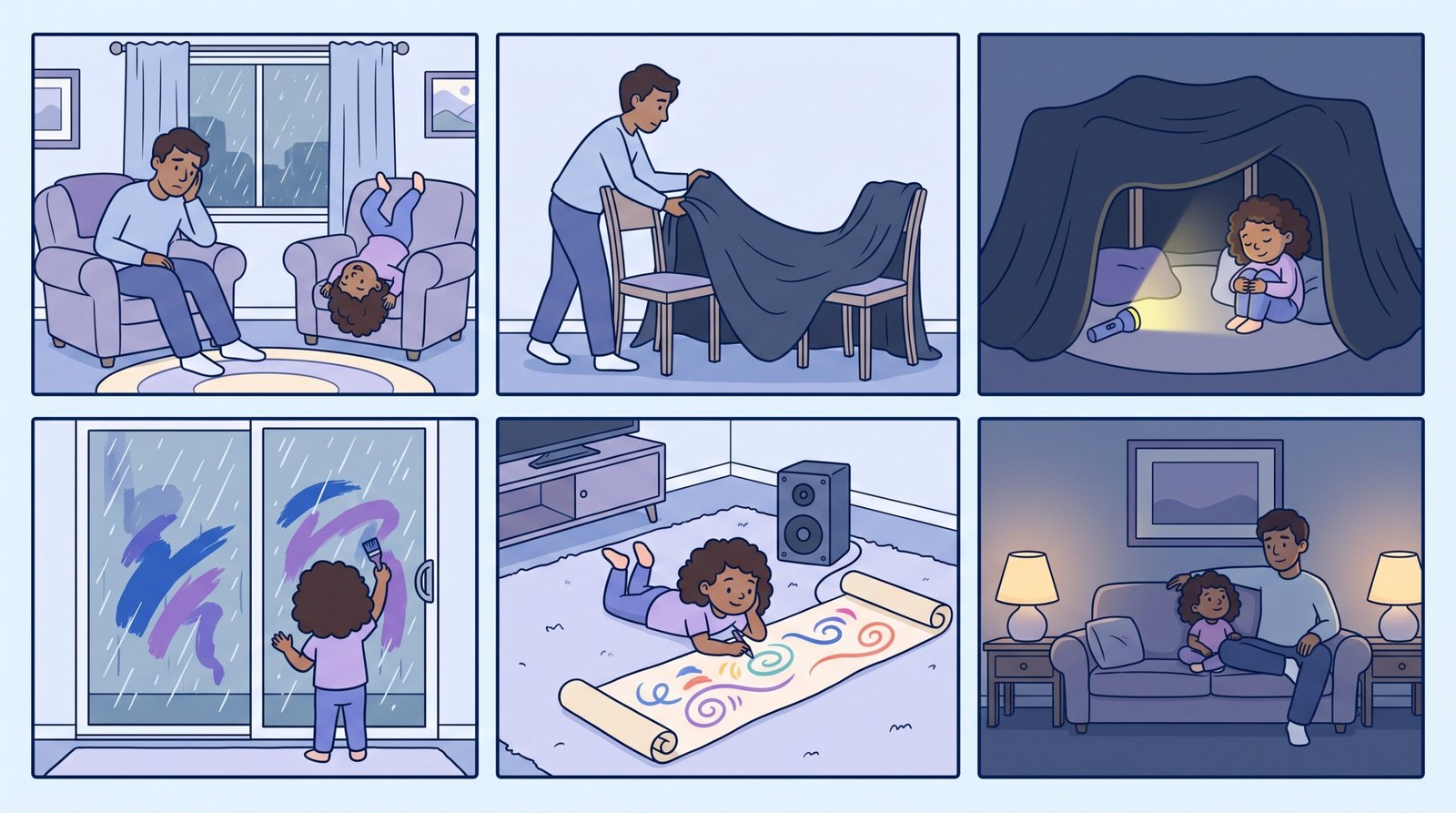
It was 10:42 am on a Saturday, and it was Day 3 of relentless, grey, horizontal rain.
The air inside the house felt thick, warm, and distinctly sour from damp laundry draped across three clothes airers in the hallway. Outside, the guttering was overflowing, sending a steady, rhythmic splatter against the lounge room windowpane that had long stopped being soothing and was now grinding away at my last raw nerve.
My four-year-old daughter was lying horizontally across the living room armchair, head hanging off the edge upside down, kicking the timber armrest with her bare heels.
Thump. Thump. Thump.
“I’m bored. Mummy, I’m bored. Can we go to the park? Why can’t we go to the park? Watch this. Look at my mouth. Mummy, can I have an ice block? What can we do right now? Can I jump off the couch? I want to jump off the couch.”
“Sweetheart, feet down, please. Remember our rule about furniture.”
Two seconds later, she was standing upright on the cushions, swaying, ready to launch her body toward the coffee table.
She wasn’t trying to be defiant. Her little body was vibrating with unspent physical energy that had nowhere to go. She had spent seventy-two hours within the same four plasterboard walls, and every minor frustration was escalating into an emotional emergency. Five minutes earlier, she had dissolved into hysterical, breathless tears because a blue plastic peg had rolled underneath the sofa where she couldn’t reach it.
My own brain, navigating the loud, cluttered fog of adult ADHD, was on complete sensory overload. The TV had been running for two hours earlier that morning, but rather than calming things down, it had left her glazed, irritable, and prone to explosive meltdowns the second the screen went black. The kitchen bench was buried under half-finished colouring pages, dry marker pens without lids, and cold mugs of tea I had forgotten to drink.
I looked at the hallway cupboard. I looked at the dark rain sheeting down the glass.
I felt that familiar, heavy dread of an indoor weekend: How on earth are we going to survive another eight hours of this without everyone losing their temper?
I didn’t need another generic list of fifty craft projects that took twenty minutes to prepare and held her attention for ninety seconds. I didn’t have the bandwidth to build an elaborate obstacle course.
I took a breath, stepped past the laundry airer, and walked to the linen press. I pulled down the heaviest woollen blanket from the top shelf, grabbed two timber dining chairs, and reached for the small LED torch sitting in the pantry drawer.
I didn’t say a word. I just draped the dark wool over the chairs, crawled inside the shadowy cave, turned on the beam of light, and waited. That simple choice proved that practical rainy day activities preschoolers at home can rely on do not need to be complicated; they just need to regulate an overloaded nervous system.
Why Rainy Days Hit Harder Than We Expect Movement starvation, sensory monotony, and mounting tension
When bad weather traps a family indoors for multiple consecutive days, parents often blame themselves for the mounting household friction. We assume we aren’t creative enough, patient enough, or organised enough.
In reality, the tension that builds during prolonged wet weather is rooted in basic human biology:
- Reduced Movement Starves the Nervous System: Young children regulate their emotional balance through large-muscle movement. Running, jumping, balancing on logs, and carrying heavy sticks deliver continuous proprioceptive and vestibular feedback to the brain. This input grounds autonomic arousal. When rain keeps children inside, that physical outlet vanishes. According to clinical guidance from the American Academy of Pediatrics (AAP), daily physical activity is essential for healthy emotional regulation, attention span, and impulse control in early childhood. Without large-motor expenditure, excess energy manifests as restless agitation, boundary pushing, and emotional volatility.
- Monotonous Sensory Profiles: Outdoors, the sensory environment changes second by second: cool breezes, rustling leaves, bird calls, shifting light, and varied ground textures underfoot. This natural variation satisfies the brain’s sensory appetite effortlessly. Indoors, the sensory profile is flat, artificial, and repetitive. Developmental research from Harvard Health Publishing shows that sharp declines in active physical exploration directly increase restlessness, hyperactivity, and behavioural challenges in young children.
- The Cumulative Strain of Enclosure: By Day 2 or 3 of confinement, everyone’s emotional margin for error shrinks. As demonstrated by the Harvard Center on the Developing Child, the physical environment exerts a direct influence on emotional resilience and executive function. When living rooms become crowded with laundry, scattered toys, and restless bodies, the stress response system triggers more rapidly, making intentional rainy day activities preschoolers at home can settle into an absolute priority.
What Children Actually Need Indoors (Not More Activities) Designing for sensory containment, autonomy, and manageable stimulation
The standard internet answer to wet-weather boredom is to flood parents with massive listicles: 50 crafts using dry pasta, 30 sensory bins with shaving foam, 25 indoor games for toddlers.
This approach consistently backfires because it misdiagnoses what an indoors child is experiencing.
Your child does not need a non-stop carnival of entertainment. When an overstimulated preschooler is presented with elaborate, multi-step projects, their frustration usually spikes. If an activity has too many rules, requires high precision, or depends on constant adult direction, it overloads their already depleted working memory.
Sensory Down-Regulation
Before a child can listen, draw, or cooperate, their nervous system must feel physically settled. Play must either discharge motor energy safely or provide deep, calming sensory containment.
Genuine Autonomy
Indoor confinement feels restrictive because children lose their agency under constant adult boundaries. Effective indoor invitations offer open-ended materials where there is no single “wrong” outcome.
By removing bright flashing toys, cluttered tables, and performance pressure, effective rainy day activities preschoolers at home use quiet textures, dim lighting, and steady physical feedback to help young bodies downshift out of fight-or-flight into restorative play.
Rainy Day Activities Preschoolers at Home Need for Regulation Three restorative invitations that calm busy minds and protect your sanity
Rather than an exhausting list of random crafts, here are three deeply regulating rainy day activities preschoolers at home can turn to during long stretches of bad weather.
Each setup targets a different developmental need: sensory containment, standing motor release, and focused imaginative processing.
1. Flashlight Blanket Forts: Sensory Safety and Spatial Containment
When children spend days inside open, cluttered rooms, their spatial awareness becomes unmoored. The room feels too big, too bright, and visually overwhelming. Constructing an intimate, enclosed shelter creates an immediate sensory cocoon that filters out household noise.
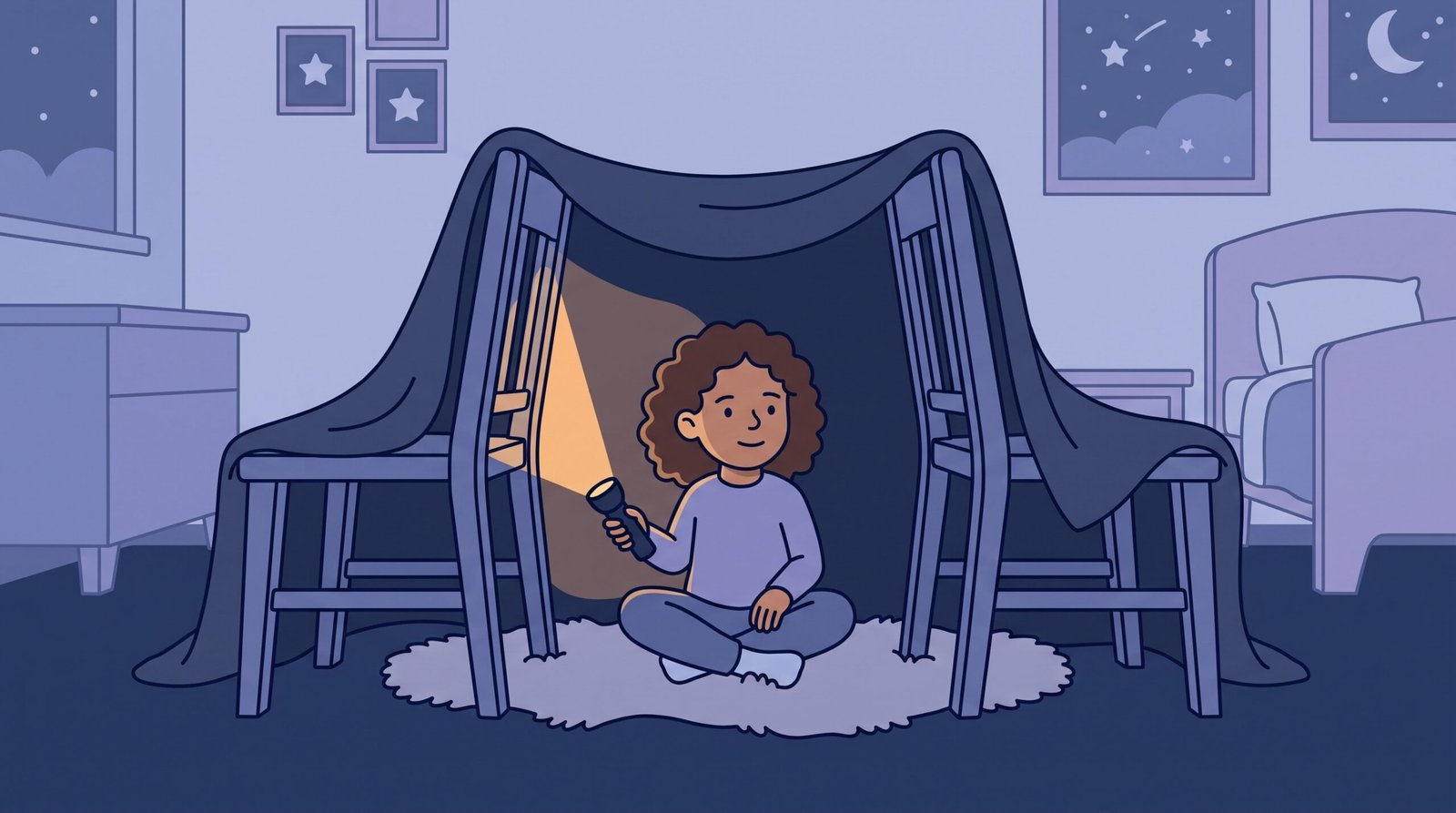
- Why It Works: A blanket fort shrinks the child’s immediate horizon to a manageable scale. Draping a heavy woollen blanket over two dining chairs eliminates 80% of the visual and acoustic distractions in the room. The subdued light signals the autonomic nervous system to soften. As research from the Harvard Center on the Developing Child emphasises, physical environments that feel secure, predictable, and contained actively support emotional self-regulation, providing children with a tangible buffer against sensory overload.
- The Simple Setup: Position two heavy dining chairs back-to-back, about one metre apart. Drape a thick woollen blanket, dark quilt, or fitted sheet across the top. Anchor the corners with heavy books or wooden pegs. Place a soft pillow or folded woollen rug on the floor inside, and hand your child a child-safe torch or battery-operated lantern.
- What to Do: Keep it delightfully low-key. Crawling into the dim space with your child for just three minutes shifts the entire atmospheric pressure of the house. Let them illuminate the woollen roof, cast hand shadows, or bring in a single soft toy. The enclosed boundary naturally suppresses the impulse to sprint and climb, replacing chaos with quiet, grounded observation.
2. Window Painting: Controlled Messy Creativity on Vertical Glass
When children are cooped up, their bodies crave large-muscle arm movements. Insisting they sit quietly at a table to colour inside small lines often triggers resistance. Window painting allows them to stand tall and work on a broad, vertical surface while enjoying natural outdoor daylight.
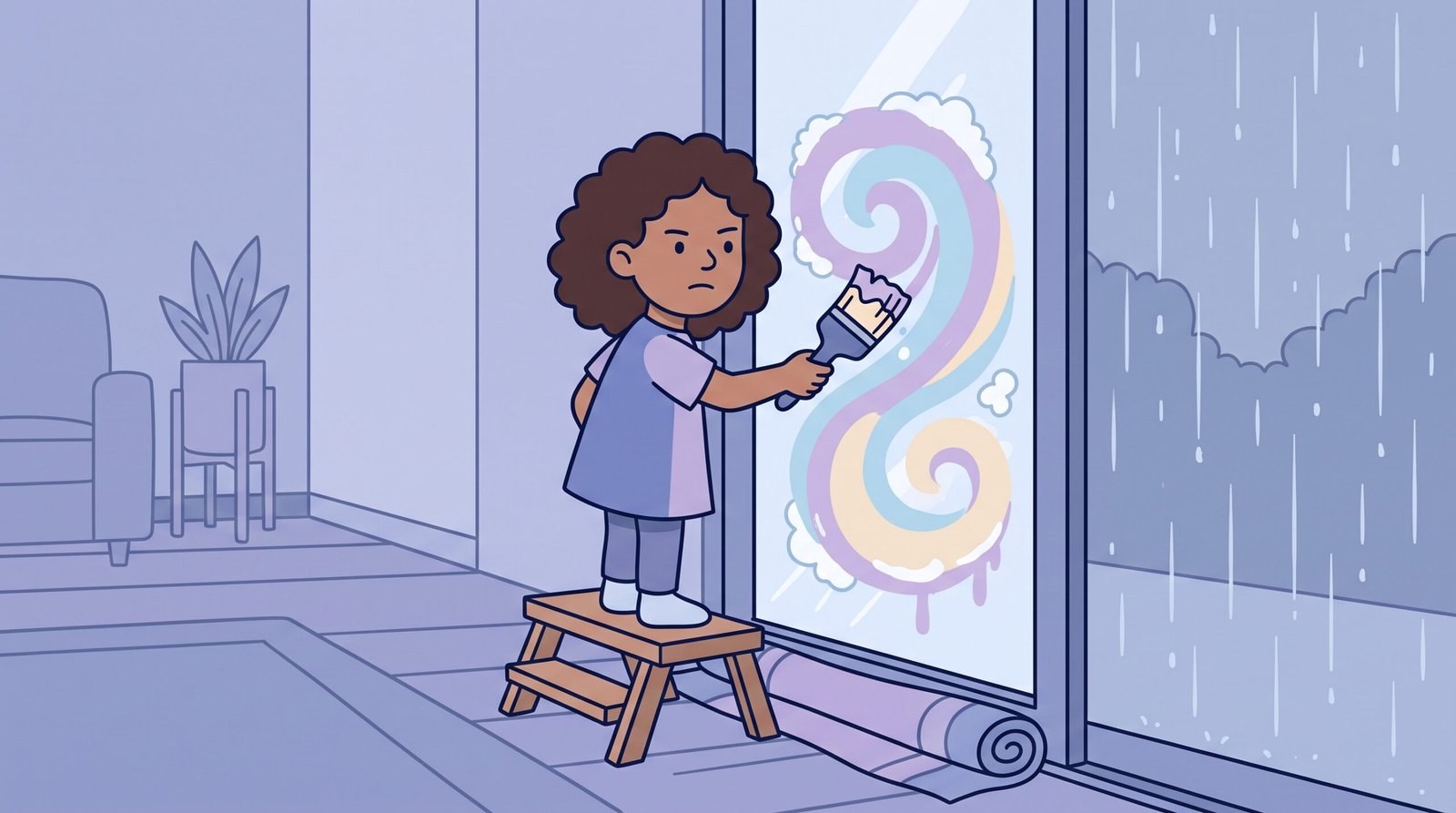
- Why It Works: Painting on a vertical plane recruits the core, stabilises the shoulder girdle, and encourages natural wrist extension. This provides deep proprioceptive feedback that soothes restless energy. Watching bright, opaque colour glide across cool glass against the backdrop of real raindrops trickling down the outside pane is visually captivating. Because glass is non-porous, cleanup is fast and effortless.
- The Foolproof Recipe: Mix two tablespoons of washable tempera or children’s poster paint with one tablespoon of standard dishwashing liquid and a tiny splash of water. The dishwashing liquid breaks the surface tension so the paint spreads smoothly onto the slick glass, and ensures the entire design dissolves instantly the moment a damp sponge touches it.
- The Setup: Lay an old bath towel along the floor beneath a low window or glass sliding door to catch drips. Pour two or three colours into an old muffin tin or plastic lids, and hand your child a wide brush or small foam roller.
- The Creative Release: Let them paint the rain outside. Encourage sweeping circular strokes, giant raindrops, or long vertical lines. According to guidelines from the National Association for the Education of Young Children (NAEYC), open-ended, process-focused creative art supports emotional expression and flexible thinking because children are free from the anxiety of producing a perfect finished product. When they are done, handing them a damp cloth or a spray bottle of water turns the cleanup into an equally engaging water activity.
3. Audio-Story Drawing: Auditory Focus and Symbolic Expression
Reaching for the television remote during long rainy afternoons is completely understandable, but high-frame-rate screens often leave sensitive preschoolers dysregulated. Audio stories, by contrast, invite internal visual imagination without the blue-light fatigue.
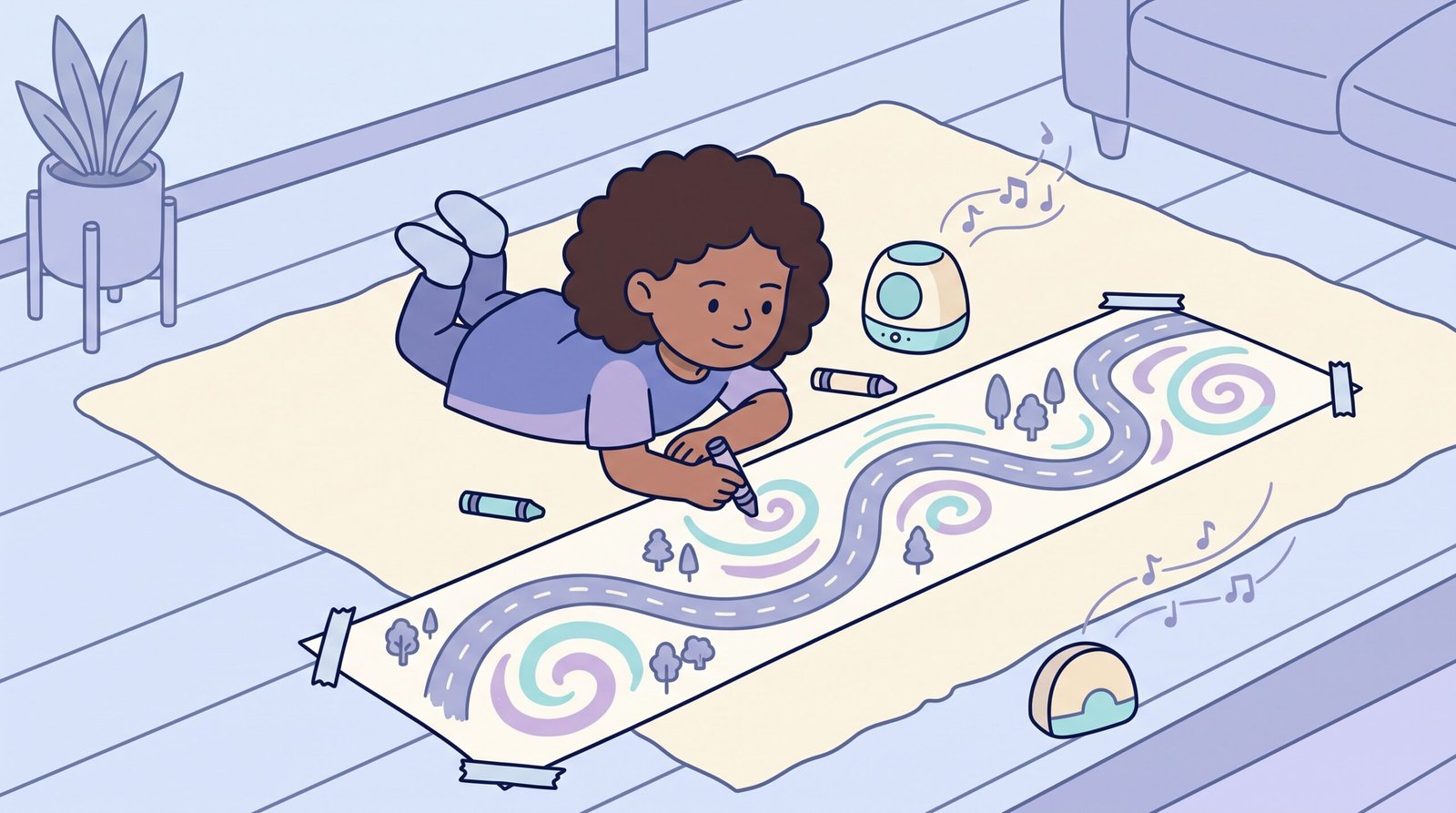
- Why It Works: Listening to a spoken narrative requires the brain to construct its own mental pictures. Pairing this auditory task with a repetitive sensory-motor activity like drawing or scribbling anchors a child’s attention in a calm, rhythmic state, providing a steady bridge out of cabin fever.
- The Simple Setup: Tape a long strip of butcher paper, greaseproof baking paper, or the back of leftover wrapping paper directly to the floorboards or dining table using painter’s tape. Set out a tin of chunky beeswax crayons or soft coloured pencils. Put on a calm, well-narrated audio story, children’s podcast, or audio picture book.
- What to Do: Avoid rigid instructions like “draw the animal in the story.” Instead, invite open-ended mark-making: “Listen to the storm in the story. Can you make your crayon dance across the paper like thunder?” The child can scribble fast during dramatic scenes or make slow, winding tracks during quiet chapters. Clinical guidance from the American Academy of Pediatrics (AAP) confirms that rich storytelling environments support advanced language comprehension and cognitive integration far more effectively than passive screen viewing.
What Children Learn When the Pressure Drops Away Cognitive schema, emotional regulation, and motor development
It is easy to look at a four-year-old curled inside a dark den or swiping soapy colour across a windowpane and wonder whether anything meaningful is happening developmentally.
Yet underneath these quiet moments, your preschooler is building vital cognitive and emotional foundations:
| What the Child Does Indoors | The Underlying Developmental Concept | Long-Term Growth Benefit |
|---|---|---|
| Retreating into a dark blanket fort | Interoceptive self-care and autonomic regulation. | Developing lifelong strategies to identify and calm sensory overload. |
| Painting on vertical window glass | Wrist extension, core engagement, and shoulder stability. | Fine motor strength and posture needed for pencil control and cutting. |
| Translating audio stories into drawings | Auditory processing and symbolic representation. | Emergent literacy intuition; understanding that marks carry narrative meaning. |
| Wiping down glass with a wet sponge | Bilateral coordination, crossing midline, and closure. | Practical life autonomy, motor planning, and functional responsibility. |
Research from the Raising Children Network (Australia) underscores that young children learn and regulate best through unstructured, imaginative play woven into everyday family life, rather than through rigid adult instruction.
What Happened in My Own Living Room Messy truths, broken expectations, and practical breakthroughs
Despite my background in early childhood education and research, managing prolonged wet weather with my own daughter was an immense learning curve. She has high sensory needs, intense physical drive, and an ADHD profile that turns standard parenting ideas upside down when she is cooped up.
During our first major winter storm, we were locked inside for four solid days. By Day 2, I had tried to run an elaborate sensory bin with dried lentils and plastic cups. Within seven minutes, she had dumped the entire container down the hallway heating duct, danced across the pulses like marbles, and slipped, banging her chin on the skirting board.
I sat on the floor amongst thousands of stray lentils, listening to her scream, and burst into tears myself. My own adult ADHD brain had completely crashed under the weight of visual mess, physical noise, and unrealistic expectations.
The turning point came on Day 3 when I stopped treating bad weather as a test of my teaching ability and started treating it as a sensory challenge.
I turned off the harsh ceiling lights, pulled the dining chairs into a corner, threw a navy blue woollen doona over them, and put a battery-operated torch inside. I crawled in and lay down on my stomach.
My daughter peeked under the blanket, saw the warm yellow beam of light, crawled inside, curled her small body into my side, and didn’t speak for twenty minutes.
She wasn’t being “difficult” earlier in the week; her sensory system had simply been drowning in the visual clutter of our house. That quiet afternoon proved to me that practical rainy day activities preschoolers at home enjoy do not need to be complicated; they just need to provide physical calm.
“Bad weather is not a parenting exam. When I stopped forcing Pinterest crafts and started creating quiet sensory dens, our rainy days shifted from exhausting power struggles into shared pockets of genuine rest.”
Dewi Griffith, PhD, Founder
What Does Not Work: Traps That Add Friction Save your patience and skip these common indoor mistakes
To keep your wet-weather days sustainable, steer clear of these common domestic traps:
- Pulling Out Too Many Toys at Once: When parents see a child wandering restlessly, the natural reflex is to offer more options: Lego bins, puzzle boxes, and dress-up tubs. This creates visual clutter that overwhelms an already dysregulated brain. Keep most toys away in cupboards, offering just one clear invitation at a time.
- Expecting Immediate Serenity: When an overstimulated child steps into a blanket fort or picks up a brush, they do not transform instantly into a quiet monk. Their nervous system needs a five-minute transition buffer to discharge residual tension. Sit quietly nearby and let the environment do its work.
- Forcing Finished Products: If your child smears blue soap across the window with their palms instead of painting a rainbow, let them. The moment you impose adult criteria on rainy day play, you introduce performance stress into a day that is already brimming with tension.
How to Survive Multiple Rainy Days Without Losing Your Mind Practical household adaptations for long indoor stretches
When bad weather stretches into Day 4 or 5, you need realistic operational boundaries to keep the household functioning:
- Dim the Lighting: Bright white downlights stimulate the nervous system. On stormy days, switch off ceiling fixtures and rely on warm table lamps, safe candles on high benchtops, or the soft natural grey light from windows. Lowering the light level instantly softens household energy.
- Schedule Parallel Quiet Rest: Preschoolers do not always need organised entertainment; they frequently need shared physical stillness. Lie on a rug together listening to an audio story, look at books side-by-side, or watch raindrops slide down the windowpane without talking.
- Provide Heavy Proprioceptive Work: If your child is jumping off furniture, redirect that physical energy into safe heavy work: pile cushions on a rug for a crash zone, have them push a laundry basket full of damp towels down the hallway, or play “bear walks” to the kitchen and back.
- Normalise Cabin Fever: Accept that indoor days are naturally slower, messier, and emotionally heavier. Giving yourself permission to do the bare minimum—scrambled eggs for dinner and an extra quiet rest—is not a failure; it is wise parenting.
Expanding Your Low-Stress Play Toolkit Simple sensory solutions across your home
Having a variety of simple, contained routines prevents you from having to invent ideas on the spot when cabin fever strikes:
- When the late-afternoon unravel hour hits the kitchen, turn to our step-by-step guide on sink water play for preschoolers using warm tap water and kitchen tools.
- Keep tactile exploration safe on your living room rug with our tested strategies for low mess sensory bins for preschoolers that protect your carpet.
- Turn pantry staples into exciting cause-and-effect science right at the bench with our favourite preschool kitchen science experiments.
- Transform delivery packaging into hours of independent spatial exploration with our practical cardboard play ideas for preschoolers.
Looking for Grounding, Low-Mess Activities for Restless Days?
When you need quiet, table-based activities that soothe busy minds and build fine motor precision without living room mess, our Montessori-inspired story tracing printables offer a peaceful, structured transition.
Explore Calm Story Tracing BundlesReferences & Research Foundations Credible developmental, paediatric, and early learning research
- American Academy of Pediatrics (AAP). (2018). The Power of Play: A Pediatric Role in Enhancing Development in Young Children. Clinical Report. aap.org
- Harvard Health Publishing. (2018). The importance of movement and physical play for emotional self-regulation in young children. Harvard Medical School. health.harvard.edu
- Center on the Developing Child at Harvard University. (2014). Enhancing and Practicing Executive Function Skills with Children from Infancy to Adolescence. Harvard University. developingchild.harvard.edu
- National Association for the Education of Young Children (NAEYC). (2020). Expressive Arts and Early Inquiry Through Open-Ended Materials. naeyc.org
- Raising Children Network (Australia). (2024). Indoor play and creative activities for preschoolers. Australian Government Department of Social Services. raisingchildren.net.au
This article is based on personal family experience parenting an active child with ADHD traits alongside my professional early childhood education research background. It is shared for educational and supportive purposes only and does not constitute paediatric, clinical, or medical advice. Every child has unique sensory thresholds and developmental patterns. If you have ongoing concerns about your child’s emotional regulation, sensory processing, or motor development, please consult your GP, a paediatrician, or an accredited occupational therapist.