
Pocket Heavy Work Cards: 6 Calming Sensory Exercises for Meltdowns
When a child crashes into sofa cushions, runs wild across the hallway, or unravels completely at three in the afternoon, their nervous system is craving physical feedback. Discover how pocket heavy work cards provide deep proprioceptive input to ground an overloaded body before a meltdown takes over.
Table of Contents
- Why Children Crash and Bump at 3 PM
- How Proprioception Calms an Overloaded Nervous System
- Preview: The 6 Pocket Heavy Work Cards Sheet
- The 6 Pocket Heavy Work Cards Explained
- How Parents Can Use the Cards Without Power Struggles
- From Big Movement to Quiet Story: Easing School Anxiety
- Keeping Movement Safe on Living Room Floors
- What Happened on My Own Floorboards
- Download Your Free Pocket Heavy Work Cards
- References & Research Foundations
- Safety & Editorial Disclaimer
Why Children Crash and Bump at 3 PM Sensory seeking, after school restraint collapse, and dysregulation
Around mid-afternoon, many households experience a familiar storm. A child who held it together at kinder or school suddenly walks through the front door, kicks off their boots, and begins hurtling into furniture. They might push aggressively into your legs, jump off armchairs, or stomp around the kitchen shouting.
To an exhausted parent, this looks like defiance or wild hyperactivity. Physiologically, it is often what occupational therapists call sensory seeking. After spending six hours holding their body still and processing endless auditory and visual stimuli, the child’s brain loses its internal sense of where the body is in space.
Telling an overstimulated child to simply sit down and use their quiet voice almost never works. Their brain is screaming for physical resistance to help it feel anchored. Using targeted pocket heavy work cards gives them a clear, playful outlet to find that input without turning the lounge room into a demolition zone.
Verbal Commands to Settle (High Friction)
Demands cognitive filtering when the brain is already depleted. Spikes frustration, triggers fight-or-flight defensiveness, and ignores the body’s physical need for input.
Proprioceptive Heavy Work (Low Friction)
Provides direct compression to muscles and joints. Sends calming signals to the central nervous system, naturally lowering heart rate and sensory arousal.
How Proprioception Calms an Overloaded Nervous System The biological science behind joint compression and muscle work
Proprioception is our internal body awareness sense. Receptors located in our muscles, tendons, and joints tell our brain where our limbs are without us having to look at them. When these receptors fire during pushing, pulling, carrying, or contracting muscles, the brain receives deep organising feedback.
Dr A. Jean Ayres, the pioneer of Sensory Integration theory, demonstrated that proprioceptive input has an inherent regulating effect across all sensory systems. Unlike spinning or swinging (vestibular input), which can sometimes over-excite a sensitive child, heavy muscle work acts as a neurological brake. It releases serotonin and dopamine while dampening an overactive sympathetic fight-or-flight response.
When you introduce pocket heavy work cards, you are not asking your child to follow an exercise regime. You are handing their nervous system a physiological reset tool that restores felt safety.
| Card Movement | Primary Sensory Input | Calming Nervous System Benefit |
|---|---|---|
| Bear Walk | Weight-bearing through wrists, shoulders, and hips | Grounds spatial awareness and provides heavy bilateral muscle resistance. |
| Crab Crawl | Core muscle extension and shoulder girdle stability | Strengthens trunk stability while engaging full-body balance. |
| Wall Push | Isometric joint compression through arms and spine | Allows intense physical exertion without running or moving across the room. |
| Turtle Tuck | Full-body flexion and sensory cocooning | Cuts off overwhelming visual stimuli and brings heart rate down to rest. |
| Kangaroo Hop | Controlled two-foot landings through ankles and knees | Satisfies the need for jumping while enforcing soft, grounded landings. |
| Quiet Palm Press | Bilateral chest-level isometric compression | Centres autonomic breathing and completes the motor regulation cycle. |
The 6 Pocket Heavy Work Cards Explained Storybook movements designed to lower arousal without clinical stress
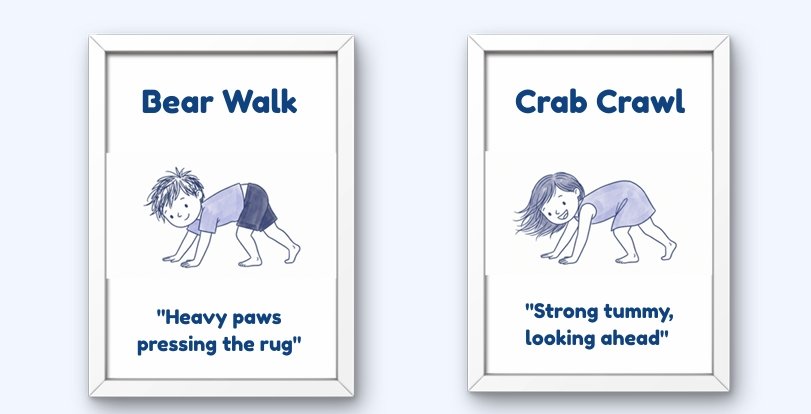
Rather than clinical therapy diagrams that make a child feel like a patient, our printable cards feature our recurring storybook characters—the spiky-haired boy and the windswept girl—demonstrating each posture with warm, calm simplicity.
1. Bear Walk
The spiky-haired boy walks on hands and feet across the rug with his hips lifted high. The cue: “Heavy paws pressing the rug.” Keeping arms and legs relatively straight sends firm, continuous weight into wrists and shoulder sockets.
2. Crab Crawl
The windswept girl places her hands and feet behind her, lifting her tummy upward while looking ahead. The cue: “Strong tummy, looking ahead.” This inverted position gives powerful feedback to the back of the neck, spine, and hamstrings.
3. Wall Push
Standing firmly with flat palms against a solid wall, elbows slightly bent. The cue: “Push the strong wall away.” This isometric exercise allows a child to push with every ounce of strength without moving an inch or knocking anything over.
4. Turtle Tuck
Curling forward onto knees, tucking arms around the sides, forehead resting gently on the rug. The cue: “Curled up cosy in my shell.” This flexion pose shuts out bright room lights and creates a snug, protected shell.
5. Kangaroo Hop
Hands tucked gently by the chest like paws, bending knees and landing on both feet simultaneously. The cue: “Spring up, land softly.” The emphasis is on the soft, controlled landing, which delivers joint compression through the lower body.
6. Quiet Palm Press
Sitting cross-legged, pressing palms flat together in front of the chest, taking a slow breath. The cue: “Press palms, steady breath.” This isometric reset marks the transition from big body movement to peaceful quiet play.
How Parents Can Use the Cards Without Power Struggles Low demand scripts and gentle connection techniques
How you introduce pocket heavy work cards determines whether they calm your child or trigger immediate demand avoidance. Here are practical ways to weave them into daily life:
1. Offer Choices Rather Than Demands
Never say: “You are out of control, go do your wall pushes.” That phrasing instantly triggers shame and defensiveness. Instead, kneel down with two cards in your hand: “Your body has big energy right now. Would you like to do a heavy bear walk or a turtle tuck with me?” Giving autonomy keeps connection alive.
2. Body Double on the Floor
Do not stand over your child giving instructions. Get down on the rug and do the crab crawl or push the wall right beside them. Children mirror our autonomic state. When they see you doing the movements with a relaxed jaw and steady breath, their nervous system follows your lead.
3. Keep Them Accessible on a Ring Clip
Punch a small hole in the top corner of each card and thread them onto a simple metal binder ring. Hang them by the hallway shoe rack, keep them in your handbag, or leave them on the coffee table. Having them within arm’s reach means you can hand a card to your child the moment you notice early sensory seeking.
From Big Movement to Quiet Story: Easing School Anxiety Pairing physical regulation with emotional reassurance
Once your child has worked through heavy joint compression and finished with the Quiet Palm Press, their heart rate settles and their body feels anchored. This post-movement window is the golden moment for emotional co-regulation.
For many children, after-school restlessness or morning freeze is driven by deep school anxiety—worrying about being away from home, navigating big classroom expectations, or feeling different. Grounding their muscles opens up space to read together, talk about their day, and build confidence.
Personalised First Day of School Book | Wobblin Storybook
If big school transitions trigger morning hesitation or afternoon meltdowns, pairing your heavy work cards with our personalised storybook creates a soothing bridge between home and classroom. Customised with your child’s name, this gentle story normalises wobbles, validates first-day nerves, and reminds them that home is always waiting at the end of the day.
A meaningful back-to-school gift designed specifically to support school anxiety through felt safety, warmth, and low-pressure connection.
View on Etsy Australia →Keeping Movement Safe on Living Room Floors Floor surfaces, sharp corners, and slip prevention
Child Safety & Living Room Hazard Notes
Because heavy work involves pushing, crawling, and controlled hopping, setting up a safe physical environment is essential:
- Clear Floor Space: Always check that the rug or floor area is free of loose toys, pencils, and hard plastic blocks before starting bear walks or crab crawls.
- Socks Off for Grip: Running and hopping in cotton socks on polished timber or tiled floors causes slips and falls. Take socks off so bare feet can grip the floor securely.
- Round Laminated Card Corners: If you laminate your pocket cards for durability, use a corner rounder punch or scissors to smooth all four points. Cut plastic edges can easily scratch hands or faces during active movement.
- Solid Walls Only: For wall pushes, ensure children press against solid brick or stud walls, away from freestanding mirrors, glass doors, or unstable bookshelves.
What Happened on My Own Floorboards Discovering the power of joint compression when words stopped working
For months, our three o’clock transitions were a minefield. My child would arrive home from kindergarten looking pale and exhausted, only to start sprinting laps around our dining table, banging into door frames, and dissolving into tears over the slightest request.
I tried quiet time on the couch. I tried putting on gentle music. I tried offering snacks. None of it helped because his muscles were starved of deep pressure. The afternoon I finally stopped talking, crouched down, placed my hands on the hallway wall, and said, “This wall feels heavy today, can you help me push it back?” everything shifted.
He leaned his entire body weight into the plaster beside me, gritting his teeth and pushing with all his might. After thirty seconds of intense isometric effort, his shoulders dropped three inches. He let out a long sigh, slid down the wall to sit on the floorboards, and calmly asked for an apple. That was the moment I realised: the body needs to reset before the thinking brain can return.
“A child crashing into your sofa is not asking for discipline. Their body has lost its borders in space, and they are using impact to find where their edges begin. Offer them heavy resistance, and their nervous system will find its way back to calm.”
Dewi Griffith, PhD, Founder
Download Your Free Pocket Heavy Work Cards
Get our calm, printable 6-card sensory regulation set featuring minimalist navy ink art, soft watercolor tones, and gentle storybook cues. Perfect for pocket rings, classrooms, and home calm-down corners.
Download Free Printable PDF (A4 Sheet)References & Research Foundations Sensory integration, proprioceptive processing, and motor regulation
- Ayres, A. J. (1972). Sensory Integration and Learning Disorders. Western Psychological Services.
- Blanche, E. I., Bodison, S., Chang, M. C., & Reinoso, G. (2012). Development of the Comprehensive Observations of Proprioception (COP). American Journal of Occupational Therapy, 66(6), 691-698.
- Case-Smith, J., & O’Brien, J. C. (2014). Occupational Therapy for Children and Adolescents. Elsevier Health Sciences.
- Porges, S. W. (2011). The Polyvagal Theory: Neurophysiological Foundations of Emotions, Attachment, Communication, and Self-regulation. W. W. Norton & Company.
- Reisman, J. E. (1993). Using a touch pressure protocol to reduce sensory defensiveness in children. American Journal of Occupational Therapy, 47(12), 1063-1070.
This article reflects personal parenting experience alongside established occupational therapy research and is provided for educational purposes only. It does not replace individualized clinical assessment by an occupational therapist or pediatrician. Ensure all physical movements are completed on safe, non-slip surfaces under supportive adult supervision.