
ADHD Behaviour Strategies: 4 Powerful Reasons Behaviour Charts Fail
Re-evaluating our core ADHD behaviour strategies begins with confronting an uncomfortable truth: visual reward ladders, star charts, and point economies do not build self-regulation in neurodivergent children—they systematically break it down.
Effective ADHD behaviour strategies shift the intervention away from extrinsic motivation systems (stickers, tokens, and consequence ladders) toward environmental scaffolding and autonomic nervous system co-regulation. Behaviour is not an issue of willpower; it is an issue of capacity, sensory load, and executive function gating.
- The Sticker Chart Paradox: Why Good Intentions Backfire
- 4 Powerful Reasons Behaviour Charts Fail Neurodivergent Children
- The Dopamine and Executive Function Gap
- 4 Practical ADHD Behaviour Strategies to Replace Charts
- Real-World Application: The Morning Routine Shift
- Connected Guides in the Regulation Cluster
- Academic References & Scientific Sources
The Sticker Chart Paradox: Why Good Intentions Backfire
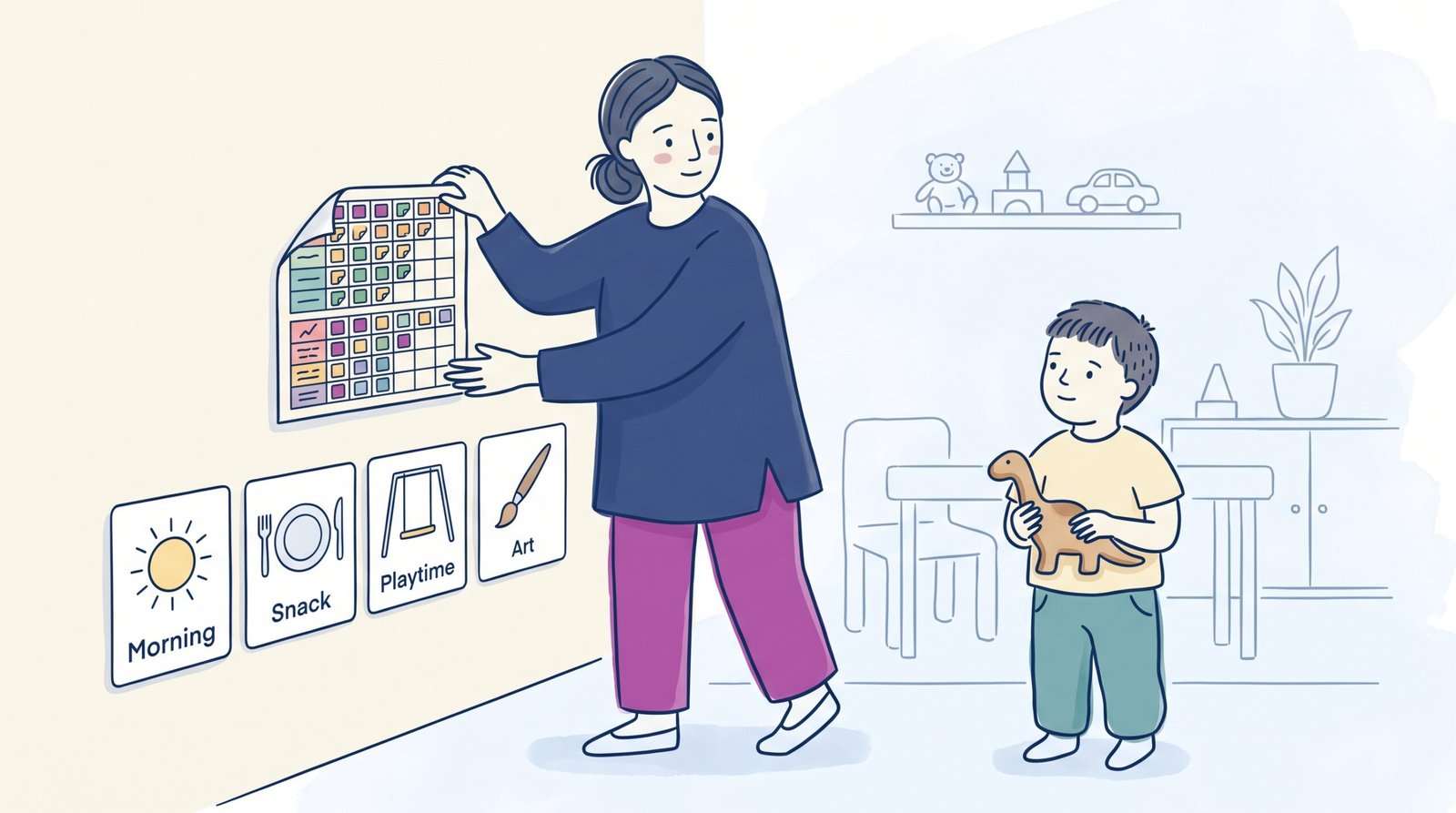
Walk into almost any early childhood room, preschool, or family home across Australia, and you are likely to see one: a brightly coloured laminated chart stuck to a wall or refrigerator door. It has rows for “Listening Ears,” “Gentle Hands,” “Sitting on the Mat,” and “Packing Away Toys.” At the start of the week, clean grids promise gold stars, smiley face magnets, or Friday prize box tokens.
For a neurotypical child with predictable executive function, high working memory capacity, and typical dopamine regulation, a chart works reasonably well as a visual reminder. But when applied to children with Attention Deficit Hyperactivity Disorder (ADHD), Autism, or sensory processing differences, traditional charts almost inevitably collapse by Wednesday afternoon.
When the child fails to earn their sticker, adults double down. We assume the reward wasn’t exciting enough, the consequence wasn’t sharp enough, or the child was simply being stubborn.
Under Australia’s Early Years Learning Framework (EYLF), educators are charged with fostering authentic belonging and emotional wellbeing. Modern ADHD behaviour strategies acknowledge that behaviour is communication. When an ADHD child throws a pencil or bolts from a group mat, they are demonstrating a breakdown in nervous system regulation, not an absence of desire to please the adult in the room.
4 Powerful Reasons Behaviour Charts Fail Neurodivergent Children
To implement genuine, sustainable ADHD behaviour strategies, we must dissect the four mechanical flaws that make visual behaviour charts counterproductive for neurodivergent nervous systems.
| Design Assumption of Charts | Neurological Reality of ADHD | Practical Behavioral Consequence |
|---|---|---|
| 1. Temporal Consistency: Assumes skill execution is consistent across all hours of the day. | Asynchronous Capacity: Executive function fluctuates dramatically based on fatigue, sensory load, and hunger. | The child succeeds at 9:00 AM but experiences complete system collapse at 11:30 AM due to sensory depletion. |
| 2. Delayed Gratification: Assumes a Friday token can motivate an immediate Tuesday impulse decision. | Time Blindness & Myopic Gating: ADHD brains exist largely in the “now” and “not now.” Future rewards lack neurological salience. | The child cannot summon prefrontal inhibition in the moment based on an abstract, distant reward. |
| 3. Public Accountability: Uses visible marker moves (green to yellow to red) to prompt self-correction. | Rejection Sensitivity: Public exposure activates acute sympathetic threat, shunting blood away from the reasoning brain. | Instant escalation into defensive anger, aggression, or catatonic dorsal shutdown. |
| 4. Moral Choice Framing: Views dysregulation as a deliberate choice between good and bad actions. | Involuntary Survival Response: Outward behaviour reflects autonomic threat states governed by lower subcortical circuits. | Deep internalised shame; the child concludes they are fundamentally defective and stops trying. |
1. They Assume Skill Capacity Is Constant
Behaviour charts operate on the flawed assumption that if a child can sit quietly during storytime on Tuesday, they should be able to sit quietly during storytime on Thursday. When they fail on Thursday, adults view it as wilful disobedience.
In neurodivergent profiles, capacity is asynchronous and variable. A child’s ability to inhibit an impulse depends directly on how much cognitive and sensory energy they have already expended trying to filter background acoustic noise, balance their vestibular system on a chair, or process rapid verbal instructions. A chart penalises a child for having an empty neurological battery.
2. They Rely on “Time Blind” Future Rewards
ADHD is fundamentally a disorder of temporal processing and executive function. Russell Barkley famously noted that ADHD creates a “nearsightedness in time.”[1] Telling a four- or five-year-old child that packing away their blocks right now will help them earn a prize on Friday afternoon is like asking an adult to work for payment delivered in five years.
The reward is too distant to generate the necessary dopamine to bridge the executive function gap. When the friction of the immediate task is high, an abstract future sticker possesses zero motivational leverage.
3. They Trigger Acute Rejection Sensitive Dysphoria
Most behaviour charts are inherently public. Whether hung in a kitchen or displayed on a classroom whiteboard, everyone can see who has gold stars and who has empty squares or warning pegs.
Many ADHD individuals experience intense vulnerability known clinically as Rejection Sensitive Dysphoria (RSD)—an extreme emotional response to perceived failure, rejection, or criticism.[2] When a clip is moved down or a star is withheld, the neuroception of the child registers acute social danger. The prefrontal cortex goes completely offline, triggering a catastrophic survival surge: kicking, shouting, running away, or total withdrawal.
4. They Confuse “Won’t” with “Can’t”
Ross Greene’s foundational premise applies directly here: “Kids do well if they can.”[3] If a child had the internal self-regulation, impulse control, and working memory to execute the expected behaviour in that exact environment at that exact second, they would do it.
No child enjoys being the one whose clip is on red. When we use behaviour charts, we are essentially holding up a public scorecard of a child’s neurological disability. Over time, the child stops viewing the chart as a path to success and starts viewing it as formal confirmation that they are “the bad kid.”
The Dopamine and Executive Function Gap
To design functional ADHD behaviour strategies, we have to look beneath the surface behaviour and examine the neurotransmitter dynamics of the ADHD brain.
ADHD brains feature dysregulated dopamine pathways. Dopamine is the primary chemical messenger responsible for motivation, task initiation, working memory gating, and sustained attention. In neurotypical brains, the anticipation of completing a task or pleasing an authority figure triggers an internal release of dopamine sufficient to overcome the initial friction of doing something boring or difficult.
In an ADHD brain, baseline dopamine availability is significantly lower. The brain cannot generate internal motivation for low-interest tasks on command. It requires immediate, high-salience external drivers: novelty, urgency, intense interest, or direct physical engagement.
As documented by neurodevelopmental research from Harvard’s Center on the Developing Child, working memory and inhibitory control do not mature in isolation. They are built through stable adult co-regulation and reduced cognitive load, not through punitive tracking systems.
4 Practical ADHD Behaviour Strategies to Replace Charts
If we take down the charts, what do we put in their place?
Effective ADHD behaviour strategies do not abandon structure, clear expectations, or boundaries. Instead, they shift the focus from documenting failure to scaffolding physiological success. Here are four practical, research-backed alternatives you can implement immediately:
1. Point-of-Performance Visual Sequences
Instead of an abstract reward chart hung on the wall, place visual prompts directly where the action occurs. If a child struggles to unpack their kindergarten bag, do not track “good unpacking” on a star chart. Place three simple, laminated photo cards on their locker:
- 1. Bag on hook.
- 2. Water bottle in basket.
- 3. Hat in pigeonhole.
This offloads working memory at the exact moment of execution, eliminating the need for adults to repeat verbal reminders eight times.
2. The “Start Together” Body Doubling Technique
Task initiation is one of the highest friction points for ADHD brains. Demanding that a child “go clean your room” or “pack up the construction blocks” triggers instant executive paralysis. The task looks massive, overwhelming, and impossible to sequence.
Use physical co-regulation and body doubling: “I will hold the basket; you find three blue blocks.” Once the physical momentum begins, the dopamine friction drops, and the child’s nervous system can take over the remaining task.
3. Heavy Work Transitions
Much of what gets labelled as “disruptive behaviour” in early childhood is actually sensory seeking or vestibular dysregulation. Before demanding that an ADHD child transition into a sit-down task, embed proprioceptive “heavy work”:
- Carrying a heavy basket of library books to the reading corner.
- Pushing down firmly against a doorway or executing wall pushes.
- Crawling through an obstacle course or animal walking to the rug.
Proprioceptive input sends rapid, stabilizing neural feedback to the central nervous system, naturally reducing motor restlessness without verbal discipline.
4. Low-Demand Nervous System Connection
When an ADHD child begins escalating—shouting, knocking over chairs, or arguing—stop issuing behavioural warnings. Drop your physical stature, sit sideways on the floor at a safe distance, and lower your vocal volume.
Validate their physiological reality before addressing the boundary: “Your body feels really loud and fast right now. You are safe. I am right here.” Only after their autonomic breathing returns to baseline do you quietly address what went wrong.
Real-World Application: The Morning Routine Shift
To see how these ADHD behaviour strategies transform daily reality, examine how a typical morning routine changes when you shift away from extrinsic tracking:
The Traditional Chart Approach (High Friction, Daily Failure):
- Adult stands in the hallway repeating: “Put your shoes on! Remember, you won’t get your morning star if you don’t hurry up!”
- Child is distracted by a stray Lego brick; their internal time-tracker registers no urgency.
- Adult raises voice: “That’s it, you’ve lost your star for today!”
- Child experiences acute rejection sensitivity, kicks the shoe across the hall, and dissolves into a 45-minute screaming meltdown.
- Family arrives at school late, emotionally exhausted, and flooded with mutual guilt.
The Neurodivergent Learning Design Approach (Low Friction, Sustainable):
• Reduce Choice Overload: Shoes are always stored in the exact same open, labeled tub right next to the front door, not tucked away in a dark wardrobe.
• Body Doubling: The adult sits on the bottom stair next to the shoe tub putting on their own footwear: “Shoe time together. Left foot first.”
• Sensory Check: Adult checks if the socks have irritating seams or if the shoes feel too tight before assuming the child is refusing to cooperate.
• Outcome: Shoes are on in 90 seconds. No stars were awarded, no threats were made, and both adult and child arrive at school with their nervous systems intact.
• Learn our step-by-step physical de-escalation protocol in Child Meltdown Co-Regulation: 3 Powerful Steps →
• Decode subtle somatic warning signals before meltdowns occur in Fight, Flight, and Freeze in Children Decoded →
• Return to our cluster foundation for broader models on Regulation and Behaviour in Early Childhood →
Academic References & Empirical Frameworks
- Barkley, R. A. (2012). Executive Functions: What They Are, How They Work, and Why They Evolved. Guilford Press. [Temporal myopic processing and working memory constraints in ADHD].
- Dodson, W. (2016). Emotional Regulation and Rejection Sensitive Dysphoria in ADHD. ADDitude Magazine. [Clinical framework for autonomic vulnerability to perceived failure].
- Greene, R. W. (2014). Lost at School: Why Our Kids with Behavioral Challenges Are Falling Through the Cracks and How We Can Help Them. Scribner.
- Kohn, A. (1993). Punished by Rewards: The Trouble with Gold Stars, Incentive Plans, A’s, Praise, and Other Bribes. Houghton Mifflin.
- Shanker, S. (2016). Self-Reg: How to Help Your Child (and You) Break the Stress Cycle and Successfully Engage with Life. Penguin Random House.