
Number Sense Playdough Mats 1 to 10: 3 Simple, Easy Ways to Build Early Maths With Squishy Hands On Play
Number sense playdough mats are printable pages where children make a number with dough: they roll a snake into the numeral shape, squash dough balls into a ten frame, and count the little picture at the bottom. Hands stay busy, pencils stay away, and counting feels like play.
This guide covers why young children need to touch and move numbers, what each part of the mats does, what research says about subitising and fine motor skills, three steps to start, ten games to stretch the mats further, tips for neurodivergent children, important safety notes on choking and homemade dough, our dough and pebble counting in Indonesia, the free 10 page mats PDF, a new Roll and Squish Ten Frame Game and twelve more free PDFs.
A child can say “one, two, three, four, five” long before they understand what five actually is. Squashing five dough balls into a frame, one by one, is where that understanding starts to click.
- How This Page Helps
- Why Young Children Need to Touch Numbers
- Dough Balls and Pebbles in Indonesia
- What’s on Each Mat
- What the Research Says
- 3 Steps to Start
- 10 Ways to Stretch the Mats
- By Age and Stage
- For Neurodivergent Children
- Safety: Choking and Homemade Dough
- For Educators
- Download the Free Mats
- New: Roll and Squish Ten Frame Game
- More Free PDFs
- FAQs
How This Number Sense Playdough Mats Page Helps
- Understand number sense in plain words: knowing what numbers mean, not just saying them in order.
- Use the free mats with three simple steps, then ten games when your child is ready for more.
- Keep it safe, with clear choking and dough safety notes that many printable posts skip.
- Adapt the mats for toddlers, kinder children and neurodivergent children.
- Add a new game board that turns the ten frame into a turn taking game.
There’s one safety fact about homemade playdough that surprises most parents. It’s in the safety section, and it’s worth reading before you mix your next batch.
Why Young Children Need to Touch Numbers
Number sense is a child’s feel for numbers: knowing that five is more than three, that five can be three and two, and that the numeral 5 stands for five things. Counting out loud is part of it, but only part. Plenty of children can recite to twenty without yet knowing that the last number they say tells them how many there are.
Young children build that understanding by doing: moving objects, lining them up, grouping them, seeing them. Flat worksheets ask them to work with symbols before the meaning is in place, and to grip a pencil before their hands are ready. For children who are still building hand strength, or who find sitting still hard, that’s a lot at once.
Counting worksheets
Need pencil control and symbol knowledge first. Little feedback for hands. Easy to get “wrong”, which can make some children avoid maths.
Number sense playdough mats
Hands do the counting. Each dough ball is something you can see and touch. Mistakes squash away. Hand strength grows along the way.
That doesn’t mean worksheets are bad. Later on, they have a place. But for most three to five year olds, numbers make more sense when they’re something you can squeeze.
Dough Balls and Pebbles in Indonesia
Long before these mats existed, back in Indonesia, both my girls counted with their hands. We’d roll little balls of dough and line them up in rows to count them. And we counted pebbles too.
Rows of dough balls and a handful of pebbles: simple things you can move, group and count again. When I designed these mats years later, that’s the feeling I wanted to keep.
The ten frame on each mat is really just a tidy version of those rows. It gives the dough balls a place to go, and it makes amounts easier to see at a glance.
What’s on Each Number Sense Playdough Mat
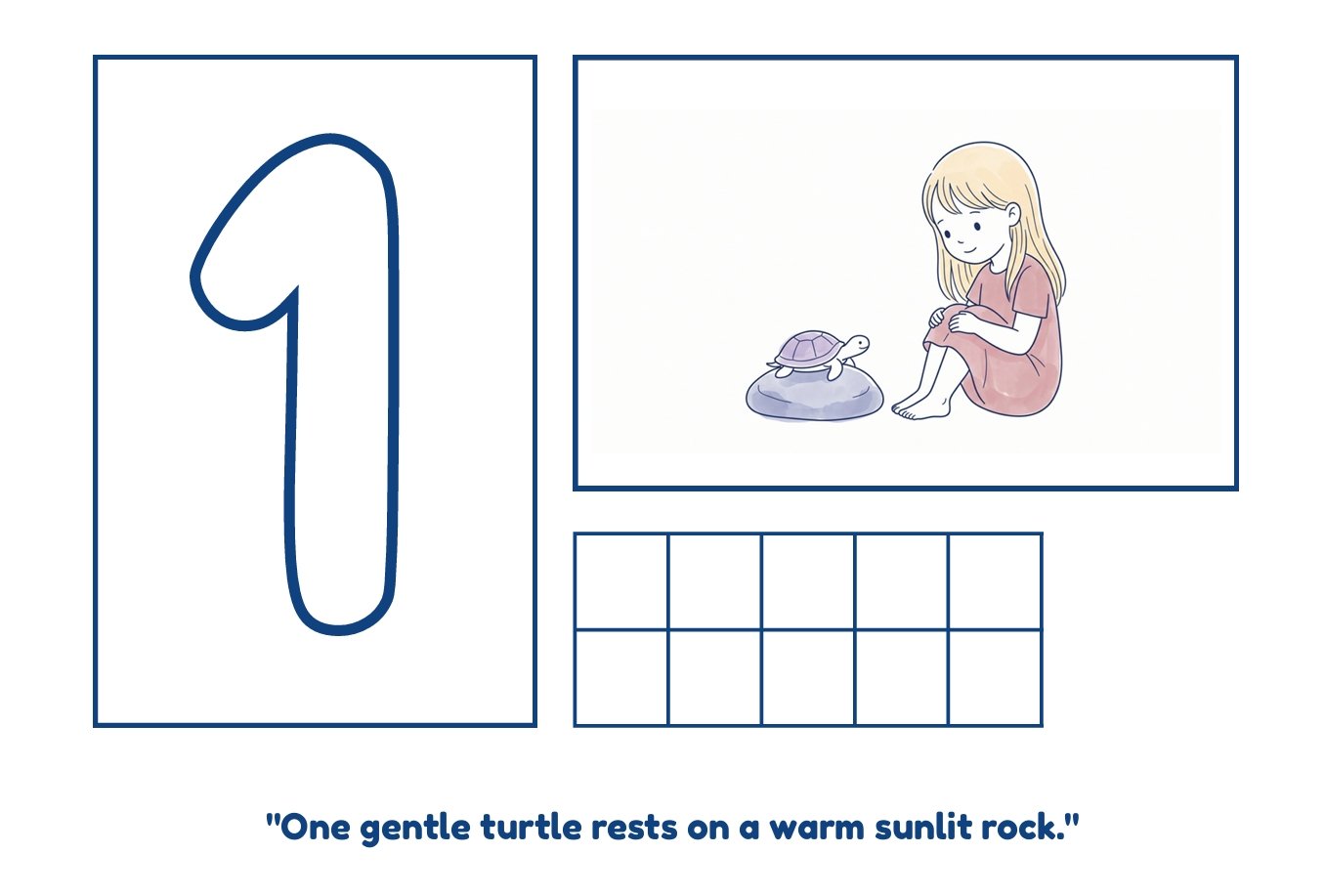
There are ten mats, one for each number from 1 to 10. Each one uses soft blues and navy lines with plenty of white space, so the page isn’t busy for sensory sensitive eyes.
| Part of the mat | What your child does | What it builds |
|---|---|---|
| Large numeral outline | Rolls a dough snake and presses it into the number shape, or traces it with a finger | Knowing what the numeral looks like and how it’s formed, with no pencil |
| Ten frame | Squashes one dough ball into each box, up to the number on the mat | One to one counting, seeing amounts in rows of five, early “how many more to 10” |
| Counting picture | Counts the small objects in the scene, like leaves or stones, with two little story characters | Linking the number to real things |
The Numeral Outline
The wide, hollow number invites children to roll long coils of dough and bend them into the shape. Following the curves and corners with dough helps children notice how numbers are formed, long before they write them. Some children prefer to flatten dough into the shape with their knuckles, and that’s fine.
The Ten Frame
A ten frame is two rows of five boxes. It helps children see amounts without counting every one: five is a full row, seven is a full row and two more. Small amounts up to about four can often be seen at a glance, which is called subitising. The ten frame helps children start to “see” bigger amounts in chunks too.
The Counting Picture
At the bottom of each mat, two story characters find everyday treasures, like three gum leaves or four creek stones. Counting them keeps the number tied to real things, not just marks on a page.
What the Research Says About Number Sense Playdough Mats
Subitising Matters
Douglas Clements describes subitising, seeing how many at a glance without counting, as an important early number skill, and recommends helping children see small amounts in organised patterns, like dots and frames.1
Children Learn Maths Along Paths
Julie Sarama and Douglas Clements describe learning trajectories: children typically move from reciting numbers, to counting objects one by one, to knowing the last number tells “how many”, to seeing and combining groups.2 The mats support several steps on that path, from one to one counting to seeing five and some more.
Hands and Numbers May Be Linked
A study by Ursula Fischer, Sebastian Suggate and Heidrun Stoeger found that preschoolers’ finger dexterity was linked with their number skills, partly through how they used their fingers to show numbers. The authors call the link tentative, so it isn’t proof that playdough improves maths.3 But it fits with the idea that busy hands and early maths go well together.
Early Maths Should Be Playful
A joint position statement from the National Association for the Education of Young Children and the National Council of Teachers of Mathematics encourages early maths experiences that build on children’s play and everyday interests.4
A note on the evidence: there’s good support for hands on, playful early maths, ten frames and subitising. There isn’t research testing these particular mats, or playdough in particular. Treat them as a friendly way to practise counting and number sense, not a programme with guaranteed results.
3 Steps to Start With Number Sense Playdough Mats
Keep it relaxed. Sit on the rug or at the bench, with no lesson plan and no rush.
Roll the Snake
Warm a handful of dough between your palms and roll a long snake together. Invite your child to bend it into the number shape. If they’d rather pinch, poke or flatten, let them. The goal is relaxed, happy hands.
Squish the Ten Frame
Roll small balls. Put one in each box, starting top left, and squash it flat with a thumb. One ball, one squish, one count. Stop at the number on the mat.
Count the Picture Slowly
Count the treasures at the bottom together, with a slow, flat finger touch on each one. Slow touching helps words keep pace with fingers. Then ask, “Is it the same as your dough balls?”
That’s it. Many children will want to do the same number again and again. Repeating is how it sticks, so follow their lead.
10 Ways to Stretch Number Sense Playdough Mats
Once your child is comfortable with the basics, these ideas keep the mats interesting for months. The free Roll and Squish Ten Frame Game PDF adds a turn taking game too, or you can print it from this page.
| Game | How to play | What it builds |
|---|---|---|
| Quick look | Fill the ten frame, cover it with a cloth, lift for two seconds. “How many did you see?” | Subitising |
| One more, one less | Make the number, then add one ball or take one away. “How many now?” | Counting on and back |
| How many more to 10? | Make 7. How many empty boxes are left? | Early addition and number pairs |
| Two colours | Make 5 with two dough colours, like 3 red and 2 blue. Find other ways. | Parts of a number |
| Mat match | Lay out three mats. Make a dough amount. Which mat matches? | Linking amount and numeral |
| Pebble swap | Count large pebbles or chunky blocks instead of dough (see safety notes) | Counting different objects |
| Order the mats | Mix up the mats and line them up from 1 to 10 | Number order |
| Finger show | Show the mat’s number on your fingers too | Finger counting |
| Story count | Make up a story about the picture: “Three leaves fell, then one more…” | Language and number together |
| Jump it | Jump the number on the mat, then check with dough | Counting with the whole body |
For more ideas, see number sense activities, the number line jumping game and maths games for kids. The Subitising Dot Cards pair well with the quick look game, and Ways to Make 5 and 10 takes the two colours game further.
Number Sense Playdough Mats by Age and Stage
Around 2 to 3 years
Squish and poke. Use mats 1 to 3 only. Count together while your child squashes. No need to fill the numeral yet. Supervise closely.
Around 3 to 4 years
Mats 1 to 5. Roll snakes for the numerals. One ball per box. Start the quick look game with 2 or 3.
Around 4 to 5 years
All ten mats. One more, one less. How many more to 10. Two colour ways to make 5.
Starting school
Make number pairs to 10, record with dots, and use the mats alongside early sums. See number activities at home.
Number Sense Playdough Mats for Neurodivergent Children
- ADHD: Keep sessions short, two or three mats. Let your child stand, kneel or lie on their tummy. Squishing gives busy hands a job. See early number sense for neurodivergent children.
- Autistic children: Use the same mats in the same order at first, and show how it works before asking them to join. Some children love the predictability of filling every box.
- Sensory sensitive children: If dough feels unpleasant, try dough in a zip lock bag, a finger “drawing” on the mat, or large pom poms. Never push touch.
- Sensory seeking children: Firm, cool dough gives lots of input. Heavy squishing can be calming.
- Children with weaker hand strength: Softer dough and bigger balls help. For more hand ideas, see fine motor skills.
Number Sense Playdough Mats Safety: Choking and Homemade Dough
Choking. Children under 3, and older children who still mouth objects, can choke on small items. Don’t use dried beans, chickpeas, buttons, glass gems, marbles or small pebbles with them. The ACCC’s free Choke Check tool helps you test whether an object is small enough to be a choking hazard for children under 3.5 If in doubt, stick to dough or large, soft counters, and always supervise.
Homemade playdough is salty. Here’s the fact that surprises most parents: homemade dough recipes often use a lot of salt. A US poison centre estimated that about one tablespoon of some salt dough recipes could put a 10 kg toddler in the toxic range for salt.6 So homemade dough isn’t “taste safe”. Supervise, discourage eating it, and store it out of reach. It’s also dangerous for dogs.
If your child eats a lot of dough or anything you’re unsure about, call the Poisons Information Centre on 13 11 26 (24 hours, Australia). In an emergency, call 000.
Laminated corners. Trimmed laminate can leave sharp points. Round every corner with scissors or a corner punch, or use matte dry erase pockets instead.
Number Sense Playdough Mats for Educators
- Set the mats out as an open invitation at the playdough table, with a few mats at different levels.
- Let children choose their own number. That’s natural differentiation. See how to stop writing a separate plan for every kid.
- Use the Number Sense Observation Checklist to note who counts one to one, who subitises and who counts on.
- Link the mats to the EYLF learning outcome on children as confident and involved learners and to numeracy across play.
- Keep small loose counters away from children under 3 and mouthing children.
Download the Free Number Sense Playdough Mats 1 to 10
Ten A4 mats, one for each number, with soft blue tones, navy line art and roomy ten frames.
Download the Free Mats PDF (A4)How to Use the Number Sense Playdough Mats
- Print the ten mats on thick paper or card. Laminate them or slide them into matte dry erase pockets, and round off any sharp corners.
- Start with mats 1 to 3 (or 1 to 5 for older children). Put out only one or two mats at a time so the table isn’t crowded.
- Follow the three steps: roll a snake for the numeral, squash one ball per ten frame box, and count the picture slowly together.
- When your child is confident, add the stretch games: quick look, one more and one less, how many more to 10, and two colour ways to make the number.
- Keep the mats in a folder with a tub of dough nearby, so they’re easy to grab for five minutes before dinner or on a rainy afternoon. Check the dough safety notes above first.
New Free Printable: Roll and Squish Ten Frame Game
A two player game board for the playdough table. Roll a die, squish that many dough balls into your ten frame, and race to fill it. Then count how many more you’d need.
Download the Free PDFRoll and Squish Ten Frame Game
Roll. Count the dots. Squish that many. Who fills their frame first?
How to Use the Roll and Squish Ten Frame Game
- Print the board, laminate it or put it in a dry erase pocket, and find one die. For younger children, use a die with only 1, 2 and 3 (cover 4, 5 and 6 with stickers saying 1, 2 and 3).
- Each player rolls small dough balls ready, or uses large counters if everyone is over 3 and not mouthing. Take turns rolling the die and counting the dots out loud.
- Squish that many balls into your ten frame, filling the top row first, left to right. If a roll would go past 10, you can choose to wait for a smaller number or just stop at 10.
- The first player to fill all ten boxes wins. Then both players look at the other frame and work out “how many more to make 10?”, and write or draw the answer in the little box.
- Play again and swap who goes first. Once it’s easy, try the “race back” version: start with a full frame and take away the number you roll until it’s empty.
More Free PDFs for Number Sense
Number Sense Observation Checklist
Notice maths thinking in play.
Download PDFFor educatorsMore free tools are on our printables page.
Looking Back
In Indonesia, it was rows of dough balls and a handful of pebbles. Today it’s a set of printable mats. But the idea hasn’t changed: children understand numbers best when they can roll them, squash them, line them up and count them again. Number sense playdough mats just give those little hands a place to start.
- Start here: early maths hub
- Everyday maths: number sense activities
- Patterns: pattern activities at home
- Toddlers: shapes and colours for toddlers
- Hands: pencil control activities
- Messy play: low mess sensory bins
- About me: how this began
Number Sense Playdough Mats FAQs
What are number sense playdough mats?
They’re printable pages where children make a number with playdough: rolling a snake into the numeral, squashing dough balls into a ten frame, and counting a small picture. They build counting, seeing amounts at a glance and hand strength without a pencil.
What age are the playdough mats for?
Most children enjoy them from about 3 to 6. Two year olds can squish and count along on mats 1 to 3 with close supervision. Older children can use the stretch games like one more, one less and how many more to 10.
Is homemade playdough safe if my child eats it?
Not in large amounts. Homemade dough is usually very salty, and eating a lot can make a small child seriously unwell. Supervise, discourage eating, store it out of reach, and call the Poisons Information Centre on 13 11 26 if your child eats a lot.
What is a ten frame?
A ten frame is two rows of five boxes. Filling it with dough balls or counters helps children see amounts in groups of five and ten, which supports subitising and early adding.
Can I use counters instead of playdough?
Yes, for children who are over 3 and no longer mouth objects. Use large counters, blocks or pebbles that pass the ACCC Choke Check. For younger children, stick to dough or large soft items.
Research and safety: Clements on subitising, Sarama and Clements on learning trajectories, Fischer and colleagues on fine motor skills and number, the NAEYC and NCTM position statement on early maths, the ACCC’s Choke Check, and Vanderbilt University Medical Center’s poison centre on salt dough.
Experience: rolling dough balls into rows to count and counting pebbles with both my girls in Indonesia are real family memories. The mats were designed much later, in 2026. The steps, games and tips come from early childhood practice.
This is educational content. It doesn’t replace advice from a health professional. Always supervise children with small objects and dough. Last reviewed: 10 November 2026.
References
- Clements, D. H. (1999). Subitizing: What is it? Why teach it? Teaching Children Mathematics, 5(7), 400-405.
- Sarama, J., & Clements, D. H. (2009). Early childhood mathematics education research: Learning trajectories for young children. Routledge.
- Fischer, U., Suggate, S. P., & Stoeger, H. (2020). The implicit contribution of fine motor skills to mathematical insight in early childhood. Frontiers in Psychology, 11, Article 1143. https://doi.org/10.3389/fpsyg.2020.01143
- National Association for the Education of Young Children, & National Council of Teachers of Mathematics. (2010). Early childhood mathematics: Promoting good beginnings [Joint position statement].
- Australian Competition and Consumer Commission. (2022). Choke check: The DIY safety tool. https://www.accc.gov.au/about-us/publications/choke-check-the-diy-safety-tool
- Vanderbilt University Medical Center, Tennessee Poison Center. (2016, September 16). Back to school: What are the dangers of borax slime and homemade salt dough? https://www.vumc.org/poison-control/toxicology-question-week/sept-16-2016-back-school-what-are-dangers-borax-slime-and-homemade-salt
