
Free Shape Learning Activities for Preschool & Kindergarten
Free printable shape learning activities for preschool and kindergarten, built to go beyond naming shapes and into really understanding them: sides, corners, and all the rotated, resized, “does this still count?” versions too. Four packs, all starring Wobblin, a little glowing friend who finds shapes very confusing sometimes.
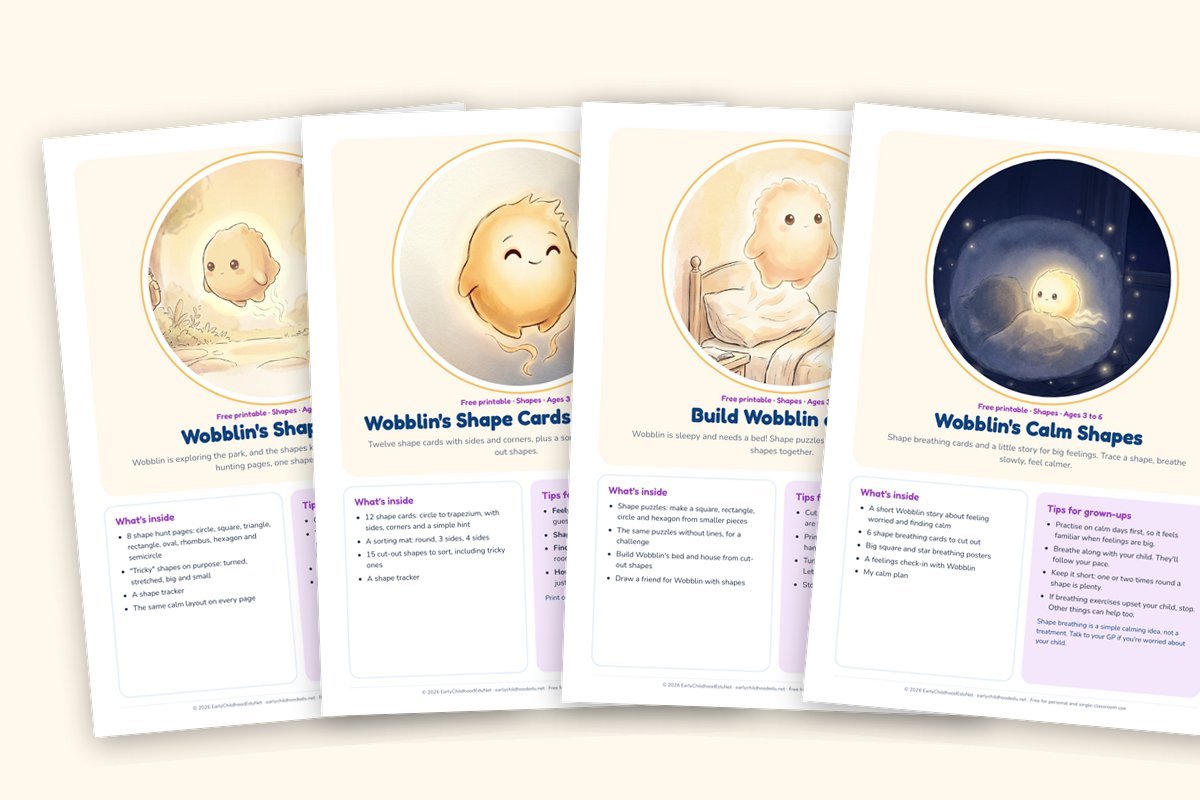
Four free shape learning activities packs
Shape hunts, shape cards and sorting, shape puzzles and calming shape breathing cards. Free, no email required.
Choose Your Free Pack ↓- Shape learning activities that go beyond “name that shape”
- Four free shape learning activities packs
- Why tricky shapes matter in shape learning
- How to use these shape learning activities in five minutes a day
- Calming shape learning activities: shape breathing cards
- Shape learning activities for neurodivergent kids
- Shape learning activities by age
- FAQs
Shape Learning Activities That Go Beyond “Name That Shape”
Most children can name a triangle, square and circle fairly early on. What takes longer to develop is a flexible understanding of those shapes: knowing a square is still a square when it’s turned onto a corner, or that a long, skinny triangle is just as much a triangle as the neat, equal-sided one in a picture book.
These packs were built with that gap in mind. Rather than sticking to tidy, upright shapes throughout, they deliberately mix in turned, stretched and less common examples, so little learners build a real understanding of what makes a shape that shape, not just a memorised picture.
Four Free Shape Learning Activities Packs, Starring Wobblin
Each pack of shape learning activities opens with a guide for grown-ups and uses calm, predictable layouts. Wobblin appears on every page in a different mood, puzzled, curious, happy, worried, calm and sleepy, so children meet a character who sometimes gets confused or wobbly too.
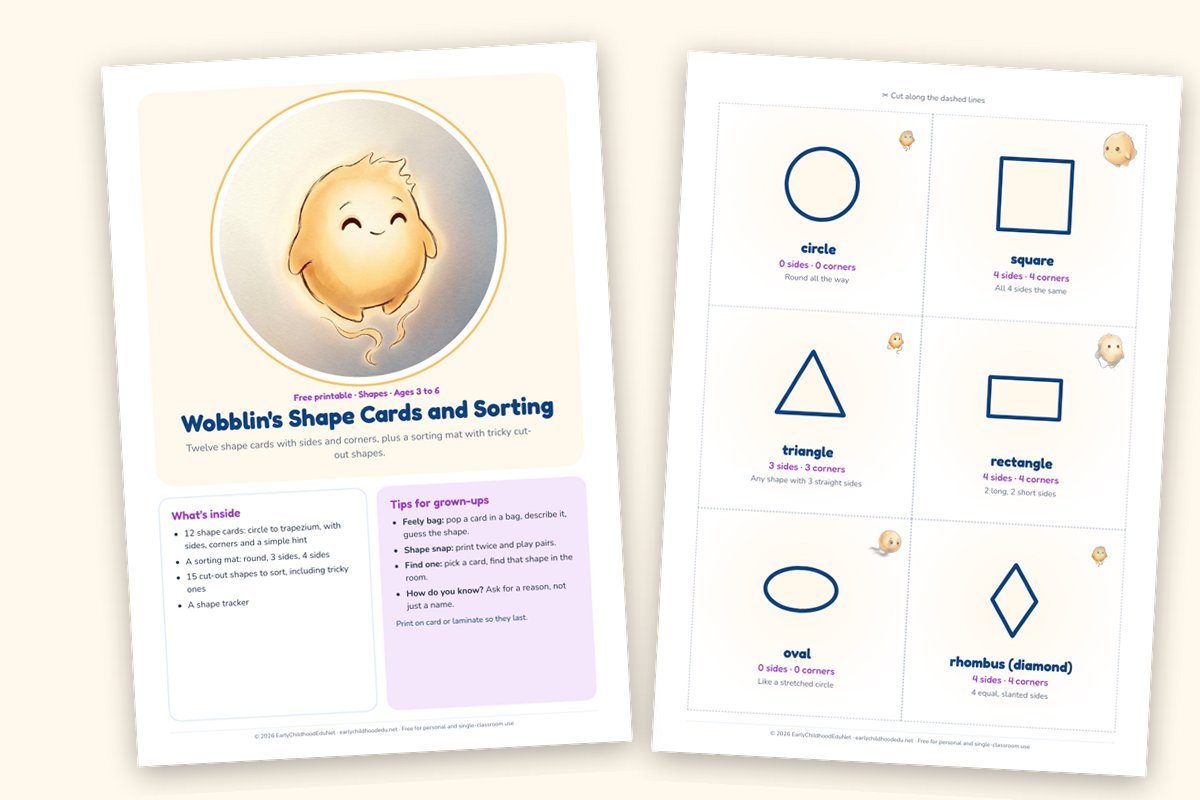
Wobblin’s Shape Hunt
Eight hunt pages: circle, square, triangle, rectangle, oval, rhombus, hexagon and semicircle. Each target shape hides among others, including tricky turned, stretched and tiny versions.
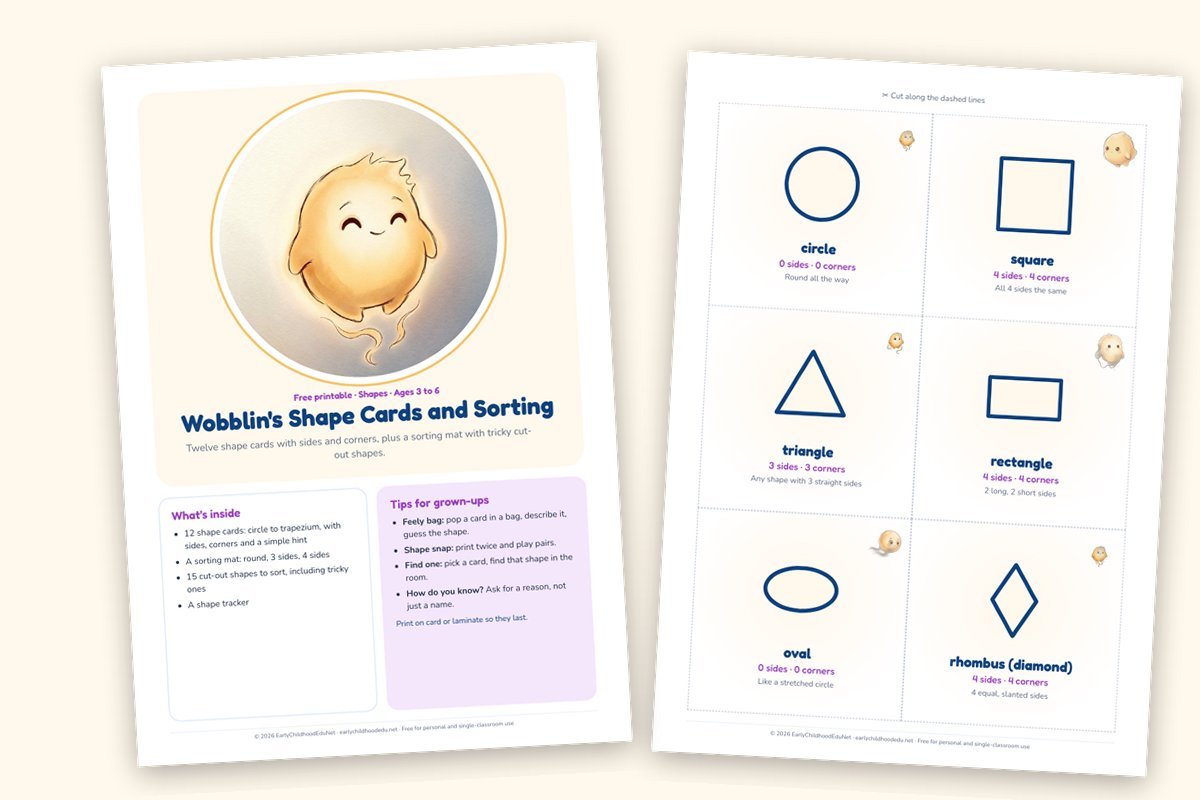
Wobblin’s Shape Cards and Sorting
Twelve shape cards with sides, corners and a simple hint, a sorting mat (round, 3 sides, 4 sides) and fifteen cut-out shapes to sort.
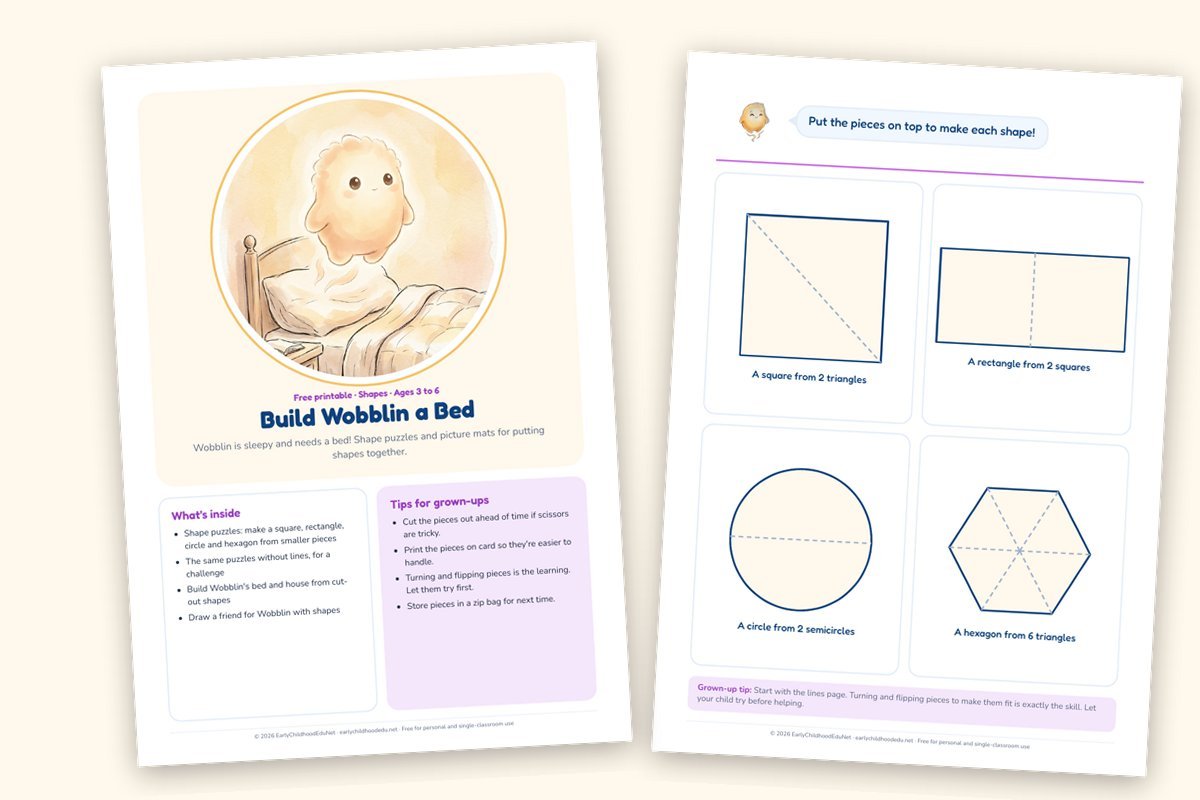
Build Wobblin a Bed
Shape puzzles (two triangles make a square, six make a hexagon), the same puzzles without lines, and cut-out shapes to build Wobblin’s bed and house.
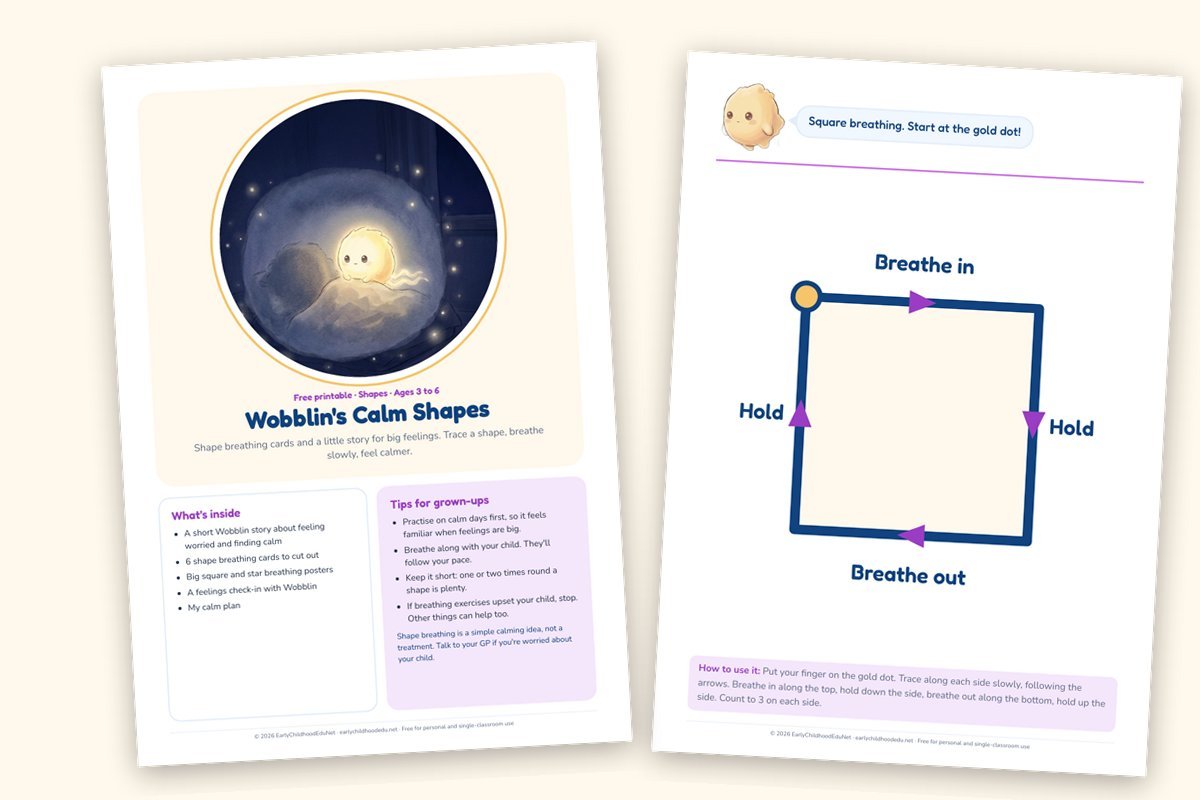
Wobblin’s Calm Shapes
A short story about Wobblin feeling worried, six shape breathing cards, big square and star breathing posters, a feelings check-in and a calm plan.
Who is Wobblin? Wobblin is a soft, glowing little character who appears across EarlyChildhoodEduNet printables. He gets puzzled by tricky shapes, worried when things feel big, and calm again with a little help. A friendly face asking “Can you help me find every triangle?” can make starting a worksheet feel easier.
Why Tricky Shapes Matter in Shape Learning Activities
Children often lock onto a single typical example of a shape: an upright triangle, a flat square. Anything that doesn’t match that exact picture can get rejected or renamed. In one study of preschoolers’ ideas about shapes, Douglas Clements and colleagues found that young children often judged shapes by how they looked overall, rather than by their sides and corners [1]. A worksheet full of only tidy, uniform shapes can accidentally reinforce that narrower idea.
That’s why Wobblin’s Shape Hunt leans into “tricky” examples on purpose: a turned square, a thin triangle, a long rectangle standing on its end. Children practise checking a shape’s actual properties (“It has 3 straight sides, so it’s a triangle”) rather than relying on a quick glance. In the Australian Curriculum, the first year of school asks children to sort, name and create familiar shapes and to recognise and describe them in the world around them, giving reasons [2]. These packs cover each of those pieces.
For hands-on ideas beyond the page, see my guide to shape activities and early geometry, or shapes and colours activities for toddlers for younger children.
How to Use These Shape Learning Activities in Five Minutes a Day
- Start with three shapes. Circle, square and triangle first. Add rectangle, oval and the rest once these feel easy.
- Feel the sides. Run a finger along each side and count together. Corners get a little tap.
- Turn it around. Hold a shape card upside down or on its corner and ask, “Is it still a square? How do you know?”
- Hunt one shape at a time. One hunt page, one shape. Then look for that shape around the room.
- Sort by a rule. Use the sorting mat: round, 3 sides, 4 sides. Ask your child to explain where each one goes.
- Put shapes together. The puzzles show that two triangles can make a square. That’s early geometry thinking.
- Colour the tracker. Celebrate each shape your child can name and find.
Calming Shape Learning Activities: Shape Breathing Cards
Shapes can help with feelings too. Shape breathing gives a child something to look at and trace while they slow their breathing down: in along one side, hold, out along the next. Wobblin’s Calm Shapes includes square, triangle, balloon (circle), star, long rectangle and honeycomb (hexagon) breathing cards, plus big square and star posters for a calm corner.
- Practise on calm days first, so it feels familiar when feelings get big.
- Breathe along with your child. They’ll follow your pace more than any instruction.
- Keep it short. Once or twice around a shape is plenty.
- Offer, don’t insist. Some children dislike breathing exercises. Movement, a hug or a quiet space may help more.
The pack starts with a short story about Wobblin feeling worried, so children can talk about feelings through him first. For what helps in the middle of a meltdown, see my post on co-regulation during meltdowns, and my free first-then regulation reset mats work well alongside the cards. Shape breathing is a simple calming idea, not a treatment, so talk to your GP if you’re worried about your child.
Shape Learning Activities for Neurodivergent Kids
I have ADHD myself and I’m raising a daughter with ADHD, so these packs were designed with busy, sensitive and neurodivergent learners in mind. Every child is different, so take what helps and leave the rest.
- Predictable pages. Every hunt page has the same layout, so the only new thing is the shape.
- Hands-on options. Cutting, placing and building pieces suits children who learn best by doing. Cut pieces out in advance if scissors are hard.
- A character with feelings. Wobblin gets puzzled and worried too, which can make it easier for children to say when something feels hard.
- Many ways to answer. Pointing, placing a counter or holding up a card all count. Speech isn’t required.
- Regulation comes first. A child who is overwhelmed can’t learn shapes. See regulation before learning for why.
Shape Learning Activities by Age
A rough guide only. Follow your child, not the number.
| Age | What many children are working on | Try these pages |
|---|---|---|
| 3 | Matching identical shapes and naming circle, square and triangle | Shape cards, circle, square and triangle hunts with an adult, calm shapes story |
| 4 | Naming more shapes, starting to notice sides and corners | All hunt pages, sorting mat, puzzles with lines |
| 5 | Recognising turned and stretched shapes, explaining why | Tricky hunt pages, puzzles without lines, building the bed and house |
| 6 | Sorting by properties and creating shapes from other shapes | Sorting with reasons, hexagon puzzle, drawing a friend for Wobblin from shapes |
Who These Shape Learning Activities Are For
- Parents wanting shape practice that goes beyond simple naming
- Preschool and kindergarten teachers after low-prep, print and go geometry activities
- Homeschooling families building a well-rounded early maths routine
- Occupational therapists and tutors after simple sorting, matching and calming printables
Shape Learning Activities FAQs
What shapes should preschool shape learning activities cover?
Many preschoolers start with circle, square and triangle, then add rectangle, oval and others. More important than the number of names is understanding that a shape stays the same shape when it’s turned, bigger, smaller or stretched.
Are these shape learning activities free?
Yes. All four packs of shape learning activities are free to download and print for your family or a single classroom, with no email sign-up required.
What is shape breathing?
Shape breathing is a simple calming activity where a child traces the sides of a shape with a finger while breathing slowly, for example breathing in along one side of a square and out along the next. It works best when practised on calm days first.
Why does my child say a turned square is a diamond?
That’s very common. Young children often judge shapes by how they look overall. Count the sides and check they’re all the same length together, then turn the card back to show it’s the same shape.
Do the shape learning activities print in black and white?
Yes. The shapes and lines are navy outlines that print clearly in black and white. Wobblin just looks a little more grey.
More Ways to Build Early Maths Skills
- Shape activities and early geometry
- Shapes and colours activities for toddlers
- Early maths activities hub
- Counting activities for kids at home
- Pattern activities for preschoolers
- Math games for early learners
- Clements, D. H., Swaminathan, S., Hannibal, M. A. Z., & Sarama, J. (1999). Young children’s concepts of shape. Journal for Research in Mathematics Education, 30(2), 192–212.
- Australian Curriculum, Assessment and Reporting Authority. (2022). Australian Curriculum: Mathematics, Version 9.0, Foundation (AC9MFSP01). v9.australiancurriculum.edu.au