
Daily Routine for Neurodivergent Children: 4 Grounding Stages for Calmer Days
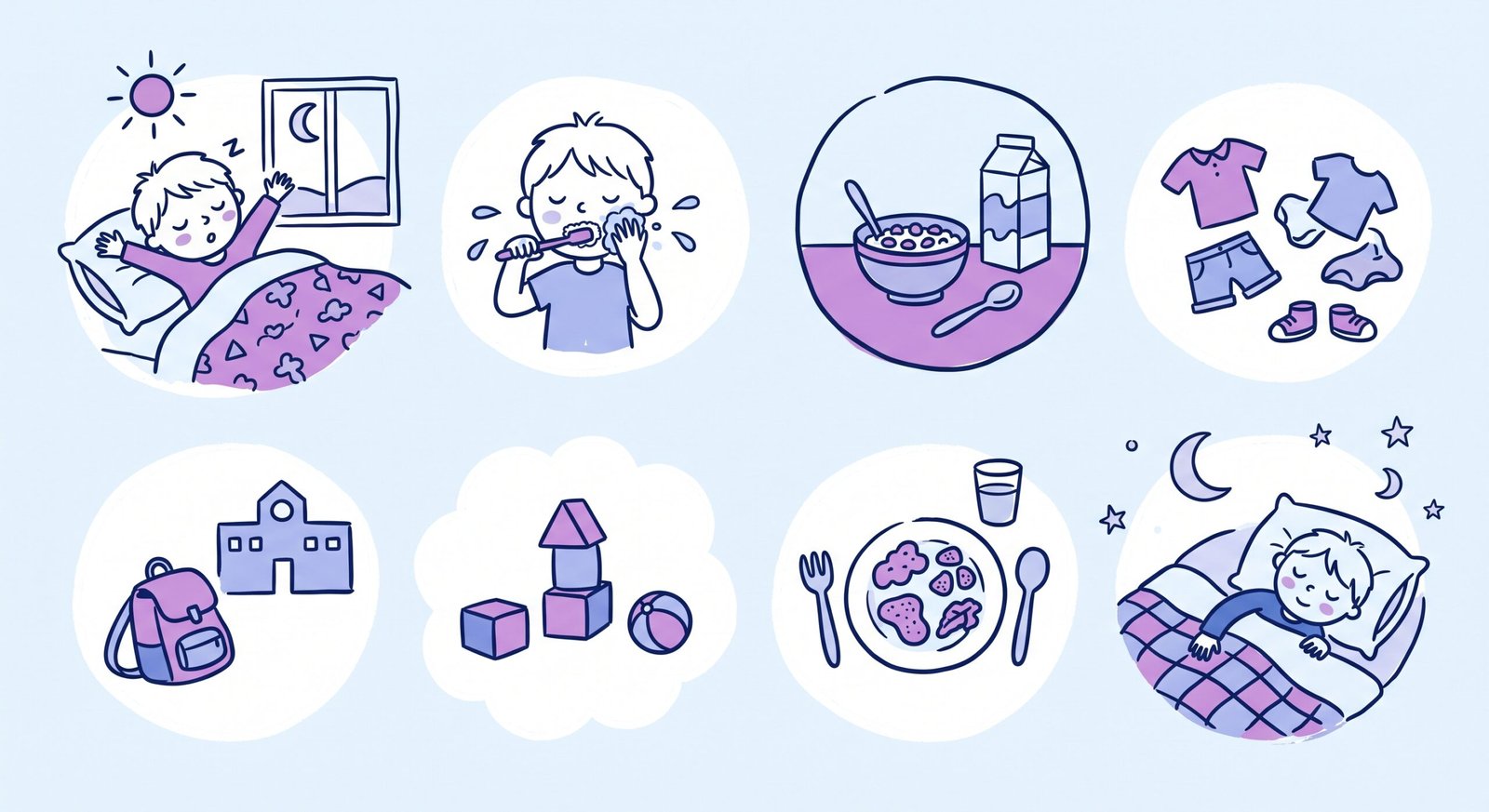
A daily routine for neurodivergent children works best when it’s predictable in order but flexible in timing. Instead of racing the clock, many families find it helps to follow a rhythm: move first, settle into low demand time, reset with movement before changes, and recover in a calm space after school or care.
This guide shares what we learned in our own family, four grounding stages, sample routines for mornings, after school and bedtime, ideas for early learning rooms, a free printable rhythm sheet and twelve free PDFs.
Our laminated timetable said it was sock time. My daughter was under the kitchen table, kicking. No chart in the world was going to fix that morning.
- The Morning Under the Kitchen Table
- Clock Time vs Order: Why Many Routines Fall Apart
- Visual Schedules, Done Kindly
- From Timetable to Rhythm
- The 4 Grounding Stages
- The 4 Stages at a Glance
- A Calmer Morning Routine
- The After School Stretch
- A Gentle Bedtime Routine
- A Sample Day, Home and Weekend
- Adapting the Routine on Hard Days
- Routines in Early Learning Rooms
- What Helps and What Backfires
- Free Printable Grounding Rhythm Sheet
- More Free Routine Printables
- Routine FAQs
The Morning Under the Kitchen Table
When my girls were small, mornings in our house often felt like a constant juggle. My eldest daughter, Bella, found the start of the day especially hard.
One morning, Bella was under the kitchen table, kicking the underside until the salt shaker wobbled off the edge. The tension filled the room. Socks were missing. Shoes were nowhere to be found. On the fridge was the visual timetable we’d spent Sunday afternoon laminating, cheerfully saying that 7.30 to 7.45 was for socks and bags.
I stood at the bench with a cold cup of coffee, my own mind racing with everything I had to do that day. I didn’t know then that I had ADHD, or that Bella did. If I’d followed the parenting books, I would have pointed at the picture of socks and calmly repeated the instruction. It wouldn’t have helped. Insisting on the timetable in that moment would only have made the whole morning harder for both girls.
It took me years, and later my work as an early childhood educator and my professional development in autism, to understand what was happening. Bella wasn’t being defiant. Her body was telling me she’d hit a wall, and the clock on the fridge didn’t care.
Clock Time vs Order: Why Many Routines Fall Apart
Most routine advice starts with a timetable: this at 7.30, that at 7.45. For many neurodivergent children, the problem isn’t the routine itself. It’s the clock.
Switching from one activity to another uses executive function skills, like stopping, shifting attention and starting something new. Harvard’s Center on the Developing Child describes how these skills are still developing in young children, and how stress makes them harder to use.[1] Many children with ADHD find starting and switching especially hard.[2] When we ask a child to change just because the clock says so, we may be asking for more than their brain can give in that moment.
| What Clock Based Routines Assume | What Often Happens Instead |
|---|---|
| Energy is the same every day. | Capacity changes with sleep, noise, hunger and stress. What was easy on Tuesday can be hard on Thursday. |
| Being on time matters most. | A child who feels rushed often slows down or shuts down. |
| A transition is just an instruction. | Stopping something absorbing takes real effort, especially for children who focus deeply. |
If your child freezes when asked to start something, when an ADHD child won’t start tasks explains why, and what helps.
Visual Schedules, Done Kindly
I want to be clear about something, because I got it wrong for a while. Visual schedules aren’t the problem. Picture schedules and other visual supports are widely recognised as helpful for many autistic children, and many children with ADHD benefit from them too.[3]
The problem was how I used ours: with exact times, as a set of rules to obey. What works better for many children is a schedule that shows the order of the day, not the minutes.
- Show what’s next, not what time it is: “First breakfast, then shoes, then car” is easier than “7.30 socks”.
- Use “first, then”: two pictures side by side can be enough for young children. Our First Then Reset Mats are made for this.
- Let children move the cards: turning over or moving a finished picture gives a sense of progress.
- Stay flexible: the schedule is a guide. On hard days, you can skip, swap or shrink steps.
Our visual routine cards and free daily routine template help you set this up, and visual routine cards for ADHD kids explains how to use them.
From Timetable to Rhythm
What worked better for us was a rhythm instead of a timetable.
| A Timetable Says | A Rhythm Says |
|---|---|
| “At 8.00 we eat breakfast. At 8.30 we put on shoes.” | “After moving our bodies, we have a quiet stretch, then a quick reset before we leave.” |
| Success means being on time. | Success means getting through calmly, even if it takes longer. |
| The question is “What’s next on the chart?” | The question is “What does my child’s body need right now?” |
A rhythm isn’t a lack of structure. The order stays predictable, which is what most children need. The timing bends when life gets messy. Many children seem to swing between under aroused (flat, slow, seeking movement) and over aroused (loud, fast, easily overwhelmed). A rhythm helps us respond to where they actually are.
The 4 Grounding Stages
These four stages are how I think about a day now. They’re not a clinical program. They’re a simple way to plan around children’s energy, drawn from family life, my years as an educator and my professional development.
Move First: The Morning Anchor
Many children start the day better after some “heavy work”: pushing, pulling, carrying and climbing. Occupational therapists often use these kinds of activities with children who seek or need extra body input, and many families find them settling, although research on sensory activities is still developing.[4]
- Try: pushing a laundry basket down the hallway, carrying the shopping bag in, wall pushes, animal walks to the bathroom.
- Maybe avoid: very wild bouncing straight after waking, which can wind some children up more.
- Why it may help: purposeful movement seems to help many children feel more settled and aware of their bodies before sitting tasks.
Our Pocket Heavy Work Cards have quick ideas, and animal walks for gross motor play makes movement fun. Later in the day, classic playground games give the same kind of active play outdoors.
Low Demand Time: Saving Energy
After moving, many children settle best into a stretch where an adult is nearby but not asking for much. A string of instructions (“eat your eggs, get your hat, find your shoes”) can tip a child over before the day has started.
- Try: your child plays with blocks or magnetic tiles while you fold washing nearby. Breakfast is simply offered. Few questions.
- Maybe avoid: quizzing about the day ahead, or leaving the room altogether. Quiet company helps.
- Why it may help: a calm adult nearby, with few demands, can help a child feel safe and save their energy for the transitions to come.
Quiet, repetitive play like pattern activities suits this stage well.
Reset Before Changes: The Movement Bridge
Countdowns (“five minutes, two minutes”) help some children, but for others they build worry. A short burst of movement right before a change can make the switch easier.
- Try: a big floor cushion by the door for a few safe “crash landings”, wheelbarrow walks to the shoe basket, or carrying the school bag to the car.
- Maybe avoid: relying only on sudden alarms or timers, which can feel jarring to a child who’s deeply focused.
- Why it may help: moving the body seems to help many children let go of what they were doing and shift to what’s next.
Starting the next step together helps too. See the ADHD start together task trick and sensory micro transitions.
Recover: A Calm Space, Not a Time Out
After a long day of holding it together at school or care, many children come home with nothing left. This stage is about recovery, not discipline.
- Try: a quiet corner with cushions, soft light, a favourite book, headphones with calm sounds, a snack and a cold drink.
- Maybe avoid: using the space as a punishment, or asking lots of questions about the day straight away.
- Why it may help: less noise, light and talk gives a tired body a chance to settle. Stuart Shanker’s Self-Reg work describes how reducing stressors helps children recover.[5]
See calm corner design and classroom noise and sensory overload.
The 4 Stages at a Glance
| Stage | Purpose | Everyday Ideas | Maybe Avoid |
|---|---|---|---|
| 1. Move first | Help the body wake up and settle. | Pushing baskets, carrying bags, wall pushes, animal walks. | Very wild play straight after waking. |
| 2. Low demand time | Save energy for the day ahead. | Blocks on the rug, adult nearby, simple breakfast. | Lots of questions or instructions. |
| 3. Reset before changes | Make transitions easier. | Cushion landings, wheelbarrow walks, carrying something. | Sudden alarms, rushing, raised voices. |
| 4. Recover | Rest after a big day. | Quiet corner, soft light, snack, calm sounds. | Questions, bright light, using the space as punishment. |
A Calmer Morning Routine
Mornings are often the hardest part of the day. Here’s an illustration of the same morning, two ways. It’s a composite, drawn from family life and from many families I’ve worked with.
The timetable way: It’s ten past eight. “Shoes on, we’re leaving in two minutes.” Your child stares at a toy and doesn’t move. You say it louder. They flop to the floor and cry that their socks feel prickly. You try to put the shoe on for them, they kick, and everyone leaves the house upset.
The rhythm way: Five past eight. Your child is playing quietly. You sit nearby and say softly, “I need some strong muscles to help push the front door open today. The big cushion’s waiting by the door if you need a landing.” They crawl down the hallway and flop onto the cushion with a big breath out. Their shoes are right there. “Firm laces or loose today?” “Firm.” You put the shoes on together and head out a few minutes later, calmer.
A few things help most mornings:
- Prepare the night before: bags packed, clothes chosen, shoes by the door.
- Picture the order: a simple strip of morning pictures by the door.
- Leave buffer time: ten extra minutes takes a lot of pressure off.
- Offer small choices: “This jumper or that one?” “Firm or loose?”
- Check sensory comfort: seamless socks, soft labels and familiar clothes can prevent a lot of battles.
The After School Stretch
Many families find the hour after school or care the hardest. Children who hold it together all day often fall apart at home, where they feel safe. People sometimes call this after school restraint collapse. It’s a popular term rather than a research finding, but it describes something many families see.
- Snack first: hunger makes everything harder. Have food ready.
- Fewer questions: “How was your day?” can wait. Try “I’m glad to see you.”
- Movement or quiet: some children need to run, climb or jump. Others need a dim corner and a book. Many need both, in that order.
- Calm space: a recovery corner (Stage 4) ready and waiting.
- Homework and reading later: once the tank has refilled.
I write more about this in regulation before learning.
A Gentle Bedtime Routine
Bedtime can be a battle for many neurodivergent children, especially busy children with ADHD. Research suggests that having a consistent bedtime routine is linked to better sleep and wellbeing in young children.[6]
- Same order every night: bath, pyjamas, teeth, book, bed. Keep it short.
- Movement earlier: active play in the late afternoon, not right before bed.
- Dim, warm light: switch to lamps after dinner. See fluorescent lighting and ADHD.
- Fewer screens before sleep: bright screens can push back sleepiness.
- Calm connection: a story, a back rub if your child likes it, or quiet talk.
For more, see toddler sleep resistance and ADHD. If sleep problems are severe or ongoing, talk with your GP or paediatrician.
A Sample Day, Home and Weekend
Here’s what a rhythm might look like. The order stays the same. The times are just rough guides, and they’ll move.
| Part of the Day | School or Care Day | Weekend or Home Day |
|---|---|---|
| Wake up | Move first: carry the cereal box, wall pushes. | Slow start, then outdoor play or a walk. |
| Breakfast | Low demand time: simple food, quiet play. | Breakfast together, maybe cooking something easy. |
| Getting ready | Picture strip by the door, cushion landing, shoes on. | Fewer steps, more choice about clothes. |
| Middle of the day | School or care. | Play, outing, then quiet time. |
| After school | Snack, movement or quiet, calm corner. | Free play, outdoor time. |
| Dinner | Simple, predictable meal. | Same. |
| Wind down | Lamps on, bath, pyjamas, teeth, book. | Same order, same calm. |
Our Daily Routine Chart gives you pictures for each part of the day.
Adapting the Routine on Hard Days
Neurodivergent development isn’t a straight line. On Wednesday, your child might get dressed, eat breakfast and walk to the car happily. On Thursday, the same child might cry at the sight of a sock. They’re not going backwards or seeking attention. Their capacity is just lower that day. I explain more in spiky profiles in neurodivergent children and why your child can do it some days and not others.
On low capacity days, the rhythm bends:
- Stage 1 gets gentler: a cosy blanket over their lap while they wake, instead of carrying things.
- Stage 2 gets wider: skip anything that isn’t essential. Breakfast on the floor is fine.
- Stage 3 becomes closeness: holding hands to the car, with a steady squeeze if your child likes it.
- Stage 4 starts early: calm from the moment of pick up, with no questions on the way home.
Routines in Early Learning Rooms
The same ideas work in kinder rooms, long day care and Prep classrooms.
- Visual daily schedule at child height: pictures in order, with the current activity marked.
- Movement before sitting: a quick song with actions or animal walks before group time.
- Warnings before changes: a transition song, a visual cue and a short movement reset.
- A calm space anyone can use: never a punishment corner, always within sight.
- Individual first then cards: for children who need more help with a particular transition.
- Share with families: what works in the room can help at home too. The Home and Kinder Snapshot makes this easy.
The Sensory Space Audit Checklist helps you check noise, light and clutter across the room, and the sensory environment has more ideas.
What Helps and What Backfires
| What Tends to Help | What Tends to Backfire |
|---|---|
| Watching your child, not just the clock: pacing, chewing collars or speeding up can mean it’s time for movement before instructions. | Debating in the middle of overwhelm: explaining the schedule to a very upset child rarely works. |
| A low, slow voice: calm, few words help a child feel safe. | Reward charts for transitions: when a child can’t, rather than won’t, missing out on a sticker can feel like shame. |
| Familiar anchors: the same goodbye routine, the same bag, the same song. | Treating a changed plan as failure: if your child goes to school in gumboots, the day isn’t lost. |
And remember your own capacity. If you’re neurodivergent too, keep routines simple enough for you to follow. I write about that in being a parent with ADHD.
Free Printable Grounding Rhythm Sheet
A simple A4 landscape sheet for tired brains. No clock times, no tick boxes. Just four gentle stages to jot down the movement, calm and reset ideas that suit your family.
Our Daily Grounding Rhythm
This isn’t a schedule. It’s a rhythm.
Move first
push, carry, climb, animal walks
Low demand time
play beside, few questions
Reset before changes
cushion landing, carry the bag, first then
Recover
quiet space, soft light, snack, calm
More Free Routine Printables
These free PDFs from this site help with predictable days, smoother transitions and calmer recovery.
Daily Routine Chart
Pictures for each part of the family day, in order.
Download A4 PDF Best for familiesVisual Routine Cards
Picture cards to show the order of mornings, bedtime and more.
Download PDF For home and roomsFirst Then Reset Mats
“First shoes, then car.” Simple and clear.
Download PDF For home and roomsPocket Heavy Work Cards
Movement ideas for mornings and transition resets.
Download PDF For home and roomsCalm Shapes Breathing Cards
A gentle tool for the calm corner and wind down time.
Download A4 PDF For home and roomsCalm Counting 1 to 10
Low demand pages for quiet stretches of the day.
Download A4 PDF For home and rooms“Big Feelings” Storybook
Talk about hard mornings and big feelings once everyone’s calm.
Download A4 PDF For home and roomsSensory Space Audit Checklist
Check noise, light and clutter in your room or home.
Download PDF Best for educatorsWhat I’m Noticing Diary
Track which parts of the day are hard, and what helps.
Download PDF For home and roomsHome and Kinder Snapshot
Share routines that work between home and the room.
Download PDF For families and educatorsWeekly Battery Check-In
Notice your own energy across the week.
Download PDF For parents and educatorsSmall Refills Menu
Quick ways to top yourself up on hard days.
Download PDF For parents and educatorsMore free tools are on our printables page.
Looking Back
That laminated timetable didn’t last long. Looking back, I remember the exhaustion of trying to squeeze our family into tidy little boxes on the fridge.
What helped wasn’t a better chart. It was noticing what our bodies needed, keeping the order predictable and letting the timing bend. Our days weren’t perfect, but they became calmer and steadier. And steady, for a neurodivergent family, is a lot.
- The big picture: child development and neurodivergent children
- Calmer rooms: the sensory environment
- Picture routines: visual routine cards for ADHD kids
- Calm comes first: coregulation strategies
- A safe place to rest: calm corner design
- Light and focus: fluorescent lighting and ADHD
Daily Routine FAQs
What is a good daily routine for neurodivergent children?
A good routine is predictable in order but flexible in timing. Many families find it helps to move first, then have a quiet, low demand stretch, use a short movement reset before changes, and build in calm recovery time after school or care. Picture routines that show the order of the day, rather than exact times, help many children.
Do visual schedules help autistic children and children with ADHD?
Yes, visual supports such as picture schedules are widely recognised as helpful for many autistic children, and many children with ADHD benefit too. They tend to work best when they show the order of activities and what comes next, rather than strict clock times, and when adults stay flexible on hard days.
Why does my child melt down after school?
Many children work hard to hold it together all day, then fall apart at home where they feel safe. People sometimes call this after school restraint collapse. A snack, quiet time, fewer questions and a calm space usually help more than asking about their day straight away.
How do I make transitions easier for my neurodivergent child?
Give a warning, show what comes next with a picture, and try a short movement reset like wall pushes, a few animal walks or carrying something heavy before the change. Keep words short and calm. Starting the next step together also helps many children.
What should a bedtime routine look like for a neurodivergent child?
A short, predictable sequence each night, such as bath, pyjamas, teeth, book and bed, with dim, warm light and fewer screens before sleep. Research suggests consistent bedtime routines are linked to better sleep in young children. Movement earlier in the evening can help busy bodies settle.
Research and guidance: Harvard’s Center on the Developing Child on executive function, Barkley on ADHD, the 2020 review of evidence based practices for autistic children (which includes visual supports), Dunn’s work on sensory processing, Shanker’s Self-Reg and research on bedtime routines.
Experience: the kitchen table story and the laminated timetable are from our own family. The four stages, the sample day and the two morning scenes come from family life and my work as an educator. The morning scenes are a composite. Research on sensory activities like heavy work is still developing.
This is educational content, not occupational therapy or medical advice. Last reviewed: 8 November 2026.
References
- Center on the Developing Child at Harvard University. (n.d.). Executive function and self-regulation. https://developingchild.harvard.edu/
- Barkley, R. A. (Ed.). (2015). Attention-deficit hyperactivity disorder: A handbook for diagnosis and treatment (4th ed.). Guilford Press.
- Steinbrenner, J. R., Hume, K., Odom, S. L., Morin, K. L., Nowell, S. W., Tomaszewski, B., Szendrey, S., McIntyre, N. S., Yücesoy-Özkan, S., & Savage, M. N. (2020). Evidence-based practices for children, youth, and young adults with autism. The University of North Carolina at Chapel Hill, Frank Porter Graham Child Development Institute, National Clearinghouse on Autism Evidence and Practice Review Team.
- Dunn, W. (2014). Sensory Profile 2: User’s manual. Pearson.
- Shanker, S. (2016). Self-Reg: How to help your child (and you) break the stress cycle and successfully engage with life. Penguin Press.
- Mindell, J. A., & Williamson, A. A. (2018). Benefits of a bedtime routine in young children: Sleep, development, and beyond. Sleep Medicine Reviews, 40, 93-108. https://doi.org/10.1016/j.smrv.2017.10.007
