
Why Milestones Don’t Fit Neurodivergent Children: The Capacity View
If you have ever sat in a community clinic waiting room or a parent-teacher interview with a tightening chest, staring at a checklist that treats your child like a collection of broken parts, you already know in your bones why milestones don’t fit neurodivergent children.
There is a quiet, heavy loneliness that settles over families when standard developmental forms arrive in the post or get handed over on a clipboard. The little square boxes demand clean, tidy answers. Does your three-year-old copy a circle? Does your four-year-old sit quietly on the mat during group storytime? Does your five-year-old open their lunchbox, unwrap their sandwich, and finish their food without adult guidance?
When our kids do not fit neatly into those boxes, the educational and medical system immediately reaches for words like delayed, deficient, or disordered. Yet when you live with these children day in and day out, you quickly realise that standard age markers miss the heart of what is actually going on. Exploring why milestones don’t fit neurodivergent children frees us from trying to cure healthy natural differences. Having worked on the floor in early learning settings, earned a doctorate through Deakin University, and parented my vibrant six-year-old ADHD daughter here in Victoria, I know how deeply these rigid frameworks harm developing self-worth.
The Day the Maternal Health Form Left Me in Tears
To understand why milestones don’t fit neurodivergent children, let me bring you into a chilly consulting room at our local maternal and child health centre when my daughter was three and a half.
I sat on a grey plastic chair while the nurse slid a developmental screening sheet across the desk. My daughter was on the floor beside my knees, narrating an elaborate ocean journey using two plastic pegs and an empty tissue box. Her spoken language was breathtaking. She was using terms like migration, trench, and currents, which she had absorbed from a nature book we had read on our couch three weeks earlier.
Then I looked down at the paper. The form asked if she could hold a spoon with three fingers without spilling food, if she separated easily from me in unfamiliar rooms without distress, and if she responded the very first time her name was called in a busy space.
None of the little boxes made sense. If I ticked “no”, the form categorised her as developmentally delayed. If I ticked “yes”, it erased her genuine distress with metal cutlery, room echo, and crowded places. There was no box for: Speaks in lyrical, complete paragraphs about marine biology, but experiences sheer panic if an unfamiliar adult looms over her table.
I walked out to our car that morning feeling hollow. Despite all my academic training in early childhood, the institutional checklist made me feel like our parenting was falling short. That quiet ache is familiar to so many neurodivergent families. Standard age grids take a complex, uneven human being and flatten them into a percentile score. This clinical rigidity is precisely why milestones don’t fit neurodivergent children in real life.
The Flaw in the Linear Staircase View of Early Childhood
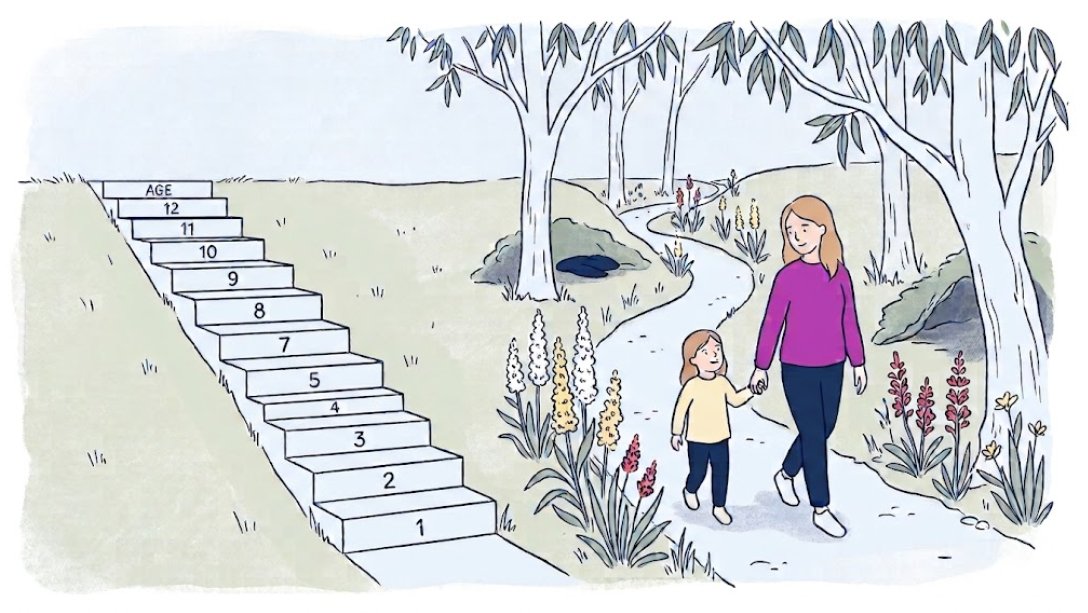
Traditional developmental psychology was built on an industrial, factory-floor metaphor. It treats child development as a tidy staircase where every developmental domain is expected to climb upward together at the exact same pace.
In that linear worldview, gross motor stability, fine motor control, expressive language, working memory, and emotional self-regulation are assumed to be tethered together. If a child reaches step four in reading, the system expects them to be at step four in managing frustration, opening containers, and sitting still on the carpet.
The reality of neurodivergent brains is that development does not happen on a staircase. Decades of research into asynchronous development, pioneered by giftedness scholar Linda Silverman, confirm that non-linear learners develop along an uneven landscape.[1] Different parts of the central nervous system mature along completely different timelines. This unevenness is the core reason why milestones don’t fit neurodivergent children.
| Developmental Domain | What Standard Milestones Demand | Why Milestones Don’t Fit Neurodivergent Children in Real Life |
|---|---|---|
| Language and Vocabulary Speaking in simple 4-to-5 word sentences by four years of age. |
Assumes verbal speech matches fine-motor and social stamina. | Towering Peak: Speaking like a young naturalist about specialised interests, using complex narrative structures while struggling with small talk. |
| Emotional Self-Regulation Calming down independently within five minutes of an activity ending. |
Treats emotional recovery as a simple willpower choice. | Sensory Valley: An intense, perceptive nervous system that becomes rapidly flooded by ambient noise, visual glare, or fatigue. |
| Self-Care and Motor Planning Dressing completely, fastening buttons, and opening lunch items without adult assistance. |
Assumes physical execution is an automated, reliable habit. | Capacity Dependent: Opening containers easily on rested mornings, but needing physical support when sensory overload sets in. |
| Social Play and Turn-Taking Playing cooperatively in large groups for extended periods. |
Equates large-group conformity with healthy social competence. | Authentic Connection: Connecting deeply in one-on-one play around shared interests, but becoming exhausted in chaotic group settings. |
Under Australia’s national early childhood framework administered by ACECQA, educators are charged with honouring each child’s individual learning pathway. When we recognise why milestones don’t fit neurodivergent children, we stop trying to flatten their uneven development and start building rooms that work with how their minds operate.
Why Milestones Don’t Fit Neurodivergent Children: The Capacity Alternative
If traditional age-based checklists do not serve our children, what do we replace them with? The answer lies in moving from an age-based deficit model to a capacity-based model.
An age-based checklist asks: “What can this child accomplish on their own by forty-eight months?”
A capacity-based view asks: “What does this child’s nervous system need to access their natural skills in this environment today?”
As foundational neurodevelopmental research from Harvard’s Center on the Developing Child proves, developing executive functions do not operate in a vacuum. They rely directly on biological stability and environmental safety. This biological dependency illustrates why milestones don’t fit neurodivergent children when measured without context.
1. Context Dictates Access: A child’s fine-motor coordination or emotional patience looks completely different in a noisy kindergarten hall than it does on a quiet living room rug beside a warm lamp.
2. Energy Determines Execution: Knowing how to do something in long-term memory is entirely different from having the physical fuel to do it when sensory channels are overloaded.
3. Support Is Not Regression: Stepping in to help a six-year-old zip their jacket on an exhausted afternoon is not creating dependency. It is responsive care that preserves their remaining battery.
4. Asynchrony Is Lifelong: Growth continues across the lifespan. Having valleys alongside peaks is not a temporary flaw to fix; it is a permanent, valid neurotype.
This shift transforms our teaching and parenting. We stop evaluating children by what they produce without help, and start looking at how much energy their physical surroundings demand from them. This perspective is central to understanding why milestones don’t fit neurodivergent children.
The Spiky Profile: Understanding the Mountains and Valleys
In neurodivergent advocacy, we often talk about spiky profiles. Rather than a flat, round wheel of skills, a neurodivergent child’s development looks like an intricate mountain range.
Imagine an eight-year-old who can compose complex piano melodies by ear, write brilliant fantasy stories, and explain the intricacies of prehistoric ecology. That same child may struggle to hold a pencil without hand cramps, forget to wipe their mouth after eating, and dissolve into tears if someone changes the classroom seating plan without warning.
When clinicians or educators look only at the valleys, they see a child with global developmental delays. When they look only at the peaks, they see a gifted child who is simply being difficult when they refuse to write. Both views are wrong. The peaks and the valleys belong to the same child, and this reality clarifies why milestones don’t fit neurodivergent children.
Clinical psychologist Russell Barkley has written extensively on how ADHD involves a fundamental disruption in the timing and application of executive functions.[2] The child knows what to do, but their prefrontal cortex cannot consistently bridge the gap between intention and action. Expecting smooth, linear milestone progression ignores this neurochemical reality.
The Hidden Danger of the Delayed Label in Early Childhood
When education and healthcare systems insist on using rigid age grids, children with uneven profiles carry an unfair emotional burden. This institutional bias explains why milestones don’t fit neurodivergent children without causing lasting harm to self-esteem.
Consider what happens to a five-year-old whose conceptual understanding is years ahead, but whose fine-motor coordination is still developing. If that child is judged solely by their handwriting or their ability to open plastic packets at lunchtime, they are marked as behind.
Because their intellectual perception is sharp, they notice the furrowed brows of the adults around them. They see their peers finishing cutting activities quickly while their own hands ache with fatigue. They absorb the idea that they are defective before they even finish prep.
Scholar Ross Greene reminds us that children do well if they can.[4] When a child cannot manage an item on a developmental checklist, it is not because they are failing childhood. It is because the demands of the moment exceed their current physiological capacity. Understanding why milestones don’t fit neurodivergent children protects our kids from internalising a false sense of failure.
Sensory Gating and the Drain on Everyday Capacity
To understand why milestones don’t fit neurodivergent children, we must also look at how their nervous systems process ambient physical surroundings.
Occupational therapy researcher Winnie Dunn established that individuals with sensory processing differences have altered neurological thresholds.[3] In a standard Australian classroom with polished floors, humming fluorescent tubes, and dozens of voices, a neurodivergent child’s brain is working overtime just to filter out the noise.
Canadian educator Stuart Shanker highlights that this constant sensory filtering creates a heavy biological drain.[5] When a child spends seventy percent of their energy trying to tolerate sensory input, they have very little fuel left for following instructions, managing emotional frustration, or coordinating fine-motor tasks. A milestone checklist that ignores this sensory drain can never provide an accurate picture of a child’s true capabilities.
How to Advocate for Your Uneven Child in Australian Schools
When you sit down for individual learning plan meetings or school transition chats, you do not have to accept flat developmental grids. You can use your voice to explain why milestones don’t fit neurodivergent children and guide educators toward capacity-based adjustments:
1. Describe Their Spiky Profile Directly and Without Apology
Tell teachers clearly: “My child has an asynchronous, spiky profile. Her verbal reasoning and conceptual comprehension are well beyond her age, but her fine-motor stamina and sensory filtering tire out quickly. When her handwriting falls apart or she resists drawing, it is a sign that her battery is flat, not that she is choosing to avoid work.”
2. Shift Goals from Age Standards to Environmental Comfort
Instead of accepting a goal like “Will sit on the group mat for twenty minutes without moving,” reframe the target: “Will have access to a boundary cushion, floor chair, or quiet corner so her body can listen comfortably without physical strain.”
3. Protect Their High Peaks from Being Held Back
Do not let schools restrict a child’s advanced thinking while waiting for their vulnerable skills to catch up. A child who is ready to explore rich stories, complex science, or advanced mathematics should be supported through audiobooks, drawing, or speech-to-text tools, even if they still need help holding a pencil or fastening their shoes.
4. Document Daily Energy Fluctuations in Learning Plans
Advocate for individual support plans that recognise capacity swings throughout the week. A child who handles a group activity on Tuesday morning may need quiet, parallel play on Thursday afternoon. Building this flexibility into school documentation directly addresses why milestones don’t fit neurodivergent children in rigid institutional settings.
Throwing Away the Checklist on Our Living Room Rug
On our living room floor in Victoria, my daughter still has mornings where she builds intricate cardboard worlds while her school runners sit in the hallway, untied and unfastened.
I no longer look at those untied shoes with worry. I do not check an age booklet to see what month she is supposed to manage them without help. I see a six-year-old girl whose mind is making connections, whose sensory system worked hard through the school week, and whose hands simply need a bit of help from her mum today.
When we throw away the checklist, we finally see the whole child standing right in front of us. Understanding why milestones don’t fit neurodivergent children allows us to celebrate their progress on their own timeline, with all the uneven, wonderful beauty of their developing minds.
- Read why skills rise and fall throughout the week in Why Child Can Do It Some Days Not Others →
- Discover the link between dopamine and focus in ADHD Skills Inconsistency Explained →
- How to look after yourself when caregiver exhaustion hits in Parent and Teacher Burnout in Neurodivergent Care →
- Return to our main cluster guide on Spiky Profiles and Capacity in Neurodivergent Children Hub →
References
- Silverman, L. K. (2002). Upside-Down Brilliance: The Visual-Spatial Learner. DeLeon Publishing. [Examining asynchronous development, uneven developmental profiles, and non-linear learning pathways].
- Barkley, R. A. (2012). Executive Functions: What They Are, How They Work, and Why They Evolved. Guilford Press. [The neurology of dopamine regulation, task initiation, and variable performance in ADHD].
- Dunn, W. (2014). Sensory Profile 2: User’s Manual. Pearson. [How environmental noise and sensory thresholds drain nervous system reserves].
- Greene, R. W. (2014). Lost at School: Why Our Kids with Behavioral Challenges Are Falling Through the Cracks and How We Can Help Them. Scribner. [The foundational principle that children do well when they have the capacity to do so].
- Shanker, S. (2016). Self-Reg: How to Help Your Child (and You) Break the Stress Cycle and Successfully Engage with Life. Penguin Random House. [Understanding the hidden stressors that undermine daily regulation].