
How a Multilingual Child Processes Their Expanding World: 4 Brilliant Ways to Belong
In our household, observing how a multilingual child processes their expanding world taught me that silent observation is not a sign of confusion. Rather than forcing quick English words, honouring our home language and providing visual belonging anchors gave my daughter the deep security she needed to venture out.
Understanding how a multilingual child processes their expanding world starts with realising that silence is rarely empty space; it is a quiet construction site where belonging takes root.
The morning chatter in the kindergarten room was loud and cheerful, a flurry of boots being unzipped and wet raincoats hung onto low wooden pegs. Five year old Zara stood near the door, her hands pressed tightly against the sides of her navy skirt. She had her eyes fixed on the floorboards, watching a single drop of water clinging to the toe of her shoe. Around her, children were calling across the carpet, swapping stories about weekend trips to the park or morning toasted sandwiches.
Zara did not move toward the art table or the wooden block corner. When a classmate stepped closer to offer a tub of coloured pencils, Zara took half a step backward, tucked her chin into her chest, and looked toward the window.
For weeks after we moved to Melbourne from Jakarta, mornings followed this exact quiet rhythm. In the car on the way to school, our family spoke Indonesian. We laughed, sang along to tape cassettes, and talked about what we would buy at the grocery store later that afternoon. But the moment Zara crossed the threshold of her Australian kindergarten classroom, a heavy curtain of quiet fell over her.
Watching her stand at the edge of the rug, I felt the familiar weight of parent worry. It is easy to look at a silent child in a new language setting and worry that they are isolated, confused, or falling behind. We want them to step up, join the circle, and start using English words right away. Yet seeing how a multilingual child processes their expanding world through quiet mapping shows that belonging develops from the inside out.
When we pause to observe how a multilingual child processes their expanding world, we discover that what looks like hesitation is often an intentional period of gathering clues, deciphering social rituals, and connecting new experiences back to the safety of home.
In this honest reflection and guide:
The Quiet Work of Social Mapping in a New Language
What looks like hesitation on the outside is often deep cognitive work on the inside. Understanding how a multilingual child processes their expanding world requires us to look past the surface silence.
Zara was not frozen. She was observing, listening, and quietly mapping out where she belonged in this new landscape.
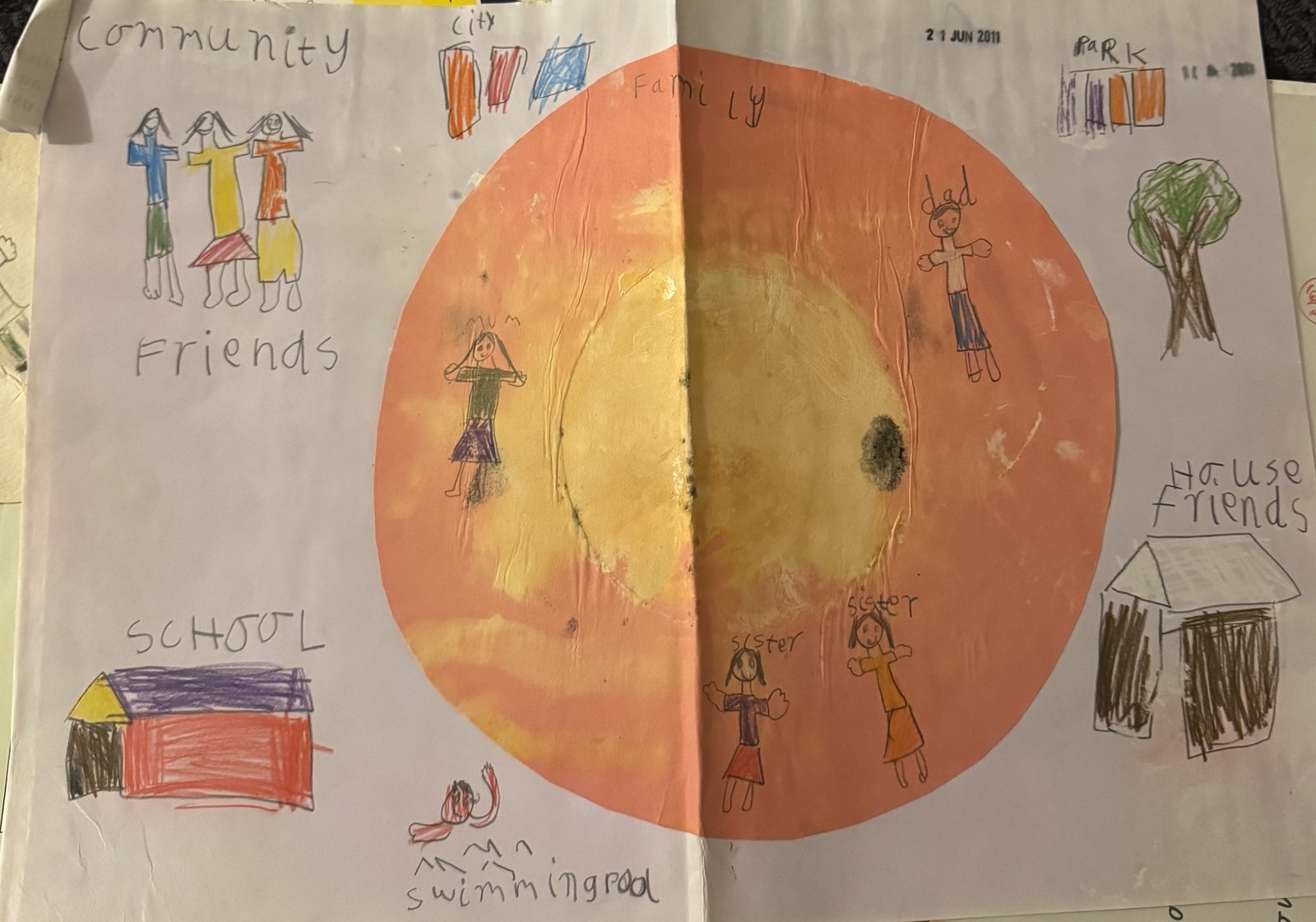
Zara’s Belonging Circle: Anchoring the Core Family
A few months into the school year, Zara brought home a drawing activity called the Belonging Circle. Looking at that page gave me a clear lens into how a multilingual child processes their expanding world.
Right at the center of the page, coloured in warm, confident strokes of orange and yellow crayon, were four figures: Mum, Dad, Sister, and Sister. Surrounding that inner core was a large outer ring filled with new places and people: School, Friends, Park, City, and Swimming Pool.
In early childhood developmental psychology, particularly within ecological systems theory, a child development relies on the strength of their innermost microsystem.[1] The home, the primary language, and the immediate family form the emotional anchor. When a child feels completely safe at the center, they gain the psychological security needed to venture out into the wider mesosystem of school, playground games, and new peer groups.
Language learning is not a process of replacing a child’s original world. It is an additive process. As second language acquisition researcher Jim Cummins famously noted, literacy and conceptual understanding built in a child’s first language serve as the primary foundation for acquiring a second one.[2]
Recognising how a multilingual child processes their expanding world through their primary language allows educators and parents to nurture biliteracy naturally. Insights from Harvard’s Center on the Developing Child emphasize that secure relational buffers protect executive attention during stressful transitions. When we honour the home core, the outer circle takes care of itself.
Under Australia’s national early childhood framework administered by ACECQA, belonging stands as the first foundational outcome: children must experience learning environments that respect their home identity, home language, and cultural safety.
Lowering the Emotional Pressure: What Actually Helped
When children are thrust into a new language environment, their emotional filter naturally goes up.[4] If they feel pressured to speak before they are ready, anxiety blocks their ability to absorb new sounds and phrases.
Instead of pushing Zara to speak English at home after a long, exhausting school day, we made a conscious choice to keep our home environment deeply Indonesian. We read stories in our first language, talked through our evening cooking routines, and let her draw whatever she wanted at the kitchen counter.
We also used visual mapping to help her bridge her two worlds. Supporting how a multilingual child processes their expanding world means prioritizing emotional reassurance long before expecting fluent conversational English.
By creating low-demand spaces at home, we gave her room to decompress. Appreciating how a multilingual child processes their expanding world reminds us that cognitive energy is finite, especially after a full day spent translating an unfamiliar classroom environment.
Surface Silence vs Deep Internal Processing
Understanding the difference between outward behaviour and internal processing helps parents replace anxiety with steady patience:
| Observed Classroom Behaviour | Common Adult Misconception | What the Child Is Actually Processing |
|---|---|---|
| 1. Standing on the Rug Edge Hesitating at the door and holding skirts or coats. |
The child is timid, antisocial, or unable to make friends. | Scanning the room to map routines, decode body language, and find safe entry points. |
| 2. The Silent Classroom Period Refusing to answer questions verbally in English. |
The child is falling behind or lacks vocabulary understanding. | Absorbing auditory cadences, syntax, and phonology while building internal confidence. |
| 3. Drawing Family at the Center Placing parents and siblings in every art piece. |
The child is overly dependent on home and struggling to separate. | Constructing an anchor of safety that allows the outer social world to expand securely. |
| 4. Using One-Word Cues Pointing and saying “Here” or “Mine” softly. |
Speech development is delayed or restricted to fragments. | Taking initial brave steps in low-demand social reciprocity with peers. |
Focus on Visual Anchors Before Verbal Demands
If you are supporting a young child navigating a similar transition, one small, realistic shift makes a world of difference:
Focus on Visual Anchors Before Verbal Demands
Give your child simple opportunities to map out their relationships visually. Drawing family circles, making photo collages of home and school, or using simple visual charts allows a child to organise their feelings without the heavy cognitive load of translating everything into spoken English.
Global development principles highlighted by UNICEF on early childhood development remind us that young children build resilience when their emotional security and cultural identity are fostered concurrently.
In neurodiversity-affirming frameworks and early childhood emotional regulation guides, visual predictability and emotional safety are recognized as foundational requirements for any child processing a complex environment. Looking closely at how a multilingual child processes their expanding world through drawings confirms that non-verbal tools build an enduring bridge to communication. Giving a child visual ownership over their story builds safety.
Watching the Circles Connect at the Craft Table
A few weeks after Zara completed her belonging circle sheet, I arrived at kindergarten a few minutes before home time.
I looked through the glass paneling of the classroom door. Zara was sitting at the low craft table beside two classmates. She was holding an orange crayon, carefully drawing a house with a steep roof. She did not say a full sentence in English, but as her classmate reached for a glue stick, Zara pointed to the basket and said softly, “Here.”
The classmate smiled, took the glue, and kept working side by side with her. Zara did not need to perform or speak in fluent paragraphs to belong. She knew that her family was waiting for her at the end of the day, that her home language was safe, and that she had a valid place at that craft table.
It is natural to feel anxious when a child sits quietly on the edge of a busy classroom. When we examine how a multilingual child processes their expanding world, we see that confidence grows steadily when we protect their home identity, celebrate their first language, and give them simple visual tools to process their days.
Ultimately, respecting how a multilingual child processes their expanding world allows us to meet them with calm reassurance rather than impatience. A child who feels secure at the center of their world will always find the confidence to reach outward.
Explore Our Visual Literacy & Tracing Bundles
Discover printable activity packs built around story-based drawing, visual vocabulary, and low-anxiety pre-writing practice for young learners.
Explore Early Literacy Bundles- Discover our personal journey from Jakarta to Melbourne in From Jakarta to Melbourne: What My 5-Year-Old’s Drawings Taught Me About Early EAL →
- Explore seasonal vocabulary in Early EAL Learning: How Moving Climates Build Environmental Vocabulary →
- Support daily routines with “What Should I Wear Today?” Using Weather Drawings for Daily English →
- Return to our overarching framework on the EAL & Multilingual Learning Hub →
References & Readings That Guided Me
- Bronfenbrenner, U. (1979). The Ecology of Human Development: Experiments by Nature and Design. Harvard University Press. [Theoretical foundation on microsystems, ecological security, and child belonging].
- Cummins, J. (2000). Language, Power and Pedagogy: Bilingual Children in the Crossfire. Multilingual Matters. [Evidence on common underlying proficiency and first language foundation in second language acquisition].
- Australian Government Department of Education. (2022). Belonging, Being and Becoming: The Early Years Learning Framework for Australia (V2.0). [Embedding cultural identity, home language respect, and relational security in early childhood programs].
- Krashen, S. (1982). Principles and Practice in Second Language Acquisition. Pergamon Press. [Defining the affective filter and the necessity of low anxiety environments for natural language acquisition].
- State of Victoria (Department of Education and Training). (2016). Victorian Early Years Learning and Development Framework (VEYLDF). [Guidelines supporting multi-lingual learners and cultural inclusion across Victorian early childhood services].