
Why “Hot Wathers” is a Win: Invented Spelling in Early EAL
Understanding invented spelling in early EAL became real for me on a chilly Tuesday afternoon in Melbourne, watching my five year old daughter sit hunched over our kitchen table. Her grey lead pencil was gripped tightly between her fingers, her knuckles pale with effort. She held down a quartered paper wheel she had brought home in her portfolio from kindergarten. She pressed the graphite tip into the paper, paused, and leaned in so close her nose almost brushed the page. I watched her sound out a word under her breath, whispering consonants slowly into the quiet kitchen before carefully pressing each letter into the paper.
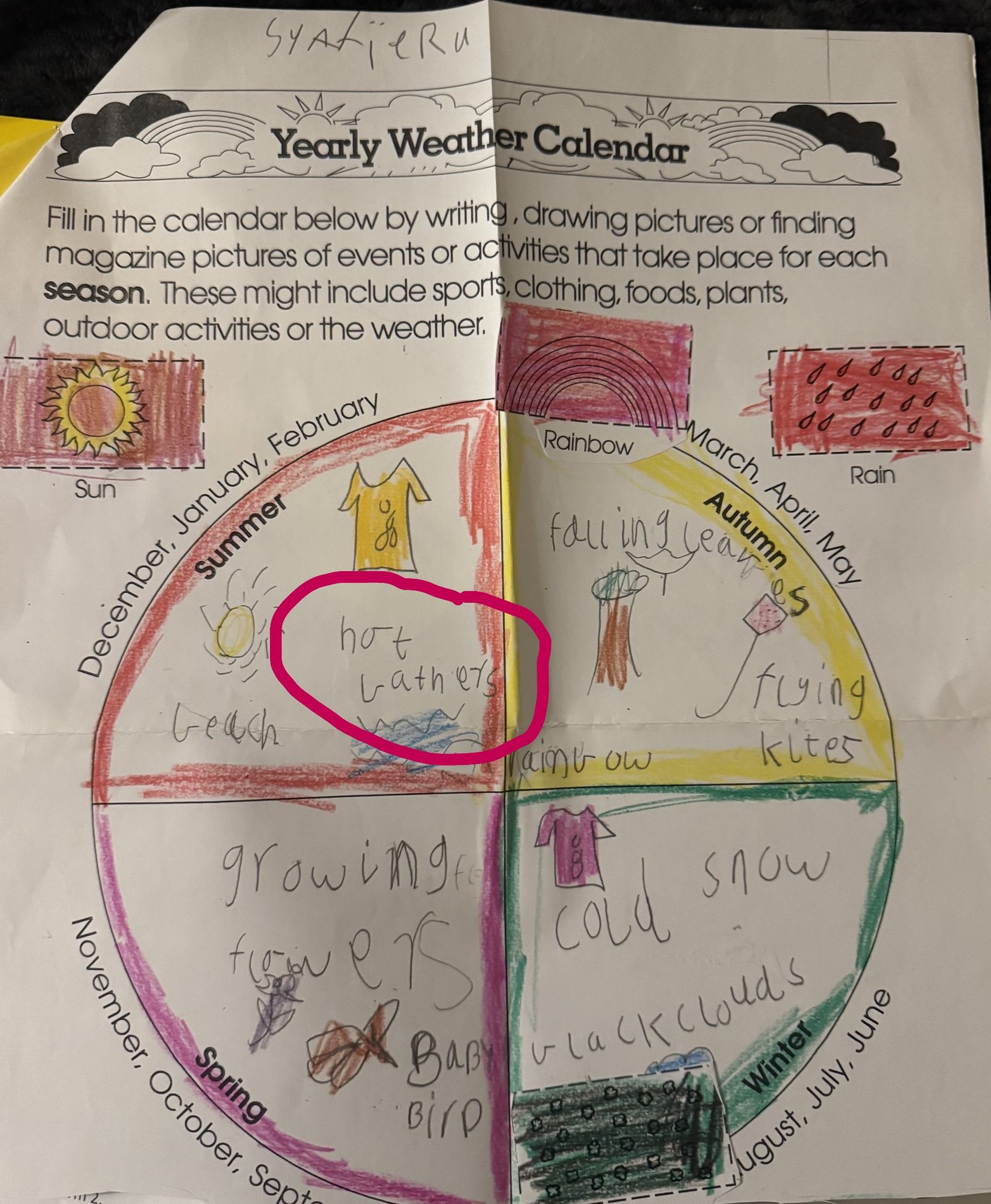
When she finished, she looked up at me with a mix of concentration and quiet pride, pointing her index finger at the bright red quarter she had coloured in with crayon. Right beside a pencil sketch of a yellow sun and a t-shirt, she had written out three words in her small, deliberate handwriting: “Sun”, “Beach”, and “hot wathers”.
As a mother who was also completing a PhD in early childhood education, my first instinct was surprisingly split. The educator in me recognised what she had done, but the tired mother sitting across the table reached reflexively toward the pink eraser in her pencil case. I felt a quick urge to step in, point out the extra letter, fix the vowel sound, and gently show her the standard dictionary spelling for weather.
In that brief second, Zara caught my hand moving. Her pencil hovered above the paper, and I saw her shoulders tense. The easy confidence on her face turned into a subtle hesitation, her small fingers pulling back as if she were waiting to be told her hard work was wrong.
The Living Room Reality vs Academic Theory
When you spend your days reading academic literature on child development, concepts like code switching, emergent literacy, and phonetic decoding sound orderly. Textbooks present early writing development as a clean, step by step progression where children smoothly move from scribbling to phonetic attempts, and finally to conventional spelling.
In living room reality, watching your own child struggle to write in a second language feels much more raw.
We had arrived in Melbourne from Jakarta in October 2010. Everything was brand new, from the freezing morning winds to the fast rhythm of Australian English spoken in Zara’s kindergarten classroom. At home, our conversations flowed naturally in Indonesian. We cooked together, told bedtime stories, and chatted about our day in our native language. But at school, Zara spent her mornings navigating a brand new linguistic world.
When you are an immigrant parent balancing study or work while watching your child adjust to a new school, small spelling errors can easily trigger underlying anxiety. It is easy to worry that misspelled words mean your child is falling behind, getting confused by two languages, or picking up habits that will be difficult to unlearn later on.
Yet, when we examine invented spelling in early EAL through a developmental lens, we discover that these phonetically creative attempts are not errors at all. They are evidence of high-level cognitive processing, linguistic courage, and active learning.
Deconstructing “Hot Wathers”: What Is Really Happening in the Brain?
To understand why an attempt like “hot wathers” is such a huge milestone, we have to trace the complex mental steps a child takes to put those letters onto paper.
For a child who spoke only Indonesian a few months prior, producing an English word in print requires multiple layers of cognitive translation:
- Auditory Processing: The child must pull a spoken word (*weather*) out of the fast stream of English spoken around them in the classroom or at the park.
- Phonemic Segmentation: They must isolate the individual speech sounds inside that word: the initial /w/, the short vowel sound, the tricky voiced /th/ blend, and the ending sound.
- Grapheme Mapping: They must search their memory to match those abstract sounds to physical letter shapes they have practiced tracing.
- Motor Execution: They must hold a pencil, maintain hand control, and write those letters down from left to right.
When Zara wrote “wathers”, she captured almost every phonetic component of the word correctly. She identified the initial /w/ sound, recognised the short vowel, picked up the complex /th/ sound, and mapped the final /rs/ ending phonetically. She did not copy the word from a whiteboard or memorise it for a test. She constructed it from scratch using her own understanding of English phonics.
This is the core strength of invented spelling in early EAL. It demonstrates that the child is not just passively absorbing sounds; they are actively testing hypotheses about how written language works.
Stephen Krashen and the Emotional Barrier to Writing
So why does stepping in with an eraser cause so much damage to an early writer?
In second language acquisition research, linguist Stephen Krashen introduced a concept known as the Affective Filter Hypothesis. Krashen explained that emotional variables, such as anxiety, self-consciousness, and fear of making mistakes, act as an invisible mental filter that can block learning.
When a child’s affective filter is low, they feel safe, relaxed, and open. They are willing to try new words, guess spoken phrases, and attempt to write words they have never seen spelled out. But when an adult frequently corrects early attempts, the affective filter shoots up. The child begins to worry about performance, fears making mistakes, and forms a mental wall.
For a young EAL child, a high affective filter often looks like sudden reluctance. The child might insist, “I don’t know how to write it,” ask an adult to write every word for them, or stick exclusively to a few simple words they know how to spell perfectly, such as cat or sun.
In neurodiversity-affirming frameworks and inclusive early literacy practices, such as those discussed in Understanding Autism: A Neurodiversity Affirming Workbook for Children and Teens, lowering anxiety and prioritizing psychological safety are recognized as preconditions for meaningful communication. When children know that their ideas are valued more than mechanics, their willingness to take risks expands.
The Misunderstanding of Practice: Correction vs Modelling
A common point of confusion for parents is the fear that ignoring a spelling error will fix that error in the child’s mind forever. It feels logical: if they write “wathers” today, won’t they keep writing “wathers” in Year 1?
Developmental research shows that literacy acquisition does not work like a permanent stamp. Children continually refine their spelling rules as their reading exposure grows. As a child reads more picture books, sees environmental print around Melbourne, and participates in classroom shared reading, their visual memory of words updates naturally.
Directly correcting an emergent writer shifts their attention away from meaningful communication and places it entirely on accuracy. Instead of viewing writing as a way to share thoughts, stories, and observations, the child begins to see writing as a high-stakes test where they can fail.
A Practical Shift: How to Celebrate Phonetic Risk-Taking at Home
Reframing how we respond to early writing does not mean we ignore language growth. It simply means shifting our role from a strict editor to a supportive reader.
If your child brings home a drawing with phonetic spelling, or sits beside you at the kitchen table trying to write a shopping list, here is a practical, low-pressure approach you can use:
1. Validate the Message First
Before saying anything about the letters, respond to what your child actually expressed. Read their word out loud, look at their drawing, and connect with their idea: “Hot weather at the beach! Yes, summer in Melbourne gets so hot, we need our bathers.” This tells your child that their writing successfully communicated their thought.
2. Praise the Phonetic Logic
Notice the specific sounds your child got right and acknowledge their effort: “You heard the /w/ sound at the start of weather! That was a clever sound to pick out.” Pointing out what worked builds intrinsic confidence and reinforces their phonetic awareness.
3. Model Natural English Without Direct Erasure
Instead of erasing their work, model the conventional spelling naturally in another context. You might write a caption beneath a photo together on a new page, or write a note to a family member: “Let’s write ‘Hot weather today’ on our fridge calendar!” This exposes them to standard spelling without invalidating their original attempt.
4. Keep the Home Language Vibrant
Continue telling stories, reading books, and sharing daily life in your native language. A rich home vocabulary builds strong underlying concepts that directly support second language writing. A child who understands complex concepts in their first language will easily map those ideas into English over time.
Return to the Kitchen Table: Watching Confidence Bloom
On that afternoon in our Melbourne kitchen, I took a breath and put my hand back on the table, leaving the pink eraser inside the pencil case.
I looked at Zara’s quartered calendar, pointed to the red summer drawing, and smiled. “Hot weather at the beach! You remembered that Melbourne gets really hot in January, and you wrote down the sounds you heard in weather.”
The tension left her face immediately. Her shoulders dropped, her fingers loosened around the pencil, and a big smile broke across her cheeks. She did not hide her paper or pull away.
Instead, she leaned back over the page with renewed energy, tapped her pencil tip onto the green winter section, and whispered sounds to herself again. She drew a thick purple jumper, dark rain clouds, and wrote out the words “cold” and “snow” beneath her drawing without a single second of hesitation. She was not worried about whether her spelling was dictionary-perfect; she was eager to share what she knew about winter.
Brave Writers Need Safe Spaces
Looking back at Zara’s kindergarten portfolio years later, those pages filled with phonetic spelling attempts are among my most treasured memories. They capture a moment in time when a five year old girl from Jakarta was bravely building a bridge into a new language, one pencil mark at a time.
Supporting invented spelling in early EAL is not about lowering standards or ignoring grammar. It is about protecting a young child’s courage during a time of massive transition.
When we celebrate phonetic risk-taking, lower the emotional barrier, and offer safe, supportive spaces at home, we give young children permission to become brave, curious, and confident writers. Every invented word on a page is proof that a child is listening, thinking, and reaching out to share their world with us.
Explore Our Visual Literacy & Tracing Bundles
Discover printable activity packs built around story-based drawing, visual vocabulary, and low-anxiety pre-writing practice for young learners.
Explore Early Literacy Bundles