
Animal Walks Gross Motor Preschool: 8 Easy, Joyful Moves for Calmer Transitions
Animal walks gross motor preschool activities invite children to move like bears, crabs, frogs and sloths. Slow, heavy movements that carry body weight through the hands and feet build strength, balance and coordination, and many families and educators find they help busy children settle before quiet tasks.
This guide shares the bear walk that changed our afternoons in Indonesia, eight animal walks with step by step instructions, when to use them, what the research does and doesn’t say, links to fine motor skills, a free printable set of Animal Walk Movement Cards and twelve free PDFs.
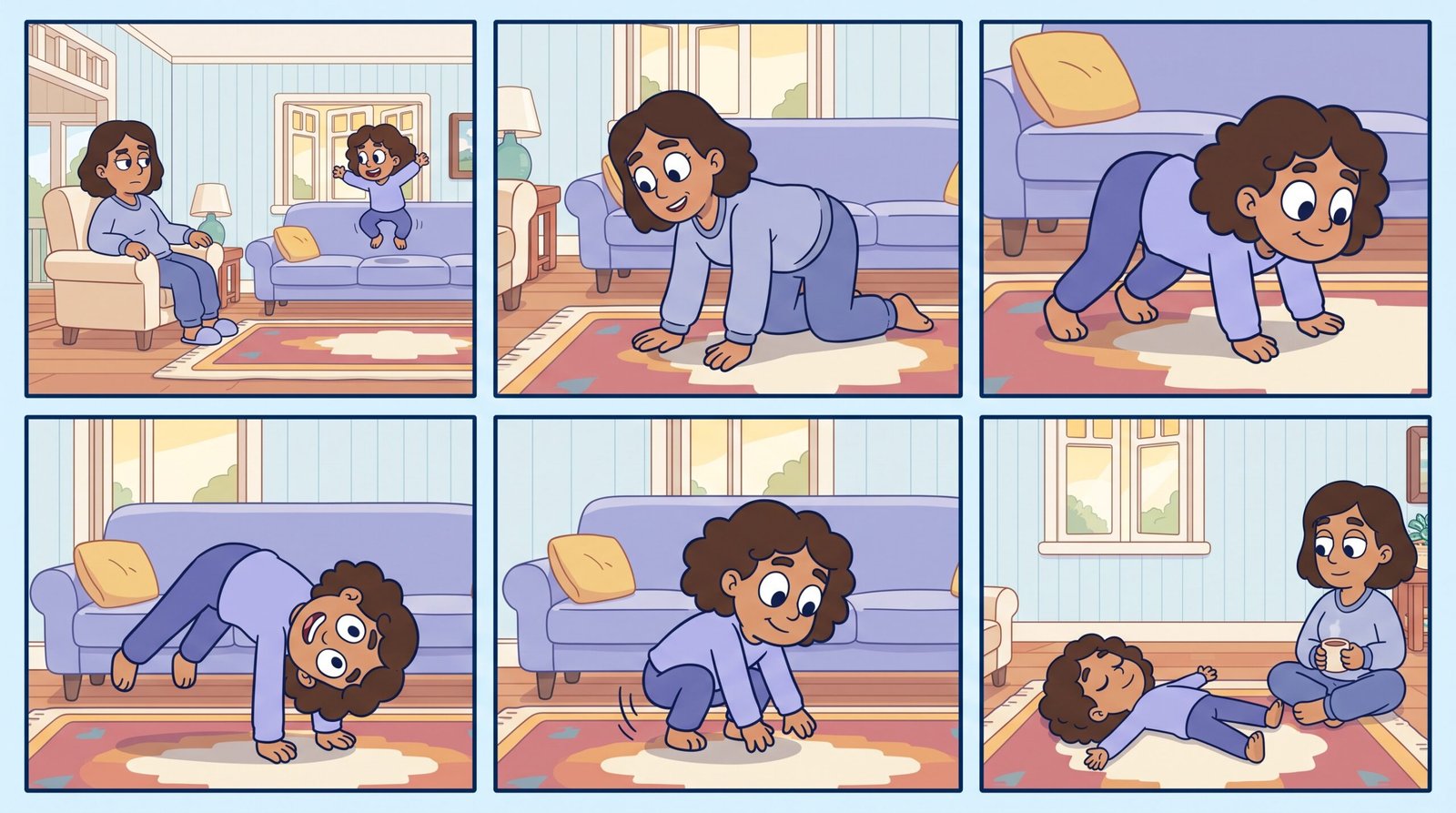
“The hallway has turned into a muddy riverbank,” I said. “We have to crawl like heavy brown bears to get to the bathroom.” Zara dropped straight to all fours.
- The Bear in Our Hallway
- Why Animal Walks Work for Busy Bodies
- What the Research Does and Doesn’t Say
- What Happens in the Body on All Fours
- 8 Animal Walks Gross Motor Preschool Moves
- Animal Walks at a Glance
- When to Use Animal Walks
- Mat Time in a Melbourne Room
- From Bear Walks to Pencil Grip
- Animal Walks for ADHD and Sensory Seeking Children
- Animal Walks by Age
- Safety and When to Ask for Help
- Free Printable: Animal Walk Movement Cards
- More Free PDFs
- Animal Walks FAQs
The Bear in Our Hallway
I’m not an occupational therapist or a physiotherapist. I’m an early childhood educator and a mother. This story is from our years in Indonesia, when my girls were small and I was lecturing in early childhood teacher education.
Afternoons at home often followed the same exhausting pattern. My younger daughter, Zara, would come home from a big, busy day, and when I gently asked her to take off her shoes, wash her hands and sit down for a snack, her body would speed up instead of slowing down.
She’d run full speed into the lounge room, launch herself onto the couch cushions, kick the legs of the coffee table and spin in circles until she fell sideways. If I asked her to sit still and listen, frustration spilled into tears. She’d clench her fists, stomp her heels and refuse to come to the table.
In my work, I’d read about proprioception, the body’s sense of where it is, and about how some children seek strong movement and pressure. On paper it felt theoretical. Watching Zara crash and spin, it suddenly made sense. She didn’t seem defiant. Her body seemed to be looking for something firm to push against.
So one afternoon, instead of telling her to sit still, I knelt down and said, “The hallway has turned into a muddy riverbank. We have to crawl like heavy brown bears to get to the bathroom.”
She dropped to all fours straight away. Palms flat, shoulders strong, she moved down the hallway in slow, heavy bear steps. By the time she reached the basin, the spinning had stopped. Her breathing had slowed. She washed her hands and sat down for her snack, calmer than she’d been all afternoon.
That afternoon showed me that movement could do what my words couldn’t. You can read more about crashing and pressure seeking in sensory seeking toddlers and proprioception.
Why Animal Walks Gross Motor Preschool Routines Work for Busy Bodies
Walk into most early learning rooms at transition time, say, coming inside from outdoor play, and you’ll see children struggling to slow down. Educators say “walking feet” and “quiet hands”, and the words often bounce off.
Animal walks gross motor preschool routines work for a few reasons:
- They’re heavy: carrying body weight through the hands and feet gives strong feedback to muscles and joints, which many busy children seem to find settling.
- They’re slow: unlike running or wild jumping, which can wind children up, a bear walk is naturally contained.
- They’re playful: “be a sloth” is far more inviting than “calm down”.
- They need no equipment: a hallway, a rug or the grass is enough.
- They build real strength: shoulders, core, legs and balance all get a workout.
Australia’s Early Years Learning Framework includes children’s physical wellbeing within Outcome 3, “Children have a strong sense of wellbeing”, and animal walks are an easy, everyday way to support it.[1]
What the Research Does and Doesn’t Say
It’s important to be honest about evidence.
Movement breaks: research on short classroom movement breaks is encouraging. In one study, Mahar and colleagues found that after ten minute classroom activity breaks, the on-task behaviour of primary school children rose from about 71% to 79%, and the least focused children improved the most.[2] That study was with older children, not preschoolers, but it supports the idea that moving can help children focus afterwards.
Sensory activities: research on specific sensory based activities, like weighted items or particular “heavy work” routines, is still limited. A systematic review of sensory interventions for autistic children found the evidence for many sensory based activities was weak.[3]
So animal walks gross motor preschool activities aren’t a treatment. They’re good, playful movement that builds strength and coordination, and that many families find helpful for settling. Watch your own child and use what works for them.
What Happens in the Body on All Fours
Why might getting down on hands and feet help a frantic child more than sitting on a chair? Here’s a simple picture.
Body Awareness From Muscles and Joints
Proprioception is the sense that tells us where our body is and how much force we’re using. It comes from sensors in our muscles, tendons and joints.[4] Pushing, pulling and carrying weight give these sensors lots of information. Jean Ayres, who developed sensory integration theory, described how this information helps children plan and organise movement.[5]
Strong Core, Steady Sitting
Sitting up straight on a mat takes more core strength than we think. A child with low core strength or weak body awareness may slump, lean on friends or fidget constantly. On all fours, the body shares the work between arms, legs and trunk, and children build the strength that makes sitting easier later. This is one reason a child may manage some days and not others. See why your child can do it some days and not others.
Moving Slowly Takes Control
Moving fast is easy for a busy body. Moving very slowly takes real control and focus. That’s why the sloth crawl can be surprisingly settling.
8 Animal Walks Gross Motor Preschool Moves
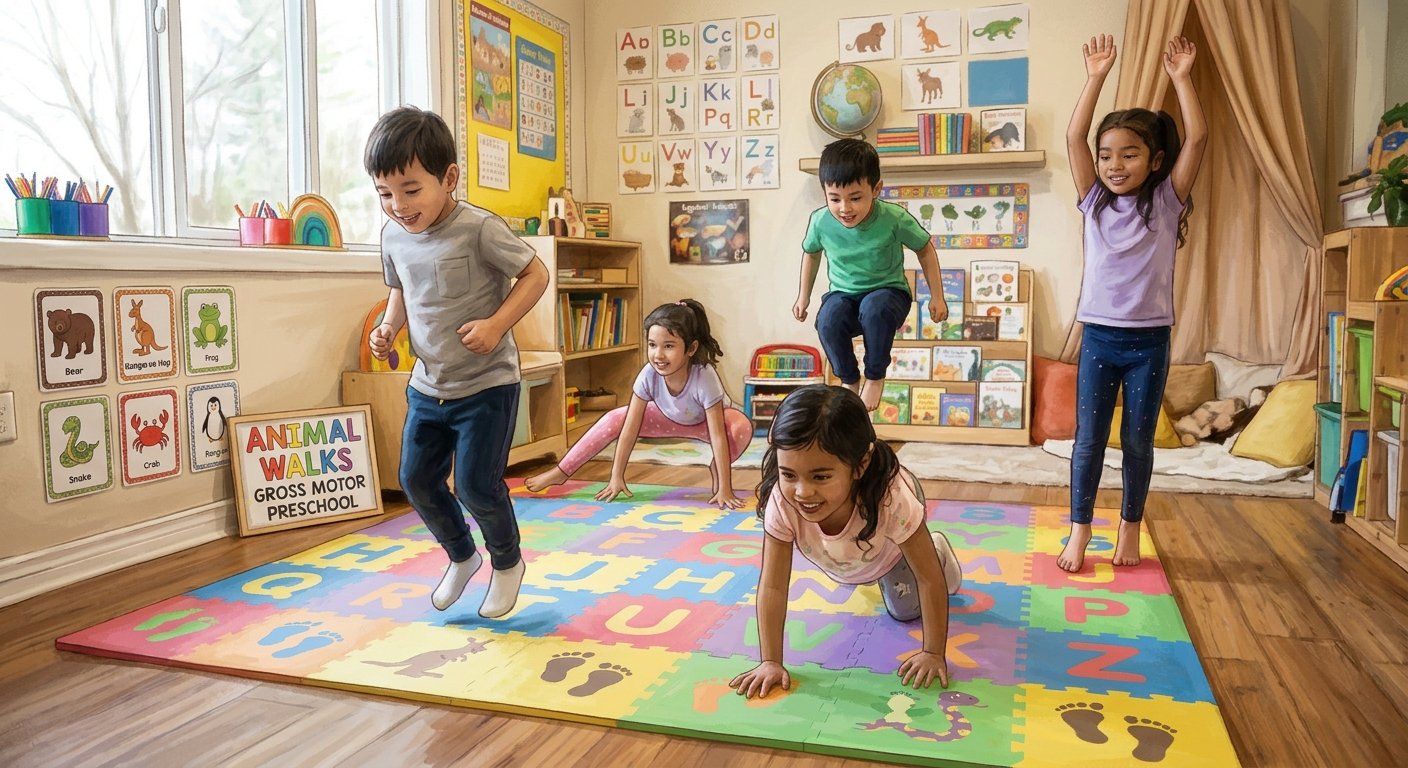
These eight animal walks need no equipment. Do them in a hallway, across a rug or on the grass. Show your child first, then do it together.
Bear Walk: Heavy and Grounding
- How: hands and feet flat on the floor, bottom up high, knees a little bent. Walk forward slowly, opposite hand and foot together.
- Say: “Heavy bear paws. Press them into the mud.”
- Builds: shoulder, arm and wrist strength, coordination.
- Watch for: racing. Keep it slow and heavy.
Crab Walk: Tummy to the Sky
- How: sit down, hands flat behind you, feet flat in front. Lift your bottom and walk backwards or sideways.
- Say: “Keep your tummy up so the waves don’t get it wet.”
- Builds: arm, back and core strength, body awareness.
- Watch for: a sagging bottom. Short distances are fine to start.
Frog Hop: Spring and Land
- How: squat low with knees wide and hands on the floor between your feet. Spring forward and land softly back in a squat.
- Say: “Soft frog landings, so you don’t scare the fish.”
- Builds: leg strength, balance, controlled landing.
- Watch for: hard floors. Use a rug, grass or mat.
Sloth Crawl: Slow and Steady
- How: on hands and knees, move as slowly as possible, counting to three for each hand or knee.
- Say: (whispering) “Sloths never hurry.”
- Builds: control, focus, core strength.
- Watch for: turning it into a race. Slow is the whole point.
Kangaroo Jump: Feet Together
- How: feet together, hands tucked up like little paws. Jump forward with both feet, landing softly.
- Say: “Kangaroo feet stay stuck together.”
- Builds: leg power, two sided coordination, balance.
- Watch for: too many jumps if a child is already wound up. Finish with a slow walk.
Elephant Stomp: Big and Heavy
- How: bend forward slightly, clasp hands together for a trunk, and take big, heavy, slow steps.
- Say: “Make the ground shake, slowly.”
- Builds: leg strength, heavy feedback through the feet.
- Watch for: noisy floors upstairs. Grass is perfect.
Inchworm Walk: Stretch and Gather
- How: start standing, bend down to put hands on the floor, walk hands forward until long and flat, then walk feet up to hands.
- Say: “Stretch long, then scrunch up small.”
- Builds: core and shoulder strength, stretching, planning.
- Watch for: it’s tricky. Help with the first few.
Flamingo Balance: Still and Tall
- How: stand on one leg, arms out like wings, and count. Swap legs. Hold a wall or a hand at first.
- Say: “How long can the flamingo rest?”
- Builds: balance, focus, stillness.
- Watch for: frustration. Three seconds is a great start.
You can build these into an indoor obstacle course on rainy days, or carry the Pocket Heavy Work Cards for more ideas. See also how to use pocket heavy work cards.
Animal Walks Gross Motor Preschool Moves at a Glance
| Animal Walk | Body Position | Main Strength | Best For |
|---|---|---|---|
| Bear walk | Hands and feet, bottom up. | Shoulders, arms, wrists. | Settling before sitting tasks. |
| Crab walk | Hands and feet, tummy up. | Arms, back, core. | Children who slump on the mat. |
| Frog hop | Deep squat, spring forward. | Legs, balance. | Children who love to jump and crash. |
| Sloth crawl | Hands and knees, very slow. | Core, control. | Calming down, getting ready to listen. |
| Kangaroo jump | Feet together, jumping. | Legs, coordination. | Outdoor play, energy release. |
| Elephant stomp | Standing, heavy steps. | Legs. | Feeling the ground, outdoors. |
| Inchworm | Stretch and gather. | Core, shoulders. | Older preschoolers, a challenge. |
| Flamingo | One leg balance. | Balance, focus. | Finishing calmly. |
When to Use Animal Walks Gross Motor Preschool Routines
Animal walks gross motor preschool routines fit naturally into the moments of the day that are hardest.
- After school or care: a bear walk to the bathroom, as in our hallway.
- Before mat time or table tasks: a slow crawl to the mat. See when a child won’t sit for circle time.
- Between activities: “Hop like frogs to the sink.” See sensory micro transitions.
- In the morning: part of moving first. See daily routines for neurodivergent children.
- On rainy days: an animal parade down the hallway.
- Before bedtime: only slow ones, like sloth crawls and flamingo balances.
Finish with a calm one, like a sloth crawl or flamingo balance, rather than a jumping one.
Mat Time in a Melbourne Room
Years later, after finishing my PhD, I worked as a casual relief educator in centres across Melbourne’s east. The story below is a composite of moments I saw, not one child or centre. “Liam” isn’t a real child’s name.
The words only way: Twenty children come inside from busy outdoor play. “Hats away, sit on the mat with crossed legs and quiet hands.” Liam rushes across the room, trips over a basket and lands on the carpet. He rolls onto his back, kicks his legs up and bumps the child next to him. Told to sit properly, he clenches his teeth, throws his hat and hides under a shelf in tears.
The animal walk way: Same group, same morning. The educator stands at the door and whispers, “The carpet is a quiet forest. We’re big, heavy bears walking slowly to our cave.” She drops into a bear walk around the edge of the rug. Liam drops to all fours. He moves slowly, palms pressing into the rug. When the educator invites everyone to sit, he settles more easily, back against a low shelf, and listens to the story.
Movement doesn’t work for every child every time. But I saw how much easier transitions were when bodies moved first. I write more about this in regulation before learning and classroom noise and sensory overload.
From Bear Walks to Pencil Grip
A common mistake is asking children to practise pencil control before their shoulders and arms are strong enough to support their hands. A child with a wobbly shoulder may grip the pencil tightly, press hard and hunch over the page.
- Weight through the hands: bear and crab walks put the wrist in an extended position and build hand and arm strength. See hand strength activities for kids.
- Stable shoulders: carrying weight through the arms builds the shoulder stability that lets fingers move freely.
- A warm up: a couple of minutes of animal walks before drawing can help some children settle into the chair. See pencil control activities and pincer grasp activities.
Many occupational therapists use weight bearing play alongside fine motor activities, which fits the idea that steady movement starts from the body’s centre and works outwards to the hands.[6]
Animal Walks for ADHD and Sensory Seeking Children
My eldest, Bella, showed signs of ADHD from babyhood and was diagnosed in her twenties. Looking back, so many of our hard moments were about a body that needed to move. Busy and sensory seeking children often get the most from animal walks gross motor preschool routines, with a few tweaks.
- Go heavy, not fast: bear walks and elephant stomps over fast running.
- Make it a job: “Bear walk this cushion to the couch” adds purpose.
- Use visual cues: a card with the animal picture beats spoken instructions. Try the printable cards below.
- Finish slowly: always end with a sloth crawl or flamingo balance.
- Pair with first then: “First bear walk, then snack.” See the First Then Reset Mats.
See also when an ADHD child won’t start tasks and calm corner design for after the movement.
Animal Walks Gross Motor Preschool Ideas by Age
A rough guide from my years in early childhood. Every child is different.
| Age | Good Starting Moves | Tips |
|---|---|---|
| 2 years | Elephant stomps, bear crawls on knees, kangaroo jumps with help. | Copy you, short distances, lots of fun. |
| 3 years | Bear walks, frog hops, sloth crawls. | Use stories: “the river”, “the forest”. |
| 4 years | Crab walks, kangaroo jumps, flamingo balances. | Count steps, make an animal parade. |
| 5 years | Inchworms, longer crab walks, animal obstacle courses. | Let children invent their own animals. |
Safety and When to Ask for Help
Do animal walks on soft, clear surfaces like rugs, grass or mats, away from furniture corners. Keep jumping moves on soft ground. Stop if a child is in pain. Talk with your GP, Maternal and Child Health nurse, or a paediatric physiotherapist or occupational therapist if your child is much clumsier than peers, falls often, avoids physical play, tires very quickly, has trouble with balance or loses skills they used to have. The GP Appointment Planner can help you prepare.
Free Printable: Animal Walk Movement Cards
Eight animal walks gross motor preschool cards on one A4 landscape page. Children draw their animal in the box, then you cut along the dashed lines. Pull out a card at transition time.
Animal Walk Movement Cards
Slow and heavy. Finish with a sloth or a flamingo.
Bear Walk
Hands and feet, bottom up. Heavy paws.
Steps: ______Crab Walk
Tummy to the sky. Walk backwards.
Steps: ______Frog Hop
Squat low, spring, land softly.
Hops: ______Sloth Crawl
Hands and knees. Very, very slow.
Steps: ______Kangaroo Jump
Feet together. Jump, jump.
Jumps: ______Elephant Stomp
Big, slow, heavy steps. Trunk swing.
Stomps: ______Inchworm
Hands walk out, feet walk in.
Inches: ______Flamingo
One leg, wings out. Count and swap.
Seconds: ______More Free PDFs
These free PDFs from this site pair well with animal walks gross motor preschool routines for movement, calm and transitions.
Pocket Heavy Work Cards
More pushing, pulling and carrying ideas.
Download PDF For home and roomsSensory Space Audit Checklist
Find space for movement in your room.
Download PDF Best for educatorsWeekly Battery Check-In
Busy afternoons drain parents too.
Download PDF For parents and educatorsMore free tools are on our printables page.
Looking Back
That bear on our hallway floor in Indonesia taught me something I later saw in Melbourne rooms too: a busy body isn’t a badly behaved body. Often it’s a body asking for something firm to push against.
By inviting children to lumber like bears, crawl like sloths and hop like frogs, we give them a joyful, dignified way to settle, and the strength to grow. And honestly, it’s a lot more fun than “sit still”.
- The big picture: the sensory environment
- Pressure seekers: sensory seeking toddlers and proprioception
- Small changes: sensory micro transitions
- Rainy day moves: indoor obstacle course
- Calm first: regulation before learning
- Gentle pace: fostering a love of learning
Animal Walks FAQs
What are animal walks for preschoolers?
Animal walks are playful movements where children copy how animals move, such as bear walks on hands and feet, crab walks with tummy up, frog hops and slow sloth crawls. They build strength, balance and coordination, and many educators use them to help children settle during transitions.
Do animal walks help children calm down?
Many families and educators find that slow, heavy movements like bear walks and sloth crawls help busy children settle before sitting tasks. Research on short movement breaks in school shows improvements in on-task behaviour, although research on specific sensory activities is still limited. Watch your own child and use what helps.
Which animal walks are best for preschoolers?
Bear walks, crab walks, frog hops, kangaroo jumps, elephant stomps, inchworm walks, flamingo balances and slow sloth crawls are all popular. Start with bear walks and frog hops, which most three to five year olds enjoy, and keep the pace slow and heavy rather than fast.
Can animal walks help with pencil grip and writing?
Weight bearing through the hands, as in bear walks and crab walks, builds shoulder, arm and hand strength. Many occupational therapists use these activities alongside fine motor play to support the stability children need for drawing and early writing.
When should I worry about my child’s gross motor skills?
Talk with your GP, Maternal and Child Health nurse or a paediatric physiotherapist or occupational therapist if your child is much clumsier than peers, falls often, avoids physical play, tires very quickly, has trouble with balance or loses skills they used to have.
Research and guidance: the Early Years Learning Framework, Mahar and colleagues on classroom movement breaks, Case-Smith and colleagues’ review of sensory interventions, Proske and Gandevia on proprioception, and Ayres and Bundy on sensory integration.
Experience: the bear walk in our hallway, with Zara, happened in Indonesia. The mat time story is a composite of moments from my relief educator years in Melbourne, and “Liam” isn’t a real name. The eight walks, the age table and the tips come from my practice, not from research.
This is educational content, not occupational therapy, physiotherapy or medical advice. Last reviewed: 9 November 2026.
References
- Australian Government Department of Education. (2022). Belonging, being and becoming: The early years learning framework for Australia (V2.0). https://www.acecqa.gov.au/sites/default/files/2023-01/Belonging_Being_And_Becoming_V2.0.pdf
- Mahar, M. T., Murphy, S. K., Rowe, D. A., Golden, J., Shields, A. T., & Raedeke, T. D. (2006). Effects of a classroom-based program on physical activity and on-task behavior. Medicine & Science in Sports & Exercise, 38(12), 2086-2094. https://doi.org/10.1249/01.mss.0000235359.16685.a3
- Case-Smith, J., Weaver, L. L., & Fristad, M. A. (2015). A systematic review of sensory processing interventions for children with autism spectrum disorders. Autism, 19(2), 133-148.
- Proske, U., & Gandevia, S. C. (2012). The proprioceptive senses: Their roles in signaling body shape, body position and movement, and muscle force. Physiological Reviews, 92(4), 1651-1697.
- Ayres, A. J. (2005). Sensory integration and the child: 25th anniversary edition. Western Psychological Services.
- Bundy, A. C., Lane, S. J., & Murray, E. A. (2002). Sensory integration: Theory and practice (2nd ed.). F. A. Davis.
