
Mud Kitchen Play Ideas at Home: 5 Simple Backyard Setups (Without Ruining Your Garden)
Practical, contained mud kitchen play ideas at home that soothe overstimulated bodies, keep garden beds alive, and cut setup time down to two minutes flat.
Table of Contents
- The Backyard Reality: When Water Meets Soil
- Why Mud Kitchen Play Ideas at Home Actually Work
- The Real Concerns: Mess, Garden Damage, and Parental Exhaustion
- Doable Mud Kitchen Play Ideas at Home (Water, Grinding, and Crates)
- What Children Are Really Learning When Hands Get Dirty
- Containment Strategies: How to Protect Your Yard and Sanity
- What Happened in My Own Backyard
- What Does Not Work (Common Traps to Skip)
- How to Start Small When You Are Already Overwhelmed
- References & Further Reading
The garden hose was running directly into my potted rosemary.
My daughter was three years old, squatting on her haunches in the gravel path, wearing a pair of yellow gumboots and a clean cotton singlet. In her small hands, she held an old silver soup ladle that had lived at the back of our cutlery drawer for five years. Beside her, the soil around the rosemary had dissolved into a thick, glossy brown soup that was rapidly overflowing the terracotta rim and creeping toward the back door.
Her fingers were buried up to the wrists in the slurry. She was completely silent, her jaw slightly unclenched, watching the way the muddy bubbles rose and popped whenever she scooped another ladle of water into the pot.
My immediate physical reaction was a tightening in my chest. My mind, already racing with the executive chaos of late-diagnosed adult ADHD, instantly calculated the aftermath: soaked socks, brown footprints across the timber floorboards, a drowned culinary herb, and thirty minutes of hose-down time right when I needed to make dinner. I opened my mouth to say, “Turn it off, sweetheart, that is enough now.”
Then I stopped and looked at her face.
For the past two hours, our house had been a high-friction pressure cooker. She had run from room to room, crashing into sofa cushions, struggling to transition away from the television, and showing all those classic, intense nervous system signals that happen when a little body is thoroughly dysregulated. Yet right here, with cold mud squishing between her knuckles and the repetitive sound of water pouring over soil, her breathing had dropped into her belly. Her eyes were steady. She was completely grounded.
That was the afternoon I gave up on pristine outdoor aesthetics and began figuring out realistic mud kitchen play ideas at home that could calm a busy nervous system without destroying the backyard in the process.
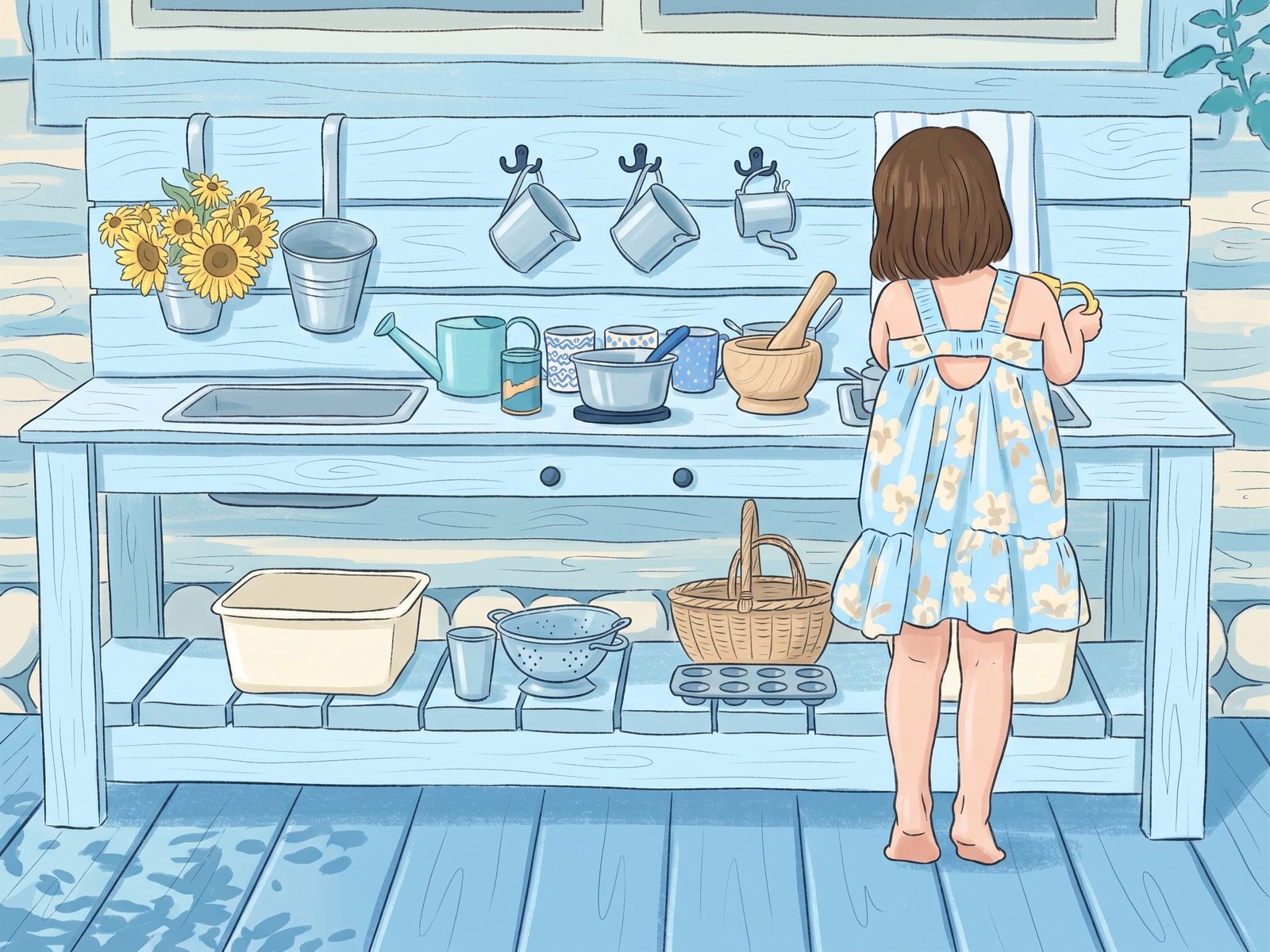
Why Mud Kitchen Play Ideas at Home Actually Work Sensory feedback, autonomic settling, and open-ended curiosity
When parents hear the words “mud kitchen”, they often picture expensive cedar carpentry from Pinterest boards, complete with miniature chalkboards, fake brass taps, and tidy little spice racks filled with lavender sprigs.
Real children do not need miniature timber cabinetry. What they need is the raw, grounding sensory properties of earth and water.
From a developmental perspective, outdoor sensory play acts as an immediate reset for a child’s nervous system. As documented by the Harvard Center on the Developing Child, hands-on, exploratory play forms the foundational architecture for executive function, emotional resilience, and self-regulation. When a young child handles wet earth, cold water, and rough stones, their central nervous system receives direct, heavy proprioceptive and tactile feedback.
This sensory input does something extraordinary: it cuts through mental noise.
Clinical insights from Harvard Health Publishing on outdoor play highlight that open outdoor environments naturally reduce anxiety, build physical confidence, and encourage children to engage in healthy, self-directed risk assessment. The tactile resistance of mud requires children to push, pull, lift, and stir. This “heavy work” activates muscle receptors, which triggers the release of calming neurochemicals and helps an overstimulated child downshift out of sympathetic fight-or-flight into a more settled parasympathetic state.
Furthermore, earth and water are completely open-ended materials. Unlike a plastic toy with buttons that dictates how a child must interact with it, mud offers zero correct outcomes. There is no failure in a mud pie. There is no wrong way to stir a bowl of wet sand. For children who navigate high emotional sensitivity or performance pressure during the preschool day, bringing mud kitchen play ideas at home into your afternoon routine provides an indispensable, low-demand sanctuary where their brain can simply be.
The Real Concerns: Mess, Garden Damage, and Parental Exhaustion Validating the stress parents feel before opening the back door
It is easy for educational texts to wax lyrical about the romance of childhood mud play. It is much harder when you are the tired adult who has to scrub red dirt out of fingernails while dinner burns on the stove.
Let us be completely honest about why parents hesitate:
- The Infiltration Fear: Mud has an uncanny ability to migrate from the garden path to the carpet, couch cushions, and bathroom walls within three seconds flat.
- Landscape Destruction: You spent time and money planting garden beds, turf, or patio pots. Watching a preschooler excavate the root ball of an expensive fern to make “gravy” is genuinely upsetting.
- The Clean-up Debt: If an activity takes five minutes to play with but thirty minutes to pack away and scrub down, the cost-to-benefit ratio is completely broken for an exhausted parent.
- Executive Function Drain: For parents managing their own neurodivergence, like adult ADHD, the visual chaos of scattered plastic bowls, hose puddles, and soaking wet clothes can feel physically overwhelming.
These worries are not signs of being an uptight or unsupportive parent. They are practical realities of running a home.
The secret to successful mud play is not learning to love the chaos; it is designing containment systems that protect your sanity before the first drop of water is poured. When the boundaries are clear, you stop hovering and scolding, and your child feels the freedom to truly immerse themselves.
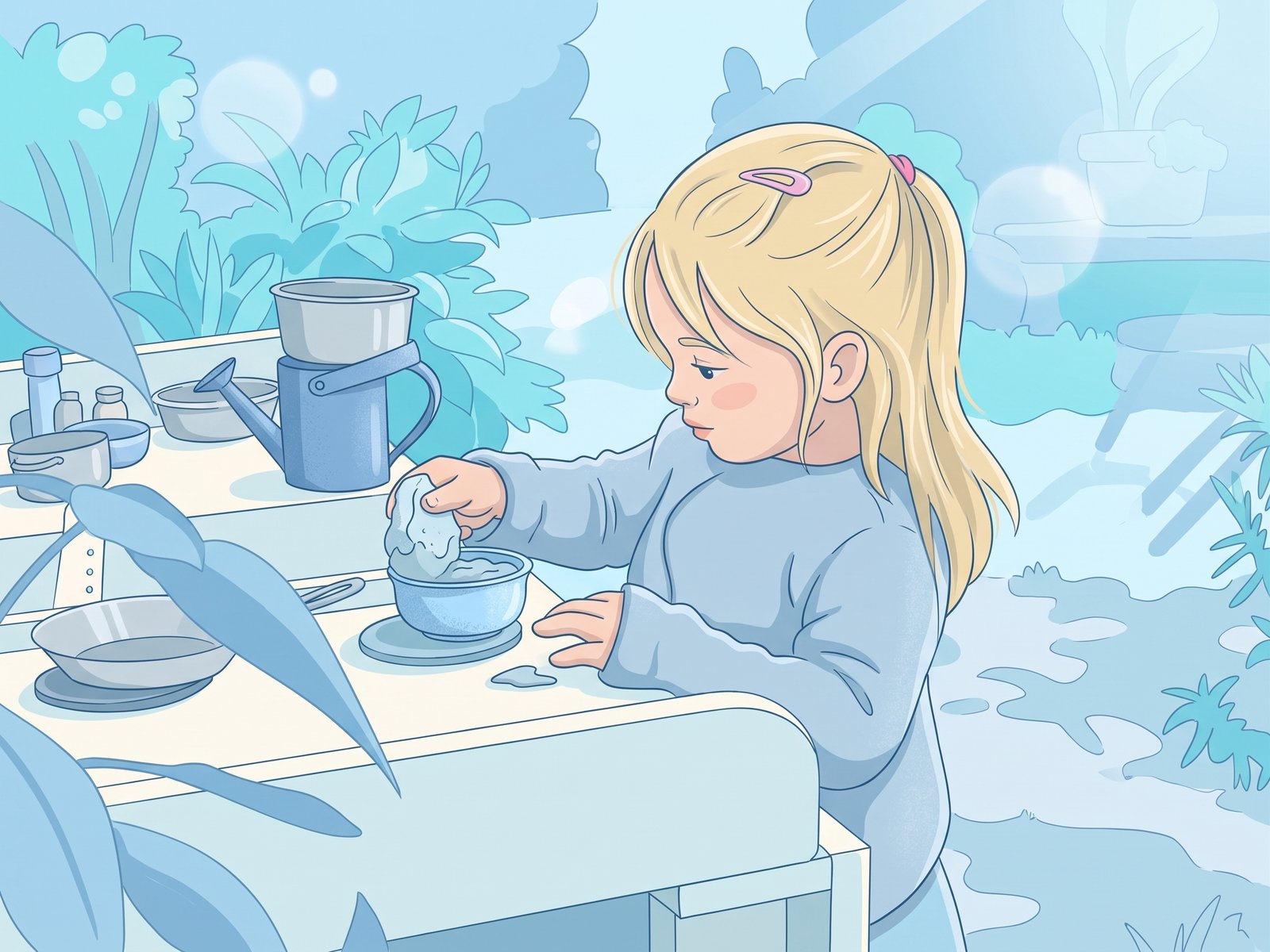
Doable Mud Kitchen Play Ideas at Home (Water, Grinding, and Crates) Practical backyard invitations using materials you already own
You do not need a carpenter, and you certainly do not need to spend hundreds of dollars at a toy store. Some of the most deeply engaging mud kitchen play ideas at home use cast-off kitchen tools, recycled storage crates, and pruned garden clippings.
Here are three core play mechanics that keep preschoolers focused for long stretches without ruining your lawn.
1. Water Transference Play: Volume, Gravity, and Flow
Water is the primary engine of any mud kitchen. Children do not just want to stir; they want to move liquids from one vessel to another. This repetitive transference builds bilateral coordination, wrist stability, and spatial estimation.
Instead of running a garden hose continuously (which instantly creates an uncontrollable swamp), set up a closed water loop:
- The Central Reservoir: Fill one large, shallow washing tub or an old 10-litre plastic storage container with clean water. This is their absolute water budget for the session. Once it is empty, the water is done.
- Vessels of Varying Heights: Offer two or three tall, narrow containers (like washed pasta sauce jars or yoghurt tubs) alongside wide, flat bowls (old pie tins or dog bowls).
- Transference Tools: Provide tools that require different hand grips. An old metal soup ladle encourages wrist flexion, a plastic turkey baster or medicine syringe builds finger squeeze strength, and a small metal teapot or measuring jug teaches controlled pouring.
- The Spill Zone: Place all the small containers inside a larger plastic storage tub lid or under-bed storage box. Any drips or spills are caught by the tray rather than washing away your lawn.
If your child struggles with pencil grip fatigue or hand cramps during table activities, as discussed in our guide to fine motor skills for neurodivergent preschool, this kind of water transference is exceptional physical therapy disguised as messy play.
2. Grinding and Mixing Nature Materials: Tactile Transformation
Preschoolers are fascinated by changing the physical state of materials. Breaking, crushing, snapping, and grinding offer rich auditory and tactile sensations that ground restless energy.
Collect dry materials in small baskets or takeaway containers before bringing in any water:
- Crisp Autumn Leaves: Teach your child to crunch them inside their fists to create “pepper” for their soups.
- Garden Herbs: Rosemary clippings, lavender heads, mint leaves, or dandelion flowers. Snapping tough stems and bruising leaves releases aromatic oils, engaging the olfactory system to help calm an anxious child.
- Dry Dirt & Gravel: Provide a cup of sifted garden soil or sandbox sand for mixing textures.
- Grinding Tools: An inexpensive wooden mortar and pestle, an old garlic press, or even two flat river stones. Crushing dried leaves into powder using downward arm pressure recruits the large shoulder muscles, providing deep proprioceptive input.
The “Dry First” Rule
Keep the crushed leaves, herbs, and petals in dry bowls initially. Let your child smell, sort, and slice them with a butter knife before introducing liquid. This doubles the play time before mess begins.
Aromatics for Regulation
Using sturdy, non-toxic herbs like rosemary or lavender provides sensory input that signals safety to the brain, naturally lowering emotional volatility during difficult afternoons.
3. The Simple Crate & Pot Setup
If you do not have a dedicated timber mud kitchen, do not buy one.
Take two heavy-duty plastic milk crates or sturdy upturned storage tubs. Place a flat offcut of untreated pine timber or a wide metal baking tray across the top. That is your kitchen counter.
Stock it with real, discarded adult tools from op-shops or your bottom cupboards:
- One heavy stainless steel saucepan or skillet (the weight provides stability so it does not tip over when stirred).
- A metal whisk, a wooden spoon, and a slotted spatula.
- A muffin tin (perfect for sorting small stones, seed pods, and mud balls).
- A plastic colander or pasta strainer for filtering mud from gravel.
This modular setup can be tucked away against a garden shed in sixty seconds when the weather turns foul.
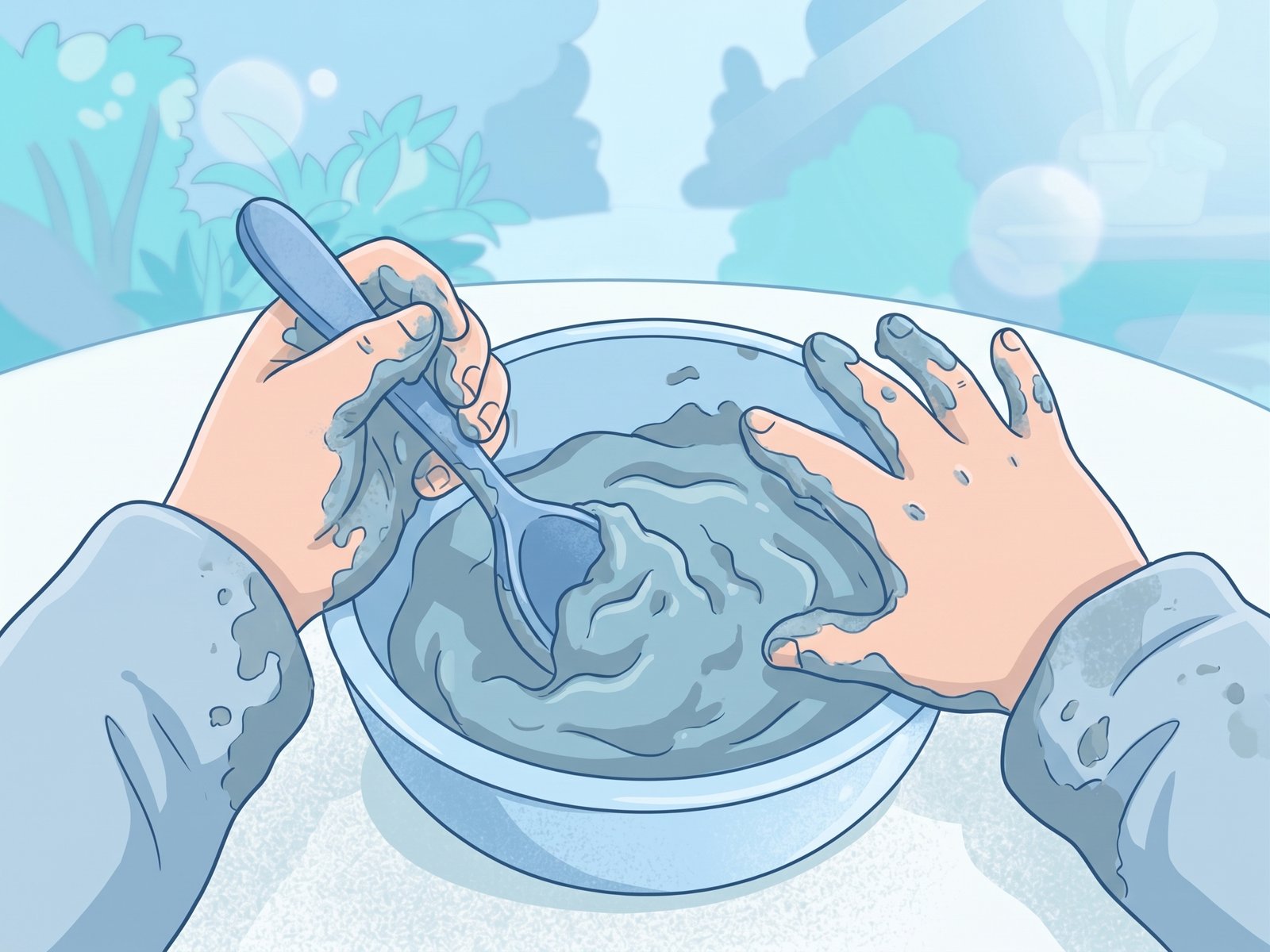
What Children Are Really Learning When Hands Get Dirty Cognitive schema, early physics, and functional problem-solving
When an adult watches a child stir dirt in an old pot, it is easy to view it as trivial recreation. Yet underneath the brown splashes, the child’s brain is processing complex developmental equations.
Educational research from Project Zero at Harvard University underscores that playful learning occurs when children experience agency, curiosity, and delight. In a self-directed mud kitchen, the child is acting as the lead researcher in their own physical science laboratory.
Consider what is happening cognitively:
| What the Child Is Doing | The Underlying Scientific / Cognitive Concept | Long-Term Developmental Benefit |
|---|---|---|
| Adding water to dry sand in stages | Saturation points, viscosity, and states of matter. | Early physics and chemistry intuition; understanding cause and effect. |
| Watching water drain through a colander | Permeability, filtration, and gravity. | Spatial reasoning, problem-solving, and visual tracking. |
| Filling small cups to balance a big pot | Volume conservation and non-standard measurement. | Foundational mathematical thinking without formal symbolic pressure. |
| Stirring thick, heavy mud paste | Resistance, friction, and motor planning. | Shoulder girdle stability, hand separation, and bilateral coordination. |
| Gathering, naming, and sorting natural items | Attribute classification (rough/smooth, dry/wet). | Categorical thinking and emergent scientific inquiry. |
When we allow children to explore mathematical concepts physically through mud and water, we lay the bedrock for spatial reasoning that worksheets can never provide. If you have a child who resists paper math drills, our look at early math and number sense for neurodivergent learners explores why physical, weighted materials are essential for healthy cognitive scaffolding.
Containment Strategies: How to Protect Your Yard and Sanity The practical rules that prevent your garden from becoming a wasteland
This is where the rubber meets the road. If mud kitchen play ideas at home do not have firm, physical boundaries, parents will abandon them after two sessions.
You do not need to be a drill sergeant, but you do need an engineered environment. These five strategies will keep your outdoor space intact:
1. Establish the “Mess Zone”
Designate one single corner of the yard where mud is permitted. It should ideally be an area with poor grass, gravel, bare earth near a fence, or concrete pavers that can be swept.
Make the physical boundary unmistakable:
- Lay down an old canvas drop sheet, an inexpensive plastic tarp, or interlocked rubber foam gym mats on the ground.
- The kitchen crates and bowls sit in the middle of the tarp.
- The simple, non-negotiable household rule is: “Mud stays on the mat.” If bowls wander toward the lawn or garden beds, play pauses while we walk them back to the station.
2. The “Pre-Filled Bucket” Water Rule
Never, under any circumstances, hand a three- or four-year-old an open, running hose in a mud kitchen unless you want a flooded yard.
The hose belongs to the adult. Fill one bucket or a water dispenser with a push-tap. When the bucket is empty, that is the natural transition point. If they want more water, they must wait for the next play session or use the muddy water they have already created in their mixing bowls. This limits the total volume of liquid in play, ensuring puddles dry up within an hour.
3. The “No Green Plants” Rule
To protect your garden beds, establish a clear foraging protocol. Children love collecting, but they will happily strip your prize hydrangeas down to sticks if you do not guide them.
The rule in our garden was simple: only pick what is brown or on the ground.
Fallen leaves, dry seed pods, loose gravel, sticks, and brown grass clippings are fair game. Living garden beds, vegetables, and potted plants are off-limits. If they desperately want flowers, plant a cheap pot of hardy, edible nasturtiums or marigolds specifically for them to harvest from, or buy a bunch of supermarket celery for them to chop.
4. The Clothing Transition System
Keep the messy clothing process outside the house:
- Dedicate two pairs of “mud shorts” and t-shirts that you never care about staining.
- Keep an empty plastic washing basket right beside the back door.
- Before coming inside, boots are slipped off on the patio, clothes are stripped down and dropped directly into the basket, and the child walks straight into the shower or bath wrapped in a towel.
5. Strategic Timing
Do not schedule mud kitchen play at 10:00 am on a Saturday if you have to leave the house at 11:00 am for a birthday party.
The best time for mud kitchen play ideas at home is 4:30 pm. The day is winding down, everyone is experiencing late-afternoon sensory fatigue, dinner is simmering, and the natural next step is straight into the evening bath. The water washes away both the mud and the day’s accumulated stress.
What Happened in My Own Backyard Reflections from an educator raising an intense, active girl
When I first set up our little backyard kitchen, I brought all my university early childhood theory with me.
I spent an hour setting out neat little aluminium pie pans, categorised jars of leaves, and measured water cups. I imagined my daughter sitting peacefully, pretending to bake apple pies while I sat nearby on an outdoor chair reading an academic paper with a warm cup of tea.
That fantasy lasted roughly four minutes.
She ignored the neat pie pans entirely. Instead, she dumped all the collected gravel into the water bucket, rolled her sleeves up to her armpits, and began violently churning the water until it sloshed over her knees. Then she dragged an old plastic plant pot over, filled it with wet dirt, and began testing how many stones it took to sink her plastic toy dinosaurs into the sludge.
My initial educator impulse was to step in: “Darling, wouldn’t you like to make soup? Look, we have pretty leaves here.”
I caught myself. I was imposing my neurotypical, aesthetic vision of play onto a child whose nervous system desperately needed physical force, trajectory, and heavy resistance. She was not interested in domestic pretend play; she was exploring buoyancy, weight, displacement, and joint impact.
When I stopped directing and simply let her stir her heavy, grey stone stew, she played in concentrated silence for nearly an hour. In neurodivergent parenting, especially when both parent and child carry ADHD traits, stepping back and letting functional play happen without adult scripting is the hardest, yet most healing, shift you can make. It echoes the core principles we unpack in our guide to DIR Floortime play at home: following the child’s natural lead rather than forcing adult expectations onto their space.
The most surprising lesson was the sleep connection. On afternoons when she had thirty minutes of deep mud and water play, her bedtime resistance dropped noticeably. Her nervous system had discharged that restless, buzzing motor energy into the earth, allowing her body to settle without the two-hour bedtime battles that usually drained our evenings.
Dewi Griffith, PhD, Founder
What Does Not Work (Common Traps to Skip) Save your money, your patience, and your backyard
If you want your mud kitchen to remain sustainable, avoid these common traps:
- Buying a fragile, elaborate wooden kitchen: Cheap flat-pack timber kitchens rot in the rain, swell up, and grow mould within twelve months. Sturdy plastic milk crates, recycled timber pallets, or concrete cinder blocks with an untreated hardwood plank last years longer and cost almost nothing.
- Hovering and policing: If you find yourself saying “Careful, don’t splash,” every thirty seconds, the setup is flawed. Move the kitchen further away from the patio doors, lower the water volume, or strip them down to their undies. Mud play cannot thrive under continuous micromanagement.
- Using food from the pantry: Dumping cups of plain flour, food colouring, dried lentils, and spices into garden mud is expensive, creates sticky cement that is hard to clean, and attracts pests. Stick to natural soil, water, leaves, sand, and stones. The garden provides all the texture you need.
- Expecting neat, photographic results: Real sensory play is messy, brown, and chaotic. If you are setting it up for an Instagram photo, you will be disappointed. If you are setting it up to soothe a dysregulated child, it will succeed every single time.
How to Start Small When You Are Already Overwhelmed A two-minute starter plan for tired parents
If reading this makes you feel exhausted just thinking about cleanup, take a deep breath. You do not need to build a backyard kitchen station this afternoon.
Start with the absolute minimum viable setup:
- Grab one plastic storage tub or a wide washing basin from the laundry.
- Take it outside and place it on the grass or patio.
- Put two handfuls of garden dirt into the tub.
- Add half a jug of warm tap water.
- Toss in one metal soup ladle and two plastic cups.
- Sit on the step and let them explore.
That is it. That is a complete, developmentally rich mud kitchen. When they finish, dump the water onto a thirsty shrub, rinse the tub with the hose, and bring your child inside for a warm bath.
Early childhood growth is not measured by the perfection of your backyard equipment. It is measured by the freedom your child feels to explore their world with curious hands, calm bodies, and the steady confidence that their messy, joyful learning is welcome in your home.
Looking for Grounding, Low-Mess Activities for Restless Days?
When the outdoor weather turns foul and your child needs a calming, low-demand way to regulate their motor system indoors, our Montessori-inspired story tracing printables provide a soothing bridge back to focus.
Explore Calm Story Tracing BundlesReferences & Further Reading Credible developmental and paediatric research
- Center on the Developing Child at Harvard University. (2014). Enhancing and Practicing Executive Function Skills with Children from Infancy to Adolescence. Harvard University. developingchild.harvard.edu
- Burdette, H. L., & Whitaker, R. C. (2005). Resurrecting free play in young children: Looking beyond fitness and fatness to attention, affiliation, and affect. Archives of Pediatrics & Adolescent Medicine, 159(1), 46–50.
- Harvard Health Publishing. (2018). 6 reasons children need to play outside. Harvard Medical School. health.harvard.edu
- Project Zero, Harvard Graduate School of Education. (2023). Pedagogy of Play: A Framework for Playful Learning. Harvard University. pz.harvard.edu
- Raising Children Network (Australia). (2024). Outdoor play and learning: Babies and children. Australian Government Department of Social Services. raisingchildren.net.au
- Ayres, A. J. (2005). Sensory Integration and the Child: Understanding Hidden Sensory Challenges. Western Psychological Services.
This article is based on personal family experience, late-diagnosed adult ADHD reflections, and professional early childhood education research. It is shared for educational and supportive purposes only and does not constitute paediatric, clinical, or occupational therapy advice. Every child has unique sensory thresholds and developmental needs. If you have concerns about your child’s sensory processing, motor skills, or physical development, please consult with your GP, a paediatrician, or an accredited paediatric occupational therapist.