
Practical Life Activities for Preschool at Home (Simple Daily Routines That Actually Work)
Simple, functional practical life routines that channel intense preschooler energy, build genuine domestic autonomy, and soothe busy nervous systems without expensive wooden kits or social media perfection.
Table of Contents
- The 7:42 AM Morning Reality: When Helping Feels Like a Delay
- Why Practical Life Activities for Preschool at Home Actually Matter
- What Most “Montessori at Home” Content Gets Wrong
- 3 Practical Life Activities for Preschool at Home That Work
- What Children Learn When Doing Real Household Work
- What Happened on My Own Kitchen Tiles
- What Does Not Work: Traps That Add Tension and Friction
- How to Make Practical Life Routines Work in Real Homes
- Why Real-World Participation Directly Reduces Behaviour Issues
- Expanding Your Low-Stress Home Toolkit
- References & Research Foundations
- Safety & Editorial Disclaimer
It was 7:42 am on a Wednesday, and we were already running eleven minutes behind schedule.
The kitchen bench was an untidy spread of sourdough crumbs, butter wrappers, and an unwashed coffee plunger. I was standing in front of the sink, mentally calculating how long it would take to pack the preschool bag, find two matching socks, and get my daughter strapped into her car seat without tears.
My four-year-old daughter appeared beside my left elbow, dragging our heavy wooden step stool across the tiles with a piercing scrape.
“I do it,” she declared. Her hand reached straight for the ceramic bowl of warm porridge I was trying to stir.
“Sweetheart, not right now,” I said, my voice carrying that tight, sharp edge of adult impatience. “Mummy is in a rush. Step down, please. We need to walk out the door in twenty minutes.”
“No! I want to stir! I want to do the breakfast!”
She grabbed the handle of the metal spoon. I held onto the bowl. In the ensuing struggle, a dollop of warm, sticky oats flipped over the rim, landing directly on the cuff of my clean work shirt.
I closed my eyes. The familiar buzzing tension of adult ADHD was throbbing behind my temples. My internal motor was screaming at me to push forward, wipe the bench, take control, and get everything done as fast as possible. Having a preschooler insert herself into every single household movement felt like walking through waist-deep mud. Everything took four times longer. Every simple chore turned into an exhausting battleground of wills.
I looked down at her. She was not throwing a tantrum out of spite. Her face was flushed, her brow was furrowed, and her little fingers were white-knuckled around the spoon handle. She did not want to play with the plastic toys in the lounge room. She did not want to look at a picture book.
She desperately wanted to do what I was doing. She wanted to belong to the real work of our home.
I let out a slow, ragged breath. I took my hand off the spoon.
“Okay,” I said, stepping back half a pace. “Hold the bowl with this hand so it doesn’t slide, and stir three times with that hand. Show me how steady you can make it.”
She blinked, surprised by the sudden drop in resistance. Her posture softened immediately. She gripped the rim of the bowl, carefully rotated the spoon through the thick oats, and watched the mixture fold over itself with quiet, intense concentration.
The frantic hum of the morning dropped two octaves.
Yes, it took an extra four minutes. Yes, a few flakes of oats ended up on the benchtop. But we walked out the front door without tears, without shouting, and without that heavy cloud of mutual frustration. That was the morning I stopped viewing her desire to help as an interruption, and started understanding how real, grounded practical life activities preschool at home routines can transform daily chaos into calm competence.
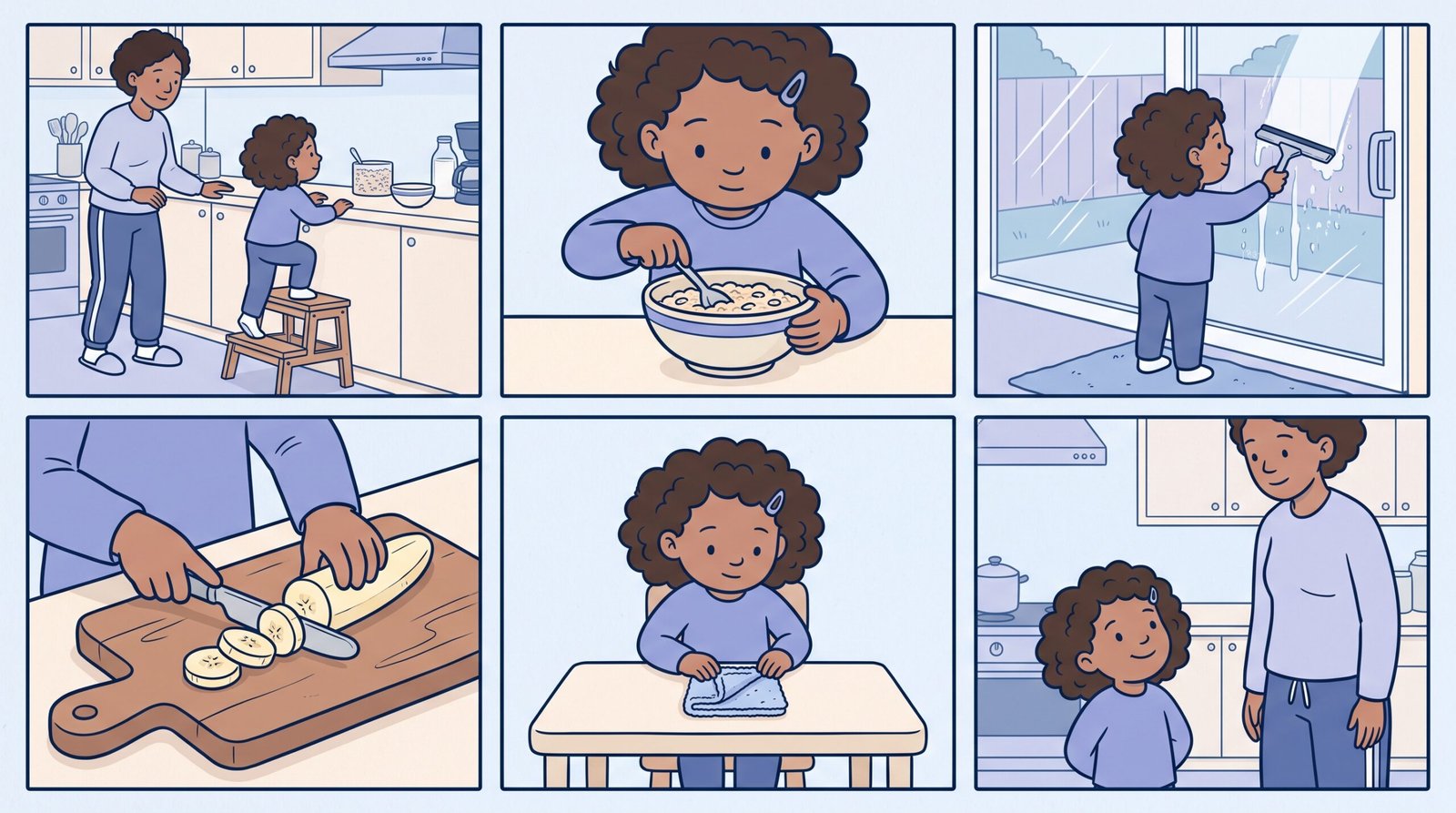
Why Practical Life Activities for Preschool at Home Actually Matter Biological imitation, serve-and-return interactions, and functional autonomy
In modern parenting culture, we have created an artificial divide between “play time” and “real life.”
We buy miniature plastic kitchens so children can pretend to cook, plastic cleaning sets so they can pretend to sweep, and elaborate sensory bins designed to mimic real-world textures. Yet when our children attempt to touch actual food, hold a real broom, or wash a real dish, our immediate adult reflex is often to shoo them away: “Go play with your toys while Mummy gets this done.”
Children see right through this separation.
From an evolutionary and developmental perspective, young children are biologically driven to imitate the functional labours of their family group. They do not want pretend tasks when real, purposeful work is happening right in front of them:
- Real-World Participation Builds Brain Architecture: Everyday household routines are not interruptions to childhood development; they are the primary medium through which development occurs. As highlighted by the Harvard Center on the Developing Child, the foundational architecture of the brain is built through daily, responsive interactions known as “serve and return.” When a parent pauses, notices a child’s interest in a household task, and scaffolds their participation, neural connections relating to language, motor planning, and social competence are actively reinforced.
- Developing Functional Self-Efficacy: Maria Montessori observed over a century ago that young children possess an innate desire to master their physical environment. She termed tasks like sweeping, pouring, polishing, and food preparation “practical life activities.” These were not chores designed to save adult time; they were deliberate exercises in self-construction. When a preschooler learns to pour their own water from a small jug, peel a mandarin, or wipe up their own spill, their internal perception of self changes. They shift from a passive passenger who relies on an adult for every physical need to an active, competent contributor.
- Routines Support Executive Function: Clinical guidelines from the American Academy of Pediatrics (AAP) reinforce that incorporating young children into predictable daily routines supports executive functioning, self-regulation, and long-term emotional wellbeing far more effectively than isolated academic instruction.
When we introduce practical life activities preschool at home families can realistically sustain, we are not adding an extra curriculum to our day. We are simply opening the door to the life that is already happening.
What Most “Montessori at Home” Content Gets Wrong The trap of aesthetic perfection versus real domestic utility
If you have ever scrolled through social media looking for practical life ideas, you have likely encountered the aesthetic side of the Montessori movement:
- Spotless, custom-built timber child-sized kitchen units costing hundreds of dollars.
- Rows of identical glass jars filled with colour-coded beans on minimalist white shelves.
- Children wearing neutral linen aprons silently slicing organic cucumbers on marble benchtops without dropping a crumb.
This idealised imagery does modern parents a profound disservice. It transforms a practical, liberating developmental philosophy into an expensive, high-pressure aesthetic performance.
Aesthetic Social Media Setups
Focuses on visual perfection, expensive child-sized cabinetry, and pre-packaged activity trays that create extra prep and parental exhaustion.
Real-Life Practical Utility
Focuses on functional participation: a step stool at the kitchen sink, a butter knife from your drawer, and slowing down tasks you must do anyway.
Real life with a preschooler is messy, unpredictable, and loud. True practical life is not about having a picture-perfect environment; it is about functional utility.
Your child does not need a plumbed, miniature wooden sink. They need a solid step stool dragged over to your existing stainless steel sink, a plastic bowl, and a tap running at a gentle trickle. They do not need expensive imported wooden materials; they need an ordinary butter knife from your cutlery drawer and an old tea towel from the bottom of your linen press.
When parents believe that practical life requires setting up elaborate, curated “trays” every morning, it simply adds another burden to an already crushing mental load. The beauty of authentic practical life activities preschool at home routines is that they require zero extra preparation. The laundry is already there. The dinner vegetables already need peeling. The table already needs wiping. You do not need to create artificial work; you simply need to slow down the work you are already doing and allow your child to hold the other side of the cloth.
3 Practical Life Activities for Preschool at Home That Actually Work Window washing, banana slicing, and cloth folding routines
To make this approach sustainable, stop searching for complex craft tasks. Focus on high-repetition, low-stress domestic actions that offer clear physical feedback.
Here are three foundational practical life activities preschool at home routines that hold attention, build motor competence, and integrate seamlessly into a normal day.
1. Window Washing with Squeegees: Repetitive Gross-Motor Focus
Preschoolers have an innate urge to make large, sweeping physical movements. Window washing channels that gross-motor drive into a satisfying, highly visible domestic task.
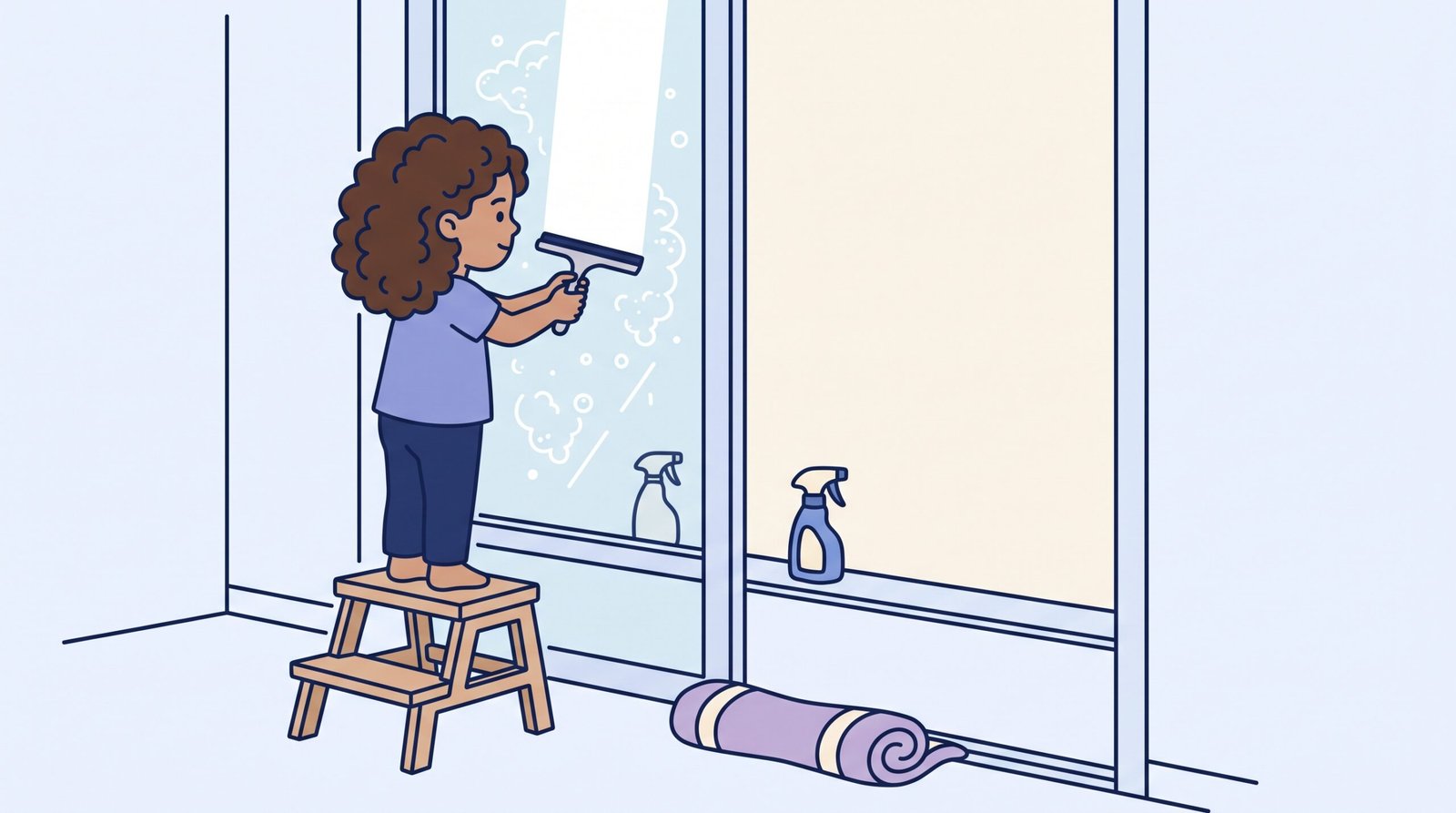
- Why It Works: Washing glass provides instant, clear visual feedback. The child can plainly see where the glass is wet, where the suds are, and where their squeegee has left a clear, dry path. The physical action requires the child to coordinate their non-dominant hand holding the frame with their dominant hand, pulling downward against the friction of the rubber blade. This downward resistance provides heavy proprioceptive input to the shoulders and core, which naturally down-regulates a hyperactive or restless nervous system.
- The Simple Setup: A small travel spray bottle filled with tap water and one single drop of dishwashing liquid, a child-sized rubber squeegee from the car accessory aisle, an old bath towel laid along the window frame to catch running water, and a dry cloth.
- How to Introduce It: Keep your demonstration completely silent and deliberate. Spray the glass three times: Pssh, pssh, pssh. Place the rubber edge of the squeegee at the top of the wet patch. Pull straight down to the towel in one smooth movement. Wipe the squeegee blade with the dry cloth. Hand the spray bottle to your child: “Your turn.”
- The Experience: They will spray too much water. They will pull the squeegee sideways. Let them explore. The repetitive rhythm of spraying, pulling, and wiping can keep a preschooler deeply absorbed for fifteen to twenty minutes while you fold the washing in the same room.
2. Slicing Bananas with Butter Knives: Purposeful Hand Control
Food preparation is the gold standard of practical life because the motivation is entirely intrinsic: when the work is finished, you get to eat the result.
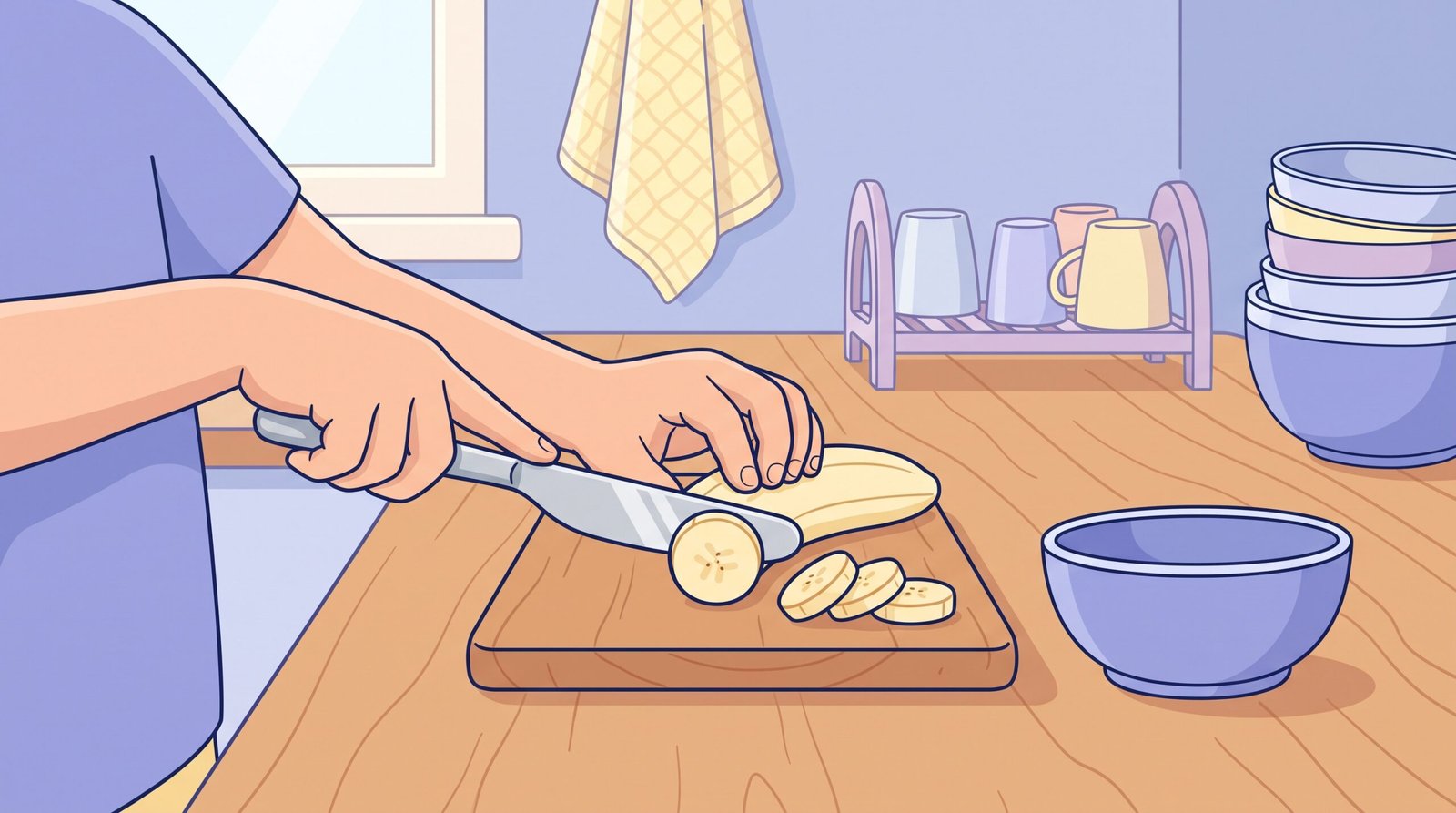
- Why It Works: Many parents are terrified of letting young children handle cutlery. Yet avoiding tools entirely prevents children from learning how to modulate force and respect sharp edges safely. A ripe banana offers the perfect resistance: it is soft enough to yield to a blunt, round-tipped butter knife, but firm enough to hold its structure so the child can feel the knife slice through the fibres.
- The Developmental Impact: According to research from the National Association for the Education of Young Children (NAEYC), using real, functional tools in early childhood builds spatial judgment, hand-eye coordination, and self-confidence far more deeply than manipulating plastic pretend food.
- The Simple Setup: One small cutting board, a standard blunt butter knife, half a peeled banana, and a small ceramic bowl for the finished slices.
- How to Introduce It: Show your non-dominant hand forming a curved “bear claw” holding the banana well back from the cutting zone. Show your dominant hand pressing the blade downward with steady pressure until it hits the board with a soft thunk. Lift the blade, slide the banana forward half an inch, and repeat. Let your child cut the fruit into thick chunks or paper-thin slivers. They are exercising bilateral coordination, digit strength, and motor planning.
3. Folding Face Washers: Predictable Structural Calm
Laundry is an unavoidable domestic constant. It is also an extraordinary tool for spatial reasoning and emotional grounding.
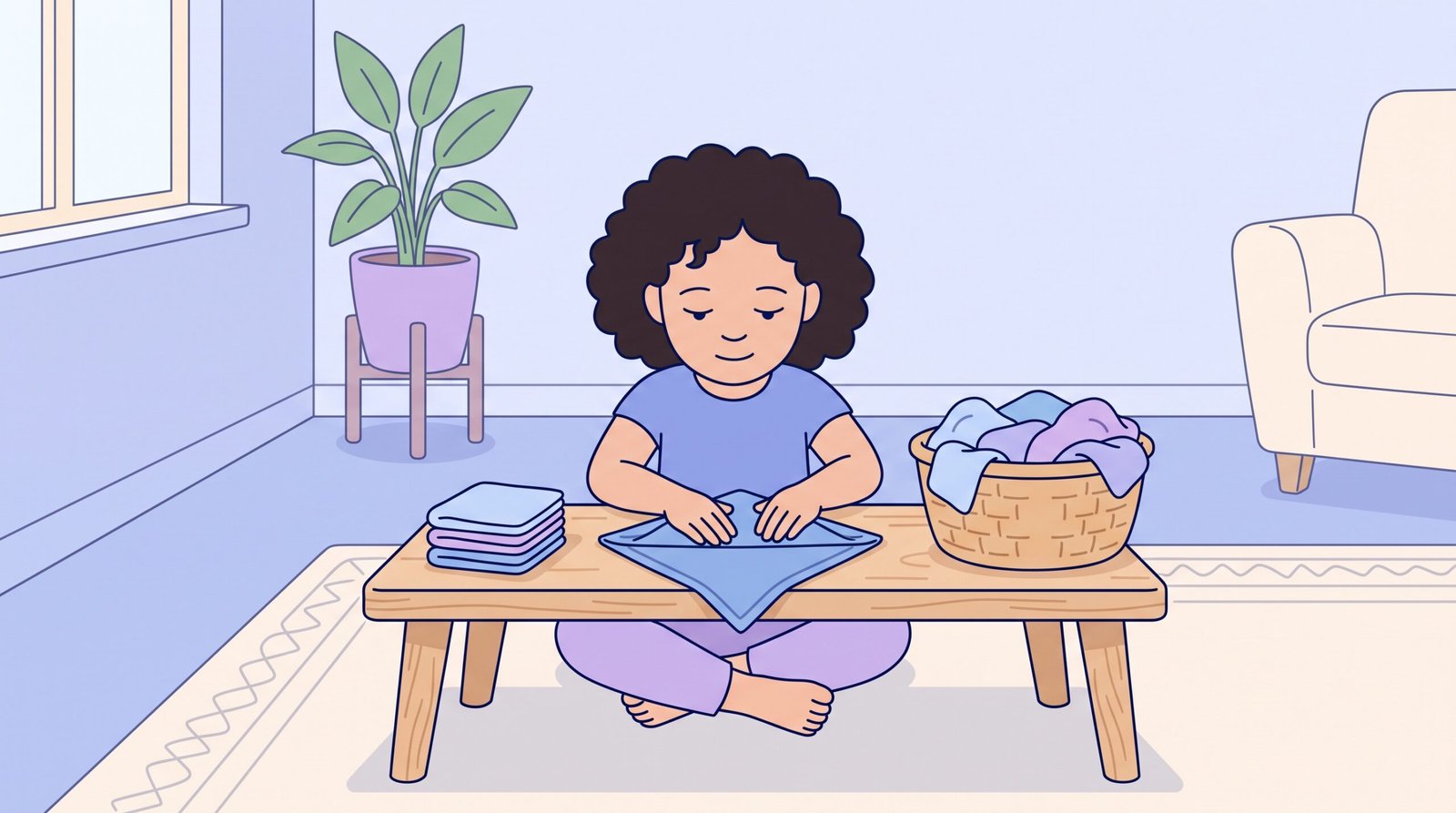
- Why It Works: Large bath sheets and fitted sheets are physically unmanageable for a preschooler. Face washers, washcloths, and cloth napkins fit their proportions perfectly. Folding a square cloth in half requires symmetry, corner-to-corner alignment, and smooth two-handed bilateral smoothing. The repetitive nature of smoothing down a soft textile provides calming tactile feedback that grounds a restless child.
- The Simple Setup: A small basket containing four to six dry, clean face washers or cloth napkins, and a clear, flat surface like a coffee table or rug.
- How to Introduce It: Lay the square cloth flat, smoothing it with both palms from the centre outward. Pinch the bottom two corners between your thumbs and index fingers. Lift the bottom edge, bring it up to meet the top two corners, and align them carefully. Use the flat of both hands to smooth the new fold: “Corner to corner, smooth it flat.” Fold it in half once more to create a neat square, and place it into a finished pile.
- Accepting Imperfection: Will their corners match perfectly? Rarely. The developmental value does not lie in the perfection of the fold; it lies in the intentional, structured sequence of the movement. Having a defined beginning, middle, and end provides a sense of closure that settles an overactive brain.
What Children Learn When Doing Real Household Work Cognitive sequencing, bilateral control, and emotional competence
When an adult watches a child slowly wipe a counter or cut a piece of fruit, it is easy to see it merely as a chore. In reality, the child is constructing foundational neurobiological pathways.
| What the Child Does in the Home | The Underlying Executive Function Skill | Long-Term Developmental Benefit |
|---|---|---|
| Multi-step window washing sequence | Working memory and inhibitory control. | Translates into reading comprehension and multi-step math planning. |
| Stabilising fruit while slicing with knife | Bilateral motor control and hand separation. | Builds the hand arches and wrist stability required for pencil grasp. |
| Aligning corners of folded face washers | Spatial awareness, symmetry, and visual tracking. | Foundational geometry intuition and visual-spatial reasoning. |
| Pouring water from a small pitcher | Modulation of physical force and motor planning. | Physical self-regulation, impulse control, and body awareness. |
Much like the spatial exploration we examine in our guide on how to encourage independent play in preschoolers, children flourish when environments are intentionally prepared to foster competence rather than dependence.
What Happened on My Own Kitchen Tiles Messy truths, broken expectations, and the reality of ADHD parenting
I hold a PhD in early childhood education. I have lectured university students on child-centred learning and observed dozens of exemplary preschool classrooms.
Yet when I was at home with my own daughter, trying to manage my own adult ADHD while she displayed the same buzzing, intense neurodivergent traits, my professional theory flew out the window.
In those early years, our home was a daily cycle of friction. I was constantly trying to keep her “occupied” so I could catch up on housework. I would set out an elaborate sensory tray or puzzle, and within three minutes she would abandon it, run into the kitchen, and try to grab whatever I was holding. I felt frantic, like I was failing at home management and failing as a calm parent.
The shift happened over a spilled carton of milk.
One afternoon, completely exhausted, I pulled a two-litre carton of milk out of the fridge. My daughter reached for it, tugged my wrist, and the entire carton hit the floorboards, creating an enormous white puddle that seeped under the fridge and into the skirting boards.
I stood there, ready to collapse into tears. My daughter looked at the puddle, then looked at my face. She looked terrified.
I took a slow breath. I forced my shoulders down.
“We need towels,” I said, my voice flat and quiet.
I walked to the laundry, pulled four old bath towels out of the basket, and handed two to her. I dropped mine onto the puddle. She dropped hers onto the puddle. She dropped to her hands and knees and began pushing the heavy, sodden towel across the floor. She worked with a ferocity and focus I had never seen her display with any toy.
We didn’t talk. We wiped. We wrung the towels out into the laundry tub. We mopped the remaining sticky residue with warm water. When we finished, she looked up at the clean floor, wiped her forehead with the back of her forearm, and said, “We fixed it, Mummy.”
She wasn’t distressed anymore. She was calm, grounded, and immensely proud.
That disaster taught me that she didn’t need to be protected from domestic realities; she needed to be invited into them. Introducing consistent practical life activities preschool at home routines was not about creating an idyllic Montessori showcase; it was about surviving our days together as a functional team.
“Practical life is not a pedagogical performance. It is what happens when an exhausted adult stops treating a child’s desire to help as a domestic delay, and starts treating it as an open invitation to connect.”
Dewi Griffith, PhD, Founder
What Does Not Work: Traps That Add Tension and Friction Save your patience and skip these common domestic mistakes
If you have tried involving your preschooler in daily routines before and it ended in tears or a destroyed kitchen, you likely encountered one of these common implementation traps:
- Hovering and Constant Verbal Correction: The fastest way to destroy a child’s concentration is to stand over them narrating their errors: “No, hold it like this! You’re spilling it! Watch out, you missed a corner.” When an adult micromanages, the task ceases to be a meaningful challenge and transforms into a high-stakes performance where the child feels incompetent. Demonstrate once silently, hand over the tool, and step back. The physical environment will teach them far more effectively than your voice will.
- Re-Doing the Chore in Front of Them: If your child spends seven minutes folding a washcloth or wiping down the dining table, do not immediately step in behind them and re-wipe or re-fold it while they are watching. Doing so sends an unmistakable psychological message: Your effort is worthless; only my standard matters. If the table is still slightly sticky, wait until they have moved to another room before discreetly wiping it, or let it go until the next meal. Protect their dignity above your aesthetic preferences.
- Introducing Tasks When You Are Already Rushing: Do not attempt to teach your preschooler how to butter toast when you have four minutes to catch the bus. Practical life activities require temporal margin. If you try to scaffold a new skill under time pressure, you will inevitably lose your temper, grab the tool from their hands, and trigger a meltdown. Choose low-stakes windows: lazy weekend mornings or quiet afternoons when the clock is not ticking.
How to Make Practical Life Routines Work in Real Homes Three practical steps to adapt your home without spending a fortune
You do not need to overhaul your entire house this weekend. Implementing practical routines is an exercise in subtle, gradual environmental adjustments:
- Start With One Single Routine: Do not try to make your child wash windows, fold washing, bake bread, and sweep floors all in the same week. Pick one routine that already causes daily friction. If breakfast is chaotic, teach them how to peel their own banana or spread butter with a blunt knife. If transitions from bath time are hard, teach them to hang their towel on a low hook. Master one task over two weeks until it becomes an automatic part of your daily rhythm.
- Adapt Your Physical Environment for Independence: Children cannot be independent in a world built exclusively for adults. You do not need to remodel your home, but you do need to remove physical barriers. Put a sturdy step stool in the kitchen and bathroom so they can reach the tap and counter safely. Lower two coat hooks in the hallway to their eye level so they can hang their own jacket. Store small water cups and a tiny jug on a bottom pantry shelf so they can get a drink without asking.
- Choose Functional, Scaled Tools: Avoid flimsy toy cleaning sets made of cheap, hollow plastic. They do not work. A toy broom with synthetic bristles that bends without sweeping up dirt only frustrates a child. Buy real tools scaled to their physical size: an ordinary handheld dustpan and brush, an adult wooden broom with thirty centimetres sawn off the handle, small cotton face washers instead of giant towels, and a small ceramic creamer jug that fits comfortably inside their two palms. When children handle real, functional materials, they treat them with real care.
Why Real-World Participation Directly Reduces Behaviour Issues Agency, functional belonging, and the evaporation of attention-seeking
One of the most remarkable side effects of introducing consistent practical life activities preschool at home routines is a dramatic reduction in daily behavioural friction.
Parents often view attention-seeking behaviours—whining, clinging, knocking over toy towers, climbing furniture—as disciplinary problems that require consequences. In reality, these behaviours are almost always signals of an unmet developmental need for agency and connection:
- Competence Dissolves Frustration: When a young child spends their day being managed, directed, dressed, fed, and instructed, they experience a profound lack of personal agency. That loss of control frequently bursts out as defiance, stubbornness, or tantrums over seemingly trivial issues. When you invite a child into real household work, you restore their agency. Slicing their own fruit or carrying a bowl of water without spilling proves to their nervous system that they are capable, powerful, and trusted. Research shared by the Raising Children Network (Australia) underscores that providing young children with age-appropriate autonomy within daily routines directly strengthens emotional self-regulation, reduces boundary-testing, and fosters intrinsic cooperation.
- Functional Belonging Replaces Attention-Seeking: Children do not simply want our attention; they want our connection. When we tell a child to go play alone while we clean the kitchen, they perceive physical and emotional separation. By contrast, when we hand them a cloth and invite them to wipe the table beside us, they experience functional belonging. They are shoulder-to-shoulder with their attachment figure, working toward a shared family goal. The desperate need to act out to capture our attention evaporates, because their need for connection is already being met through shared, meaningful action.
Expanding Your Low-Stress Home Toolkit Practical sensory and routine guides across your home
When you integrate practical life routines into your home, you discover that you do not need commercial entertainment to keep young children grounded. Explore these complementary, low-stress guides to support your family’s daily rhythms:
- When you need a quick, calming kitchen activity that buys you dinner prep time, explore our step-by-step guide to sink water play for preschoolers using warm tap water and kitchen tools.
- Keep tactile exploration completely contained on your living room rug with our tested strategies for low mess sensory bins for preschoolers that protect your carpet.
- Turn humble pantry ingredients into exciting cause-and-effect science right at the bench with our favourite preschool kitchen science experiments.
- When prolonged bad weather traps everyone indoors, use our restorative collection of rainy day activities for preschoolers at home to soothe indoor cabin fever.
Looking for Grounding, Low-Mess Activities for Restless Days?
When you need quiet, table-based activities that soothe busy minds and build fine motor precision without living room mess, our Montessori-inspired story tracing printables offer a peaceful, structured transition.
Explore Calm Story Tracing BundlesReferences & Research Foundations Credible developmental, paediatric, and early learning research
- Center on the Developing Child at Harvard University. (2014). Enhancing and Practicing Executive Function Skills with Children from Infancy to Adolescence. Harvard University. developingchild.harvard.edu
- American Academy of Pediatrics (AAP). (2018). The Power of Play: A Pediatric Role in Enhancing Development in Young Children. Clinical Report. aap.org
- National Association for the Education of Young Children (NAEYC). (2020). Developmentally Appropriate Practice in Early Childhood Programs Serving Children from Birth Through Age 8. naeyc.org
- Association Montessori Internationale (AMI). (2022). Montessori Practical Life Principles and Exercises. montessori-ami.org
- Raising Children Network (Australia). (2024). Daily routines and independence for preschoolers. Australian Government Department of Social Services. raisingchildren.net.au
This article reflects personal family experience parenting in a neurodivergent household alongside professional early childhood education research. It is shared for supportive and educational purposes only and does not constitute formal paediatric, clinical, or occupational therapy advice. Every child develops at their own unique pace, with distinct physical capabilities and safety awareness. If you have concerns regarding your child’s fine motor development, physical coordination, or emotional regulation, please seek individual guidance from your GP, a paediatrician, or an accredited paediatric occupational therapist.