
How to Encourage Independent Play in Preschoolers (Without Constant Entertainment)
Practical, grounded environmental shifts to foster deep self-directed focus, ease separation anxiety, and reclaim twenty minutes of quiet breathing room without screens or parental guilt.
Table of Contents
- The Morning Interruption: When Simple Tasks Feel Impossible
- Why Independent Play Feels So Hard (For Parent and Child)
- The Biggest Misconception About Solo Play
- How to Encourage Independent Play Preschool Strategies That Actually Work
- What Independent Play Is Actually Building Inside the Brain
- What Happened in My Own Living Room
- What Does Not Work: Traps That Add Friction and Clinginess
- A Realistic, Week-by-Week Progression
- For Parents Who Feel Utterly Stuck Today
- Expanding Your Low-Stress Play Toolkit
- References & Research Foundations
- Safety & Editorial Disclaimer
The basket of freshly washed laundry was balanced on my hip, and I had exactly three emails to send before midday. They were not complicated emails. One was confirming a dentist appointment, one was replying to my daughter’s preschool about hat week, and one was sending an invoice that had been sitting in my drafts for four days.
My four-year-old daughter was standing directly on top of my feet.
Her small hands were clutching the fabric of my track pants, anchoring her weight to my shins.
“Mummy. Play with me. Come to my room. Mummy, you have to be the baby unicorn. You sit on the rug and I will feed you the leaves. Mummy, come on. Look at me. Why aren’t you looking at me?”
“Sweetheart, Mummy just needs seven minutes to fold these school towels and press send on this message. Then we can have morning tea.”
“No. Play right now. Look at my unicorn. Mummy, look. Look. Look.”
The word repeated until it lost all linguistic meaning, turning into a persistent, sharp acoustic tap against my temple.
I set the heavy plastic laundry basket on the kitchen bench with a hollow clatter. A sharp flare of irritation rose in my throat, followed instantly by that familiar, sinking wave of maternal guilt.
My adult ADHD brain was already redlining under the cognitive weight of task-switching. Every time I looked away from my phone screen to acknowledge her, the mental thread of what I was typing snapped completely. Yet looking down at her wide, urgent brown eyes, I felt like a selfish failure.
Every modern parenting podcast I had ever listened to echoed in my ears: Be present. Connect before you direct. These years are so short.
So, I abandoned the emails. I left the damp laundry to sit in the basket. I walked into her bedroom, sat cross-legged on the floorboards, and picked up the plastic unicorn.
Within ninety seconds of me sitting down, she wasn’t even looking at the unicorn. She was wandering over to her bookshelf, pulling down three books, dropping them on the rug, and asking if she could have a biscuit.
I sat on the floor, trapped, bored out of my mind, resentful of an email I hadn’t sent, and utterly exhausted by the realisation that my constant presence wasn’t actually helping her play at all. It was just anchoring her reliance on an adult engine to drive her imagination. That was the morning I stopped treating solo play as an innate gift and began researching how to encourage independent play preschool children can actually sustain.
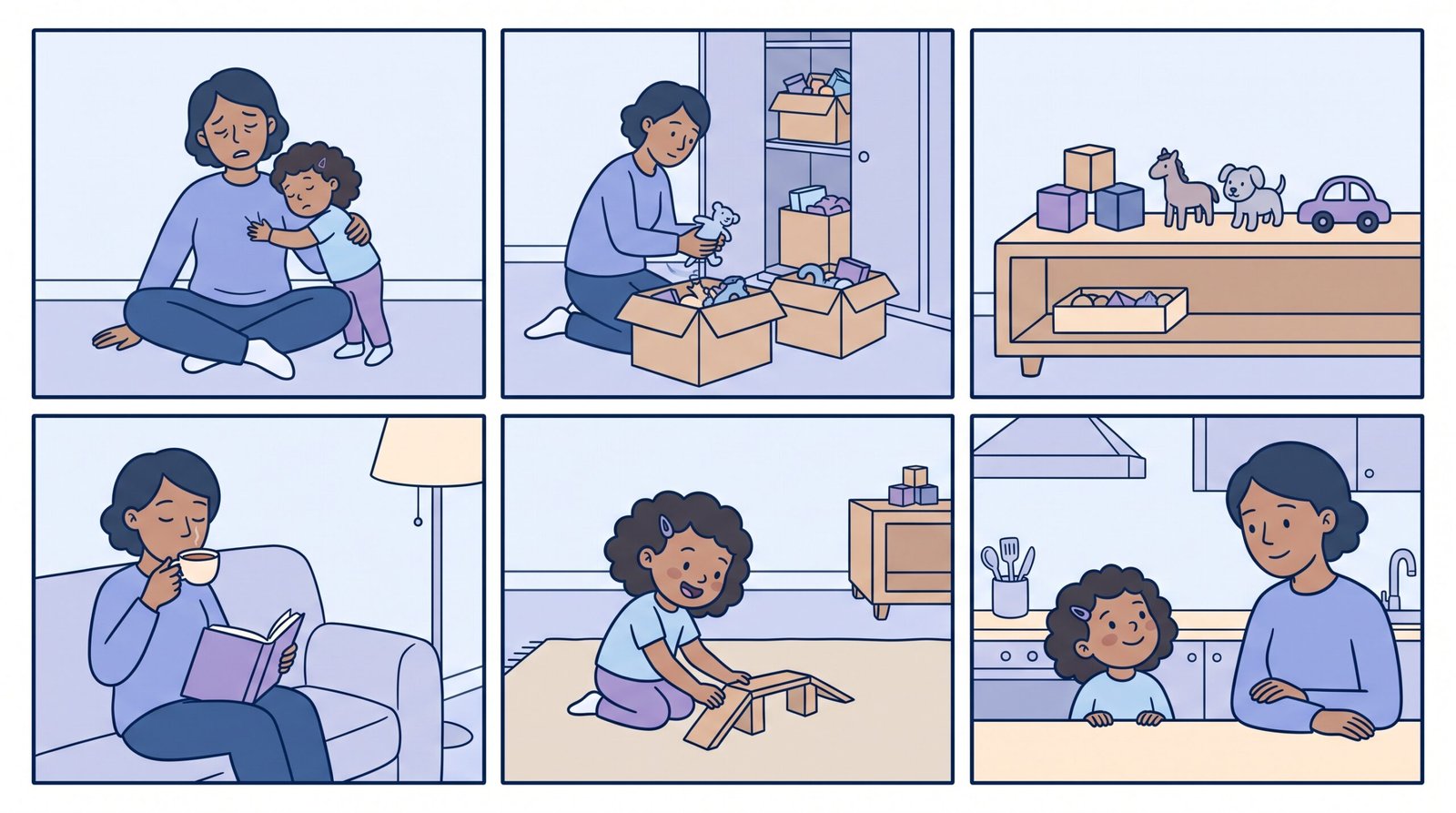
Why Independent Play Feels So Hard (For Parent and Child) Attachment biology, working memory limits, and cognitive fatigue
When a preschooler constantly demands adult entertainment, parents usually draw one of two conclusions: either their child is exceptionally needy, or they themselves have failed to foster independence.
Both conclusions are completely incorrect.
Understanding why a four-year-old follows you into the bathroom, demands you sit on the floor to watch them push a toy car, and breaks down the moment you step away requires looking at early neurobiology rather than wilful manipulation:
- The Neurobiology of the Secure Base: Young children are biologically wired for physical proximity. To an immature nervous system, physical separation from a primary caregiver registers as an evolutionary risk. In developmental psychology, this is known as the attachment-exploration continuum. As documented by the Harvard Center on the Developing Child, a child’s ability to explore their physical environment depends directly on having a reliable, secure base. When your child whines, “Play with me,” they are rarely asking for you to execute an imaginary plot. What their nervous system is actually asking is: Are you near? Am I safe? Can I borrow your regulated nervous system because mine feels disorganized right now?
- Fragile Executive Function Foundations: Independent play is not an act of relaxation for a preschooler; it is an immense cognitive workout. To play alone for twenty minutes, a four-year-old must recruit working memory (holding an imaginary scenario in mind), inhibitory control (resisting the urge to abandon the toys when a block tumbles), and cognitive flexibility (adapting when a structure falls). These executive functions develop very gradually throughout early childhood.
- The Start-Up Cost of Play: Initiating an activity requires executive energy. When a child is already tired from preschool, planning a narrative from scratch feels overwhelming. Falling back on parental entertainment is simply the easiest path for an exhausted brain.
The Biggest Misconception About Solo Play Why sudden separation fails and gradual scaffolding works
The single most counterproductive myth in modern parenting culture is the belief that independent play means walking into a room, announcing, “Go play with your toys,” shutting the door, and getting forty-five uninterrupted minutes of peace.
When parents attempt this cold-turkey transition, it almost always ends in tears. The child feels dismissed, their attachment alarm sounds, and they cling harder to the parent’s legs.
Sudden Abandonment (High Stress)
Sending a child away into an isolated room with an open toy box triggers panic. The child feels disconnected, and their play becomes shallow and fragmented.
Gradual Scaffolding (Low Stress)
Staging a small, inviting setup in your shared living perimeter while providing a brief moment of connection gives the child the confidence to step forward independently.
Independent play is not the absence of connection; it is the natural consequence of feeling securely tethered. Much like learning to swim, you do not drop a four-year-old into the deep end. You stand in the shallow water, hold their hands while they kick, let go of one hand, and gradually take a step back while keeping warm eye contact. Understanding how to encourage independent play preschool routines flourish means providing this predictable bridge.
How to Encourage Independent Play Preschool Strategies That Actually Work Four practical levers: invitations, toy rotation, decluttering, and stepping back
If your home currently feels like an exhausting cycle of non-stop entertainment on demand, do not try to overhaul everything today. Instead, focus on four environmental and relational adjustments that fundamentally change how young children interact with space.
Here is how to encourage independent play preschool children will naturally embrace, grounded in environmental psychology and developmental practice.
1. Toy Invitations: The Power of Intentional Staging
The greatest barrier to independent play in a modern home is decision fatigue. When a child walks into a room and faces an overflowing toy box stuffed with fifty assorted plastic toys, their brain does not feel inspired; it perceives chaotic visual noise.
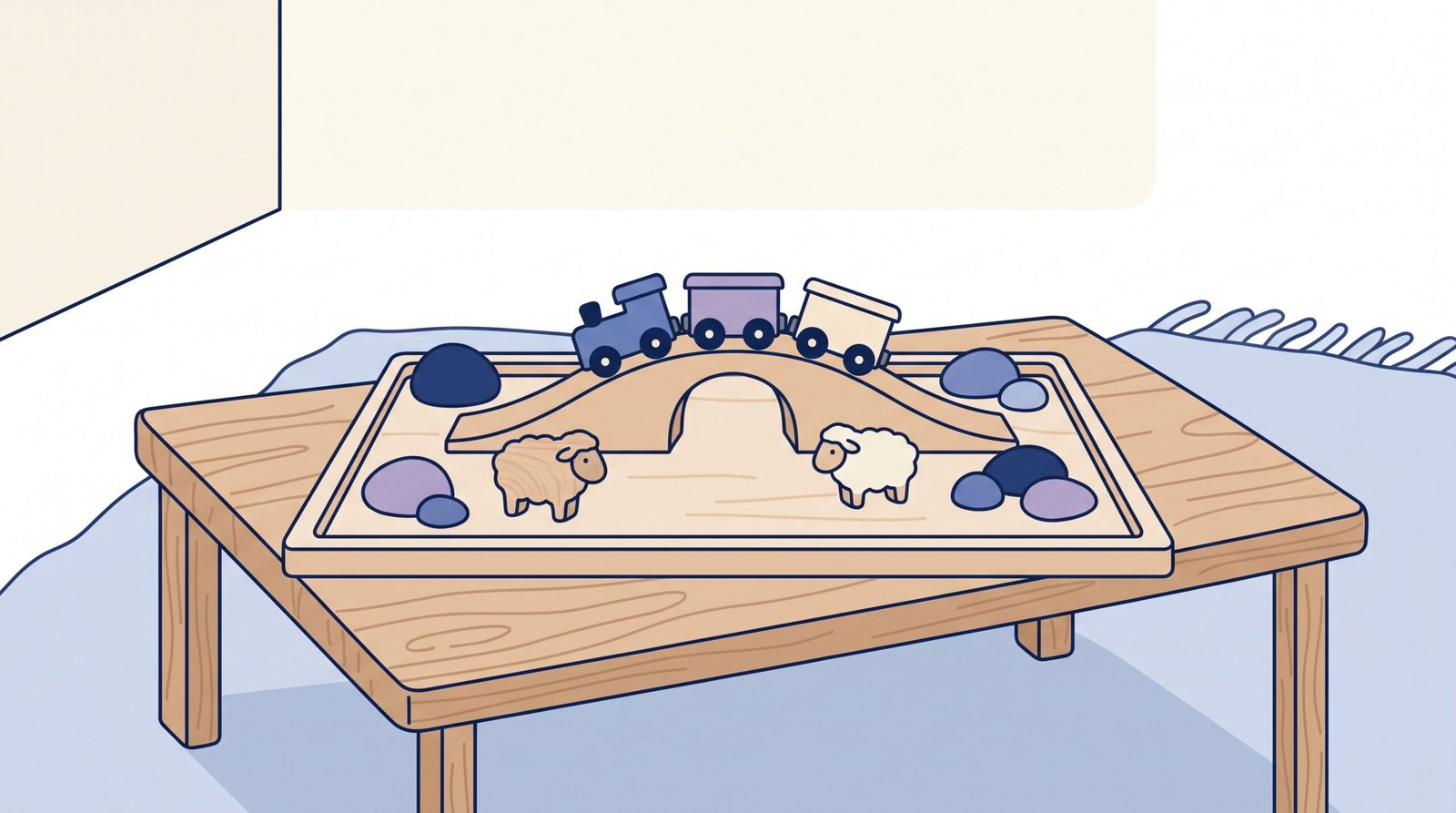
- How to Set It Up: Choose an open surface, such as a low coffee table, a clear patch of rug, or a flat wooden tray. Select no more than two or three complementary open-ended materials. Set them up mid-action. Do not leave a wooden train inside a bin; lay two tracks on the rug with the train engine halfway across a bridge, flanked by two small wooden animal figures.
- Why It Works: An open toy bin forces a child to generate an entire scenario from scratch: What do I want to play? Where are the wheels? Which tub has the track? That start-up cost is often too heavy for an overtired child. A toy invitation provides the initial narrative hook. When they walk past and see the train paused on the bridge, their brain instinctively wants to push it across. Research from the National Association for the Education of Young Children (NAEYC) confirms that carefully structured, predictable physical environments dramatically increase children’s capacity for sustained, purposeful engagement with learning materials.
2. Toy Rotation: Why Less Space Creates Deeper Play
Parents frequently purchase more toys under the mistaken impression that novelty cures boredom. In reality, a high volume of accessible toys directly degrades the quality and duration of a child’s focus.
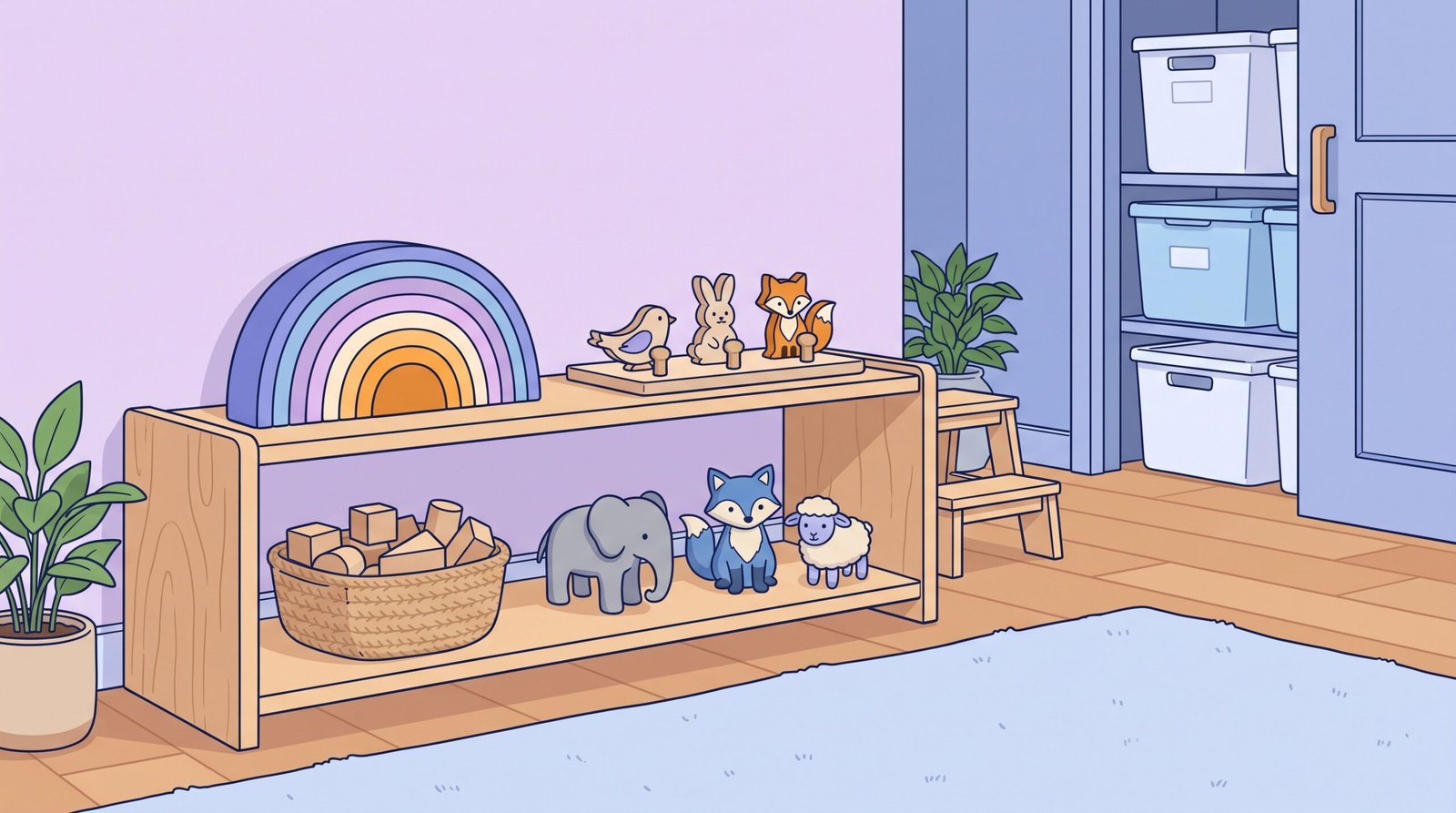
- The Landmark Toy Research: In a foundational developmental study on toy environments published by researchers investigating toddler play behaviour, children were observed playing in two distinct environments: one with four toys, and one with sixteen toys. In the four-toy room, children engaged in significantly longer, deeper, and more creative play. In the sixteen-toy room, children flitted rapidly from one toy to another, abandoning each within seconds.
- Executing a Simple Rotation: Pack away 70% of your visible toys into storage tubs in a cupboard or garage. Display only four to six distinct items on a low shelf, ensuring generous negative space around each basket or tray. Every two to three weeks, rotate two items out and bring two fresh items in. When an old wooden puzzle or set of blocks reappears after a month away, your child greets it with renewed curiosity.
3. Stripping Back Background Visual Clutter
We frequently talk about auditory noise in our homes, but we rarely address visual noise. Yet for young children, especially those with sensitive sensory profiles or ADHD traits, visual clutter acts as a constant drain on attention.
- Clear Boundaries: When living room rugs are covered in a sea of primary-coloured plastic parts, the eye jumps constantly, preventing the child from entering a flow state.
- Practical Adjustments: Use plain, neutral rugs rather than busy road-map carpets that make small pieces hard to see. Keep walls relatively calm around the play station. Store remaining toys in opaque fabric bins or natural baskets rather than clear plastic tubs that leave visual chaos on display.
4. Knowing When to Step Back (And Protecting Boredom)
The most counterintuitive part of learning how to encourage independent play preschool routines is mastering the art of quiet parental withdrawal.
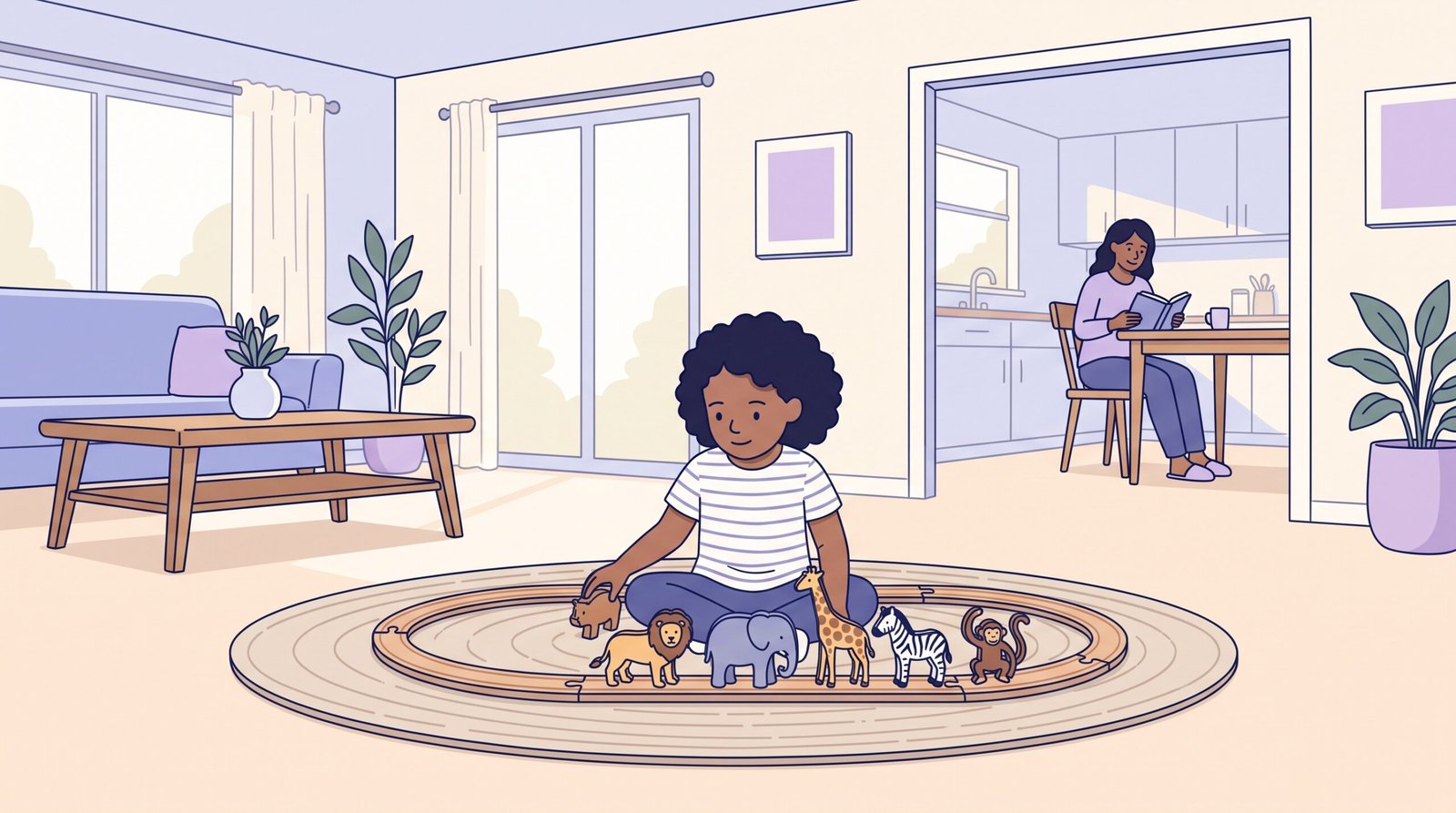
- The “Fade Out” Technique: Start as an anchor. Sit on the floor beside your child for the first two to three minutes without taking over the play. Drop in one gentle observation: “Look at those wide wheels.” Once their hands are moving, stop speaking. Transition your body up to a nearby chair or sofa. After a few minutes, stand up and move to the kitchen counter to wash a cup or fold laundry.
- Protecting the Boredom Gap: When a child whines, “I’m bored, what can I do?”, what they are feeling is the uncomfortable gap between passive entertainment and active creativity. Clinical insights from the American Academy of Pediatrics (AAP) confirm that unstructured downtime is essential for children to develop internal motivation, imaginative problem-solving, and cognitive self-direction. Resist the urge to solve boredom instantly. Acknowledge their feeling calmly: “It feels tricky when you don’t know what to do next. Your brain is getting ready to think of an idea.” Then hold the boundary. More often than not, sitting through two minutes of grumpiness allows their imagination to step forward.
What Independent Play Is Actually Building Inside the Brain Inhibitory control, working memory, and emotional resilience
When you step back and watch your preschooler spend fifteen minutes lining up wooden animals along a timber floorboard, it can look deceptively simple. It is easy to wonder whether they would be learning more from an educational tablet application or a formal phonics worksheet.
In reality, self-directed play is constructing the neurobiological bedrock for all future academic learning:
| What the Child Does During Solo Play | The Underlying Executive Function Skill | Long-Term Developmental Benefit |
|---|---|---|
| Rebuilding a fallen wooden block tower | Frustration tolerance and cognitive flexibility. | Resilience when facing academic challenges and emotional setbacks. |
| Holding an imaginary narrative across 15 minutes | Working memory and narrative sequencing. | Foundational reading comprehension and complex task planning. |
| Resisting abandoning a toy when stuck | Inhibitory control and sustained attention. | Classroom focus, self-regulation, and task persistence. |
| Choosing materials without adult direction | Intrinsic motivation and autonomy. | Self-directed learning habits and personal confidence. |
Research from the Raising Children Network (Australia) underscores that young children build sustained concentration and problem-solving skills far more effectively through child-led, open-ended exploration than through structured, adult-directed lessons.
What Happened in My Own Living Room Messy truths, broken expectations, and the reality of ADHD parenting
I hold a PhD in early childhood education. I have spent years researching child development, observing preschool classrooms, and lecturing future educators on the benefits of child-led learning.
Yet none of that theory protected me from the exhausting reality of raising my own daughter.
She is bright, intensely curious, and carries the buzzing, high-energy profile of an ADHD nervous system. During her third and fourth years, our home frequently felt like an emotional pressure cooker. I could not walk into the kitchen to make a cup of tea without her trailing behind me, crying if I looked at my phone, and insisting that I sit on the rug to narrate her tea parties.
I felt like a complete hypocrite. I was teaching educators how to foster independence in early learning settings, yet I could not get four minutes to brush my teeth in peace.
The breakthrough came on a rainy Tuesday afternoon when my own adult ADHD brain was utterly depleted. I sat on the floorboards, leaned my back against the sofa, and closed my eyes.
“I can’t play unicorns right now, sweetheart,” I said gently, without irritation. “My body is tired. I am sitting right here on the carpet, but I am resting.”
She whined for two minutes. She patted my knees. She pulled on my cardigan sleeve. I kept my breathing slow, kept my eyes closed, and offered soft verbal reassurance: “I’m right here. I am resting.”
When she realised the entertainment engine was genuinely switched off, she sighed. She walked three steps over to the window, picked up an empty cardboard shoebox and an old wooden spoon, and began tapping a slow, rhythmic pattern against the cardboard.
She stayed absorbed in that experiment for fourteen minutes.
I sat there with my eyes closed, breathing, realising that my constant, guilty effort to entertain her had been the very barrier standing in the way of her imagination. She didn’t need me to perform; she simply needed to know I was safely anchored in the room while she figured out how to direct herself. That profound shift in how to encourage independent play preschool children need transformed the culture of our home.
“Independent play is not an exam your parenting passes or fails. It is a slow, rhythmic negotiation between connection and exploration. When I stopped feeling guilty for needing ten minutes to breathe, my child finally found the space to discover her own capable mind.”
Dewi Griffith, PhD, Founder
What Does Not Work: Traps That Add Friction and Clinginess Save your energy and skip these common parenting traps
If you are working to foster autonomy but your child seems to be getting more demanding, check whether you have fallen into these common friction points:
- Sneaking Away: When your child finally gets focused on a puzzle, the urge to tiptoe out of the room like a ninja is tempting. Resist it. When an anxious or sensitive child looks up and discovers their primary attachment figure has vanished without a word, their nervous system registers a sudden breach of safety. The next time they play, they will keep one eye locked on you rather than immersing themselves in the toy. Always announce your movements calmly: “I am walking into the kitchen to put the kettle on. You keep building your road; I am right around the corner.”
- Using Screens as a Warm-Up: Handing a child a tablet for twenty minutes to “settle them down” before asking them to play with physical toys almost always backfires. High-frame-rate digital media delivers effortless, rapid dopamine. Transitioning from that intense digital stimulation to an inanimate wooden block or a tub of crayons feels dull and unrewarding, triggering immediate irritability.
- Isolating the Play Space: Preschoolers do not want to be sent down a long hallway to play alone in an empty bedroom. We are social mammals; we seek safety in the presence of others. Set up small, contained play invitations within your shared working perimeter—such as the kitchen or living room floor—so your child feels connected while you complete your chores.
A Realistic, Week-by-Week Progression Building stamina gradually over four weeks
Independent play is a muscle that strengthens through gradual, consistent repetition. You do not expect a preschooler to manage twenty minutes on Day 1.
Use this realistic framework to scaffold your expectations:
| Timeline | Target Solo Duration | Primary Focus & Parental Role |
|---|---|---|
| Week 1 | 3 to 5 minutes | Cull 70% of visible toys into storage tubs. Sit beside your child on the rug as a quiet, grounded anchor without directing. |
| Week 2 | 7 to 10 minutes | Introduce staged toy invitations. Anchor for two minutes, then move your body to a nearby chair or sofa. |
| Week 3 | 12 to 15 minutes | Step into an adjacent room to do a predictable chore. Announce movements calmly; never sneak away. |
| Week 4 | 20+ minutes | Establish a reliable daily play rhythm following a moment of deep connection. Hold the boredom boundary with confidence. |
For Parents Who Feel Utterly Stuck Today A gentle reminder when the days feel heavy
If you are reading this while hiding in the bathroom with a cold cup of coffee, listening to your child pound on the door because you stepped away for thirty seconds, please take a slow breath.
You have not broken your child.
Your child’s desire to be near you is not a design flaw; it is living proof that they feel secure in your presence. When life feels overwhelming, your body is their safe harbour. That is a beautiful truth, but it is also profoundly exhausting.
You do not have to fix everything this afternoon. Start with one tiny shift: pack away one single basket of loud plastic clutter, clear one small corner of the rug, set three wooden blocks on a tray, sit beside your child for three minutes, and then take half a step back.
Independent play is not something you force; it is something you make space for. When the environment is simplified and the pressure to perform drops away, your child’s natural imagination will step forward to fill the quiet.
Expanding Your Low-Stress Play Toolkit Practical sensory and fine motor guides across your home
When working to build independent habits, having reliable, low-prep invitations on hand makes daily implementation vastly easier:
- When you need a quick, highly engaging kitchen activity that buys you cooking time, explore our guide to sink water play for preschoolers using warm tap water and kitchen tools.
- Keep indoor sensory exploration safe and contained on your carpet with our tested strategies for low mess sensory bins for preschoolers.
- Turn simple pantry staples into exciting cause-and-effect science right at the bench with our favourite preschool kitchen science experiments.
- When prolonged wet weather traps everyone indoors, use our restorative collection of rainy day activities for preschoolers at home to soothe indoor cabin fever.
- Transform delivery packaging into hours of open-ended spatial exploration with our practical cardboard play ideas for preschoolers.
Looking for Grounding, Low-Mess Activities for Restless Days?
When you need quiet, table-based activities that soothe busy minds and build fine motor precision without living room mess, our Montessori-inspired story tracing printables offer a peaceful, structured transition.
Explore Calm Story Tracing BundlesReferences & Research Foundations Credible developmental, paediatric, and early learning research
- Center on the Developing Child at Harvard University. (2014). Enhancing and Practicing Executive Function Skills with Children from Infancy to Adolescence. Harvard University. developingchild.harvard.edu
- American Academy of Pediatrics (AAP). (2018). The Power of Play: A Pediatric Role in Enhancing Development in Young Children. Clinical Report. aap.org
- National Association for the Education of Young Children (NAEYC). (2020). Developmentally Appropriate Practice in Early Childhood Programs Serving Children from Birth Through Age 8. naeyc.org
- Dauch, C., Imwalle, M., Ocasio, B., & Metz, A. E. (2018). The influence of the number of toys in the environment on toddlers’ play. Infant Behavior and Development, 50, 78–87. ncbi.nlm.nih.gov/pmc/articles/PMC5941987/
- Raising Children Network (Australia). (2024). Play, learning and development: Preschoolers. Australian Government Department of Social Services. raisingchildren.net.au
This article reflects personal family experience parenting in a neurodivergent household alongside professional early childhood education research. It is shared for supportive and educational purposes only and does not constitute formal clinical, behavioural, or psychological advice. Every child develops at their own unique pace, with distinct sensory profiles and attachment needs. If you have ongoing concerns about your child’s emotional development, social communication, or sensory processing, please seek individual guidance from your GP, a paediatrician, or an accredited child psychologist.