
Vygotsky’s Play Theory in Real Life: Pretend Play and My Nephew, Professor Zeki
What Vygotsky’s play theory looks like in real life, through my five-year-old nephew playing a chemistry professor. Pretend play, social learning, and how adults can gently join in.
My nephew Zeki is five, and some days he is a professor.
He lives in Indonesia with my sister and her family. I wrote recently about how he is picking up English through his love of science, and since then I have been watching another side of him on his family Instagram page. People leave him questions in the comments, and then Professor Zeki sits in front of the camera and answers them in English, looking as serious as any lecturer on the first day of semester.
It makes me smile every time. It also sent me straight back to a thinker I have loved throughout my career, the psychologist Lev Vygotsky. This post brings both together: a proud aunt sharing her nephew’s play, and an educator reflecting on Vygotsky’s play theory, imaginative role-play, and why stepping into a character helps children reach further.
My sister is very happy for me to share this, including an honest observation she made about his learning rhythm.
In this reflection:
The Professor Takes a Question
In one video, a viewer asked him to explain the difference between covalent and ionic bonds, a topic most students first encounter in high school chemistry.
Zeki does not hesitate. Someone asked, so he begins his explanation. A covalent bond keeps an atom’s electron shells complete, while an ionic bond occurs when one atom pulls an electron from another. He then offers examples: water for covalent and salt for ionic, with a periodic table and world map hanging behind him on the wall.
His explanation was not textbook perfect. He omitted that covalent bonds involve electron sharing, and described water as a mineral, which an encouraging commenter gently corrected. Yet the conceptual core was solid, and he delivered it with genuine conviction.
At the end of the clip, he invited viewers to send in more questions so he could prepare future lessons. The video has gathered over a million views, proving quite an audience for a five-year-old lecturer.
Why I Keep Coming Back to Vygotsky’s Play Theory
Lev Vygotsky was a pioneering psychologist who died young of tuberculosis in 1934, aged just 37. Much of his work was not widely translated into English until decades later.[1] Even so, his sociocultural perspective continues to shape early childhood education across Australia and internationally.
He outlined much of his perspective on play in a 1933 lecture, later compiled in Mind in Society in 1978.[2] In short: imaginative play is central to cognitive development, all pretend play operates on internal rules, play helps children stretch beyond their everyday capacity, and learning is fundamentally social.
Vygotsky’s perspective resonated with me early in my academic career. During my initial postgraduate drafts, his ideas on collaborative learning grounded my thinking. While my research later shifted towards the Reggio Emilia approach, Vygotsky remained a lasting influence whenever I observe young children at play.
He viewed children not as passive recipients of instruction, but as active participants who construct understanding through dialogue and imaginative play. Watching Professor Zeki step into his lecture role brings those foundational ideas to life.
Children Have Always Played School
Beneath the high-school chemistry concepts and social media platform, Zeki is engaging in timeless early childhood play: make-believe.
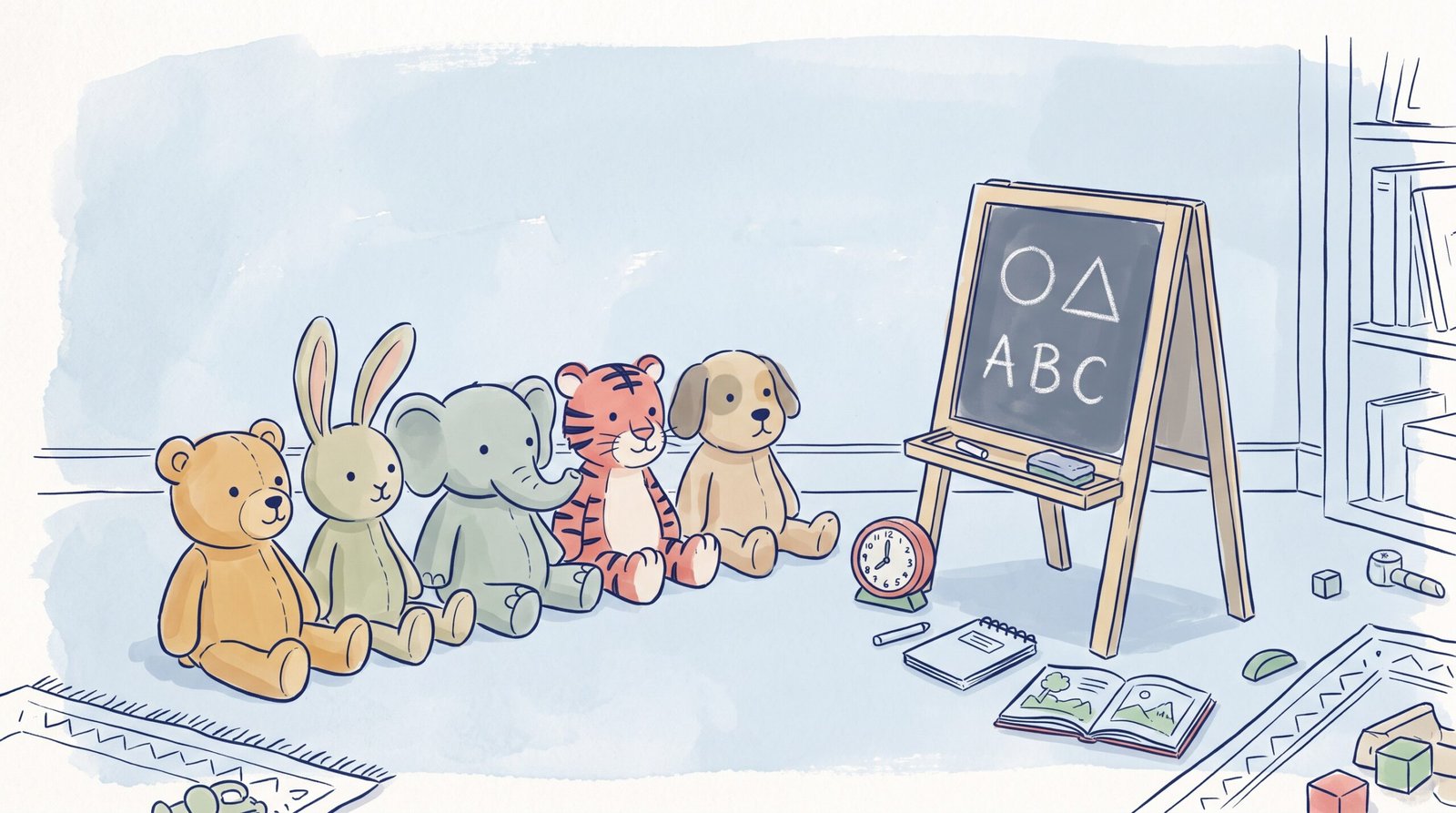
We see this across early learning centres every day. A wooden block becomes a telephone, a cardboard box turns into a spacecraft, or a child arranges chairs to run an imaginary clinic. Children line up soft toys and conduct lessons, adopting the exact tone and authority of their favourite educators.
Zeki choosing to adopt a professorial role follows that exact tradition. His audience simply happens to extend beyond the living room floor.
Vygotsky viewed this make-believe play, which emerges strongly around age three, not as frivolous entertainment, but as a primary driver of symbolic thought and self-regulation.[2]
Even Pretend Play Has Rules
A common assumption is that imaginative play is entirely unstructured. However, Vygotsky observed that all pretend play involves adherence to rules.[2]
When children play family roles or pretend to be healthcare workers, they do not act randomly. They modify their behaviour to match their internal concept of how a parent or doctor acts. If a peer steps outside that shared expectation, others quickly remind them of the role’s boundaries.
Watch Zeki in his videos and the structure is evident. He opens by restating the viewer’s question, provides a definition, offers an example, maintains a serious demeanor, and employs formal scientific terminology. He follows his mental blueprint of what an educator does.
Maintaining that role requires substantial cognitive effort. He must sequence his points, select vocabulary carefully, and consider how the information sounds to his audience. The play frame makes that mental exertion engaging rather than stressful.
A Head Taller Than Himself
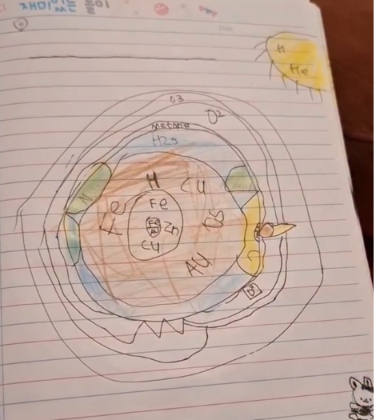
Vygotsky wrote that in play, a child behaves as though they were “a head taller than himself”.[1] It is a vivid description of how imaginative play allows young learners to operate at the upper boundary of their developmental capacity.
This connects directly to his concept of the zone of proximal development: the space between what a child can do unaided and what they can achieve with supportive guidance. Play creates its own zone of proximal development, lifting the child forward through the power of the imagined role.[2]
As an everyday five-year-old, explaining atomic structure to adults might feel daunting. As Professor Zeki, he willingly takes on the challenge. The persona provides psychological safety, allowing him to explore concepts right at the edge of his understanding.
When a Block Becomes an Atom
Vygotsky used the classic example of a child riding a hobby horse or a simple stick. The physical stick acts as a pivot, helping the young child separate the abstract meaning of a horse from the actual animal.[2]
With experience, children gradually internalise those representations and no longer require tangible props to sustain abstract ideas.
Zeki demonstrates that exact transition. In Minecraft, he uses digital element blocks as tangible anchors to assemble water molecules. The virtual block serves as a concrete pivot for an invisible atom. In later videos, he moves to hand-drawn sketches, and eventually explains covalent bonding entirely through spoken language without any physical props.
Parents sometimes wonder if children rely too long on tangible toys or drawings to work through ideas. In early childhood theory, external anchors come first, and abstract interior reasoning develops from them.
Thinking Out Loud
Preschoolers frequently narrate their actions while building or drawing. Adults occasionally view this private speech as distraction or mere noise.
Vygotsky placed great importance on this audible self-talk. He argued that language starts as a social tool between people, becomes overt self-directed speech to guide problem-solving, and gradually internalises into inner thought.[3]
In his video discussions, Zeki frequently catches himself mid-sentence, pausing to clarify with “wait, I mean”. That audible self-correction demonstrates his working memory actively evaluating and refining his statements in real time.
Assuming a teacher persona gives him a purposeful reason to externalise his thinking, allowing him to practice organising concepts into structured verbal communication.
Learning Happens Between People First
A central tenet of sociocultural theory is that cognitive functions appear twice: first on the social plane between individuals, and later on the psychological plane within the child.[1]
Zeki’s learning is deeply relational. He reads alongside his parents, discusses chemistry concepts over regular video calls with his uncle in Bali, and interacts with an online audience that responds to his questions.
Educational literature refers to this guidance as the “more knowledgeable other”, an adult, peer, or reference resource that helps scaffold the next level of comprehension. For Zeki, that role is filled collaboratively by his family, his illustrated books, and online commenters who provide supportive feedback.
For families, this removes the pressure to have every answer. Supporting a child means being present in the conversation, wondering together, and exploring answers alongside them.
Holding Back to Stay in the Game
Vygotsky observed that pretend play is an exceptional training ground for self-regulation, because maintaining an imagined role requires children to subordinate immediate impulses to the rules of that role.[2]
Contemporary research confirms this phenomenon. In a widely cited study on executive function, four- and six-year-olds given a repetitive task persevered significantly longer when encouraged to imagine themselves as a dedicated character such as Batman.[4]
A preschooler who might normally find it challenging to sit still for an extended conversation can comfortably maintain focus for several minutes while in character as a professor. The expectations of the role sustain his attention.
Teaching to Learn
Educators know well that explaining a concept to another person demands a higher level of mastery than passive reading.
Educational studies demonstrate that individuals who prepare material with the expectation of teaching it, or who present it aloud, achieve significantly stronger retention and conceptual clarity.[5]
By reading scientific material and then synthesising it into a video explanation, Zeki actively consolidates his own understanding through verbal teaching.
“Sometimes He Is Just Making It Up”
When discussing his videos, my sister remarked with a laugh that at times he simply invents answers when he reaches the limit of his knowledge.
That is entirely characteristic of five-year-old development. Stepping into an expert persona means adopting the cadence of confidence, whether the underlying information is fully formed or not. Some explanations come directly from books, while others are creative extrapolations.
Inventive explanations during make-believe are a natural part of testing ideas. He is practicing the presentation style of an authority while his factual base continues to grow.
Adults can support this growth by introducing gentle enquiry prompts, such as “How did you discover that, Professor?” or “Let us check that in your chemistry book together.” This keeps the game playful while gently cultivating research habits.
Everyone Joined the Class
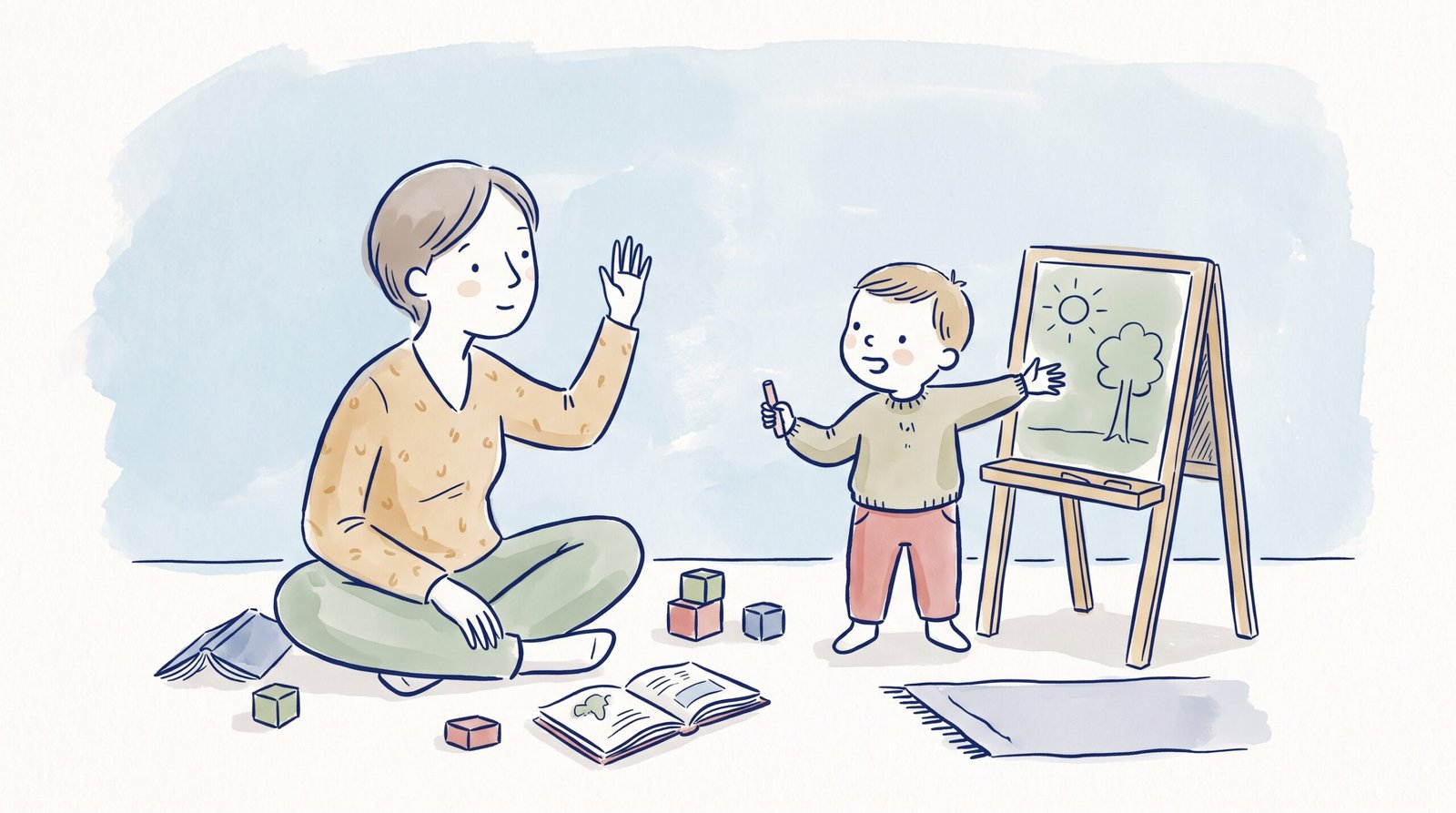
The community response beneath his videos mirrors an interactive classroom. Viewers address him as “Prof”, ask follow-up questions about acids and bases, or humorously claim he was their university tutor.
That response provides a model for how adults can engage with children’s imaginative play. Rather than correcting them from the outside, stepping into the game as a student or colleague keeps the child in control while enriching the narrative.
When viewers gently noted that water is accurately classified as a molecule rather than a mineral, they provided supportive scaffolding directly within the context of the social exchange.
Play Is Enough on Its Own
While imaginative play provides rich developmental benefits, it is important not to treat make-believe as a purely functional exercise for academic acceleration. Meta-analyses on pretend play indicate that while play supports language, narrative competence, and emotional expression, it should not be viewed as a guaranteed shortcut to academic achievement.[6]
Pretend play does not need to justify itself by producing a formal lesson. Play is valuable in its own right as the primary medium through which young children make sense of their world, a balance discussed further in integrating play-based learning without losing structure.
How We Can Join in at Home
Children do not need an interest in chemistry or an online account to benefit from these principles. Simple everyday approaches support imaginative learning in any household:
Take a role while leaving the child in charge: If your child is the teacher, be the attentive student. If they are the shopkeeper, be the customer who needs assistance. Let them guide the plot.
Ask questions in character: Asking “Doctor, what should I do for my sore throat?” invites explanation and vocabulary use within the safety of the role.
Avoid interrupting play to make corrections: Allow the narrative to unfold naturally. If a factual misunderstanding arises, revisit it later by exploring a book together.
Keep props open-ended: Simple materials like cardboard boxes, old notepads, or costume glasses support symbolic thought far more effectively than rigid single-purpose toys.
Value running commentary: Audible self-talk during play is evidence of problem-solving and executive planning in action.
Connect with knowledgeable others: When your child develops an enthusiasm for astronomy, wildlife, or mechanics, connect them with library resources, community mentors, or family members who share that interest.
Protect unstructured solitary play: Children also need ample quiet space to create independent imaginary worlds, as discussed in encouraging independent play in preschoolers. If your child enjoys building imaginative stories, our storytelling wheel offers a tactile visual template.
Professor for Now
Whether Zeki pursues science academically in the future is something only time will tell. For now, he is an enthusiastic five-year-old with a periodic table on his wall, a growing library of books, and a supportive family community.
Vygotsky wrote passionately about the capacity of imaginative play to elevate young learners. A child standing a head taller in a pretend classroom, discovering ideas out loud with people who care, reflects the enduring truth of that perspective.
From Melbourne, I remain one of his happiest supporters, ready to learn whatever the professor decides to teach next.
- Early language journeys: Child Learning English Second Language: Lessons From a Curious 5-Year-Old →
- Child-led exploration: How to Encourage Independent Play in Preschoolers →
- Early childhood approaches: The Reggio Emilia Approach at Home →
- Story creation: Storytelling Wheel: A Template for Creating and Narrating Stories →
Research: Vygotskian sociocultural theory; empirical research on executive function and imaginative roles; studies on peer tutoring and learning by teaching; and systematic reviews on pretend play. Experience: observations drawn from family discussions and public video materials. Last reviewed: October 2026.
References
- Vygotsky, L. S. (1978). Mind in society: The development of higher psychological processes. Harvard University Press.
- Vygotsky, L. S. (1967). Play and its role in the mental development of the child. Soviet Psychology, 5(3), 6–18.
- Vygotsky, L. S. (1986). Thought and language (A. Kozulin, Trans.). MIT Press.
- White, R. E., Prager, E. O., Schaefer, C., Kross, E., Duckworth, A. L., & Carlson, S. M. (2017). The “Batman Effect”: Improving perseverance in young children. Child Development, 88(5), 1563–1571. https://doi.org/10.1111/cdev.12695
- Fiorella, L., & Mayer, R. E. (2013). The relative benefits of learning by teaching and teaching expectancy. Contemporary Educational Psychology, 38(4), 281–288. https://doi.org/10.1016/j.cedpsych.2013.06.001
- Lillard, A. S., Lerner, M. D., Hopkins, E. J., Dore, R. A., Smith, E. D., & Palmquist, C. M. (2013). The impact of pretend play on children’s development: A review of the evidence. Psychological Bulletin, 139(1), 1–34. https://doi.org/10.1037/a0029321