
The Storytelling Wheel: A Simple Template for Narrating Stories
Ask a small child to “tell me a story” and you’ll usually get one of two things. Either dead silence, or the same three sentences they’ve told you four times already this week. It’s not that they lack imagination. A blank page, or a blank prompt, is actually a hard place to start from, even for adults. Give someone too much freedom and the freedom itself becomes the problem.
A storytelling wheel gets around that by doing what a good writing prompt always does, taking away just enough of the blank space that a story has somewhere to begin.
How it works
Draw a circle and divide it into a handful of sections, who the story’s about, where it happens, what goes wrong, and how it gets fixed. Four or five sections is plenty, more than that and you’re back to overwhelming a three-year-old with choice. Spin something on it, an old paperclip held in place with a pencil point does the job fine, or just close your eyes and land a finger somewhere. Whatever it lands on, that’s the piece of the story you build next.
What this can sound like out loud
Spin lands on “a grumpy dragon.” Spin again, lands on “lives inside a shoe.” Spin again, “lost his favourite hat.”
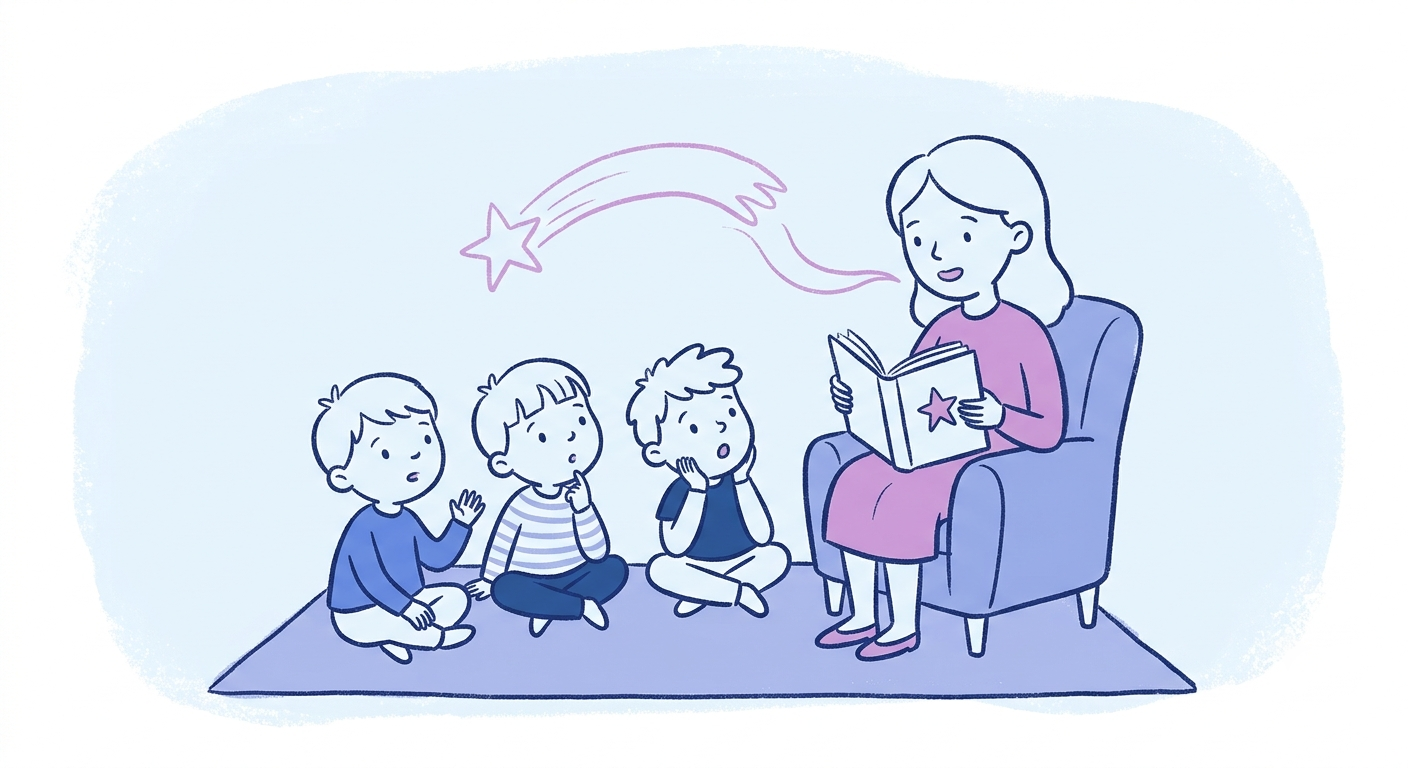
That’s already most of a story sitting there. A child just has to narrate what happens next, and most will, because the hard part, deciding where to start, has already been done for them.
Younger kids will need you to hold the pencil and ask the questions, “so what does the dragon do first,” “who does he ask for help.” Older ones will start running the wheel themselves before long, and eventually won’t need it at all, which is really the whole point, it’s scaffolding, not a permanent crutch.
Why the structure helps rather than limits
It feels a little counterintuitive that giving a child less freedom makes them more imaginative, but that’s roughly what happens. A completely open prompt asks a child to invent everything at once, character, setting, plot, all from nothing. A wheel breaks that into small decisions made one at a time, which is a much easier thing for a young brain to manage, and the imaginative leap happens in how they connect the pieces rather than in inventing the pieces themselves.
This is the same idea sitting underneath our personalised storybook template, which does something similar but starts from the child’s own name instead of a spin of the wheel. And it’s the same reasoning behind pairing a one-line story with every letter in the tracing bundle, a small amount of structure gives a child somewhere to start, rather than a blank page or a blank letter asking them to just get on with it. If you want the fuller picture of how these pieces connect, we’ve written more on why repetition alone doesn’t build literacy skills, and the Early Literacy section ties the rest together.
Where this idea comes from
Breaking a story into a small number of set parts, who it’s about, where it happens, what goes wrong, how it resolves, isn’t something we invented. It’s close to what researchers call story grammar, the basic structure most stories share, and it’s long been used as a scaffold to help young children both understand and tell stories more clearly. Reading Rockets covers story maps in more detail, including the same beginning, middle, and end prompting this wheel is built around, if you want to see the wider research behind it.
The word “scaffold” itself comes from the psychologist Lev Vygotsky, whose zone of proximal development describes the gap between what a child can do alone and what they can do with just a little support. A wheel that hands over “who” and “where” and leaves the rest to the child sits right in that gap, close enough to independent that it’s still their story, supported enough that they’re not starting from nothing. This explainer on Vygotsky’s play theory is a good starting point if you want to read further.
Want the printable wheel itself, ready to cut out and spin?
Download the Storytelling Wheel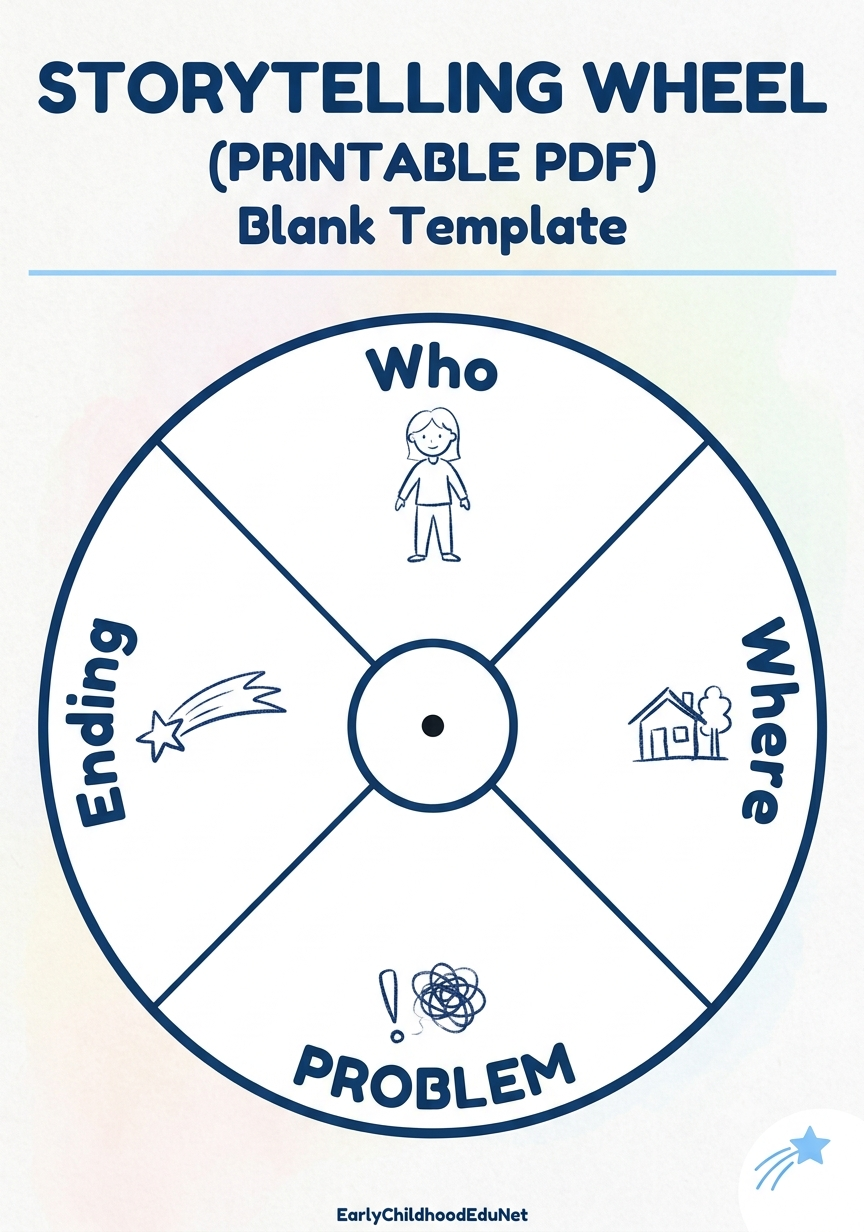
Free, no email required. Print, cut around the outer circle, and attach a paper fastener or paperclip through the centre dot.
Want a template that already has the name-based version built in?
Try the Personalised Storybook Template