
Free Alphabet Tracing Worksheets A to Z, Starring Wobblin
Story-based alphabet tracing worksheets for preschool and kindergarten. Every letter opens with a short Australian animal story, then your child traces with a finger, then a pencil, then draws.
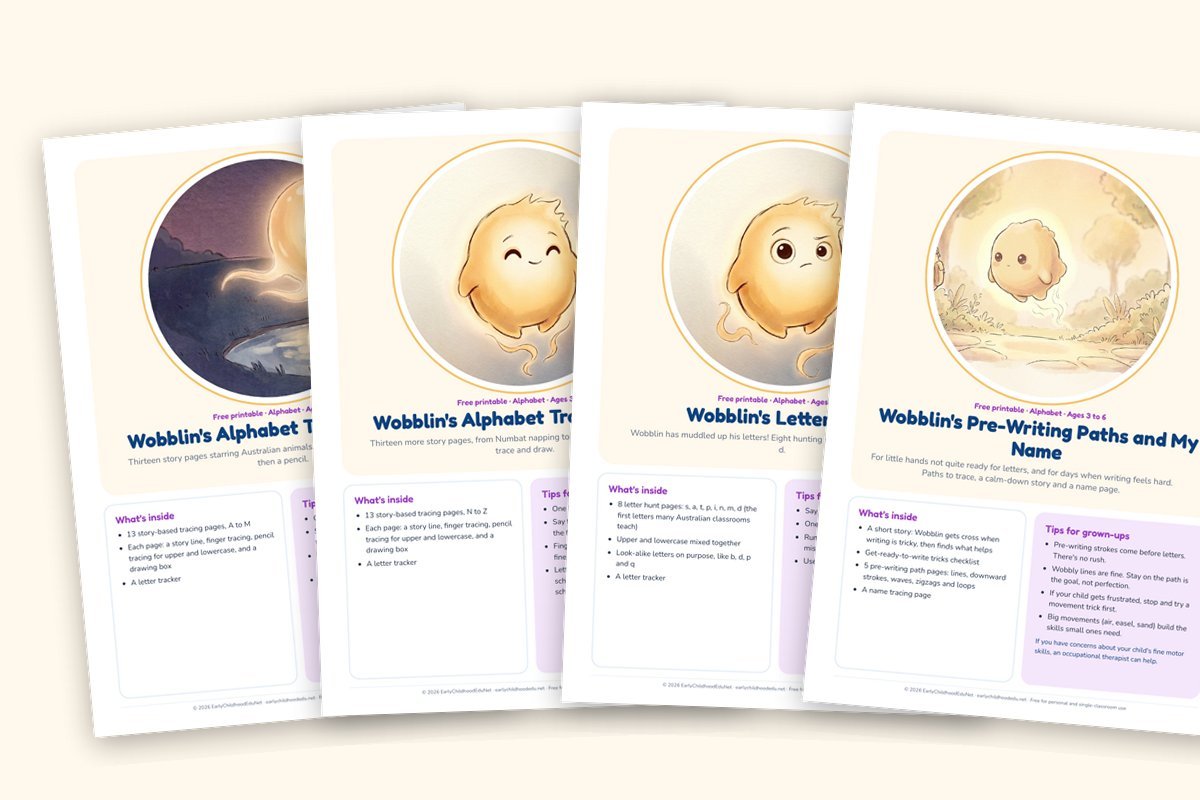
These are real, full pages, not a stripped-down taste of something bigger. Four free packs cover the whole alphabet, a letter hunt for the first letters most children learn, and pre-writing paths for little hands that aren’t ready for letters yet.
- Why story-based alphabet tracing worksheets work
- Four free alphabet tracing worksheets packs
- How to use alphabet tracing worksheets
- Alphabet tracing worksheets for neurodivergent kids
- Is your child ready for alphabet tracing worksheets?
- SATPIN: where alphabet tracing worksheets often start
- More free printables
- FAQs
Why Story-Based Alphabet Tracing Worksheets Work
Most tracing practice leans on plain repetition: trace the letter, trace it again. Tying each letter to a short story gives a child a reason to engage with the page beyond just following a line, and it quietly connects letter formation to sounds, language and imagination at the same time. It’s a small shift, but it tends to change how a child approaches the page. As South Australia’s Department for Education puts it in its guide to everyday learning for literacy, literacy is about making meaning, not just marking paper. If your child loves the stories, my free storytelling wheel template lets them invent their own.
Each page also builds in the steps young hands need. Tracing a big letter with a finger comes first, then tracing smaller grey letters with a pencil, then trying on their own. The drawing box at the end is a reward, and a chance to show what words they know with that sound.
“Seal splashes in the salty sea.”
Four Free Alphabet Tracing Worksheets Packs
Every pack opens with a short guide for grown-ups and uses the same calm layout throughout. Wobblin floats through the pages in different moods: happy, curious, puzzled, calm and, sometimes, a bit cross.
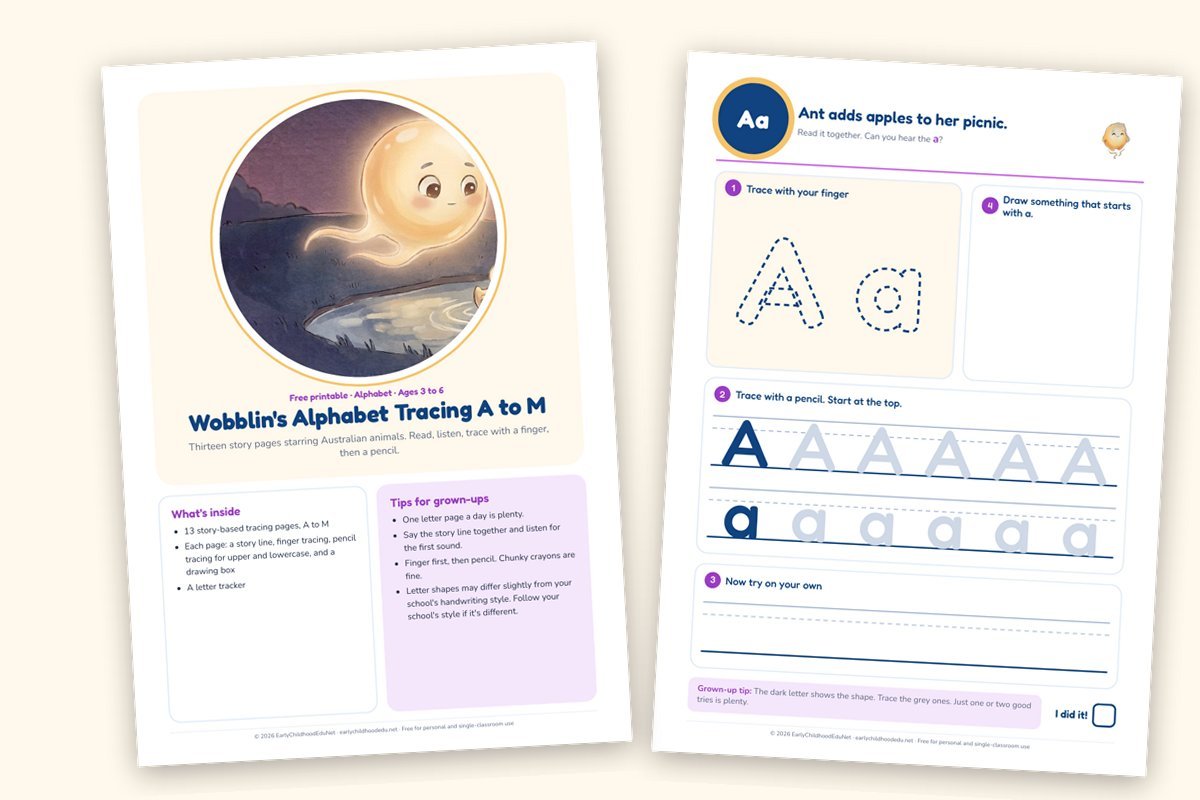
Wobblin’s Alphabet Tracing Worksheets A to M
Thirteen story pages, from “Ant adds apples to her picnic” to “Magpie munches a muffin”. Finger tracing, pencil tracing for upper and lowercase, and a drawing box.
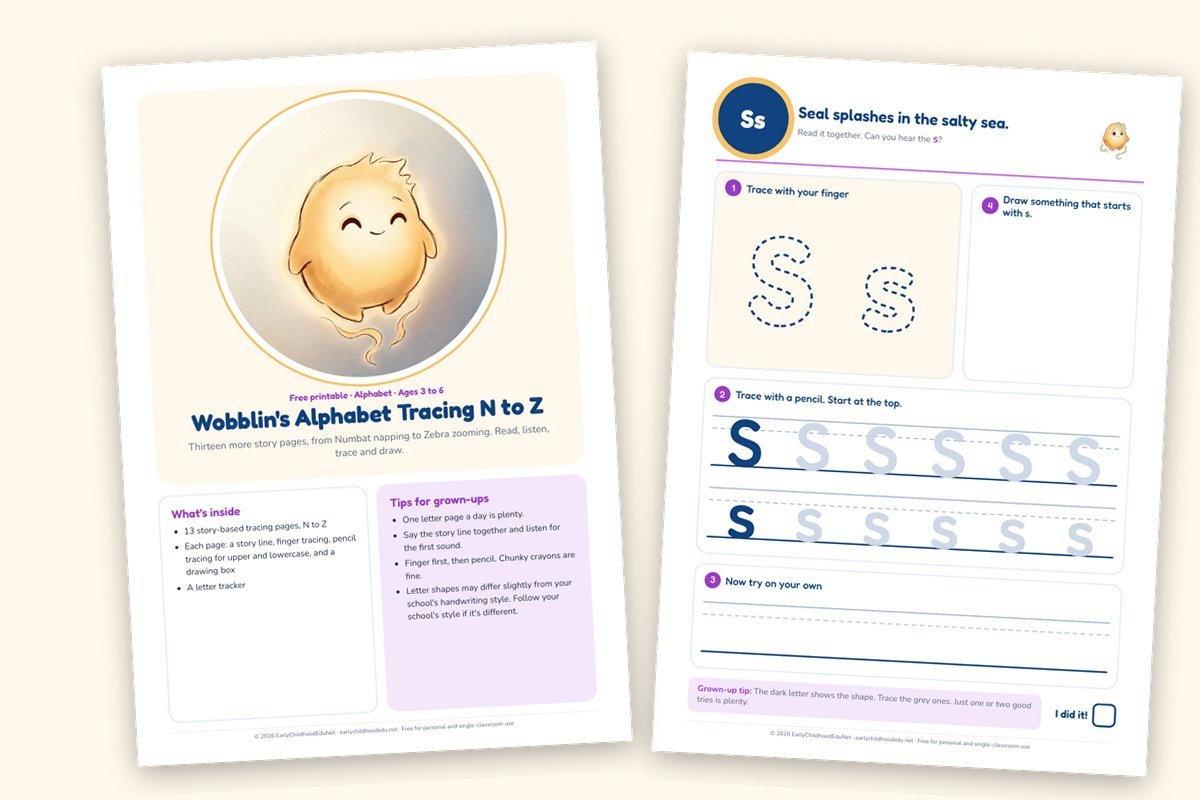
Wobblin’s Alphabet Tracing Worksheets N to Z
Thirteen more, from “Numbat naps in a nest” to “Zebra zooms down a zip line”. The same layout, so the second half feels familiar.
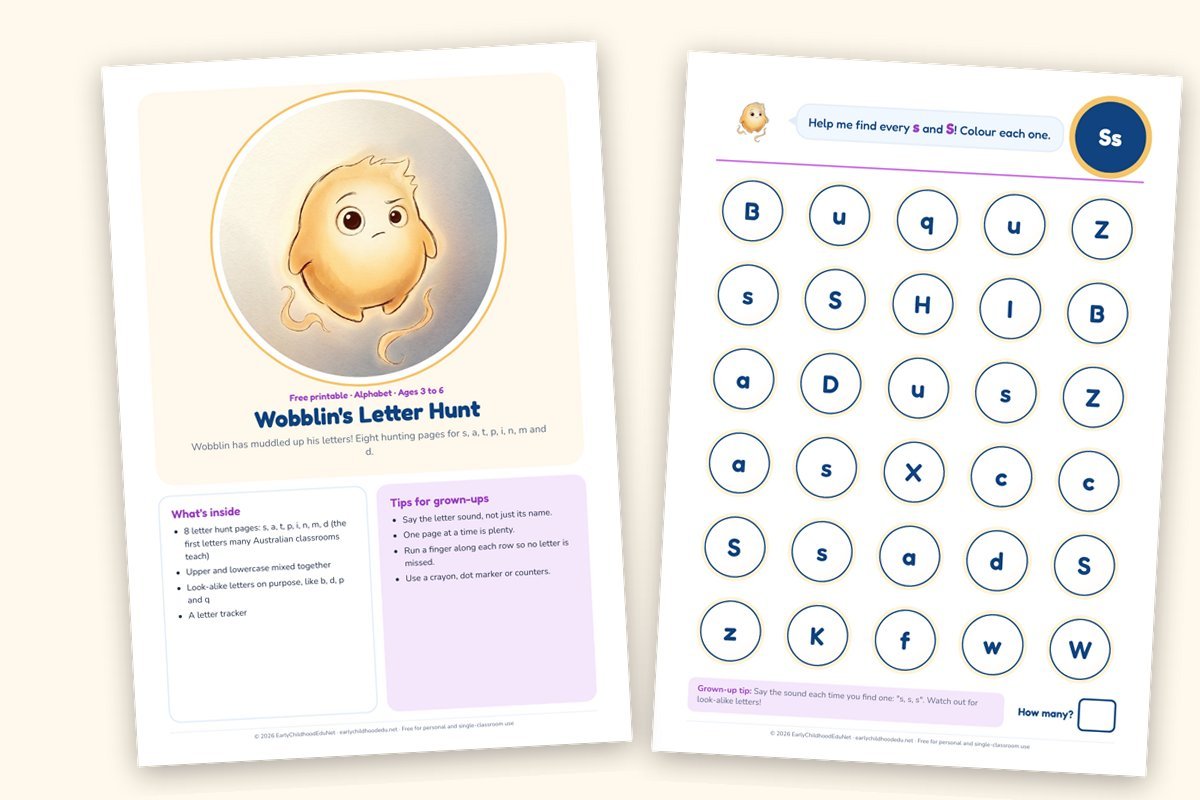
Wobblin’s Letter Hunt
Eight hunt pages for s, a, t, p, i, n, m and d. Find and colour every upper and lowercase target among look-alike letters.
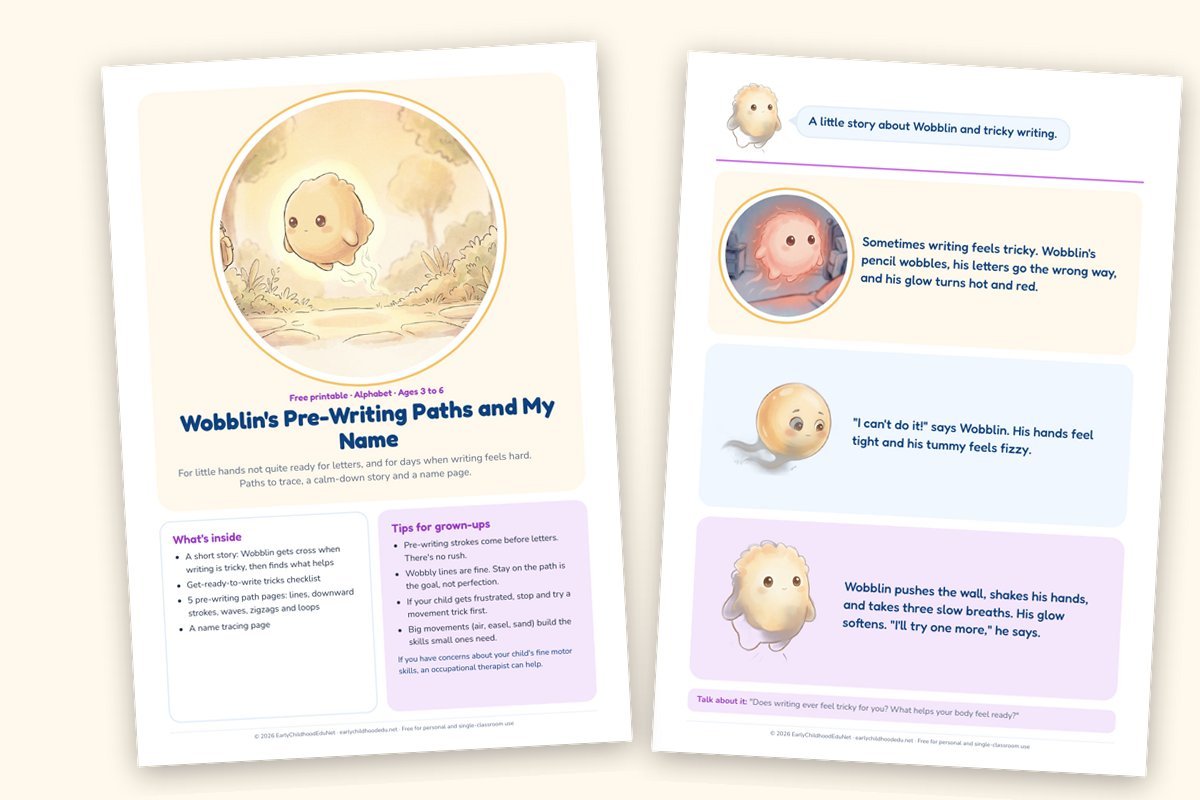
Pre-Writing Paths and My Name
A short story about Wobblin getting cross when writing is tricky, get-ready-to-write tricks, five pre-writing path pages and a name tracing page.
A note on letter shapes: each Australian state has its own school handwriting style, such as Victorian Modern Cursive or NSW Foundation Style. The letters in these worksheets are simple print shapes that will look slightly different from some school styles. If your child’s school uses a particular style, follow that for letter formation. Spelfabet has a clear overview of Australian school handwriting styles by state.
How to Use Alphabet Tracing Worksheets
- Read the story line together. Say it with a bit of drama. Stretch the first sound: “Sssseal splashes in the sssalty sea.”
- Finger first. Trace the big letters with a finger, slowly, saying the sound. This is where the shape gets learnt.
- Then a pencil. Start at the top. The dark letter shows the shape, then trace the grey ones. One or two careful tries beats a whole row of rushed ones.
- Try on your own. Have a go on the empty lines. Wobbly is fine, and so is invented spelling when they start writing words.
- Draw something. Finish with a picture of something that starts with that sound. It’s the bit most children love.
- Stop while it’s going well. One letter page a day is plenty for most three and four year olds.
For more on how children learn to form letters, see my guide to letter formation and how to hold a pencil correctly.
Alphabet Tracing Worksheets for Neurodivergent Kids
I have ADHD myself and I’m raising a daughter with ADHD, so I know how quickly a tracing page can go from fine to tears. These packs were designed with busy, sensitive and neurodivergent learners in mind.
- Same layout every time. Every letter page has the same four steps in the same places, so there’s nothing new to work out except the letter.
- A character who gets cross too. In the Pre-Writing pack, Wobblin’s glow turns red when writing feels tricky, then he finds what helps. Reading it together can make it easier for your child to say “this is hard”. A calm corner nearby gives them somewhere to reset.
- Get the body ready first. Pushing a wall, squeezing hands or drawing letters big in the air can help before sitting down. The pack includes a checklist of these, and my free pocket heavy work cards and animal walks add more ideas.
- Change the tools. Chunky crayons, a pencil grip, an easel or tracing in sand all count as practice.
- Accept wobbly. Getting the direction and shape roughly right matters more than neatness at this age.
- Make starting easier. If your child knows what to do but can’t begin, see helping neurodivergent children start literacy tasks.
For more ideas, see phonics for ADHD preschoolers, gentle phonics for neurodivergent preschoolers and sensory-friendly literacy.
Is Your Child Ready for Alphabet Tracing Worksheets?
Many children are ready to start tracing letters somewhere between ages 3 and 5, but there’s a wide range. Some signs your child may be ready: they can copy a straight line and a circle, they’re starting to hold a crayon with their fingertips rather than a fist, and they’re interested in letters, especially the ones in their name. Reading Rockets has a helpful list of reading and writing milestones for preschoolers.
If alphabet tracing worksheets feel like too much, start with the pre-writing paths instead. Lines, waves, zigzags and loops are the building blocks of letters. The paediatric occupational therapists at NSW Health’s Central Coast Local Health District explain the usual order these shapes develop in their pre-writing skills guide for parents. Building hand strength helps too. Try these pencil control activities, hand strength activities pincer grasp activities and scissor skills by age. If you’re worried about your child’s fine motor skills, an occupational therapist can help.
SATPIN: Where Alphabet Tracing Worksheets Often Start
SATPIN is a group of letters that many phonics programs teach first: s, a, t, p, i and n, often followed by m and d. They’re chosen because they quickly make lots of short words a child can sound out, like sat, pin, tap, nap, mat and dad. Wobblin’s Letter Hunt covers all eight, so it works nicely alongside a classroom phonics program.
Who These Alphabet Tracing Worksheets Are Good For
More Free Printables to Go With Your Alphabet Tracing Worksheets
If your child enjoys these alphabet tracing worksheets, these free printables go nicely alongside them. Wobblin turns up in the shape and storybook packs too.
- Shape learning activities: shape hunts, shape cards, shape puzzles and calming shape breathing cards (4 free PDFs)
- Personalised storybook templates: four books starring your child, including My Big Feelings and My Big New Step
- Free daily routine chart with picture cards for home or the classroom
- First-then regulation reset mats for tricky moments
- Number sense playdough mats 1 to 10
- Visual routine cards for ADHD kids
Alphabet Tracing Worksheets FAQs
What age are these alphabet tracing worksheets for?
Mainly preschool and kindergarten children who are starting to build early handwriting skills, roughly ages 3 to 6. The pre-writing paths suit younger children or anyone not quite ready for letters.
Are the alphabet tracing worksheets free?
Yes. All four packs are free to download and print for your family or a single classroom, with no email sign-up required.
Are these alphabet tracing worksheets suitable for classroom use?
Yes. The pages work well for small groups, a literacy rotation or independent practice. The letter hunt is a good warm-up for whole-class phonics.
Do the alphabet tracing worksheets teach uppercase or lowercase first?
Most early reading uses lowercase letters, so many educators focus on lowercase, while children often recognise uppercase from their name. These worksheets include both on every page.
My child gets frustrated with alphabet tracing worksheets. What can I do?
Keep sessions very short, try finger tracing or sand instead of a pencil, and use a movement break first. The Pre-Writing pack includes a short Wobblin story about writing feeling tricky, which can help children talk about it.