
Letter Formation: Why Where a Letter Starts Matters More Than How It Ends
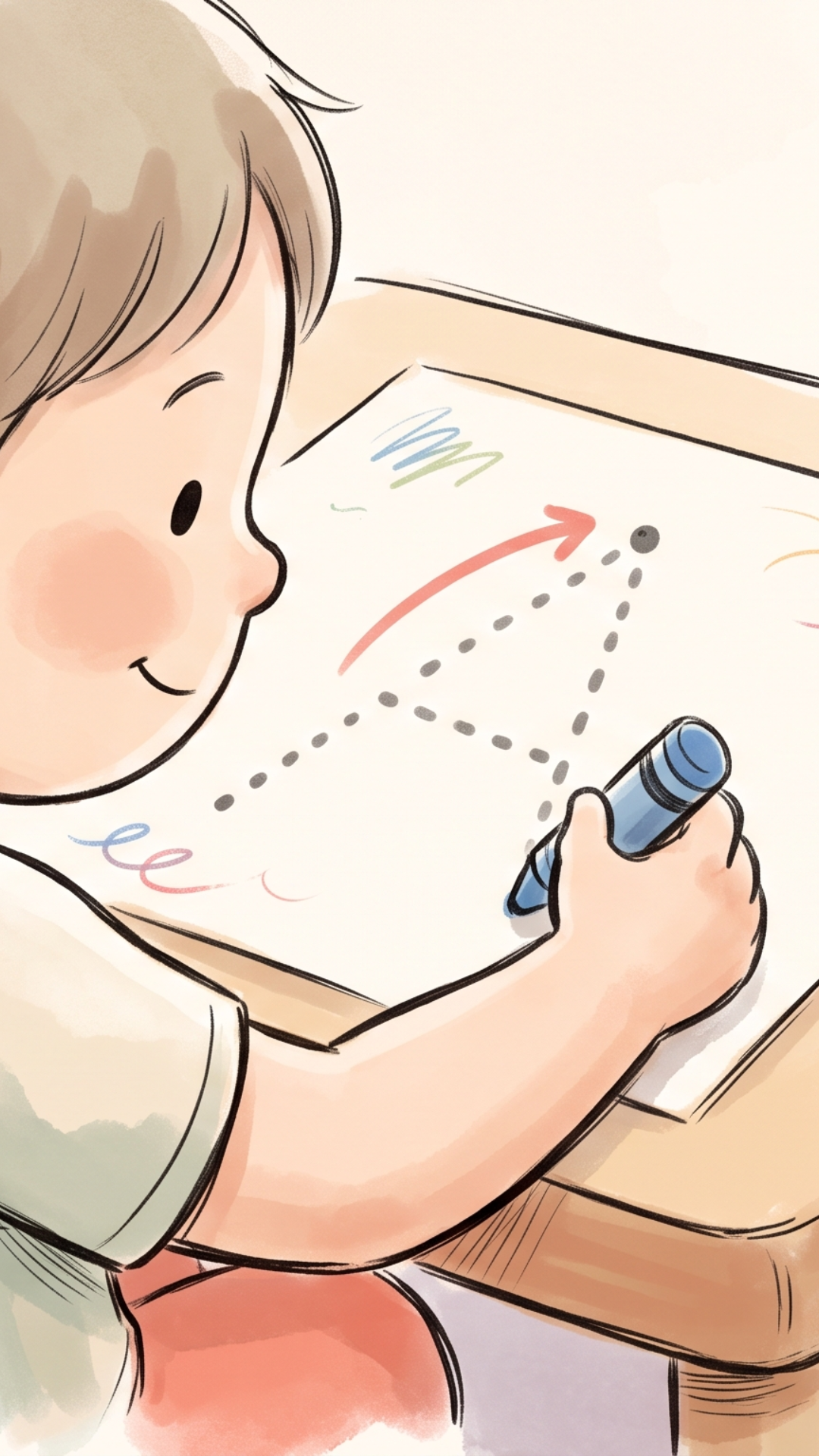
Zara could write her name before she could write it correctly, if that makes sense. The letters were recognisable, a stranger could read “Zara” on the page without much trouble, but she was starting almost every letter from the bottom and dragging the pencil upward, building each shape backwards from how it’s meant to be built. It looked fine sitting still on the page. It did not look fine once she tried to write faster, or in cursive years later, when that backwards habit turned into hesitation and shaky lines instead of a smooth motion.
Nobody had taught her the wrong way on purpose. She’d simply worked it out herself, the way kids do with most things, and by the time I noticed, the pattern was already comfortable for her hand. Undoing a habit a child has already practiced hundreds of times is a genuinely different task from teaching it correctly the first time, and that gap is really what this whole post is about.
Letter formation is not the same skill as letter recognition
It’s easy to assume that once a child can identify a letter, writing it correctly will follow naturally. It doesn’t, and this distinction matters more than most parenting content gives it credit for. Letter recognition, matching a shape to a name and a sound, tends to develop through everyday exposure, books, signs, the letters on a cereal box.[1] Letter formation, the physical sequence of strokes that builds that shape, does not develop on its own the same way. It requires explicit teaching, because a child left to invent their own method will invent one, and that invented method becomes just as automatic and just as hard to unlearn as the correct one would have been.
Researchers studying early handwriting development describe formation as a motor skill layered on top of a visual one, closer in nature to learning a specific sequence of movements than to recognising a picture.[2] That’s really the whole argument for teaching starting points early and deliberately, rather than trusting a child to land on the efficient version through trial and error.
The rules underneath all twenty-six letters
Once you know the underlying pattern, letter formation stops feeling like twenty-six separate things to memorise and starts feeling like a small handful of rules applied repeatedly. Almost every lowercase letter follows the same broad principles, start at the top, move downward, and move left to right, with straight lines generally coming before curves within a single letter.
- Start at the top of the letter, not the bottom, for nearly every lowercase letter
- Vertical and straight strokes generally come before curved ones within the same letter
- Letters with curves, a, c, d, g, o, q, and the top of s, are typically formed with a counterclockwise motion
- Movement generally flows left to right across a word, matching the direction of reading
- A continuous, single motion where possible helps prevent a letter splitting into two smaller shapes, which is part of how a becomes confused with o and i when children start writing faster
Many teachers also group letters into small families that share a starting stroke, so a child practices the movement once and it transfers across several letters at a time, rather than treating each one as a fresh, unrelated shape. The letters l, i, t, u, j, and y, sometimes called the “ladder letters,” all begin with the same downward stroke, for instance, so practicing that single motion quietly reinforces six letters instead of one.
Arrows, dots, or something in between
There’s a genuine disagreement among early years educators about how much visual guidance is actually helpful on a page. Some prefer a single dot marking the starting point and nothing more, arguing that a page covered in arrows and numbers can overwhelm a young child before they’ve even picked up the pencil.[3] Others lean fully into directional arrows on every stroke, on the basis that an explicit visual cue removes the guesswork that leads to a child inventing their own, often backwards, path.
In practice, I’ve landed somewhere in the middle, and it’s part of why our own tracing bundle uses a single clear directional arrow rather than a page cluttered with numbers and multiple markers. Enough guidance to remove genuine ambiguity about where to start and which way to move, without turning the page into something a three-year-old has to decode before they can begin. The story sentence on each page does the rest of the work that a page of bare instructions can’t, since a child engaged in “helping the little fox get home” is far more willing to repeat a stroke pattern than one being asked to trace a letter for its own sake.
See How We Teach Starting Points
Our story-based tracing bundle uses a single red directional arrow on every page, paired with a short story sentence, so correct formation habits build without feeling like a drill.
View the Tracing BundleWhat actually helped Zara unlearn a backwards habit
Undoing a pattern already in place took more repetition than I expected, and a fair bit of patience on both sides. A few things made a genuine difference.
Sky writing, tracing the letter shape in the air with a whole arm movement before ever touching pencil to paper, gave Zara a chance to feel the correct direction at a large, low-stakes scale before shrinking it down to the fine motor version. It felt a little silly standing in the kitchen air-writing letters together, but it worked faster than correcting her on paper alone.
Verbal cues mattered more than I expected too. A simple phrase repeated the same way every time, “start at the top, straight down,” or “big curve, all the way around,” gave her a script to say to herself, and hearing herself say it out loud seemed to interrupt the automatic backwards motion better than me just pointing at the page.
And slowing everything down helped more than any specific technique. Undoing an established habit needs more repetitions than building a new one from scratch does, so I stopped expecting quick progress and just kept the sessions short and frequent instead, a few letters at a time rather than a whole alphabet sheet in one sitting.
- Sky writing large letters in the air before attempting them on paper
- A single dot marking the starting point on early practice sheets, added by hand if a worksheet doesn’t already include one
- A consistent verbal cue repeated the same way every time, said by the child, not just the adult
- Tracing the letter shape in a tray of sand, salt, or shaving cream, which slows the motion down naturally and makes an incorrect start easier to notice and redo
- Grouping letters by shared starting strokes rather than working strictly in alphabetical order
Where reversals fit into this
Letters like b and d, or p and q, get confused constantly in early writing, and it’s worth saying clearly that this is developmentally ordinary rather than a warning sign on its own. Reversals are common in children under seven, and most resolve with continued practice and exposure rather than intervention.[4] Consistent, correct starting points seem to help this resolve a little faster, since a b that always starts with a downward line on the left and a d that always starts with a curve on the right gives a child’s hand a physical memory to lean on, separate from just visually distinguishing the two shapes.
Where I’d pay closer attention is a child well past seven still reversing letters frequently, or a child whose reversals are paired with broader reading difficulty, since that combination is worth mentioning to a teacher or paediatrician rather than assuming it will simply resolve on its own.
Where this fits with everything else in this series
Letter formation sits right at the end of the chain we’ve been building through this whole fine motor series, hand strength gives a child’s hand the muscle to hold a position, pencil grip gives them a stable, controlled hold, and letter formation is what that grip and strength are actually for once they’re in place. If you haven’t read the earlier pieces yet, our posts on scissor skills by age, how to hold a pencil correctly, and hand strength activities cover the layers underneath this one.
Ready to Try Story-Based Letter Practice?
A free sample of our tracing bundle, with the same directional arrows and story-driven pages described above, so you can see how it works before committing to the full set.
Download Free SampleReferences
- National Association for the Education of Young Children (NAEYC). Early Literacy Development and Alphabet Knowledge.
- Feder, K. P., & Majnemer, A. (2007). Handwriting development, competency, and intervention. Developmental Medicine & Child Neurology, 49(4), 312–317.
- Bara, F., & Gentaz, E. (2011). Haptics in teaching handwriting: The role of perceptual and visuo-motor skills. Human Movement Science, 30(4), 745–759.
- International Dyslexia Association. Understanding Letter Reversals in Early Writing.
Related topics for parents
- How to hold a pencil correctly
- Hand strength activities for kids
- Story-based tracing printable bundle
- Pincer grasp activities for preschoolers
- Pre-writing shapes before letters
Questions parents often ask
A letter can look fine sitting still on a page even if it’s built the wrong way. Feder and Majnemer’s research on handwriting development describes formation as a motor skill layered on top of visual recognition, closer to a learned sequence of movements than a shape you simply recognise. I saw exactly this with my daughter, her name looked fine until she tried writing it faster, and the backwards strokes suddenly became shaky, hesitant lines.
Formation is usually introduced once a child shows real interest in writing on their own, often around three and a half to four. Left to their own devices, children will invent their own stroke pattern, which is exactly what happened in our house, and that invented method becomes just as automatic and just as hard to change as the correct one would have been.
Sky writing the letter in the air before touching pencil to paper, a consistent verbal cue like “start at the top, straight down,” and tracing in a tray of sand to slow the motion down all helped in our house, and they line up with the haptic, multisensory approach Bara and Gentaz describe in their research on handwriting instruction. Undoing an established habit generally takes more repetition than building a new one, so I stopped expecting quick progress.
No, and NAEYC’s guidance on early literacy draws this same line, recognition tends to develop through everyday exposure to books and signs, while formation is a physical stroke sequence that needs to be explicitly taught rather than picked up incidentally. That distinction was the thing I wish someone had explained to me earlier.