
Assessment Strategies in Early Childhood Education: 4 Brilliant Steps
Working out assessment strategies in early childhood education came from an uncomfortable realisation during my early room placements: ticking off rigid skill checklists told me almost nothing about how children actually think, especially those with quiet neurodivergence. Real developmental insight comes from capturing natural play moments, watching how children regulate their bodies, and noticing how they solve problems when nobody has handed them a script.
Bringing responsive assessment strategies in early childhood education into daily practice helped me step away from cumbersome observation clipboards and focus on what matters: noticing the child who is overwhelmed, the child who needs extra time to start, and the learning that happens when adults listen rather than test.
In my first few months working as an educator across childcare centres in Melbourne’s east, fresh off a PhD and partway through a Diploma in Early Childhood Education, I was handed the same thing at every new centre: a checklist. Can identify primary colours, yes or no. Can count to ten, yes or no. Can hold scissors correctly, yes or no. Tidy boxes, one tick at a time.
I filled them in dutifully, the way you do when you are new and want to be seen doing the job properly. But I kept having the same nagging feeling. Ticking a box for a three year old who could count to ten on a good day but not on a tired one told me almost nothing useful about her as a learner. It captured a single moment, stripped of context, and called it an accurate picture of a whole child.
My academic instincts, if I am honest, initially pulled me toward trusting the checklist more than my own observation. A checklist looked rigorous. It produced something that resembled data. My own written impressions of a child felt, by comparison, soft and unscientific, the kind of thing a proper researcher would be embarrassed to submit as evidence of anything.
What troubled me even more was how this system treated children whose nervous systems did not fit the mould. In almost every room I worked in, there was at least one child with undiagnosed ADHD or sensory differences whose genuine capabilities were completely invisible on those forms. Many educators around me were genuinely caring people, but they had been trained in an approach that assumed all young nervous systems develop in a uniform, tidy line.
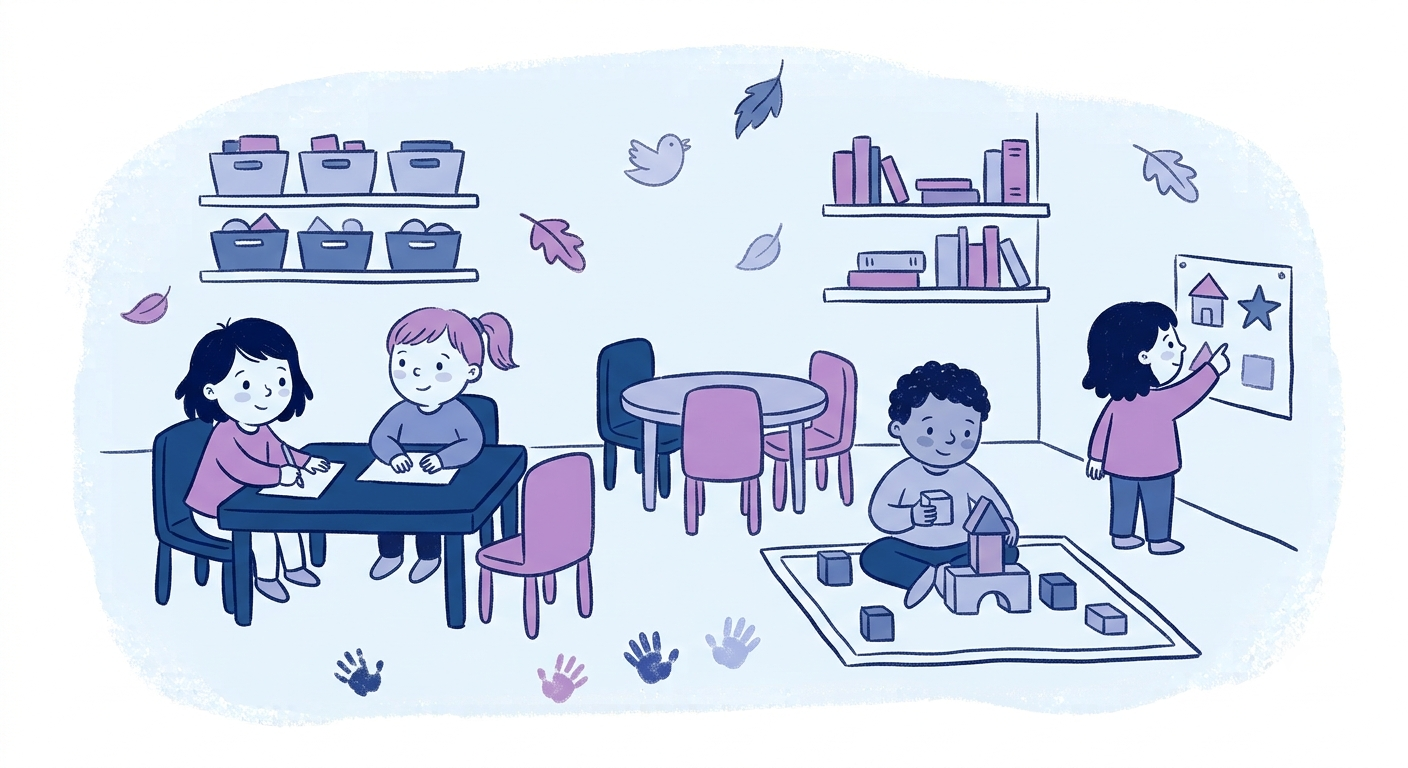
When an ADHD child ran laps around the perimeter of the room instead of sitting on the mat, it was logged as poor listening or behavioural defiance, not as a sensory regulation attempt or an executive function stall. That was the turning point for me. We did not need more complex documentation or longer progress files that took hours away from children. We needed assessment strategies in early childhood education that could see past surface behaviour and document how real, diverse minds actually learn.
In this practical educator guide:
Where the Actual Shift Came From: The Boss Block
The change happened at one particular centre, watching a more experienced educator document a child’s morning entirely differently to how I had been trained to. Rather than a checklist, she wrote a short, plain paragraph describing exactly what she had seen: a child building a tower, adjusting it twice after it fell, narrating his own thinking out loud as he worked out why the third attempt held and the first two had not. She had taken a photo alongside it. That was the whole assessment for that session.
The difference, side by side
Checklist version: Can build with blocks. Yes.
Narrative version: “He tried three times to balance the tower before it held, and figured out on his own that the wide blocks needed to go on the bottom. He said, ‘this one’s the boss block,’ and kept using the phrase for the rest of the session.”
Reading the second version, I understood immediately what the checklist had been missing. It was not just more detail for the sake of it. It captured problem solving, persistence, language development, and genuine delight, all in one small paragraph, none of which a tick box had any way of holding. The checklist told me what a child could do in isolation. The narrative told me who he actually was as a learner that morning.
There was a second thing I noticed that morning too, watching how that educator handled the handover to the child’s family at pickup. She did not recite a percentage or a list of ticked skills. She read the family the “boss block” line, and the parent’s face changed completely, from the polite, slightly glazed expression parents often wear at pickup, into genuine delight and connection with what their child had actually spent the morning doing.
A checklist has never once produced that reaction in a parent, in my experience. A specific, well observed sentence does it almost every time, a dynamic we explore in depth in our guide on how to connect with parents without endless meetings.
The ADHD Children Educators Were Not Aware Of
As I moved between toddler and preschool rooms, the limitation of the checklist became impossible to ignore when working alongside neurodivergent children.
During my second year, I spent several months in a room with a four year old boy named Marcus. On paper, Marcus was flagged for persistent disruptive behaviour. His portfolio was full of notes saying he refused group mat time, knocked over block towers, and could not finish a three step craft activity without walking away.
A couple of the experienced educators in the room viewed him as deliberately challenging. They were seasoned practitioners who ran their room with warmth, but they genuinely were not aware that Marcus was experiencing the world through a completely different nervous system. To them, compliance was developmental readiness; stepping away was defiance. They spent considerable energy trying to make him sit on his carpet spot, using reward stickers and verbal warnings that only raised his stress levels.
Because I was living with ADHD myself and raising neurodivergent daughters at home, what I saw on that carpet looked entirely different. Marcus was not refusing the lesson; his sensory cup was overflowing. The loud room, the fluorescent tube hum, and the abstract instructions were pushing his nervous system straight into fight or flight.
When Marcus circled the room during group story time, he was not ignoring the book. He was pacing to keep his dopamine levels steady so his brain could process what was being read. If you asked him a question while he was moving, he could repeat back the plot with surprising clarity.
When he knocked down block towers, it was often because another child had entered his physical space unexpectedly, triggering the sensory startle we examine in our guide to fight, flight, and freeze responses in ADHD children. Traditional milestone checklists recorded him as having poor social cooperation and weak attention span.
When we applied assessment strategies in early childhood education that looked at regulation and context first, the documentation flipped completely. We began recording what supported his focus: low lighting, a heavy cushion to hold, and starting tasks together rather than barking instructions across the room, exactly like the approach in our ADHD start together task trick. Seeing this pattern helped me realise that standard checklists do not just miss learning; they actively mischaracterise neurodivergent children.
Why It Took a While to Actually Trust This Shift
Knowing the narrative approach was better did not make it simple to adopt consistently, and the obstacles here were genuinely practical, not just a matter of changing my mind.
Time was the first and most persistent one. A checklist takes seconds to tick. A genuine, specific narrative observation takes real attention and several minutes to write well, and across a room of twenty or more children, that arithmetic does not easily work, particularly for a casual or relief educator moving between centres who did not have the luxury of building deep, ongoing familiarity with any one group of children over time.
There was resistance from some centre directors too, and it was not unreasonable resistance. Checklists produce something that looks tidy and comparable for compliance purposes, easy to file, easy to show a regulator or a parent expecting a clear yes or no answer. A folder of narrative observations, however richer, is a harder thing to standardise across a whole centre, and I understood why some directors were reluctant to move away from something that at least looked consistent on paper.
The most useful thing I found in navigating that resistance was framing narrative observation as a complement rather than a replacement, at least at first. Most centres already required some form of formal documentation for regulatory purposes, and I learned not to fight that requirement directly. Instead, I would do the required checklist quickly, then spend the time I would genuinely have spent agonising over its accuracy on a short narrative note instead, offered as an addition rather than a rebellion. Several directors who were initially sceptical came around once they saw the difference in how families actually responded to the narrative notes at pickup.
My own writing needed real practice too, more than I expected. My early attempts at narrative observation were embarrassingly close to just describing what happened without any actual insight, closer to a diary entry than a meaningful piece of assessment. It took watching several more experienced educators, and a fair amount of rewriting my own notes after the fact, before I could reliably notice and write down the moment that actually mattered inside an otherwise ordinary five minutes of play.
There was a subtler trap too, one I fell into more than once early on. A narrative observation can slide into projection if you are not careful, writing what you assume a child was thinking rather than what you actually observed them doing and saying. I had to learn to stick closely to what I could genuinely see and hear, and treat any interpretation beyond that as a guess clearly labelled as a guess, not a fact dressed up as one.
Moving between so many different centres and rooms added its own complication too. Just as I would start to build the specific, detailed knowledge of a child that makes a genuinely insightful narrative observation possible, a placement would end and I would move on to an entirely new room of children I knew almost nothing about yet. Educators who stay with the same group for a full year clearly have an advantage here that a moving, casual educator like I was during those two years simply did not have, and I had to be honest with myself about the limits of what I could observe meaningfully in a short placement.
Standard Skill Checklists Compared to Authentic Play Observations
Seeing the contrast clearly helps educators make peace with stepping away from the tick boxes:
| Assessment Dimension | Standard Skill Checklists (Compliance Focused) | Authentic Play Observations (Strengths Focused) |
|---|---|---|
| What Is Measured The focus of the record. |
Isolated milestones performed on demand under adult direction and timing. | How a child navigates real problems, collaborates with peers, and pursues curiosities during play. |
| View of Neurodivergence Interpreting spiky profiles. |
Differences in attention or regulation are marked as behavioural delays or non-compliance. | Recognises spiky profiles in neurodivergent learners, documenting environmental supports that help. |
| Educator Workload Time and energy spent. |
Heavy administrative load: chasing ticks across dozens of children creates educator exhaustion. | Manageable and integrated: capturing one vivid, meaningful micro story each day on a simple clipboard. |
| Family Partnership Sharing notes with parents. |
Parents receive clinical lists showing where their child falls behind peers, raising anxiety. | Parents receive rich stories showing their child was seen and appreciated, building mutual trust. |
4 Brilliant Steps: Assessment Strategies in Early Childhood Education
A short, simple structure ended up doing most of the work, once I stopped overcomplicating it. Describe specifically what the child did, in plain language, no jargon. Note anything they said, word for word where possible. Add one line connecting it to a broader area of development, without turning the whole thing into an essay. A photo, where appropriate, does a huge amount of the storytelling on its own.
These four practical steps show how assessment strategies in early childhood education work on the floor every day:
1. Write Three Plain Sentences, Not an Essay
Ditch long, formal learning portfolios that eat up your planning time and leave you exhausted.
- What to do: Keep a sticky notepad in your pocket. When you see something genuine happen, write three quick sentences: what the child set out to do, the obstacle they met, and how they adjusted their thinking.
- Why it works: Capturing the pivot moment records problem solving and executive function in real time. It is one of the most reliable assessment strategies in early childhood education because it fits into the natural rhythm of supervising play.
Another example, from a toddler room this time
Checklist version: Uses simple words to communicate. Yes.
Narrative version: “She pointed at the empty fruit bowl and said ‘apple gone’ with real frustration in her voice, then went and checked the fridge herself when nobody answered fast enough. First time we’ve seen her problem-solve like that rather than just repeating a word until someone responded.”
The second version, again, is not just longer for the sake of it. It captures cause and effect reasoning, independent problem solving, and persistence, alongside the language milestone the checklist was technically checking for. One paragraph doing the work of what would otherwise need several separate boxes to even attempt.
2. Assess the Room Setup Before You Assess the Child
When a child struggles to engage with an activity, evaluate the sensory environment first before writing down a developmental concern.
- What to do: Note down room factors: is the table directly under a humming fluorescent tube? Is there acoustic reverberation from the hard floorboards, as we explore in our piece on classroom noise sensory overload? Is the chair allowing their feet to rest flat?
- Why it works: Shifting the assessment focus to the environment prevents unfair deficit labelling of ADHD and autistic children, helping educators make low cost tweaks that unlock focus, matching our principles for a low cost sensory classroom setup.
3. Take a Photo and Ask the Child One Question
Educators often spend hours guessing what a child was thinking while building a structure.
- What to do: Snap a quick photo of a half-finished construction or craft piece. Kneel down and ask: “What were you working on here?” Record their exact words verbatim beneath the picture.
- Why it works: The child’s own voice provides immediate insight into their working theories, expressive language, and metacognition without requiring testing sheets.
4. Use Pickup Moments as Two Way Observation Checks
Assessment should not live in a closed filing cabinet that parents only see at end of term conferences.
- What to do: Share one specific 30 second observation with a parent at the door, exactly as we detail in our guide on how to connect with parents without endless meetings. Ask: “Does she do something similar when playing with her cousins at home?”
- Why it works: Parents provide cultural and home context that completes the developmental picture, turning assessment into a collaborative partnership that prevents parent-teacher burnout in early care.
How to Tell Whether an Observation Is Actually Useful
A few things I learned to check my own notes against, before deciding whether an observation was worth keeping in a child’s file:
- Could a parent picture the moment? Could a family member who was not there see the actual morning from what I had written, or would it read as generic enough to describe almost any child on almost any day?
- Did it capture specific thinking? Did it record something unique to that child’s own curiosity or persistence, rather than simply confirming a milestone the curriculum expected them to reach eventually anyway?
- Did it avoid quiet deficit judgements? Did it describe what the child was actually doing and exploring, rather than framing them through what they could not yet manage?
Observations that failed those checks usually needed a rewrite, not because they were dishonest, but because they had not actually captured anything a checklist could not have recorded just as well in a fraction of the time. When you use assessment strategies in early childhood education that focus on real actions, your notes serve the child rather than satisfying paperwork.
Where This Idea Comes From: Learning Stories and the EYLF
What that more experienced educator was doing, without necessarily naming it that way, sits inside a well established approach called Learning Stories, developed by Margaret Carr in New Zealand to support that country’s Te Whāriki early childhood curriculum.[1] Learning Stories are structured narrative observations built specifically to highlight a child’s strengths, interests, and dispositions, rather than measuring them against a fixed checklist of deficits waiting to be filled in.
Guidance on Te Whāriki and Margaret Carr’s Learning Stories explains the underlying philosophy well, including why Carr specifically moved away from pre-set milestone checklists toward placing the learner, and their emerging identity as a learner, at the centre of the process.
Carr’s own framing of this is worth sitting with directly. Prior to Learning Stories becoming standard practice, much of early childhood assessment relied on exactly the kind of deficit focused checklist I had been handed on day one, identifying gaps in a child’s knowledge so that teaching could target those gaps. Carr and her collaborators argued this framing quietly shaped how educators saw children overall: as a collection of missing skills waiting to be filled in, rather than as capable people already doing genuine cognitive work that simply looked different from a checklist’s narrow expectations.
This is not a foreign idea sitting outside Australian practice either. Australia’s own national Early Years Learning Framework, Belonging, Being and Becoming, explicitly encourages educators to collect what it calls rich and meaningful information that depicts children’s learning in context, rather than isolated measurements.[2] It is the actual regulatory framework most Australian early childhood settings, including every centre I worked at, operate under.
The national framework administered by ACECQA on the Early Years Learning Framework V2.0 shows that the shift I stumbled onto in one centre is not a personal preference sitting outside official practice. It is actually closer to what the framework itself asks for than the checklist habit I was handed on my first day.
Ethical practice insights from Early Childhood Australia (ECA) reaffirm that assessment must respect children’s dignity and celebrate holistic progress. It is genuinely striking that a framework and an assessment methodology developed independently in two neighbouring countries converged on the same conclusion: assessment strategies in early childhood education need to describe a whole, capable child in context, not measure isolated skills against a fixed external standard.
Free Printable: The 3-Sentence Observation Template
A simple, pocket sized narrative recording sheet designed to help educators capture meaningful play moments, sensory context, and child voice without extra paperwork.
Download the Free 3-Page SamplerWhat I Would Tell Myself with That First Stack of Checklists
I do not fill in centre checklists any more, but I still catch myself, even now, reaching for the tidier, more measurable version of things before trusting a plainer, more honest observation. Old academic habits do not fully disappear just because you have seen good evidence against them; they just get quieter and easier to notice when they show up.
Looking back across those two years, the shift from checklist to narrative was not really about assessment methodology at all, in the end. It was about what I actually believed a young child was: a bundle of measurable, isolated skills waiting to be ticked off, or a whole, thinking, capable person whose learning only makes sense in the context of what they were actually doing and saying at the time.
Once I had genuinely seen the difference those two beliefs produced, in a parent’s face at pickup, in what I actually remembered about a child months later, going back to the tidier, emptier version was never an option again. Practising grounded assessment strategies in early childhood education means backing the child in front of you.
If I could go back to that first centre with my clipboard full of tick boxes, I would tell myself this: the box was never going to tell you who that child actually was. Write down what you actually saw instead. It will take longer, and it will be worth every extra minute.
- Protect educator capacity in Parent-Teacher Burnout in Neurodivergent Care: Protecting Relational Energy →
- Understand uneven skills in Spiky Profiles in Neurodivergent Learners: Why Skills Fluctuate →
- Reduce room stress using Low-Cost Sensory Classroom Setup: Practical Strategies for Educators →
- Address sensory fatigue in Classroom Noise Sensory Overload: 4 Powerful Ways Sound Triggers Meltdowns →
- Connect with families smoothly in How to Connect With Parents Without Endless Meetings: 4 Powerful Handover Shifts →
- Streamline planning routines with How to Plan Engaging Lessons Without the Stress →
Readings and References That Guided Me
- Carr, M. (2001). Assessment in Early Childhood Settings: Learning Stories. Paul Chapman Publishing. [Foundational framework for narrative assessment and tracking learning dispositions in early years settings].
- Australian Government Department of Education. (2022). Belonging, Being and Becoming: The Early Years Learning Framework for Australia (V2.0). [National benchmarks mandating holistic, play based formative assessment and responsive curriculum planning].
- Early Childhood Australia (ECA). (2016). Code of Ethics. Early Childhood Australia Inc. [Ethical guidelines outlining child dignity, strengths based documentation, and family partnership].
- Barkley, R. A. (2015). Attention-Deficit Hyperactivity Disorder: A Handbook for Diagnosis and Treatment (4th ed.). Guilford Press. [Clinical evidence on executive function differences, sensory modulation, and situational variability in ADHD].