
Fluorescent Lighting and ADHD: 4 Easy Ways to Soften a Harsh Room
Some older fluorescent fittings vary in brightness about 100 times a second, too fast for most people to see. In one study of office workers, headaches and eyestrain were more than halved when that flicker was removed.
A survey of UK secondary classrooms found about 80 percent were lit this way. I haven’t found studies testing flicker in children with ADHD or autism, so what follows about fluorescent lighting and ADHD is my experience plus cautious reading, not an established link.
Thinking about lighting starts when we stop treating afternoon meltdowns as attitude problems and ask what the room is asking of the child.
Soon after our family moved to Melbourne, when my eldest daughter was seven and new to primary school here, and her little sister, nearly five, was waiting to start Prep, we hit an exhausting wall every weekday around four in the afternoon.
As she moved through those early primary years in Victoria, my eldest would walk through our front door with dark shadows beneath her eyes.
Her forehead felt warm to the touch, and she would press the heels of her palms hard into her temples before collapsing across the living room rug in tears over something as small as the wrong snack bowl.
Her classroom educators described her as cheerful, polite, and cooperative all morning. Yet by two o’clock every afternoon, she was squinting at the whiteboard, resting her chin heavily on her desk, and pulling away from reading tasks.
At the time, I didn’t have the neurodivergent awareness, the words, or the community around me to understand what was happening. Everyday parenting felt like wading through deep water.
I did not realise then that my daughter and I shared similar struggles, or that what felt like daily domestic chaos was two people with undiagnosed ADHD running out of steam at the same time of day. Those after school crashes are so common, and child meltdown co-regulation is what I wish I’d known then.
The dots only connected years later. After years of silently masking, my eldest daughter was finally diagnosed with ADHD in her twenties, and I received my own late diagnosis too. I write more about how ADHD so often hides in girls in signs of ADHD in girls, and about my own story in being a parent with ADHD. Later, my work as an educator and my professional training in autism support gave me new ways to look back at those afternoon headaches.
Throughout her early primary schooling, she sat beneath banks of overhead fluorescent tubes for most of the school day. I don’t know what type of fittings her school used or whether they flickered, so I can’t say that light was the cause.
Afternoon tiredness has many possible causes, including hunger, noise, a long day, and vision problems. If a child squints, rubs their eyes, or complains of headaches, an eye check with an optometrist is a sensible first step.
Looking back, the idea that her room might have been working against her fits what I saw: a bright morning and a flat afternoon. I hold it loosely.
In this practical lighting guide:
Fluorescent Light Flicker: How Sub Visible Light Pulses Might Affect Eyes
When most adults look up at a classroom ceiling, they see steady white light. Unless a tube is old and visibly buzzing, we assume the light is continuous.
The physics is simple. Mains electricity in Australia alternates at 50 Hertz. A fluorescent tube on an older magnetic ballast brightens and dims twice every cycle, so the light varies about 100 times per second.
Newer fittings with high frequency electronic ballasts flicker far less, and many schools now use LED. So this is mainly a question for older buildings. It’s worth knowing, though, that some cheaper LED globes, and some LEDs on dimmers, can flicker too. Pointing your phone camera at a light, especially in slow motion mode, can sometimes show dark bands rolling across the screen. It isn’t a precise test, and I can’t tell you which fittings your room has; your facilities team or an electrician can.
At 100 Hertz, most people can’t consciously see the flicker. That doesn’t mean it has no effect. In a double-blind crossover study of office workers, headaches and eyestrain were more than halved under high frequency lighting compared with conventional fittings. That study involved adults, not children.
A survey of 90 classrooms in eleven UK secondary schools found about 80 percent were lit with 100 Hertz fluorescent lighting. It also found a lot of glare, including from whiteboards, and desks brighter than recommended levels. It measured the rooms, not pupils’ learning or behaviour, and I don’t know the Australian picture.
For me, a flickering light overhead competes with the person who is talking to me. That is my experience, and not everyone feels it.
For some neurodivergent children, a busy visual environment may be more tiring. I haven’t found research that tests this for flicker, so I treat it as something worth watching for, not as a fact. If your child is a sensory seeker in some ways and sensitive in others, spiky profiles in neurodivergent children explains why that mix is so common.
What Eye Strain Can Look Like in a Child
Looking back, reading about how eyes focus helped me make sense of my daughter’s afternoon headaches, and of why my own ADHD brain always felt flat in brightly lit offices. These are reflections, not findings.
To focus on a picture book or a worksheet, the eyes’ focusing muscles work to keep close objects sharp. Eye strain, which doctors call asthenopia, can bring an ache around the eyes or brow, dry or stinging eyes, headaches, and print that seems to blur or swim.
Flicker and glare are only two possible causes. Uncorrected vision, reading difficulty, a bright desk, or a glaring whiteboard can look the same. The UK classroom survey found glare from projectors on whiteboards and desks that were very bright.
Fluorescent Lighting and ADHD: Why a Harsh Room May Cost an ADHD Child More
In our overarching work on the sensory environment in early childhood, I explore how physical spaces can use up a child’s attention.
Many children with ADHD find working memory and sustained focus effortful. If part of that effort goes on coping with a bright, flickering, or glaring room, there may be less left for the task. That is my reasoning from experience, not something this research tests.
It is one reason skills can look unpredictable across a week, a pattern we unpack in our guide on why a child can perform on some days but not others.
On a sunny morning when the educator turns off the ceiling tubes and opens the timber blinds, a child may stay focused and engaged. On an overcast Friday under full lighting, the same child may struggle to write their own name.
Many things change between days, so I can’t pin a day like that on the light. The issue is rarely fluctuating intelligence. It can be fluctuating load, and an afternoon of overwhelm often looks like the ADHD child who won’t start tasks.
4 Practical Ways to Soften Fluorescent Lighting
As a parent and an educator, I know that schools and centres run on tight budgets. If you suspect flicker, the most direct fix is new fittings, and that is a job for your facilities manager or an electrician. Ask whether your fittings use electronic ballasts or LED.
Short of that, small changes can reduce glare and brightness. Please check each one against your service’s safety rules first, because fire safety, electrical safety, loose cords, and supervision sightlines all apply. If money is tight, my low cost sensory classroom setup has more budget friendly ideas.
1. Reduce Harsh Overhead Light Safely
Direct glare can make a bright room more tiring. Lowering the overhead light can reduce it.
- What to Do: Ask your facilities team whether some ceiling tubes can be switched off, or fitted with approved diffusers or louvres. On bright days, lean more on daylight and lamps.
- What to Avoid: Do not hang cloth, sheets, or other fabric from or under light fittings. Fittings get warm, and fabric near them can be a fire risk. Also avoid very dark covers that turn the room into a cave. The aim is softer light, not darkness.
- Why It May Help: Less direct overhead glare can mean less squinting. The evidence for classrooms is limited, but the UK survey found desks often brighter than recommended levels.
If you are also working on sound, see classroom noise and sensory overload.
2. Add Warm Lamps at the Edges of the Room
Many people find warm, lower light softer than a bright overhead wash. This is a comfort idea rather than a treatment.
- What to Do: If your service allows it, place stable lamps around the edges of the room, fitted with warm white LED globes (around 2700 Kelvin). Keep cords out of reach and away from walkways, and check your service’s electrical safety rules.
- What to Avoid: Very bright, cool white globes (5000 Kelvin or higher) can feel harsh to some people.
- Why It May Help: Warm light has less blue in it, and many people find it gentler. I haven’t found classroom trials showing that it improves attention or calm.
At home, lamps fit easily into evening routines, as in our walkthrough of a daily routine for neurodivergent children. Softer light in the evening can also be part of a gentler wind down, which I talk about in toddler sleep resistance and ADHD.
3. Make the Most of Indirect Daylight
Natural daylight has no electrical flicker. But raw sun through unshaded glass creates glare that can be tiring.
- What to Do: Where you can, position drawing, reading, and writing tables side-on to windows rather than facing them. Use sheer curtains or blinds that meet your service’s fire safety rules to soften midday sun.
- What to Avoid: Avoid glossy white tables directly in front of unshaded north or west facing windows in the afternoon.
- Why It May Help: Filtered daylight avoids electrical flicker and cuts glare.
Light is one of several features of a classroom that research has linked to learning. Peter Barrett and colleagues studied 153 school classrooms (27 schools, 3,766 pupils) and found that seven design features, including light, together accounted for 16 percent of the variation in pupils’ progress.
That is an association, and the study was in UK primary schools, so it doesn’t tell us about early childhood rooms or about glare in particular.
For requirements that apply to your service, check the National Quality Standard (Quality Area 3 covers the physical environment) and your building’s safety rules.
4. Create a Calm, Dim Reset Nook
When a child seems overwhelmed, a quiet, softly lit retreat can help them recover. I have seen this work, though I haven’t found research on it.
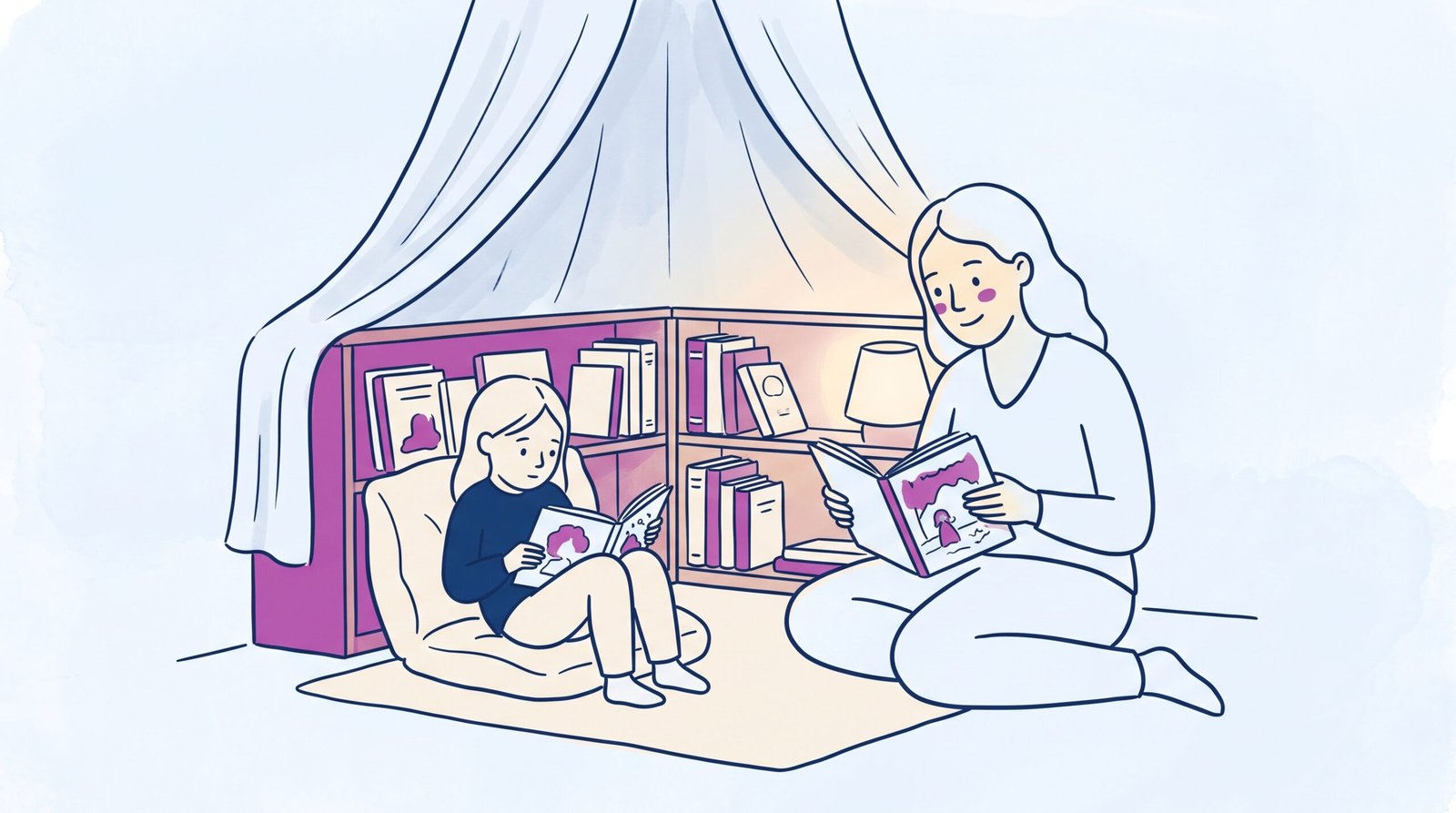
- What to Do: Make a corner with a rug, cushions, and a low, soft light source. If you add fabric or a canopy, check that it meets fire safety rules, keep it away from lamps and fittings, and place the nook where an educator can always see the child.
- What to Avoid: Never place digital screens, tablets, or battery operated flashing toys inside this nook.
- Why It May Help: A quieter, dimmer space gives a child a break from busy visuals.
Constructing this space follows the layout ideas in our companion guide on calm corner design in early childhood. What happens inside the nook matters as much as the light, and coregulation strategies in early childhood covers how to sit with a child there.
Older Fluorescent Tubes Versus Softer Light at a Glance
The table sets out my own reading and experience, plus the studies cited above.
| Lighting Parameter | Older Overhead Fluorescent Tubes | Softer Room Light | Why It May Help |
|---|---|---|---|
| Modulation Frequency | On older magnetic ballasts, the light varies about 100 times per second. | Electronic ballasts, good quality LED fittings, or natural daylight. | Removes the flicker. In an adult study, headaches and eyestrain were more than halved. |
| Colour Temperature | Cool blue white, often around 4500 to 6500 Kelvin. | Warm white, around 2400 to 2700 Kelvin. | Many people find warm light gentler. I haven’t found classroom trials. |
| Direction of Origin | Shining straight down from high ceiling fixtures. | Arriving from lamps at the edges of the room and softened windows. | May reduce glare and harsh shadows around the eyes. |
| Surface Reflection | Bounces off laminated desks, plastic trays, and shiny vinyl floors. | Absorbed by matt paper, timber surfaces, and cotton rugs. | Less reflected glare. The UK survey found desks often brighter than recommended. |
An Illustration: The 2 PM Slump in a Primary Room
To show how lighting could change a child’s afternoon, here is an illustrative scenario. It is a composite, not a case study, and a real day has many moving parts.
Under Full Fluorescent Lighting:
It is quarter to two on a cloudy Friday afternoon. Outside, the sky is grey. Inside, four double banks of fluorescent tubes flood the room with cool white light.
Seven year old Maya sits at a table writing spelling words into a workbook. Her pencil stops moving. She rests her cheek against the cool laminate desk surface, her left hand shading her eyes.
The educator walks over and says: “Maya, sit up straight please and finish your three sentences.” Maya closes her workbook with a bang and hides her face inside her woollen school jumper.
When prompted again, she kicks her desk leg and bursts into tears. The educator notes down task refusal and low resilience on her progress record.
Under Softer, Diffuse Light:
Same classroom the following Friday. The educator has switched off some of the overhead tubes. Natural afternoon light filters through sheer window blinds, and two warm lamps stand safely in the reading corners.
Maya sits at the same table. She isn’t squinting. Her chin is up, her shoulders are soft, and she writes her sentences with steady strokes. At two o’clock, she finishes her spelling, shows her partner with a smile, and walks quietly to the bookshelf. She has more left for the task.
In real life, other things would differ between the two Fridays, which is why I treat this as an idea to try, not proof. It does fit the thinking behind regulation before learning. When a child’s senses are under strain, persistence is hard to ask for. It’s also a reminder that a note like “task refusal” can hide a body that’s simply had enough, which I talk about in ADHD behaviour strategies and fight, flight and freeze in children.
Subtle Signs a Child May Be Visually Tired by Harsh Light
A young child rarely has the words to say, “The light hurts my eyes.”
Instead, their bodies may show quiet signals that adults often misread. These can have many causes, including vision problems, so if you see them often, suggest an eye check as well as looking at the room:
- The Brow Bone Rub: Pressing knuckles or palms firmly against the eyebrow ridge, temples, or bridge of the nose during table tasks.
- Visual Shielding Postures: Shading eyes with a hand while writing, pulling a bucket hat low over the face indoors, or sitting with a jumper pulled up over the nose.
- The Tabletop Slump: Laying the head flat on the desk, or tilting the head sideways to read with one eye closed.
- Excessive Rapid Blinking: Fluttering eyelashes or squeezing eyes shut tightly between sentences.
- Perimeter Seeking at Transition Times: Drifting away from central, brightly lit group mats toward shadowy corners beneath timber shelving, which may be a way of finding a quieter visual spot.
When you notice these cues, a movement break, such as the animal crawls in sensory micro transitions for preschool rooms or the moves in animal walks for gross motor play, can give restless energy somewhere to go. For reading time in particular, sensory friendly literacy has ideas for gentler book corners.
Fluorescent Lighting and ADHD at Home: A Room by Room Look
Most of the research on flicker and glare comes from offices and classrooms, but children spend a lot of their waking hours at home too. The good news is that home is where you have the most say. You don’t need a facilities team or a budget meeting. You need a slow walk around the house at your child’s height, and a bit of curiosity.
Kneel down in each room and look up. You might be surprised. A downlight that seems fine from adult height can shine straight into a small child’s eyes from the couch, and a glossy benchtop can bounce light right at the level where your child does their drawing.
The Drawing and Homework Spot
If your child does drawing, puzzles or homework at the kitchen table, look at where the light falls. Ideally, light comes from the side or slightly behind, not straight into their eyes and not bouncing off a shiny surface. A plain cotton tablecloth or a large sheet of matt card under their work can cut table glare for almost nothing.
A desk lamp with a warm white globe, angled away from their eyes and onto the page, is often gentler than a bright overhead light. If your child writes with their right hand, place the lamp on their left so their hand doesn’t cast a shadow over the page, and the other way round for a left handed child.
Bedrooms and the Evening Wind Down
Evenings are where lighting and ADHD often meet in family life, because so many children with ADHD find it hard to settle at night. Bright light in the evening, including light from screens, can push back the body’s natural sleep signals. One small study found that children’s melatonin was suppressed more by evening light than adults’ was. It was a lab study with a small group, so I hold it lightly, but it fits what many families notice.
Simple changes help here. Switch from ceiling lights to a lamp after dinner. Use warm white globes in bedrooms. Keep screens out of the last part of the evening if you can, or at least turn the brightness down. Our walkthrough on toddler sleep resistance and ADHD has more on gentle bedtime routines.
Kitchens, Living Rooms and Downlights
Many Australian homes now have rows of LED downlights. Good quality ones are usually fine, but cheaper globes and some dimmer setups can flicker. If you notice your child squinting or avoiding one room, try the phone camera check, swap one globe for a different brand, or turn off every second downlight and see if anything changes.
If a fluorescent tube in the laundry or garage is old, buzzing or visibly flickering, it’s worth asking an electrician about replacing it. That’s a job for a licensed professional, not a weekend fix.
Out and About: Shops, Clinics and Big Bright Spaces
Supermarkets, shopping centres and waiting rooms are often among the brightest places a child goes. If your child tends to fall apart at the shops, light may be one part of a big sensory load, along with noise, crowds and waiting.
- Let your child wear a cap or sunhat indoors if it helps them shade their eyes. It’s a simple, private kind of support.
- Try shorter trips, or shop at quieter times when you can.
- Offer a job, like holding the list or finding the bananas, so their attention has somewhere to go.
- Plan a quiet, dim break afterwards, such as a few minutes in the car before driving home.
Fluorescent Lighting and ADHD in Early Learning Rooms: An Educator’s Walkthrough
If you work in a long day care room, a kinder or a junior primary class, you can’t rewire the building. But you can notice, adjust what’s in your control, and raise what isn’t. This walkthrough takes about twenty minutes and works best on an ordinary day.
1. Walk the Room at Child Height
Sit on the floor at group time, then at a table, then in the book corner. Look up and around. Where does light hit your eyes? Which surfaces shine? Is there a spot where the whiteboard or a window glares? Children experience the room from about a metre off the ground, and the view is very different from there.
2. Check the Same Spots Across the Day
Light changes a lot between nine in the morning and three in the afternoon. A table that’s lovely at morning tea may sit in harsh western sun after lunch. Jot down what you notice at three times of day. Patterns often jump out within a week, especially if you also note when particular children seem tired or unsettled.
3. Think About Rest Time
Rest and sleep times are an easy place to soften light. Many services already dim the room, but check that the light left on is warm and indirect, and that you can still see every child clearly for safe supervision. Sleep and rest practices must follow your service’s policies and the guidance from ACECQA.
4. Notice Screens, Projectors and Light Tables
Interactive whiteboards, projectors and tablets add their own brightness and glare. Children sitting closest to a projected screen get the most of it. Light tables are a lovely learning tool, but some children find them intense up close. Offering a choice of where to sit, rather than a set spot, lets children move away from light that bothers them without having to explain.
5. Raise What You Can’t Change
If you suspect old fittings, talk to your director or facilities manager. It helps to bring notes rather than a general worry. You might ask whether your fittings use electronic ballasts or LED, whether any tubes are flickering or buzzing, and whether lighting has been checked against the Australian standard for interior lighting in education spaces (AS/NZS 1680). For LED lighting, there is also an engineering guide on flicker, IEEE 1789, that an electrician or lighting supplier will know.
You don’t need to be an expert to ask good questions. You just need to describe what you see. Quality Area 3 of the National Quality Standard covers the physical environment, which gives you a natural place to raise it in your quality improvement plan.
Light and Shadow Play: Turning Light Into Learning
Talking about lighting can make light sound like a problem. It isn’t. Light is one of the most wonderful things children can play with, and play is where so much of their learning happens. When children explore light on their own terms, choosing how close to get and when to stop, it can become something they understand and enjoy rather than something done to them.
- Shadow puppets: A torch, a bare wall and two hands. Children love making animals and telling stories with them, and it’s lovely language practice.
- Shadow tracing outdoors: On a sunny day, trace around a toy’s shadow with chalk in the morning, then come back after lunch. Where did the shadow go? It’s early science with no worksheet in sight.
- A cubby with a torch: A blanket over two chairs and a small torch turns into a reading den. Children control the light, which many sensitive children find calming.
- Sun catchers: Coloured cellophane on a window throws soft colour across the floor. Watch how the patterns move through the day.
- A shape and shadow hunt: Use our Shape Hunt printable and look for circles, squares and triangles in shadows as well as objects. For more outdoor ideas, try our nature scavenger hunt for kids.
Always supervise torch and light play, keep torches away from eyes, and never use laser pointers with children.
Keep a One Week Light Diary
If you’re wondering whether lighting is part of the picture for your child, a simple diary is more useful than a guess. Note the time, the place, what the light was like, and what you noticed. After a week, look for patterns. If the tough moments cluster in one room or one time of day, that’s worth exploring. If they don’t, light may not be the main thing, and that’s useful to know too.
| Day and Time | Where | What Was the Light Like? | What Did You Notice? |
|---|---|---|---|
| Monday, 3.30 pm | Kitchen table | Overhead downlights on, afternoon sun on the table | Rubbing eyes, pushed drawing away |
| Tuesday, 3.30 pm | Kitchen table | Downlights off, blind half down, lamp on | Drew for ten minutes, chatted |
| Wednesday, 10 am | Supermarket | Very bright, long aisles | Wanted to be carried, covered eyes |
These rows are only examples to show the idea. Our free What I’m Noticing Diary gives you a printable page to fill in, and it works for noise, transitions and food as well as light.
How to Talk to Your Child’s School or Centre About Lighting
Many parents worry about sounding fussy. Having sat on both sides of that conversation, I think most educators welcome specific, friendly information, because it helps them understand a child. The trick is to describe what you’ve seen rather than what you think it means, and to ask rather than tell.
A sample note you can adapt:
“Hi, I’ve noticed that Sam often comes home with sore eyes and seems very tired by the afternoon. At home, he seems more settled when we use lamps instead of the bright overhead lights. I wondered whether you’ve noticed anything similar, and whether it would be possible to try him at a table away from the window or the whiteboard for a week or two? We’re also booking an eye check. Thank you for everything you do.”
That note shares an observation, mentions what helps, suggests one small trial and shows you’re checking other causes. It invites a conversation rather than a complaint. The Home and Kinder Snapshot is a simple way to share what you see at home with your child’s educators, and the GP Appointment Planner helps you get your notes in order before an optometrist or GP visit.
Educators, if a family raises lighting, it helps enormously to take it seriously even if you haven’t seen the same thing. A child may hold it together in the room and fall apart at home. Our guide to connecting with parents without endless meetings has more ideas for keeping that conversation easy.
Free Printables for Calmer Light and Calmer Rooms
Lighting is only one part of how a room feels, so these free PDFs from this site cover the wider picture: noticing patterns, talking with educators, resetting in a dim nook, and planning a gentler day. Pick one or two that fit your child or your room rather than printing them all at once.
Sensory Space Audit Checklist
Walk the whole room for light, noise and clutter, not just the ceiling.
Download PDF Best for educatorsWhat I’m Noticing Diary
Track when and where the hard moments happen, so you can spot patterns.
Download PDF For home and roomsHome and Kinder Snapshot
Share what you see at home with educators, and what they see with families.
Download PDF For families and educatorsGP Appointment Planner
Get your notes ready before an eye check or GP visit about headaches or squinting.
Download PDF Best for familiesCalm Shapes Breathing Cards
Trace a shape and breathe slowly. A good fit for a dim reset nook.
Download A4 PDF For home and roomsCalm Counting 1 to 10
Quiet, low demand counting pages for a slow moment away from bright spaces.
Download A4 PDF For home and roomsPocket Heavy Work Cards
Movement breaks for the afternoon slump, when a body needs to move first.
Download PDF For home and roomsFirst Then Reset Mats
“First rest in the quiet nook, then back to the table.” Clear and gentle.
Download PDF For home and roomsVisual Routine Cards
Show quiet time and breaks as a normal part of the day.
Download PDF For home and roomsDaily Routine Chart
Add a “lamps on” wind down picture to your family’s evening.
Download A4 PDF Best for familiesShape Hunt
Hunt for shapes in objects and shadows. Light play with a little maths.
Download A4 PDF For home and roomsWeekly Lesson Plan Template Pack
Plan light and shadow play, and note what you observe at different times of day.
Download A4 PDF Best for educatorsOur own one page Lighting and Glare Audit is just below, ready to print. You’ll find more free tools on our printables page.
Free Printable Lighting and Glare Audit
A simple landscape A4 checklist for teachers and families. Look at ceiling light, window glare, desk reflections, and a calm dim nook from a child’s eye level. It is a reflection tool I wrote from practice, not a validated assessment.
Visual Lighting and Glare Space Audit
Look at your room from a child’s height. Small, safe adjustments.
Overhead Fixtures
Have you asked about flicker-free fittings, or safely reduced harsh overhead light?
Horizon Lamps
Are warm lamps (around 2700K) placed safely, with cords out of reach?
Window Glare
Are sheer curtains or blinds softening direct sunbeams?
Shadow Sanctuary
Is there a calm, dim nook where an educator can always see the child?
If you’re a parent, the audit can be a gentle way to start a conversation with your child’s educators rather than a complaint. Connecting with parents without endless meetings has ideas for both sides of that chat.
When we start looking at light as something that touches our children all day long, our perspective can change.
A child resting their forehead on the desk may not be unmotivated. They may be tired for many reasons, and the light could be one of them.
By softening overhead light safely, adding warm lamps where your service allows, and welcoming daylight, we may lift one load off our children’s shoulders. I find that worth trying, alongside an eye check if you are worried.
Harsh lighting affected me as an adult too. During my study years I did most of my writing at home, and I wrote about why in studying in bed and what I understand differently now.
Fluorescent Lighting and ADHD FAQs
Can fluorescent lights affect children with ADHD?
We don’t know for sure. Older fluorescent fittings can flicker about 100 times a second, too fast for most people to see, and in a study of adult office workers removing that flicker more than halved headaches and eyestrain. I haven’t found studies testing flicker in children with ADHD, so it’s worth watching for rather than assuming.
Do LED lights flicker too?
Good quality LED fittings usually flicker very little, but some cheaper LED globes, and some LEDs on dimmers, can flicker. Pointing a phone camera at the light, especially in slow motion mode, can sometimes show dark bands rolling across the screen, though it isn’t a precise test. An electrician can check properly.
What kind of lighting is best for a calm room?
Many people find a mix of filtered daylight and warm white lamps (around 2700 Kelvin) at the edges of the room gentler than bright overhead light. Cut glare by angling tables side on to windows and using matt surfaces. Always check changes against your service’s fire and electrical safety rules.
What are signs that light is bothering my child?
Look for squinting, rubbing the eyes or brow, shading their eyes with a hand, laying their head on the desk, lots of blinking, or drifting to dim corners. These can have many causes, including vision problems, so an eye check with an optometrist is a sensible first step.
Are LED lights better for children with ADHD?
Good quality LED fittings usually flicker much less than old fluorescent tubes on magnetic ballasts, so they are often a gentler choice. Quality varies, though, and some cheap LED globes and dimmer setups do flicker. I haven’t found studies comparing lighting types for children with ADHD, so treat this as a comfort choice rather than a treatment.
Is blue light from screens the same as flicker?
No, they are different things. Flicker is light pulsing on and off very quickly. Blue light is about the colour of the light. Bright, cool light in the evening, including from screens, can delay the body’s sleep signals, and one small study suggests children may be more sensitive to this than adults.
Can I ask my child’s centre or school to change the lighting?
Yes, and a friendly, specific note usually works best. Describe what you have noticed, mention what helps at home, suggest one small trial such as a different seat, and say you are also booking an eye check. Educators can then raise fittings with their director or facilities team.
- The bigger picture: the sensory environment in early childhood
- Echo and clatter: classroom noise and sensory overload
- A soft, dim retreat: calm corner design in early childhood
- On a budget: low-cost sensory classroom setup
- Group time: when a child won’t sit for circle time
- Movement resets: sensory micro-transitions in preschool
- Good days and hard days: why a child can do it some days and not others
- Why calm comes first: regulation before learning
- Adults and light too: ADHD work environments and studying in bed
- Simple reset tools: First Then reset mats and visual routine cards for ADHD kids
- All our free tools: printables page
Research: A study of office workers on flicker and headaches (adults), a survey of UK secondary classroom lighting (rooms, not pupils), a study of 153 UK primary school classrooms (an association), and a small lab study of evening light and melatonin in children.
Unknown: I haven’t found direct studies on flicker in children with ADHD or autism.
Experience: The family story, the four ideas, the home and educator walkthroughs, the light play ideas, the diary and the audit sheet come from my own life and practice. The diary rows and the sample note are made up examples. The Maya vignette is a composite drawn from classroom experience, not a single real child.
Disclaimer: The ideas here are educational, not clinical or medical advice. For safety requirements in your setting, consult your facilities manager or a qualified electrician. If a child experiences headaches or persistent squinting, consult an optometrist or GP. Last reviewed: 7 November 2026.
Readings and Research That Guided My Thinking
- Wilkins, A. J., Nimmo-Smith, I., Slater, A. I., & Bedocs, L. (1989). Fluorescent lighting, headaches and eyestrain. Lighting Research & Technology, 21(1), 11-18. [A double-blind crossover study of office workers; headaches and eyestrain were more than halved under high frequency lighting. Adults, not children].
- Winterbottom, M., & Wilkins, A. (2009). Lighting and discomfort in the classroom. Journal of Environmental Psychology, 29(1), 63-75. https://doi.org/10.1016/j.jenvp.2008.11.007 [A survey of 90 classrooms in eleven UK secondary schools; it measured room conditions, not pupil outcomes].
- Barrett, P., Davies, F., Zhang, Y., & Barrett, L. (2015). The impact of classroom design on pupils’ learning: Final results of a holistic, multi-level analysis. Building and Environment, 89, 118-133. https://doi.org/10.1016/j.buildenv.2015.02.013 [An association in UK primary school classrooms; the seven design features were light, temperature, air quality, ownership, flexibility, complexity and colour].
- Higuchi, S., Nagafuchi, Y., Lee, S., & Harada, T. (2014). Influence of light at night on melatonin suppression in children. The Journal of Clinical Endocrinology & Metabolism, 99(9), 3298-3303. https://doi.org/10.1210/jc.2014-1629 [A small lab study comparing children and adults; children’s melatonin was suppressed more by evening light].
- Australian Children’s Education and Care Quality Authority. (n.d.). National Quality Standard, Quality Area 3: Physical environment. https://www.acecqa.gov.au/national-quality-framework/the-national-quality-standard/quality-area-3-physical-environment
