
Nature Scavenger Hunt for Kids: 4 Easy Footpath Ideas, a Free Hunt Card and Printables
A nature scavenger hunt for kids doesn’t need a backyard, a bush walk or a long drive. A crack in the footpath, a fence post and a street tree hold plenty to find. Short, close to home hunts are often calmer and more fun than big planned outings.
I share our first Melbourne home with no backyard, a botanic garden trip that went wrong, and four minutes at a bus stop that went right. You’ll also find four easy ideas, 20 things to find, ideas by age and a free Footpath Hunt Card.
A whole planned day at a botanic garden ended in tears. Four minutes beside a bus stop gave my girls something to talk about all through dinner.
- How This Guide Helps
- Our Little Unit With No Backyard
- The Botanic Garden Trip
- Four Minutes at the Bus Stop
- What Research Says About Everyday Nature
- Big Outings and Footpath Moments
- 4 Easy Ideas
- Ideas by Age
- 20 Things to Find
- Everyday Learning on the Hunt
- For Neurodivergent Children
- Hunts for Every Season
- Staying Safe
- For Educators With Small Yards
- Free Printable: Footpath Hunt Card
- More Free PDFs
- FAQs
How This Guide Helps With a Nature Scavenger Hunt for Kids
- Let go of the guilt if you don’t have a garden or easy access to parks.
- See what research says about green space and children’s wellbeing.
- Try four easy ideas that work on any street.
- Use a list of 20 things to find, with ideas for every age and season.
- Print a free Footpath Hunt Card to take on your next walk.
Further down, there’s a figure from a Danish study of almost a million people. It looked at green space around children’s homes and their mental health later in life. Keep an eye out for it.
Our Little Unit With No Backyard
We moved to Melbourne in October 2010, when I started my PhD at Deakin. Our first home was a small two bedroom rental unit. We shared it with a housemate to make the rent.
There was no backyard. No courtyard, no patch of grass. Just a cold concrete front step and a strip of footpath shared with the whole block.
Bella was seven, and Zara was nearly five. Both were finding their feet in a new country and a new language. I didn’t know then that Bella had ADHD. She wasn’t diagnosed until her twenties. And I didn’t know that my own scattered focus and deep tiredness were ADHD too. My diagnosis came in my forties. I write more about that in being a parent with ADHD.
I carried a lot of quiet guilt about that unit. In my head, a proper childhood needed dirt paths, creeks and trees to climb. Our days were mostly concrete and bus timetables. I felt I was short changing them.
What does your outdoor space look like?
- What’s within five minutes of your front door?
- Where does your child stop when you’re trying to hurry?
- What do you feel when you compare your space with other families’?
The Botanic Garden Trip
Before I learnt to look at our own doorstep, I tried hard to give the girls “proper nature” the way I imagined it.
One long weekend, I planned a big trip by train to a botanic garden about forty minutes away. I packed sandwiches, filled water bottles and carried a backpack full of gear. I was determined to give the girls the proper outdoor day I thought good mothers provided.
The train was late. The platform was loud. The girls ate their sandwiches before we’d even left the station, out of pure boredom.
By the time we walked through the garden gates, the girls were hot, overwhelmed and done. We lasted about forty minutes before the tears started. I spent more time managing meltdowns on public transport than we spent looking at leaves. On the platform going home, with squashed food and tired children, I felt I’d botched the whole day.
It took me a long time to see what had gone wrong. The train wasn’t the problem. The problem was my idea that nature had to be big, green and far away to count.
Four Minutes at the Bus Stop
The shift happened on an ordinary Tuesday morning. We were waiting for the bus to school, running a couple of minutes late as usual.
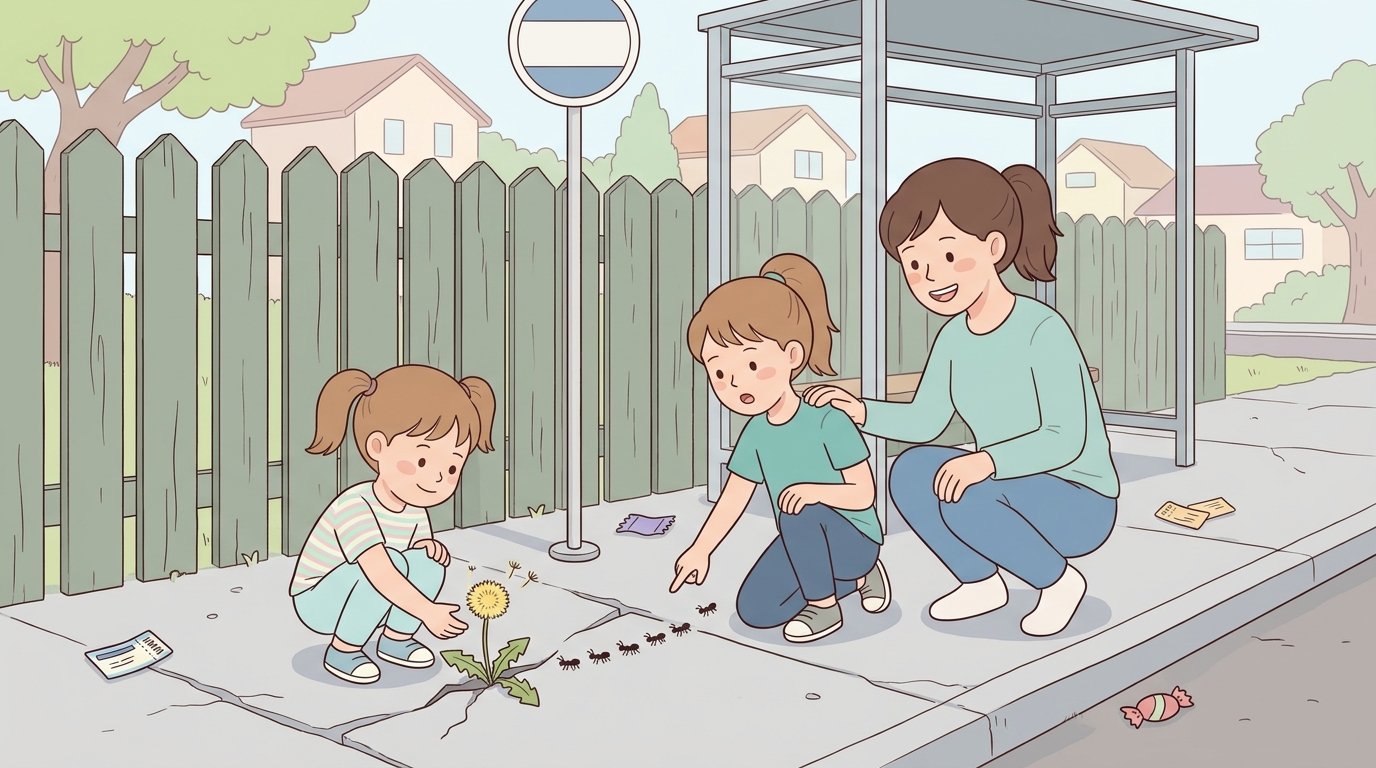
Zara dropped down beside an old paling fence. A dandelion was pushing up through a crack in the bitumen, and she was fascinated. She ran her finger over its jagged leaves and wondered out loud how a plant could grow right in the middle of the path.
For once, my urge to hurry stopped. I crouched down next to her.
Bella drifted over and crouched too. She pointed out a trail of tiny black ants carrying breadcrumbs along the bottom of the fence. Then we spotted a patch of damp green moss on the fence post. By the time the bus pulled up, we’d done a whole nature scavenger hunt for kids on two square metres of footpath.
A whole planned day had ended in tears. Four spare minutes beside a bus pole gave the girls something to talk about through dinner.
That morning changed how I saw our little unit. We didn’t have a garden. But we had cracks, fences, ants, moss and street trees. That was plenty.
What Research Says About a Nature Scavenger Hunt for Kids
Most research is about green space in general rather than footpath hunts. Still, it points in a hopeful direction.
Green space and wellbeing
This is the study I mentioned earlier. Researchers in Denmark linked satellite data on green space with health records for almost one million people.1 Children who grew up with the most green space around their homes had up to a 55% lower risk of developing a mental health condition later in life.1
That’s a link, not proof that green space causes better mental health. Many other things differ between neighbourhoods. But it’s encouraging, and it adds weight to the small, everyday green moments we can offer.
A UNICEF discussion paper brings together studies linking everyday green space in cities with children’s wellbeing and development.2 It argues that green spaces close to home matter, not just big parks far away.
Nature and attention
In one small study, children with ADHD concentrated better after a twenty minute walk in a park than after a walk through a town centre or a neighbourhood.3 It only included 17 children, so it can’t tell us everything. But it fits what many parents notice after time outdoors.
Small and quiet can be easier
For children with sensory sensitivities, big parks and gardens can be tiring. There’s wind, glare, crowds, long walks and lots to take in. A tiny patch of nature can be gentler. A patch of moss, an ant trail or a weed in a crack gives a busy mind one small thing to rest on.
Australia’s Early Years Learning Framework includes children being connected with and contributing to their world, including the natural world.4 A small nature scavenger hunt for kids on your own street fits that idea well.
Big Outings and Footpath Moments
Letting go of the picture perfect day out took a weight off my shoulders. This table shows what I thought we had to do, beside what worked for our family.
| What matters | Big planned outing | Short footpath walk |
|---|---|---|
| Sensory load | Noisy trains, crowds, tired legs | Quiet, familiar streets at the child’s pace |
| Preparation | Food, maps, transport, money | Step out the door for five minutes |
| Where attention goes | Rushing to the main attractions | Crouching to study bugs, bark and cracks |
| How everyone feels after | Frayed nerves and guilt | Calmer children and shared smiles |
4 Easy Nature Scavenger Hunt for Kids Ideas
You don’t need printed sheets or collecting bags. These four easy ideas work right where you are.
The footpath crack explorer
Look for tough little plants growing where nobody planted them.
- Dandelions in bitumen seams.
- Clover between brick pavers.
- Grass along the kerb or under a downpipe.
It gets children wondering how plants stay alive in hard places. And it works on any city street, which is exactly how our bus stop hunt began.
The tiny bug watch
Find an old fence post or the edge of a garden bed. Stay still for a minute and look for anything with legs.
- Ants carrying crumbs.
- Slaters under a loose stone.
- A caterpillar on a leaf.
Watching small creatures move slowly gives a busy mind a break. Look, don’t touch: some Australian insects and spiders can bite or sting.
The rough and soft search
Give the walk home one job: find one thing that feels rough, and one that feels soft.
- Rough: dry bark, a brick, a pine cone.
- Soft: damp moss, a petal, a feather.
Only two things to remember keeps it simple and low pressure. Children who love touch may also enjoy our low mess sensory bins.
The leaf colour line up
Pick up three or four fallen leaves and lay them out from freshest green to darkest brown.
Sorting by shade builds early comparing and ordering skills without a worksheet. NAEYC’s guidance on developmentally appropriate practice highlights the value of play and hands on exploring for young children.5 Our colour mixing chart and shapes and colours activities build on the same idea.
Nature Scavenger Hunt for Kids, Age by Age
A hunt can be as simple or as detailed as your child is ready for. These are loose guides only. Follow your child’s interest and energy.
Nature scavenger hunt for toddlers (about 1 to 3)
- One thing at a time: “Can you find a leaf?” Then celebrate whatever they bring.
- Name what you see: “Bird. Big tree. Wet puddle.”
- Let them touch safe things like bark, grass and smooth stones. Stay close, because toddlers explore with their mouths too.
- Two or three minutes is a great hunt at this age.
Nature scavenger hunt for preschoolers (about 3 to 5)
- Give a short list of three to five things, with pictures if your child isn’t reading yet.
- Add describing words: rough, smooth, tiny, tall, crunchy, soft.
- Try “find two the same” or “find something bigger than your hand”.
- Let them lead for part of the walk and choose what to look for next.
Nature scavenger hunt for early primary children (about 5 to 8)
- Use a longer list, or let them write or draw their own.
- Add counting and sorting: how many petals, how many legs, which leaf is longest?
- Ask “why” and “what if”: why is the moss only on this side of the post?
- Draw or photograph what you find and make a little book at home.
20 Things to Find on a Nature Scavenger Hunt for Kids
Pick three to five for one walk, and save the rest for another day. Most can be found on an ordinary street, a school yard or a small park.
| Look for | Feel, hear or compare |
|---|---|
| 1. A plant growing through a crack | 11. Something rough |
| 2. A line of ants | 12. Something smooth |
| 3. Something red in nature | 13. Something soft |
| 4. A feather | 14. A leaf bigger than your hand |
| 5. A spider web (look, don’t touch) | 15. A leaf smaller than your thumb |
| 6. A bird on a wire or branch | 16. Two leaves that look different |
| 7. A cloud shaped like an animal | 17. A bird singing |
| 8. Moss on a wall or post | 18. Wind moving the trees |
| 9. A seed, nut or pod | 19. A round stone |
| 10. A shadow you can step on | 20. Something that smells nice |
For children who aren’t reading yet, draw a tiny picture next to each item. Ticking things off is satisfying, but finding just one thing still counts. Our free Footpath Hunt Card has picture friendly boxes ready to tick.
Everyday Learning on a Nature Scavenger Hunt for Kids
A nature walk is already full of learning, without turning it into a lesson. Here are gentle ways to connect it with maths, words and science, if your child is interested.
Maths on the footpath
Count petals on a flower, legs on a beetle or steps to the bus stop. Sort leaves by size, then line them up from smallest to biggest. Look for patterns in fences, bricks and bark. Our free Wobblin Shape Hunt and Number Hunt sheets fit easily into a walk. Our guides to counting activities and pattern activities have more.
Words and stories
Collect describing words as you walk: crunchy, slimy, prickly, feathery. Back home, draw one thing you found and tell a story about it in our Big Adventure Storybook. For children learning English, naming nature words in both languages is a gentle bridge, as in our weather vocabulary guide.
Little scientists
Wonder together. Where do the ants go? Why is this side of the tree wet? What happens to the puddle after the sun comes out? You don’t need the answers. Wondering aloud together is the point. Our kitchen science experiments can carry the curiosity indoors.
A Nature Scavenger Hunt for Kids Who Are Neurodivergent
A nature walk can suit neurodivergent children well, because it’s flexible and can be quiet. These are practical ideas from home and practice, not therapy.
- Sensitive to noise or crowds: choose quiet streets and times, and keep hunts short. Our sensory environment guide explains why.
- Needs to move: hop to the next tree or bear walk along the path. Our animal walks guide has ideas.
- Likes predictability: use the same route and a picture list. A daily routine template can show when the walk happens.
- ADHD: short, active hunts with lots of small wins tend to work well. Let them lead and change direction.
- Doesn’t like getting dirty: offer a stick, gloves or a magnifying glass to explore without touching.
- Wanders: agree on a “stop spot” at each corner, and hold hands near roads.
Looking back at that bus stop, I think of Bella crouched over the ant trail. A small nature scavenger hunt for kids, close to home, can suit a busy mind.
A Nature Scavenger Hunt for Kids in Every Season
Melbourne weather changes fast. Changing what you look for keeps hunts going all year.
| Season | Things to look and listen for |
|---|---|
| Summer | Cicadas in street trees, shadow shapes on hot concrete, dry gumnuts to kick along the path |
| Autumn | Crunchy plane tree leaves, seed pods, birds gathering on wires |
| Winter | Bare branches against the sky, frost on car roofs, thin ice on puddles |
| Spring | New buds, blossom, bees on flowers, nesting birds |
| Rainy days | Raindrops on bus shelter glass, the smell of wet bitumen, earthworms on the path |
Let these moments be short. Four minutes at a bus stop counts as a proper hunt. On days when it’s too wet, our rainy day activities and indoor obstacle course can fill the gap.
Staying Safe on a Nature Scavenger Hunt for Kids
- Roads and driveways: stay on the footpath, stop at every driveway and hold hands near roads.
- Spiders and insects: teach children to look but not touch, and not to put hands into dark gaps, under rocks or into woodpiles.
- Plants and berries: never eat anything found outside, and wash hands afterwards.
- Sun and heat: use a hat, sunscreen and shade, and carry water. SunSmart has current UV advice for Victoria.
- Water: stay close near any water, even puddles, ponds or drains.
- Taking things home: collect only fallen leaves and seeds. Leave living plants and creatures where they are, and don’t collect from national parks or reserves.
A gentle note. If your child is very distressed by outdoor sounds, textures or crowds, or outings often end in big meltdowns, it may help to talk with your GP, Maternal and Child Health nurse or an occupational therapist. Our Venue Sensory Snapshot can help you notice patterns before an outing.
A Nature Scavenger Hunt for Kids in Small Concrete Yards
Many services have small, mostly concrete yards. The same small nature approach works there too.
- Check the fences. Palings and brick walls collect moss, webs and windblown seeds.
- Leave some weeds. Let children watch a crack weed flower and go to seed over a few weeks.
- Bring in natural loose parts. A basket of pine cones, large river stones or bark chips. Choose pieces too big to swallow for younger children.
- Add a dig patch. Even one large tub of soil gives children somewhere to dig and pour. See our mud kitchen ideas.
- Plan it into the week. A short walk around the yard or block can become a regular part of the program. Our weekly lesson plan template makes it easy to slot in.
During my relief years in centres across Melbourne’s east, I saw how much children could find in even a small yard when adults gave them time to look.
What the girls remember
Bella and Zara are grown up now. I asked them recently what they remembered about nature from that first little unit. Neither of them mentioned the botanic garden.
Both smiled and started talking about the ant trails on our front step, and the spider that spun its web in the corner of our porch every summer.
If you’re sitting on a cold step today feeling worn out, please let yourself off the hook. You don’t need paddocks or a big garden to raise children who love the outdoors. A weed in a footpath crack holds enough wonder for a five minute walk.
Free Printable: Footpath Hunt Card for a Nature Scavenger Hunt for Kids
Fifteen things to look for, feel and hear on any street, plus a space for today’s best find. Fold it in half and take it on your next walk.
Download the Free PDFFootpath Hunt Card
Slow down, crouch low, look close. Tick what you find.
A plant in a crack
A line of ants
Moss on a post
A bird
A spider web (no touching)
Something rough
Something soft
A leaf bigger than my hand
A round stone
Two leaves that look different
A bird singing
Wind in the trees
Crunchy leaves
A flower to smell
Rain or wet ground
How to Use the Footpath Hunt Card
- Print the card, or slip it into a plastic sleeve with a whiteboard marker so you can use it again.
- Before you head out, choose three to five things to look for. Younger children can choose just one.
- Walk at your child’s pace. When they stop, stop with them, and tick whatever you find.
- At the end, write or draw today’s best find and circle the weather.
- Keep finished cards in a folder, and look back at how your finds change with the seasons.
Tips for using the hunt card
- Keep it short. Five minutes on the way to the bus counts.
- Let your child hold the pen. Ticking is half the fun.
- Don’t aim to finish it. One find is a good hunt.
- Use it in rooms. Educators can take one card per small group on a yard walk.
More Free PDFs for Outdoor Learning
More free tools are on our printables page.
- Outdoor games: classic playground games and hopscotch
- Movement: animal walks for preschoolers
- Following curiosity: the Reggio Emilia approach at home
- On a budget: making learning fun without breaking the bank
- Curiosity: sparking a love of learning
- Busy weeks: mother daughter bonding activities
- Everyday maths: early maths
Nature Scavenger Hunt for Kids FAQs
What is a nature scavenger hunt for kids?
It’s a walk where children look for, feel or listen for things in nature, like leaves, ants, moss or birdsong. It can be as short as a few minutes on your own street.
Can we do a nature scavenger hunt without a backyard?
Yes. Footpath cracks, fences, street trees and small parks hold plenty to find. Short, close to home hunts are often calmer than big outings.
What age is a nature scavenger hunt good for?
Any age. Toddlers can look for one thing at a time, preschoolers can use a short picture list, and early primary children can count, sort and draw what they find.
How long should a nature scavenger hunt last?
As long as your child is enjoying it. Two or three minutes is plenty for toddlers, and five to fifteen minutes suits most young children.
How do I keep a nature hunt safe?
Stay on footpaths, hold hands near roads, look but don’t touch spiders and insects, never eat anything found outside, and use sun protection.
Research and guidance: Engemann and colleagues on green space and later mental health; UNICEF on urban green space; Faber Taylor and Kuo on park walks and attention in children with ADHD; the Early Years Learning Framework; and NAEYC on developmentally appropriate practice.
Experience: our first Melbourne unit, the botanic garden trip, the bus stop hunt with Zara and Bella, and what the girls remember are my own memories. My relief years and our ADHD diagnoses are facts from my life. The four ideas, the lists and the tips are general suggestions.
This is educational content, not medical or safety advice. Always supervise children outdoors. Last reviewed: 14 November 2026.
References
- Engemann, K., Pedersen, C. B., Arge, L., Tsirogiannis, C., Mortensen, P. B., & Svenning, J.-C. (2019). Residential green space in childhood is associated with lower risk of psychiatric disorders from adolescence into adulthood. Proceedings of the National Academy of Sciences, 116(11), 5188-5193. https://doi.org/10.1073/pnas.1807504116
- UNICEF. (2021). The necessity of urban green space for children’s optimal development [Discussion paper]. https://www.unicef.org/documents/necessity-urban-green-space-childrens-optimal-development
- Faber Taylor, A., & Kuo, F. E. (2009). Children with attention deficits concentrate better after walk in the park. Journal of Attention Disorders, 12(5), 402-409. https://doi.org/10.1177/1087054708323000
- Australian Government Department of Education. (2022). Belonging, being and becoming: The early years learning framework for Australia (V2.0). https://www.acecqa.gov.au/nqf/national-law-regulations/approved-learning-frameworks
- National Association for the Education of Young Children. (2020). Developmentally appropriate practice in early childhood programs serving children from birth through age 8 (4th ed.). NAEYC.
