
Hopscotch for Kids: 4 Brilliant Ways This Classic Game Builds Real Skills
Bringing hopscotch for kids back to our suburban driveway started when our girls grew restless and overwhelmed indoors. In Jakarta where I grew up, we called this game Engklek: nobody handed us rules, printed checklists, or expensive equipment. A piece of broken brick or chalk drawn on the concrete gave little bodies a place to jump, count, balance, and build whole body coordination naturally through joyful active play.
Rediscovering the simple magic of hopscotch for kids shows parents and educators that early numeracy, physical balance, and turn taking do not require digital apps or flashcard drills; they come alive when children hop across numbered chalk squares on a sunny footpath.
When my daughters were small and our family was adjusting to life in Melbourne, our driveway often became our primary learning space.
I was juggling doctoral research at university alongside part time work, and our family home was often filled with the restless energy that comes with neurodivergent minds. My youngest daughter, Zara, had days where sitting quietly at a table felt like an impossible demand. Her body needed vigorous movement, sensory feedback, and physical rhythm before her mind could settle into anything resembling calm focus.
On those difficult afternoons, I did not reach for educational worksheets or math flashcards. I reached into our pantry basket, pulled out a thick stick of white sidewalk chalk, and stepped out onto the driveway.
With a few quick strokes on the asphalt, a numbered grid appeared: one, two, three, split to four and five, six, split to seven and eight, nine, and a curved semi-circle for ten.
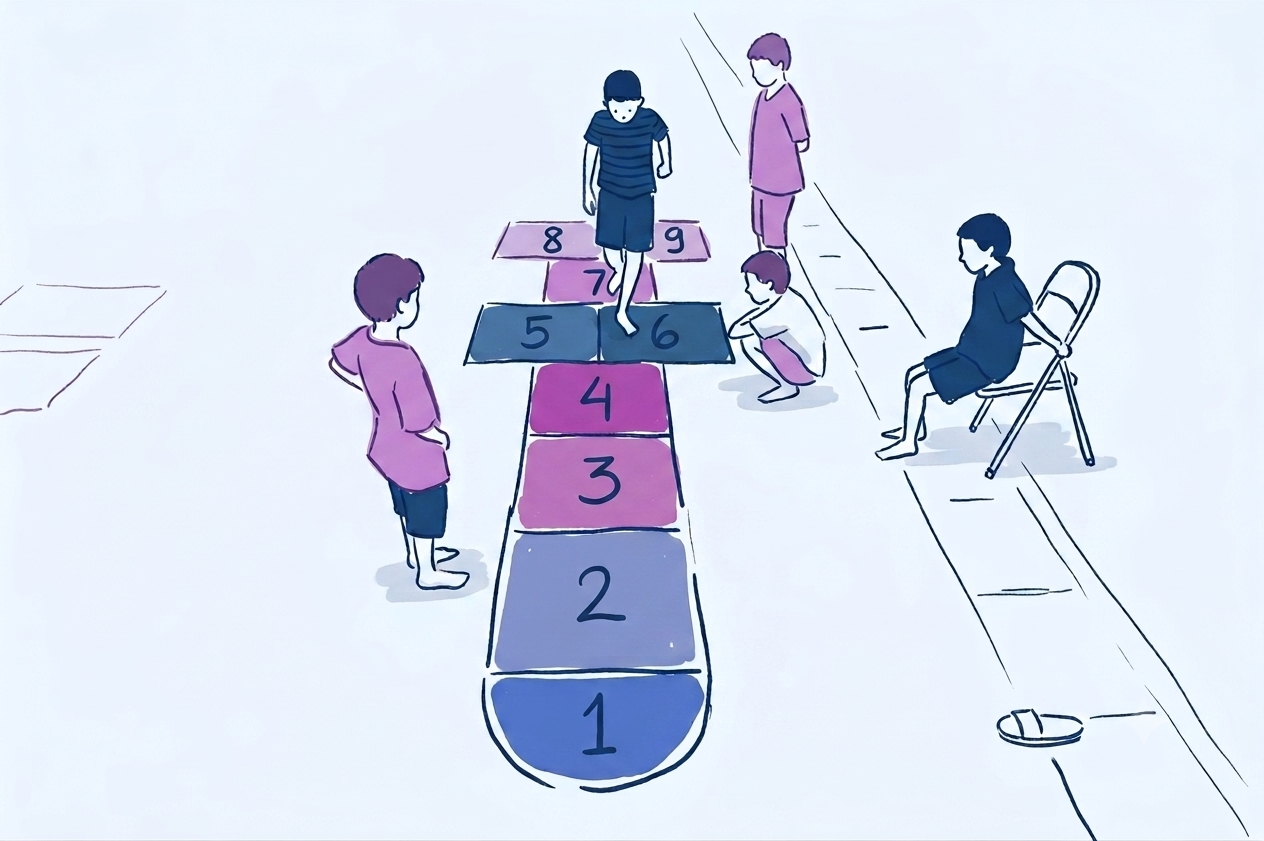
Within thirty seconds, the tension that had gathered inside our house dissolved. Both of my daughters were outside, tossing smooth garden pebbles onto the squares, laughing at wobbly landings, and calling out numbers with clear, unprompted joy.
That simple driveway grid was a powerful reminder that movement and learning are inseparable in early childhood. When we examine hopscotch for kids through a developmental lens, we see an activity that integrates balance, bilateral motor coordination, spatial mapping, and foundational math without a single second of boredom.
In this classic outdoor play guide:
Why Pavement Games Are Making a Needed Comeback
Modern childhood has shifted indoors at an unprecedented rate. Screen time, structured extracurricular schedules, and safety concerns mean young children spend significantly fewer hours moving freely in their neighbourhoods.
Yet the biological needs of a developing nervous system have not changed.
The World Health Organization (WHO) recommends that children aged three and four engage in at least 180 minutes of physical activity spread across the day, with at least 60 minutes involving moderate to vigorous energetic play.[1]
For preschoolers, meeting this target can feel overwhelming if parents assume it requires organised sports programs or expensive gym classes.
Pavement games like hopscotch offer an effortless, accessible solution. A stick of chalk costs less than two dollars, any safe paved area becomes an immediate playground, and five minutes of jumping raises the heart rate while exercising large muscle groups naturally.
Furthermore, active games provide essential vestibular and proprioceptive input. When a child balances on one foot, their joints and inner ear send thousands of electrical signals to the brain, regulating their sensory system and setting the stage for focused learning, exactly as we discuss in our reflection on regulation before learning in early childhood.
The Shared Global Heritage: From Engklek to Rayuela
One of the most delightful aspects of hopscotch for kids is its universal presence across human cultures.
While folklore often links the game to ancient Roman soldier training drills, historical folklorists note that concrete written records date back centuries. An early written English reference appears in an almanac from 1677, where schoolboys played a pavement game called “Scotch-hoppers”.[2]
The word “hop” meant jumping on a single foot, while “scotch” referred to a scored or scratched line marked into the dirt.
What is truly remarkable is how children around the world independently developed their own regional variations:
| Country or Region | Traditional Name | Unique Cultural Rule or Grid Shape |
|---|---|---|
| Indonesia | Engklek (also Ponci or Sekebat) | Often drawn in a mountain or airplane shape; players balance flat stones on the back of their foot or hand while hopping. |
| India | Stapu, Kith-Kith, Paandi | Played with smooth flat stones called gitte; players must hop through while kicking the marker from square to square without touching lines. |
| France | Marelle (and Escargot) | Features the famous Escargot variant: a giant spiral drawn like a snail shell where players hop inward to the centre rest circle. |
| Spain & Latin America | Rayuela | The course represents a symbolic journey from Earth to Heaven; players toss stones and navigate complex rectangular layouts. |
| Germany & Switzerland | Himmel und Hölle | Meaning “Heaven and Hell”; players must leap over the dreaded Hell square without landing on its lines or stopping to rest. |
| Philippines | Piko | Commonly played in school courtyards with a moon shaped home square at the top where players can rest both feet. |
In Indonesia, where I spent my own childhood, Engklek was our daily ritual. We would scratch lines into packed dirt with broken twigs or draw with leftover roof tile pieces on the road.
Sharing these international names with our children connects them to a living global tradition of childhood play, celebrating diversity in the same spirit we explore in how a multilingual child processes their expanding world.
What Hopping on One Foot Actually Teaches the Brain
Standing and hopping on a single leg looks effortless to an adult, but neurologically, it is a significant developmental milestone.
Most children cannot hop smoothly on one foot before age four.
To hop forward into a chalk square without falling, a child’s central nervous system must coordinate several complex systems simultaneously:
- Vestibular Integration: The fluid filled canals of the inner ear must detect changes in head position and rapidly signal the leg muscles to prevent tipping sideways.
- Proprioceptive Feedback: Sensory receptors in the ankle, knee, and foot arches must judge how hard the shoe hits the pavement and adjust joint stiffness in milliseconds.
- Motor Planning (Praxis): The prefrontal cortex must calculate the distance to the next square, plan the jump trajectory, and coordinate takeoff and landing while airborne.
- Visual Spatial Tracking: The eyes must scan ahead to identify the target number while ensuring the trailing foot does not brush against the outer chalk line.
Paediatric physiotherapists and occupational therapists recognise that whole-body coordination forms the foundation of all fine motor control.
When a child strengthens their core and ankle stability through outdoor jumping games, they develop the postural control needed to sit comfortably at a classroom table later on.
This connection highlights why physical play connects directly to the handwriting stability we explore in our guide on how to hold a pencil correctly and our whole body ideas in animal walks for gross motor development.
4 Brilliant Ways Hopscotch for Kids Builds Core Development
When your child hops down a driveway course, they are exercising far more than their leg muscles. These 4 brilliant benefits explain why hopscotch for kids is one of the most complete developmental activities you can share:
1. It Transforms Abstract Numbers into a Physical Spatial Map
Reciting numbers by rote from a printed worksheet is an abstract visual exercise.
- What actually happens: In hopscotch, numbers are laid out along a linear physical pathway from one to ten. The child must physically step onto two to reach three, and jump wide to land on four and five.
- The developmental gain: This embeds the mental number line directly into the child’s body schema. Numbers stop being arbitrary marks and become distances in space, strengthening the mathematical intuition we explore in our guide on teaching early math with a number line jumping game and practical number sense activities.
2. It Trains the Brain to Switch Between Single and Double Foot Landings
Alternating between single foot hops and two foot straddle landings requires split second neurological control.
- What actually happens: The child hops on one foot for square three, then must instantly fire both legs outward to land simultaneously in squares four and five, before snapping back onto one foot for square six.
- The developmental gain: This rapid switching strengthens bilateral integration, encouraging communication between the left and right hemispheres of the brain and building the motor planning that supports everyday physical independence.
3. It Builds Emotional Resilience and Natural Turn Taking
Modern video games offer instant restarts with zero social stakes; playground games teach patience.
- What actually happens: If your stone bounces off the line or you lose your balance on square six, your turn ends immediately. You step to the back of the queue, cheer for your sibling, and wait for your next chance.
- The developmental gain: Hopscotch has built-in, low stakes forgiveness. Missing a square is not a moral failure; it is simply part of the game. Children practice emotional regulation and patience, reflecting the social empathy we examine in fostering a love of learning without overcomplicating things.
4. It Sharpens Upper Body Aim and Proprioceptive Force Regulation
Tossing a small stone or beanbag onto a specific square requires delicate muscular calibration.
- What actually happens: The child must judge weight, distance, and release angle. If they throw too hard, the stone skitters off square eight; if they throw too softly, it stops on square two.
- The developmental gain: This develops graduated force regulation, the exact same motor skill children use when adjusting pencil pressure on paper so that leads do not snap, linking naturally with our work on pencil control and fine motor activities.
How to Play Hopscotch: Clear Rules for the Driveway
If it has been a few decades since you last hopped through a chalk course, here is the classic, straightforward sequence to get started on your driveway or footpath:
- Draw the Course: Draw a straight grid with chalk. Begin with square 1, followed by square 2 and square 3 in a straight line. Draw squares 4 and 5 side by side. Place square 6 alone in the centre, then draw squares 7 and 8 side by side. Finish with square 9 in the centre and a large semi-circle for 10 at the top, often called “Home” or “Safe”.
- Select Your Marker: Each player finds a small, flat stone, a wooden button, or a beanbag that will not bounce wildly on the concrete.
- Toss to Square One: The first player stands behind the baseline and tosses their marker into square 1. It must land cleanly inside the lines without touching any chalk edge.
- Hop the Course: The player hops through the grid, skipping the square that contains the marker. They hop on one foot in single squares and land with two feet simultaneously in double squares (one foot in each square).
- Turn and Return: At square 10, the player pauses, turns around on two feet, and hops back down the grid in reverse order.
- Retrieve the Marker: When the player reaches the square right before their marker, they balance on one foot, bend down, pick up the stone, and hop out over the starting line.
- Advance to the Next Square: If the run was successful, the player tosses the stone into square 2 on their next turn, working their way up to square 10. If they step on a line or lose balance, their turn ends and passes to the next player.
In many classic versions, a player who successfully completes the entire course from one to ten earns the right to claim a square. They write their initials inside that box with chalk. For the rest of the game, that player can rest on that square with both feet, while every other player must hop completely over it.
Simple Variations Across Toddlers, Preschoolers, and School Age
One of the greatest strengths of hopscotch for kids is its natural adaptability. You can adjust the challenge to match any developmental level:
For Toddlers and Young Preschoolers (Ages 2.5 to 4)
Skip the marker toss and the strict rules completely. Draw a short grid numbered from one to five with extra wide squares.
Invite your toddler to jump with both feet together like a kangaroo from square to square, calling out the numbers as they land. Two-footed jumping builds bilateral leg power without the frustration of falling over.
For Older Preschoolers (Ages 4 to 6)
Introduce the single-foot hop and the marker toss. You can also turn the grid into a lively literacy adventure: replace the numbers with lowercase alphabet letters, inviting children to call out the letter sound as their feet touch down, reinforcing the phonetic habits we share in proper letter formation for preschoolers.
For Primary Schoolers (Ages 7 and Up)
Try the classic Australian playground challenge:
- Stage One: Complete the standard hopscotch course on one foot.
- Stage Two (“Jumps”): Complete the entire grid landing with both feet glued together in every single square.
- Stage Three (“Sizzles”): Complete the course by crossing your legs in mid-air and landing with your ankles crossed in alternating directions.
For Indoor or Wet Weather Days
When winter drizzle keeps you inside, lay out a grid on your living room rug or timber floorboards using low-tack blue painter’s tape. Use rolled-up socks instead of garden stones to protect the floor.
Indoor movement tracks provide brilliant sensory regulation when children are stuck inside, echoing the creative domestic play in our rainy day activities for preschoolers at home guide.
Comparing Sedentary Digital Drills with Active Hopscotch Play
Here is how sedentary math apps compare to active pavement hopscotch across early childhood development:
| Developmental Domain | Digital Tablet Counting Apps | Active Outdoor Hopscotch for Kids |
|---|---|---|
| Physical Health | Completely sedentary: child remains seated with slumped posture and neck strain. | Vigorous gross motor exercise: raises heart rate, builds bone density, and exercises large leg muscles. |
| Sensory Processing | Visual and auditory stimulation only; lacks physical resistance or balance feedback. | Full sensory integration: vestibular, proprioceptive, tactile, and spatial awareness work in harmony. |
| Math Comprehension | Abstract symbols tapped on glass with minimal physical context. | Embodied numeracy: numbers exist along a tangible physical pathway that the child steps through. |
| Social Connection | Solitary play: limited opportunity for genuine negotiation or shared empathy. | Social cooperation: natural turn taking, cheering for friends, and managing low-stakes mistakes together. |
Digital tools have their place, but they cannot replace the rich, whole-body feedback of outdoor games. Real movement anchors learning in physical memory in a way that glass screens never can.
Helping Hesitant or Neurodivergent Children Join In Calmly
Not every child jumps into hopscotch with immediate confidence.
For children with motor dyspraxia, low muscle tone, sensory processing sensitivities, or ADHD, looking at a long numbered grid can trigger performance anxiety. If a child feels clumsy or fears falling, they will often refuse to play.
Here is how we made hopscotch welcoming and low-stress for my own daughters:
Give the child ownership of the chalk first. Before anyone hops, let them draw the numbers, decorate the margins with chalk flowers or race cars, and choose the stone. When the grid feels like their personal artwork, the physical task becomes an invitation rather than an adult demand.
Play side by side and model joyful imperfection. Hop through the grid yourself, pretend to wobble on square six, laugh out loud, and step onto the line.
When children see that adults treat wobbly balance as a funny, ordinary part of the game, the fear of making a mistake evaporates.
If task initiation triggers a freeze, hold their hand and do the first three jumps together as a team, using the gentle principles from our parent-tested ADHD start together task trick.
Connecting Whole Body Games to Fine Motor Control and Focus
Gross motor play does not exist in isolation from academic learning:
The core stability and balance children build on a hopscotch grid directly support their ability to sit upright without slouching, reducing the fatigue that causes poor handwriting posture.
Stepping along numbered sequences builds the spatial reasoning children use when sorting geometric forms in our guide on shape activities for young children or identifying mathematical rhythms in pattern activities for kids at home.
Squatting down to pick up a small stone from the pavement exercises the exact pincer pinch and hand separation we build through pincer grasp activities and early cutting in scissor skills by age.
Even managing outdoor clothing, like tying sneakers or pulling on rain boots, reinforces the self-dressing independence we explore in buttoning, zipping, and self dressing skills and our daily home routines for EAL weather vocabulary.
Under Australia’s national early childhood learning framework, Belonging, Being and Becoming, overseen by ACECQA, supporting children’s physical wellbeing, bodily agency, and outdoor exploration is recognised as fundamental to lifelong health and learning.
Take a piece of chalk, step out into the afternoon air, and draw ten simple squares on the concrete.
Watch your children discover the rhythm of their own bodies, celebrate every wobbly landing, and enjoy five minutes of pure, timeless playground joy.
Free Printable: The Outdoor Pavement Games Guide
A simple, printable pocket guide featuring chalk grid templates, number jumping variations, and low-prep outdoor movement games designed for busy families.
Download the Free 3-Page Sampler- Explore whole-body coordination through Animal Walks for Gross Motor Development in Preschoolers →
- Discover joyful number play with our Number Line Jumping Game for Early Math Skills →
- Try low-stress counting ideas in Counting Activities for Kids at Home: Simple Everyday Games →
- Discover patterns through play in Pattern Activities for Kids at Home: Preschool Math →
- Explore foot-based outdoor inquiry with our Nature Scavenger Hunt for Kids: 4 Footpath Adventures →
- Build hand strength naturally in Hand Strength Activities for Kids: 4 Practical Ways We Built Grip →
- Guide pencil grasp comfortably in How to Hold a Pencil Correctly: 4 Practical Steps for Children →
- Overcome task start freezes using the ADHD Start Together Task Trick: 4 Powerful Ways to Help Your Child Begin →
References and Readings That Guided Me
- World Health Organization (WHO). (2019). Guidelines on Physical Activity, Sedentary Behaviour and Sleep for Children under 5 Years of Age. World Health Organization. [Global clinical benchmarks establishing daily physical activity targets, sedentary screen time limits, and the importance of energetic play for early neurological development].
- Opie, I., & Opie, P. (1969). Children’s Games in Street and Playground. Oxford University Press. [Authoritative historical and anthropological documentation tracing the historical records, language, and global variants of hopscotch and street games].
- Australian Government Department of Education. (2022). Belonging, Being and Becoming: The Early Years Learning Framework for Australia (V2.0). [National curriculum benchmarks highlighting bodily wellbeing, spatial exploration, gross motor agency, and peer cooperation].
- Gallahue, D. L., Ozmun, J. C., & Goodway, J. D. (2012). Understanding Motor Development: Infants, Children, Adolescents, Adults (7th ed.). McGraw-Hill. [Foundational motor development text detailing the biomechanics of single-leg balance, locomotor hopping, and fundamental movement skill acquisition in early childhood].