
Number Sense Activities: 16 Easy Ways to Help Children Understand Numbers (+ 4 Free Printables)
What activities help children develop number sense?
The activities that build number sense best are short, hands on games where children see, move and compare real amounts, not just say numbers in order. Five kinds do most of the work:
- Quick look games with dot cards, dice or fingers, so children learn to see 1 to 5 without counting (subitising).
- Count and stop jobs, like “Get four spoons”, so the last number means how many.
- Which has more? Lining up two piles of snacks or blocks to compare.
- Shake and spill with two colour counters, to see that 5 is 3 and 2, or 4 and 1.
- Number line jumps and an estimation jar, to feel how big numbers are and where they sit.
Five minutes a day, a few times a week, is plenty for 3 to 5 year olds. Below you’ll find all sixteen activities, how to adjust them for busy or neurodivergent children, and the free printables I made to go with them: dot cards, a five frame mat, a floor number line and an observation checklist.
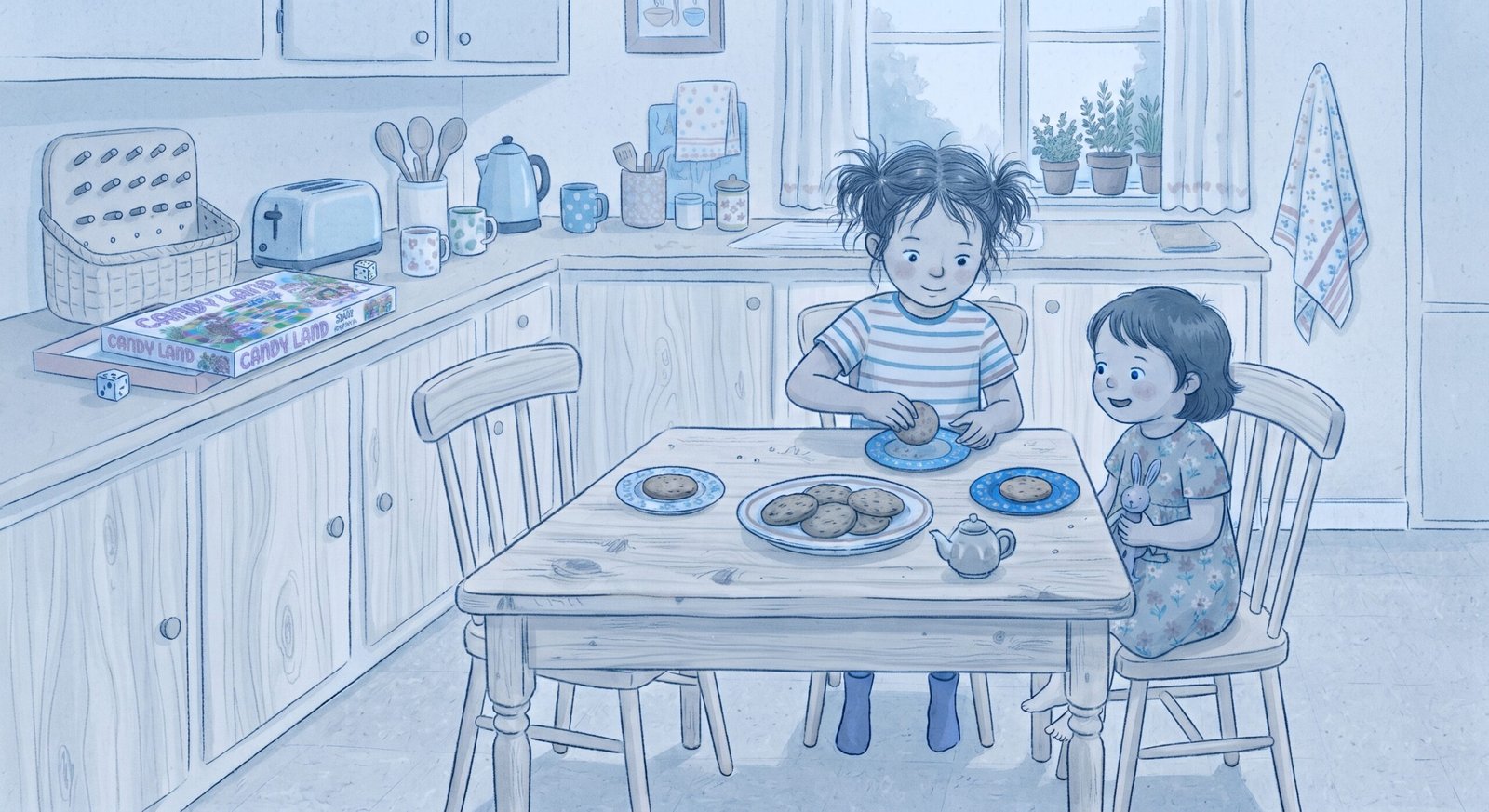
The Peg Basket: Why I Care About Number Sense
My daughters were little in the mid-2000s. My eldest was born in 2003 and her sister in 2005, before iPads, before every parent had a phone in their pocket, and long before counting apps.
We were living in Indonesia then. If we were waiting at the doctor’s, we counted the fish in the tank. If we were in the car, we counted red cars. Most of what my girls learned about numbers, they learned with their hands.
I remember my eldest proudly counting all the way to twenty on the stairs, one step and one number at a time. I was delighted. Then I asked her to pass me five pegs from the basket while I hung out the washing, and she counted happily past five and handed me the whole basket.
A few months later, her little sister was sure she had “more” biscuits because hers were spread across the plate, even though her sister had two more in a neat pile.
At the time I just laughed, even though I spent my working days lecturing student teachers about how young children learn. It took a step back to see what I had been watching at home. They knew the counting words, but they did not yet know what the words meant. That gap between saying numbers and understanding them is what number sense fills.
Looking back, the moments that built their understanding were not the counting songs. They were sharing biscuits fairly between two very watchful sisters, pegging out socks in pairs, setting the right number of plates for dinner, rolling the dice in Snakes and Ladders, and playing shop with real coins.
None of it needed a screen. All of it needed real things to touch, move and compare, and I believe that is still true for children today.
In this guide:
What Number Sense Is (and What It Isn’t)
Number sense is the understanding underneath the numbers. A child with growing number sense knows roughly how big a quantity is, can compare two amounts, can see a small group without counting it, and starts to notice that numbers are made of other numbers.
Researchers at the University of Delaware who have studied it for many years describe three connected areas: number concepts (what a number means), number relations (how numbers compare and fit together) and number operations (what happens when you add or take away).[2]
Counting is part of it, but counting alone is not number sense. Reciting “one, two, three, four, five” is closer to singing a song. Real counting means matching one word to each object, knowing the last word tells you how many, and knowing the amount stays the same however the objects are arranged. That is exactly why the basket of pegs came back full.
It is not speed or memorised facts either. A child who can say 2 + 2 = 4 but cannot show you four on their fingers has learned a fact, not a relationship. And it is not something children either have or do not have. It grows from everyday experience.
A well-known US study followed children from their first year of school to the end of Year 3 and found that their number competence in that first year strongly predicted both their later maths achievement and how quickly their maths skills grew.[1] The same research group later found that a short number sense program improved young children’s number skills, with many gains still there weeks later.[2]
In Australia, the Early Years Learning Framework describes numeracy as the capacity, confidence and disposition to use mathematics in daily life.[4] I love that word “disposition”. The aim is not a child who performs numbers on demand. It is a child who notices quantities, enjoys them and is not afraid of them. If you would like to start with counting itself, see our counting activities for kids at home.
The Five Building Blocks of Number Sense
It helps to break number sense into smaller pieces you can actually see in play. These five blocks overlap and grow together, but naming them helps you notice where a child is strong and where they might need more time.
- 1. Subitising: seeing how many at a glance Recognising a small amount instantly, without counting. Mathematics educator Doug Clements describes two kinds: seeing a small group instantly, and seeing a larger amount as smaller groups, like spotting six on a domino as “three and three”.[3] That second kind is an early form of addition.
- 2. Counting with meaning One number word for each object, knowing the last number says how many, and knowing five buttons are still five whether bunched together or spread out.
- 3. Comparing quantities: more, less and the same Often the first number idea children care about, because it is tied to fairness. “She got more!” is number sense in action. Young children are easily fooled by how spread out things look.
- 4. Part-whole thinking: numbers inside numbers Understanding that five is four and one, three and two, or five and nothing. This is where addition and subtraction really begin, long before the plus sign.
- 5. Number relationships and magnitude Knowing that eight is close to ten, that two is much smaller than nine, and that numbers sit in order with equal steps between them. It also includes linking a numeral like “7” to that many things.
You do not need to teach these in order, and progress is rarely even. A child can recognise four beautifully on Monday and seem to lose it by Thursday. If that sounds familiar, I explain why in why your child can do it some days and not others.
Free Number Sense Printables
I made four printables to go with the activities below. They are A4, free for home and classroom use, and designed to be quick to set up.
- Subitising Dot Cards (PDF, 3 pages) 24 quick-flash cards in two sets, numbers 1 to 6 in different arrangements and in two colours to show parts. Use with Activities 1 to 4.
- Ways to Make 5 and 10 (PDF, 3 pages) A “Mine and Yours” five-frame mat, a shake and spill recording sheet and a ten-frame sheet for older preschoolers. Use with Activities 11 to 14.
- Floor Number Line and Estimation Jar (PDF, 5 pages) Eleven floor tiles from 0 to 10 with matching ten-frames, jump challenges and a weekly estimation jar sheet. Use with Activities 15 and 16.
- Number Sense Observation Checklist (PDF, 2 pages) For parents and educators. Notice the five building blocks during play, with space for four dated observations and what to try next.
Every one of these number sense activities uses things you already have. Most take five minutes or less, and none needs a table. Start with small numbers, up to five, and only go higher when a child is clearly confident.
Number Sense Activities for Subitising
Quick-Flash Plates
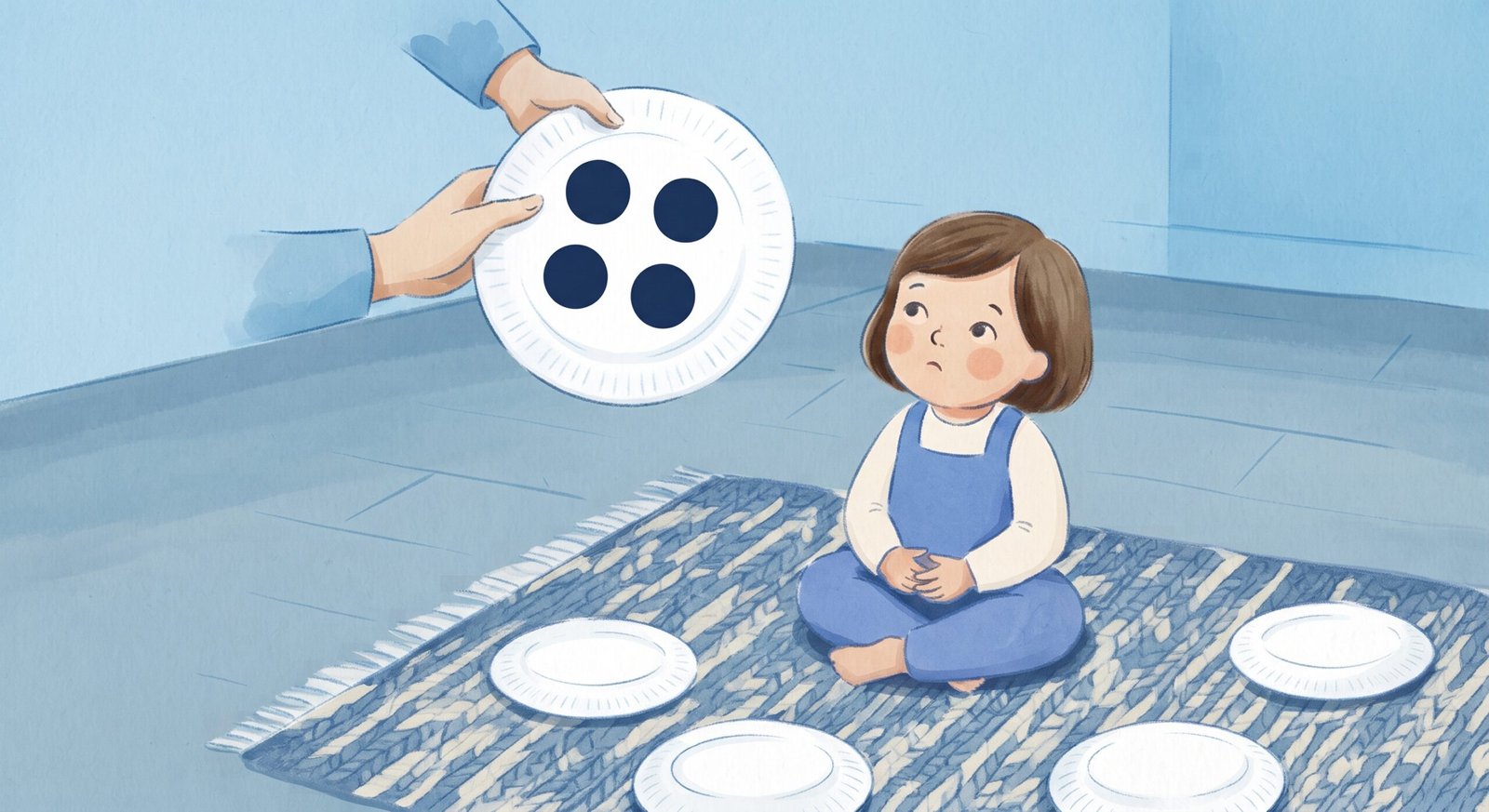
- You need: Paper plates and dot stickers, or our subitising dot cards.
- How to play: Make plates with two dots in a line, three in a triangle, four in a square and five like a dice. Flash one for about two seconds, hide it and ask, “How many did you see?”
- Why I use it: The short look is the point, because it is too quick to count. Afterwards, ask “How did you see it?” A child who says “two on top and two on the bottom” is already doing part-whole thinking.
Dice and Domino Snap
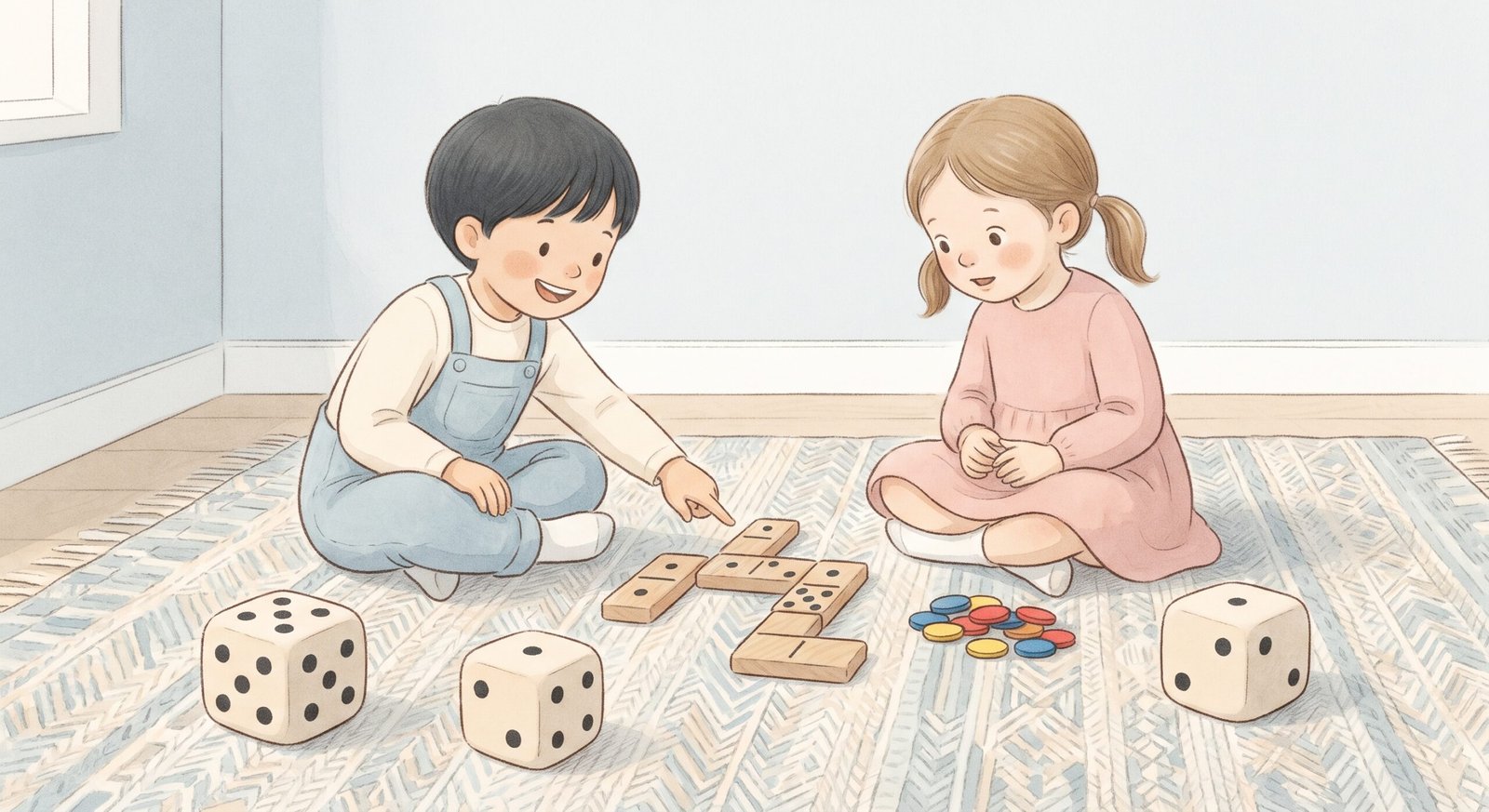
- You need: Dice, dominoes or playing cards up to six.
- How to play: Each player turns over a domino or rolls a dice. The first to say the amount wins a token. For younger children, use only the faces from one to three.
- Why I use it: Dice patterns are some of the most familiar arrangements children ever learn. This was a favourite in our house, and it builds instant recognition quickly.
Finger Flashes
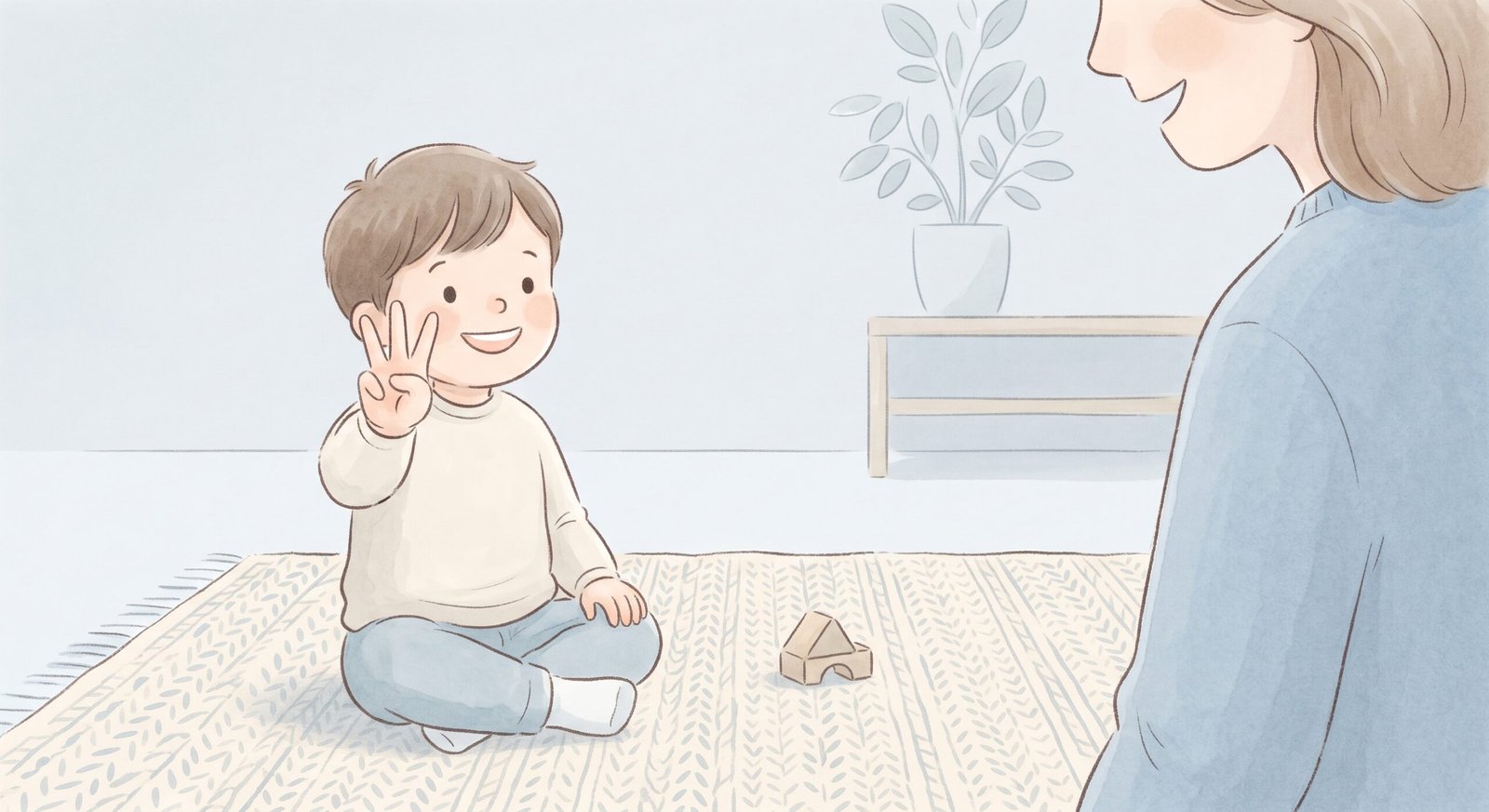
- You need: Just your hands.
- How to play: Hold up some fingers for a second and hide them. “How many?” Then swap and let your child flash for you. Show the same number different ways, like three on one hand, or two and one.
- Why I use it: Fingers are a number tool children always carry. It works in queues, in the car and in waiting rooms.
Peekaboo Pebbles
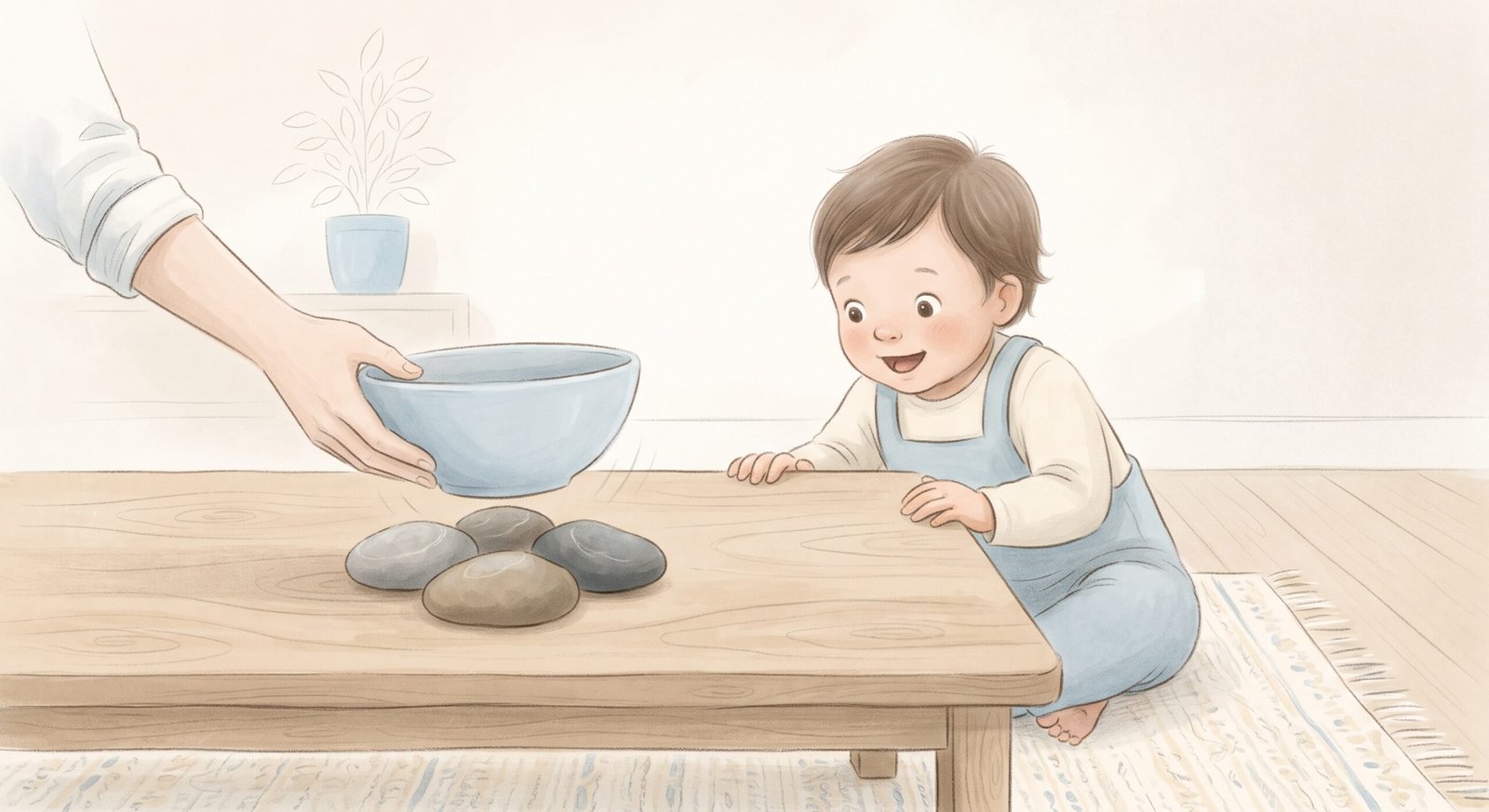
- You need: A bowl or cloth and a few large pebbles, shells or blocks.
- How to play: Hide a few objects under the bowl. Lift it for a moment, cover again and ask how many. Then lift it to check together.
- Why I use it: Children love the reveal, and checking teaches them to trust their own eyes. Choose objects too big to fit in a mouth for younger children.
Number Sense Activities for Counting with Meaning
Count and Stop
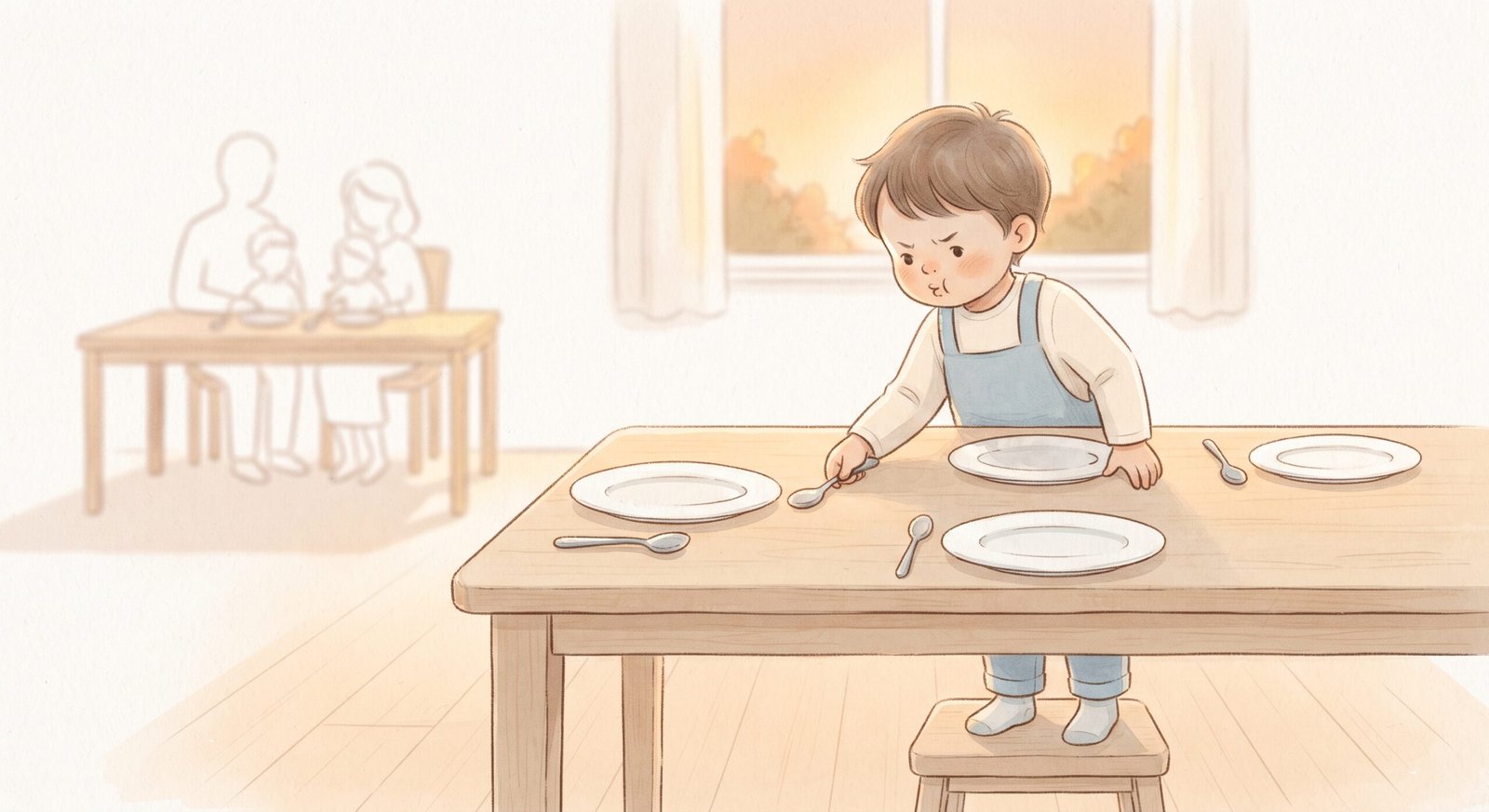
- You need: Any real household job.
- How to play: Ask for a specific number of things: “Can you get four spoons for the table?” or “Pass me five pegs.”
- Why I use it: It is harder than it sounds. A child must hold the target in mind while counting and stop at the right moment. This is the activity my daughter’s peg basket taught me. More ideas are in practical life activities for preschoolers at home.
Tap and Drop
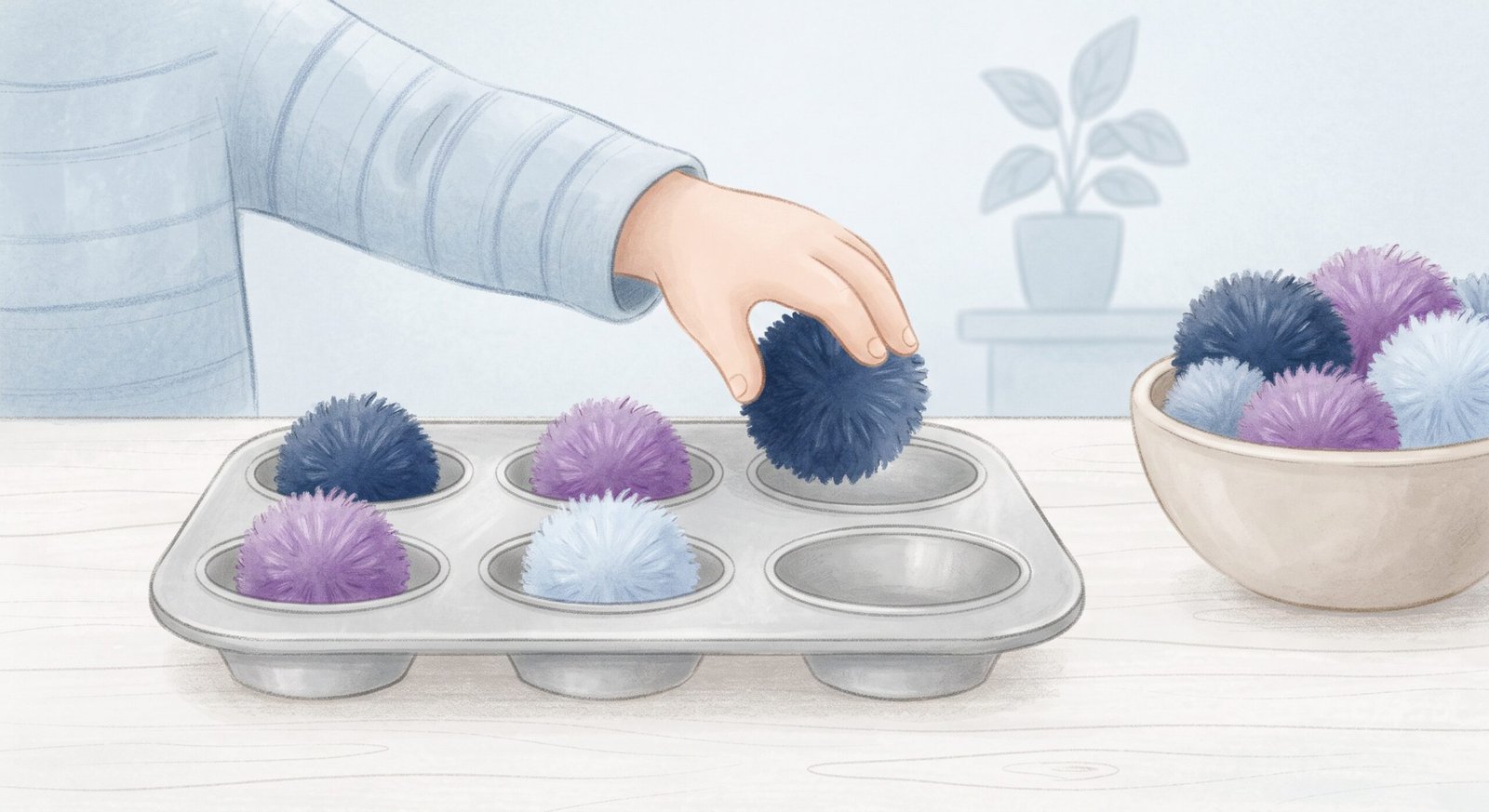
- You need: A muffin tin or egg carton and large pom-poms.
- How to play: Your child drops one pom-pom into each hole, counting aloud. When they finish, ask “So how many are there?”
- Why I use it: Dropping one object for each word builds one-to-one counting without anyone needing to correct them. The final question practises knowing that the last number says how many.
Same Number, New Shape
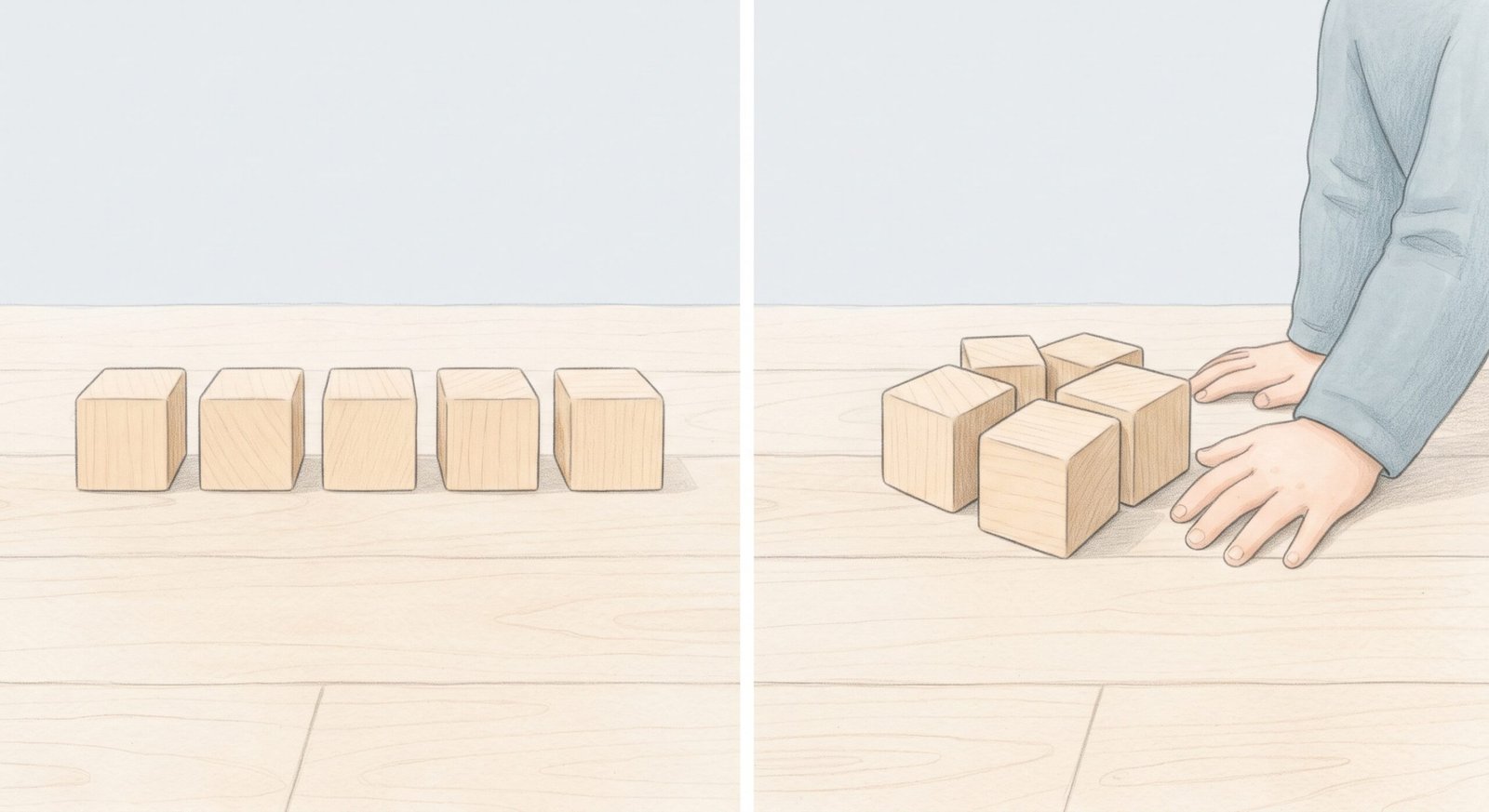
- You need: Five blocks.
- How to play: Count five blocks in a row together. Push them into a pile and ask, “How many now?” Many children will count again, and some will say there are fewer.
- Why I use it: Do not correct them. Spread the blocks out, count again and let them discover it is still five. This is the same idea my youngest was wrestling with over her biscuits, and it takes many repeats to stick.
Playdough Number Mats
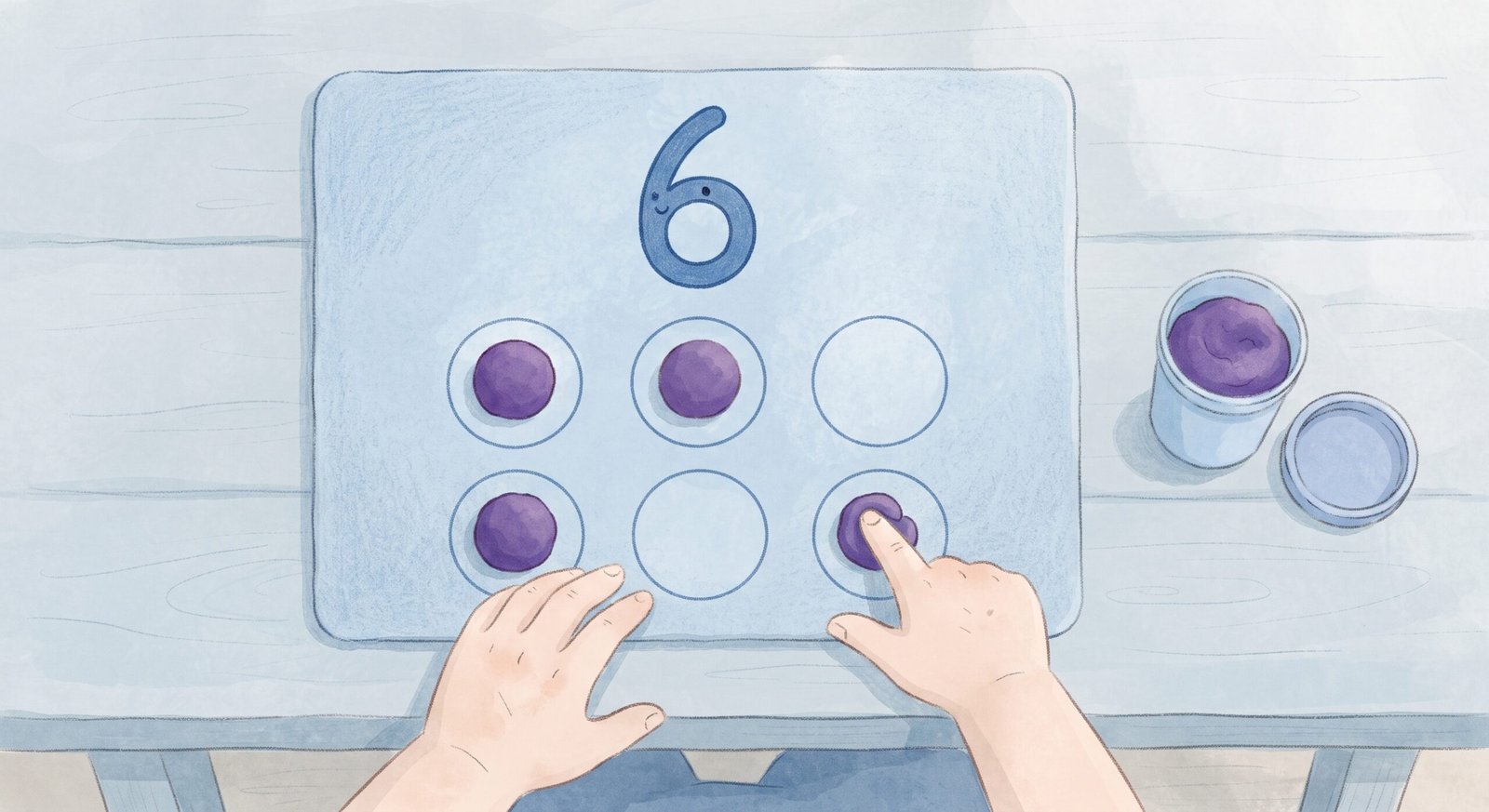
- You need: Playdough and our free number sense playdough mats 1 to 10 (or go straight to the mats PDF).
- How to play: Your child rolls a ball of playdough and presses one into each circle on the mat.
- Why I use it: Squeezing and placing each ball slows counting right down and gives the hands something to feel for every number.
Number Sense Activities for Comparing Quantities
Which Has More?
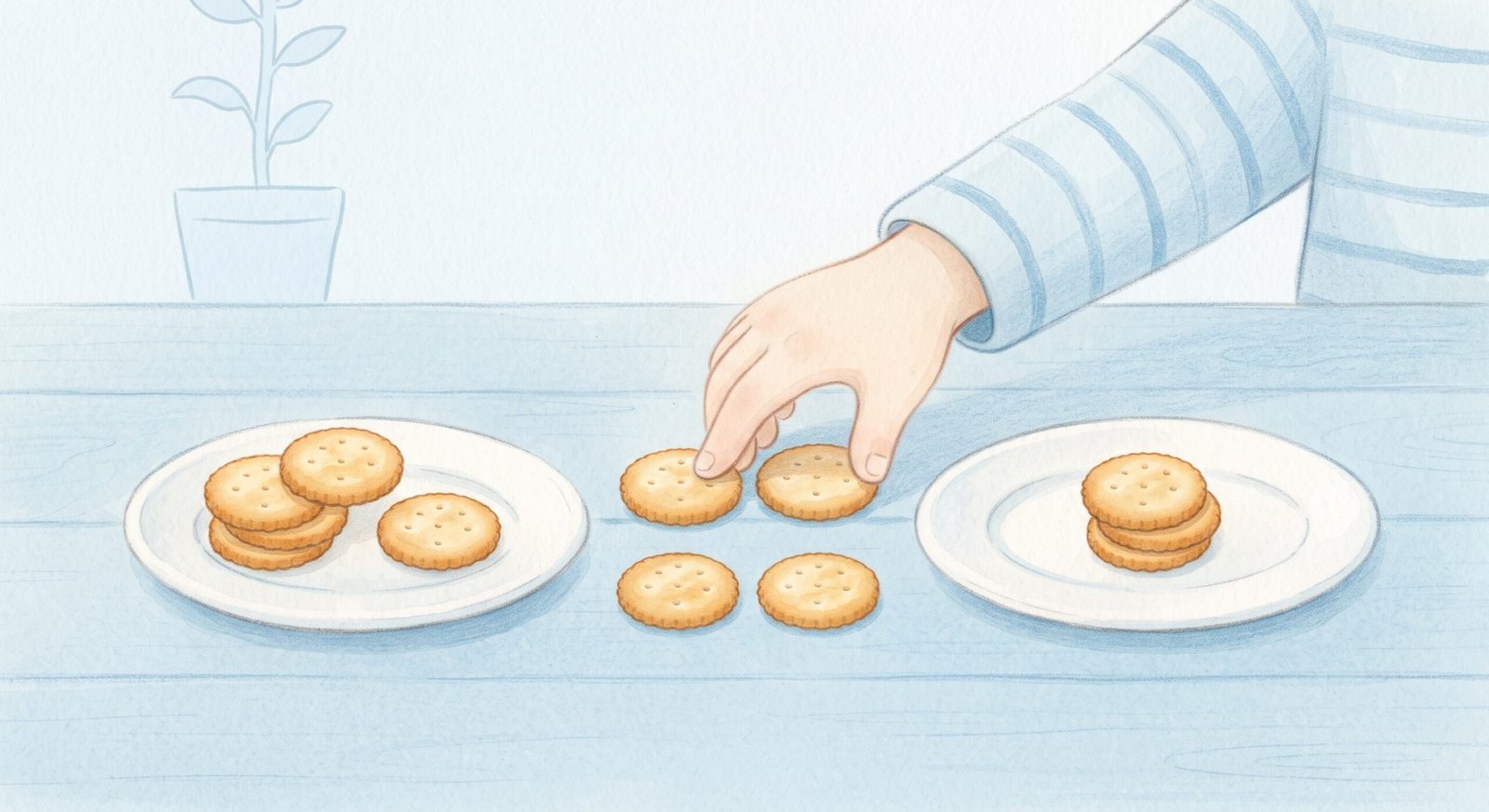
- You need: Two plates and a snack.
- How to play: Put two small piles on the plates and ask which has more and how they know. Start with big differences, then make them closer.
- Why I use it: Let your child line up one cracker from each plate until one side runs out. Comparing then naturally turns into counting, rather than the other way round.
Fair Share Picnic
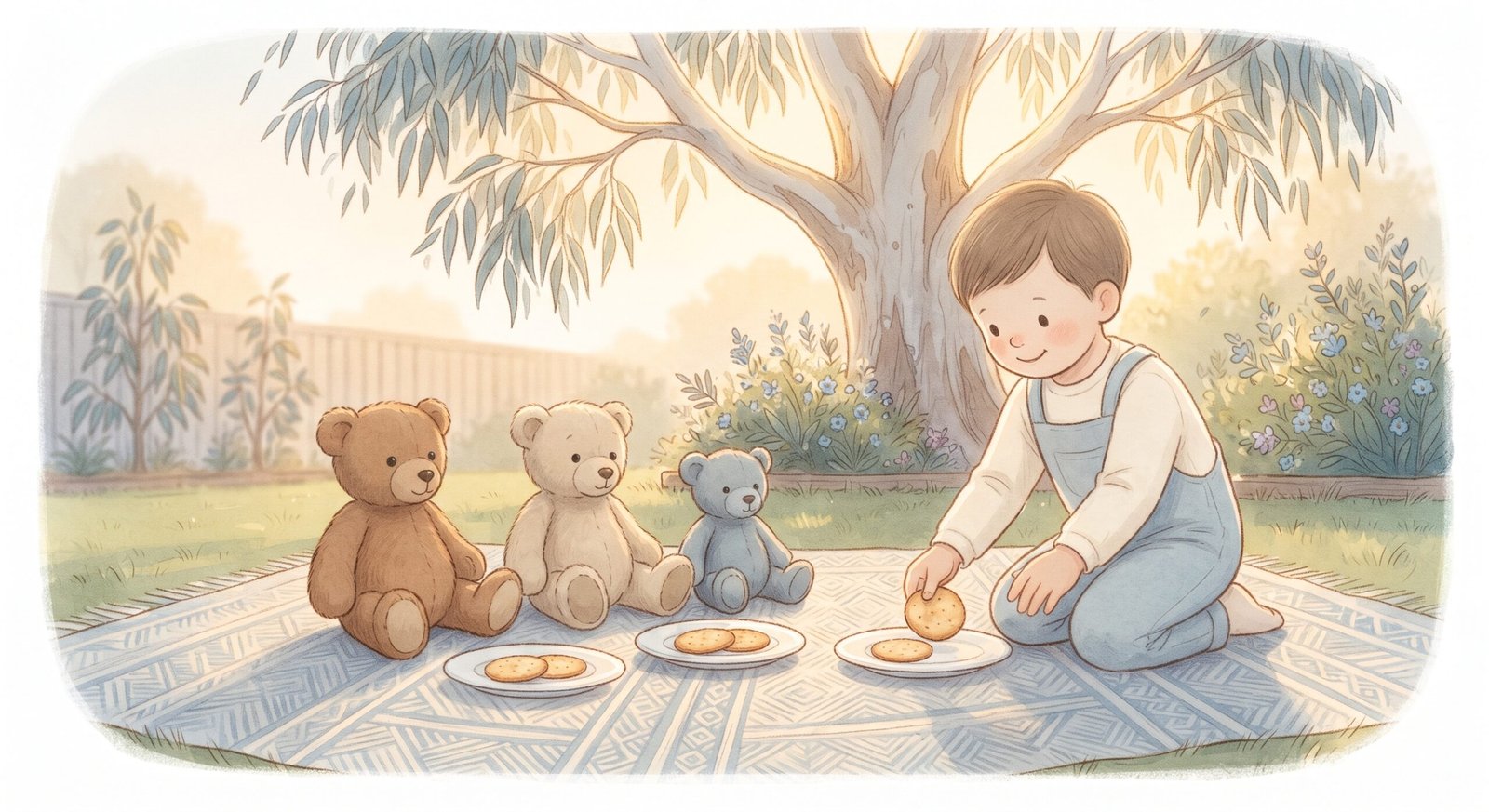
- You need: A few teddies and a handful of snacks.
- How to play: Ask your child to share the snacks between the teddies. Then ask, “Did everyone get the same? Is anyone left over?”
- Why I use it: Sharing one at a time is division before anyone calls it that. Two sisters watching every biscuit taught me that fairness gets children invested in the answer. The free Fair Share Snack Mat gives each teddy a spot.
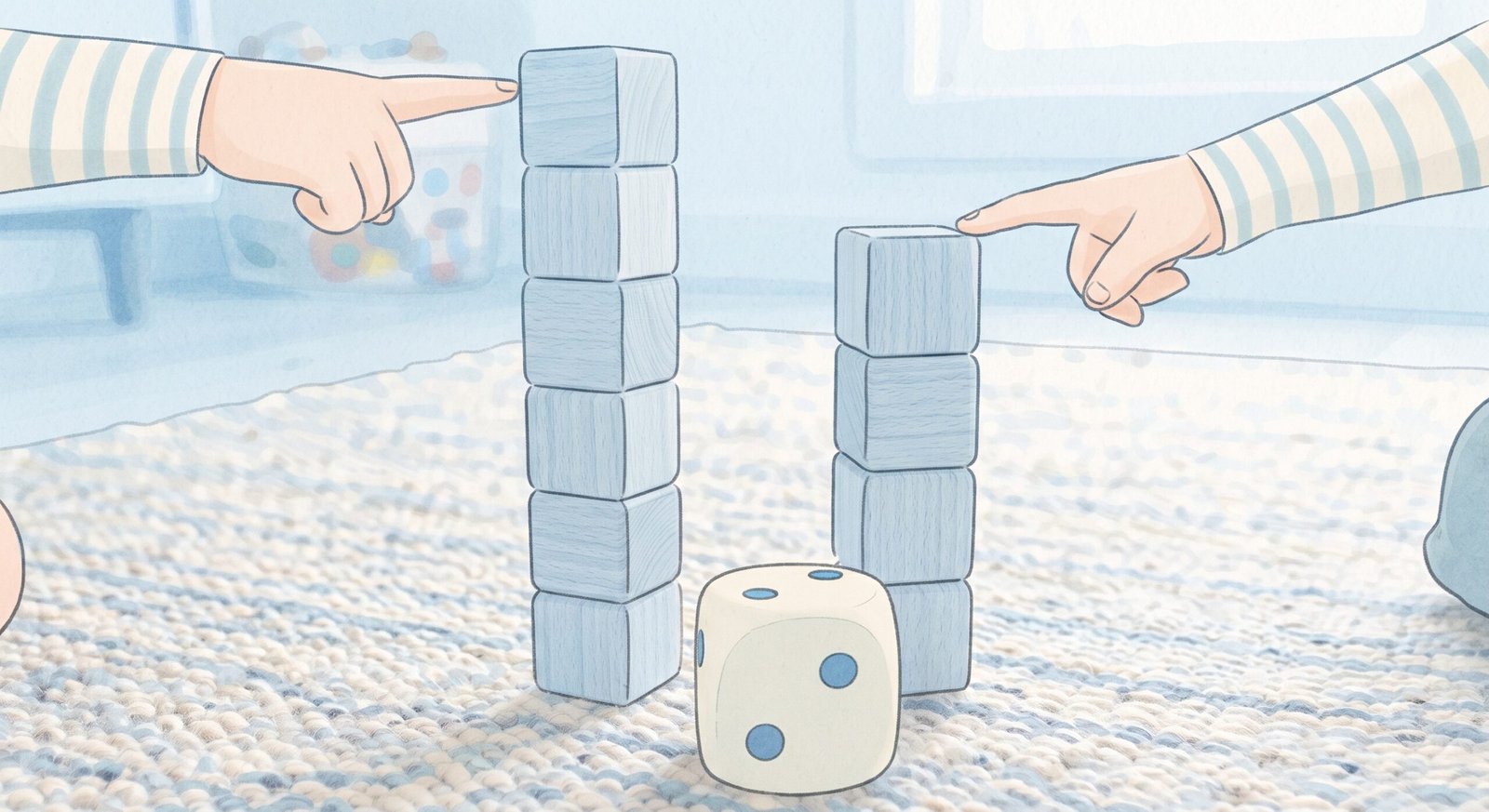
More, Less or the Same Towers
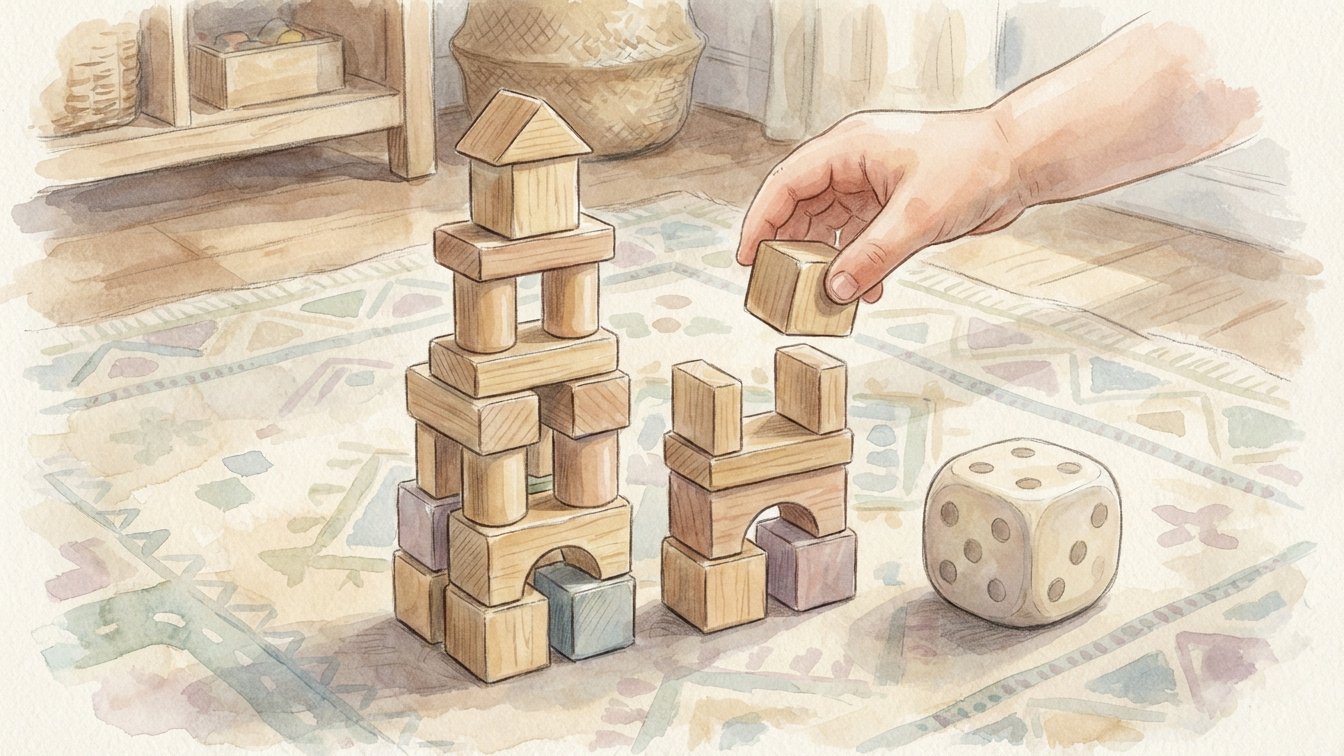
- You need: Blocks and a dice.
- How to play: Each build a tower. Stand them side by side and compare. Roll the dice: “Add that many. Who has more now?”
- Why I use it: Height makes the difference visible, and the dice turns it into a game. You can also use the “Mine and Yours” mat in our Ways to Make 5 and 10 printable.
Number Sense Activities for Part-Whole Thinking
Shake and Spill
- You need: Five two-coloured counters or large buttons in two colours, a cup, and the five-frame mat from our Ways to Make 5 and 10 printable.
- How to play: Shake and spill. Place one colour in the frame first, then the other. “Three purple and two blue. Still five altogether!” Record each spill on the sheet.
- Why I use it: Over a few spills, children see all the ways five can be made, which is the foundation for addition.
Hiding Bear
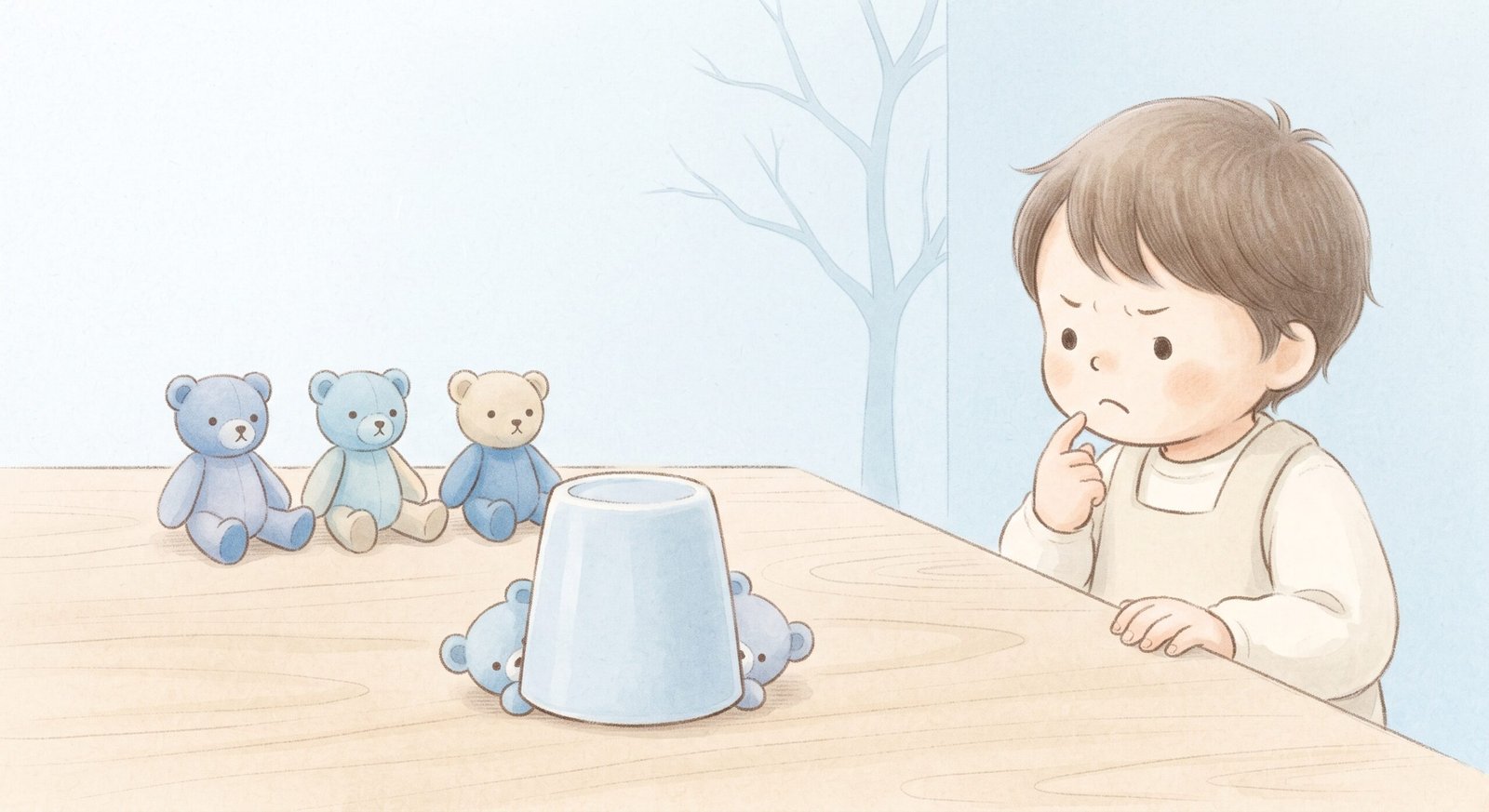
- You need: Five small toys and a cup.
- How to play: Count the toys together. While your child closes their eyes, hide some under the cup. “Two are still out here. How many are hiding?”
- Why I use it: This is early subtraction. Children often solve it by picturing the missing toys, which is exactly the thinking we want.
Two-Hand Stories
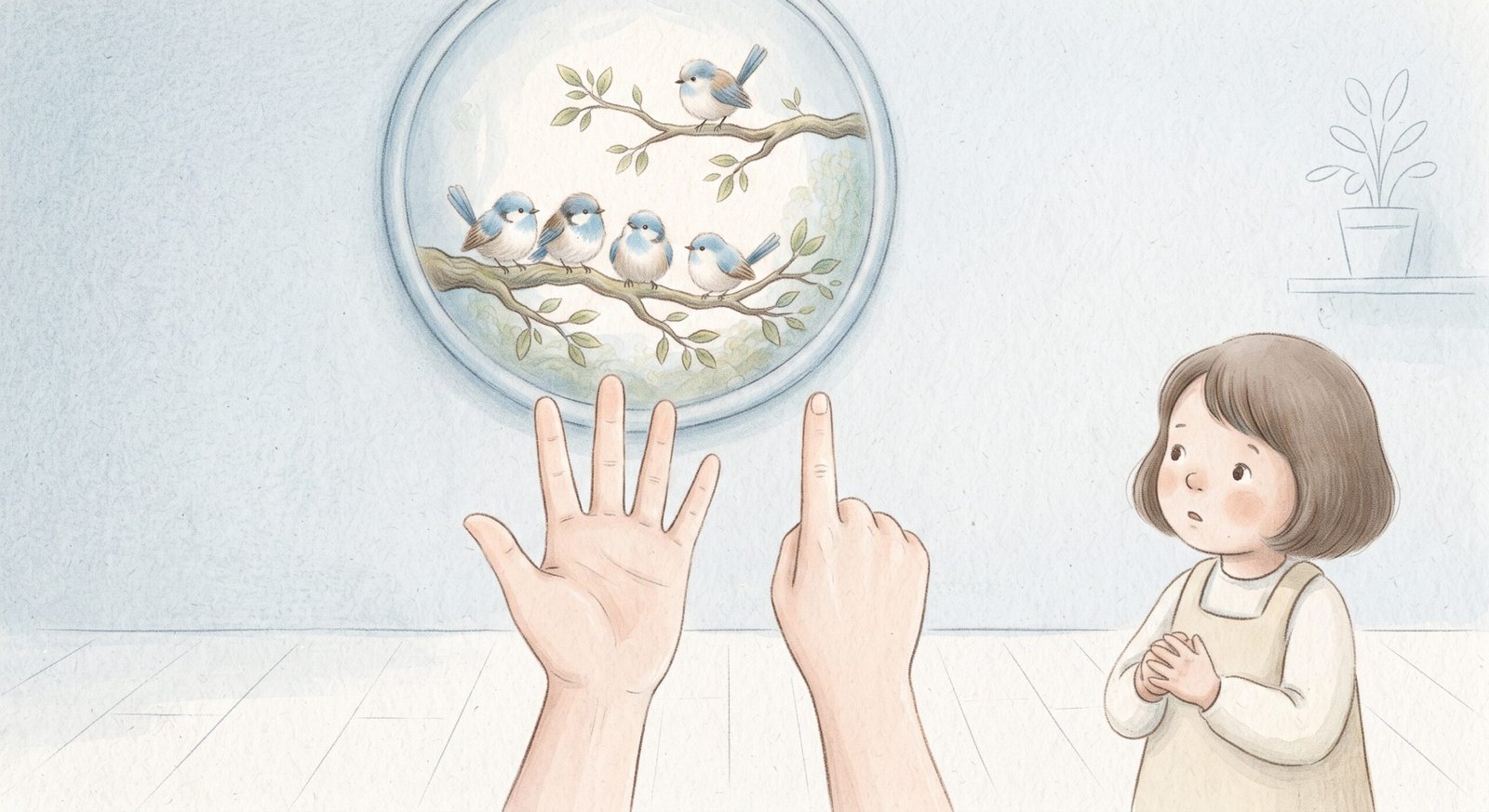
- You need: Your hands and a little imagination.
- How to play: Hold up five fingers split across two hands and tell a tiny story: “Four birds on this branch, one on that branch. How many birds?” Then change the split.
- Why I use it: The whole is always one handful, so the parts are easy to see. It needs nothing, which makes it perfect for the car.
Number Sense Activities for Number Relationships
Number Line Jumps
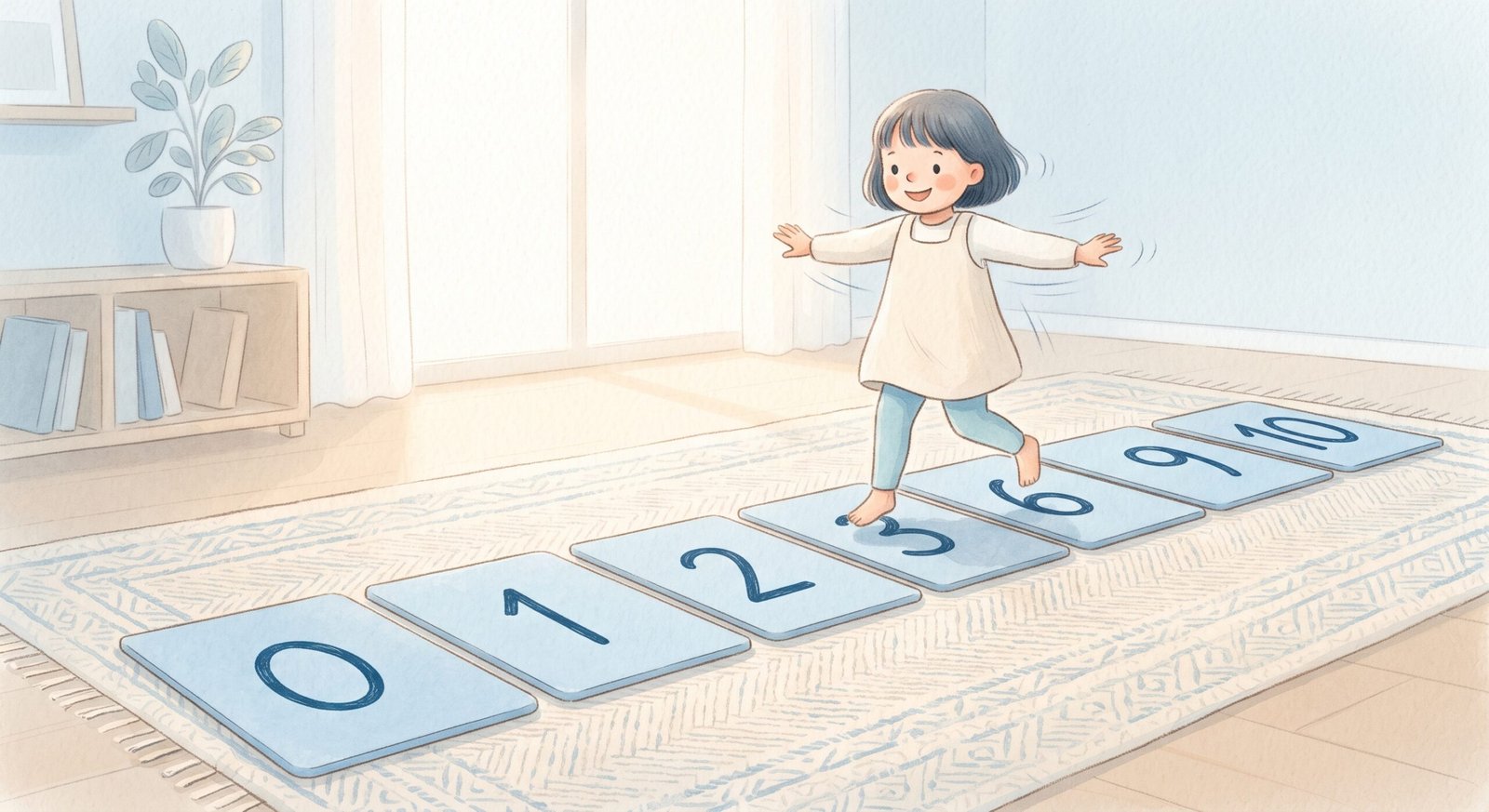
- You need: Masking tape, or the floor tiles in our Floor Number Line printable.
- How to play: Lay out 0 to 10. Call a number to jump to, then ask “Is 7 closer to 5 or to 10?” or “Jump two more. Where did you land?”
- Why I use it: Moving along the line builds the sense that numbers sit in order with even gaps. There is a full version in our number line jumping game, and hopscotch works the same way.
Estimation Jar
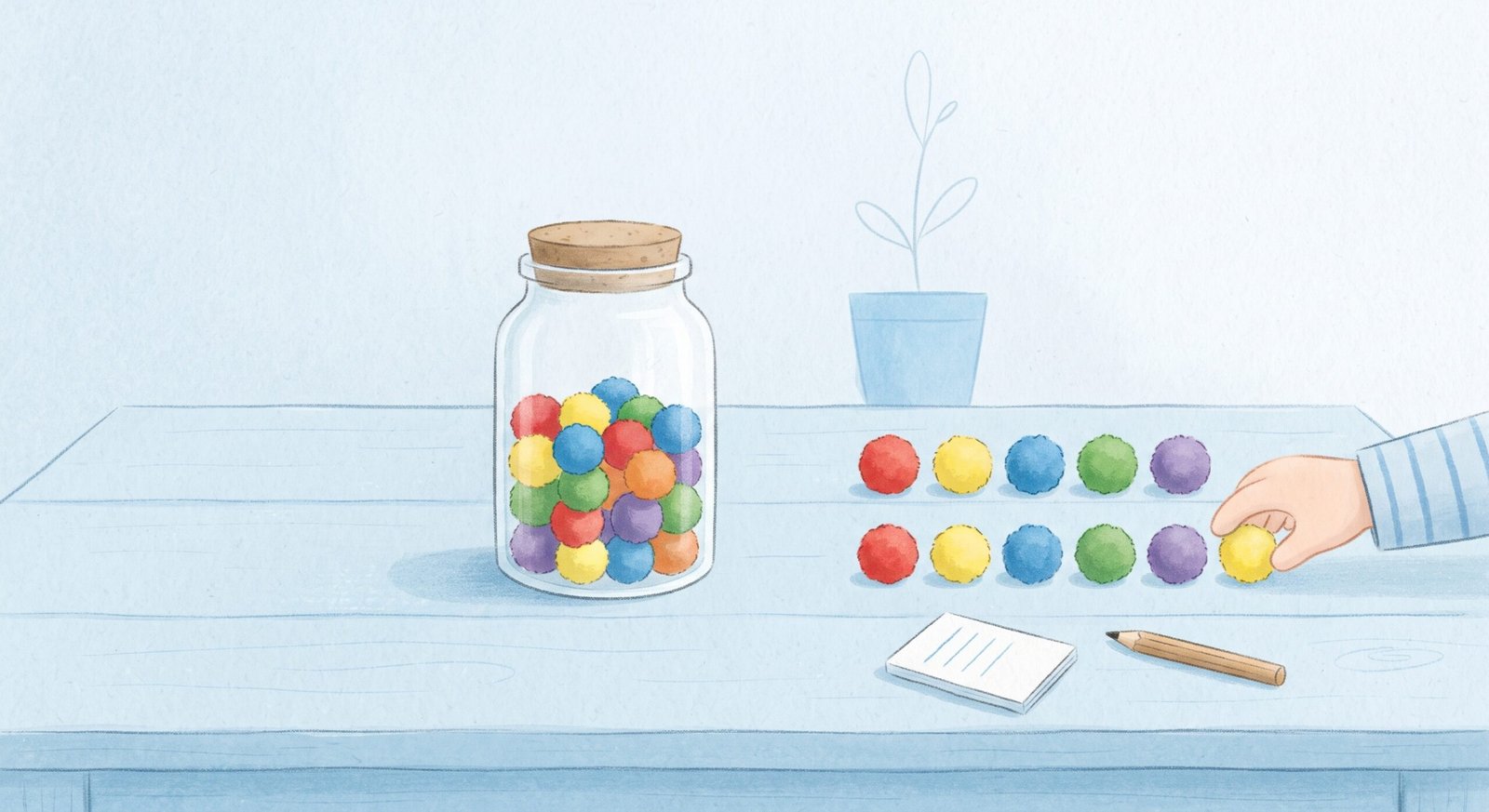
- You need: A clear jar, small objects, and the recording sheet in our Estimation Jar printable.
- How to play: Everyone guesses how many are in the jar. Then count them out together in rows of five or ten.
- Why I use it: The aim is not to guess right. It is to get better at sensing how big an amount is. Change the objects each week and watch the guesses get closer.
Looking for more? Maths games for kids, pattern activities and shape activities all build connected skills, and a nature scavenger hunt is a lovely way to count and compare outdoors.
The 16 Number Sense Activities at a Glance
The table below groups the activities by building block and suggests a rough starting age. These are my suggestions from practice, not research findings.
| Building Block | Activities | Try From About | Printable |
|---|---|---|---|
| Subitising | Quick-flash plates, dice and domino snap, finger flashes, peekaboo pebbles | 2 to 3 years | Subitising Dot Cards |
| Counting with meaning | Count and stop, tap and drop, same number new shape, playdough mats | 3 years | Playdough Number Mats |
| Comparing | Which has more, fair share picnic, more or less towers | 2 to 3 years | Ways to Make 5 and 10 |
| Part-whole | Shake and spill, hiding bear, two-hand stories | 4 years | Ways to Make 5 and 10 |
| Relationships | Number line jumps, estimation jar | 4 to 5 years | Floor Number Line and Estimation Jar |
Safety First: Small Objects
- Choking risk: Beans, buttons, pebbles, pom-poms and small counters can be a choking hazard. For children under three, or any child who still mouths objects, use items too large to fit in the mouth, such as large blocks, big pebbles or fruit pieces they are allowed to eat.
- Supervision: Stay close during any game with small items, and count them back into their container when you finish.
- Food: Check allergies and your service’s food policy before using snacks for counting.
- Movement games: Use non-slip surfaces for number line jumps, and keep the space clear of furniture corners.
This list is general and does not replace your own risk assessment.
Making Number Sense Activities Work for Busy, Sensory and Neurodivergent Children
Some children will happily sit with a domino game for twenty minutes. Others last ninety seconds before they are under the table. In my experience, neither tells you much about maths ability. For many ADHD, autistic and sensory-seeking children, the hard part is the setup, not the numbers. That’s the idea behind my neurodivergent learning design approach: settle the body and the room first, then the learning has space.
- Regulate first, count second A child whose body is buzzing has little left for noticing quantities. A few minutes of wall pushes or animal walks often helps more than a clever game. See regulation before learning and our four sensory micro-transitions.
- Put the numbers in their bodies Jump along a number line, clap out counts, stomp for “more” and tiptoe for “less”. Many children understand a number better after they have jumped it.
- Keep it short Three minutes of quick-flash plates while waiting for the toast is worth more than a long session that ends in tears. Stop while it is still fun.
- Use their interests Trains, dinosaurs and favourite characters can replace counters in nearly every activity. Interest helps with regulation as well as motivation.
- Make the start easy Set up before you invite, start alongside them, or begin with a version they know they can do. A first-then regulation reset mat or visual routine cards can help, and when an ADHD child won’t start tasks goes deeper.
- Expect a spiky profile A child may recognise numbers beautifully but struggle to count objects in order. Read more in spiky profiles in neurodivergent children and early maths and number sense for neurodivergent children.
- Bring maths into sensory play Hide a set number of objects in a low-mess sensory bin, compare cups of water at the sink, or cook a recipe of three leaves and two stones in a mud kitchen.
What Progress Looks Like, Without the Milestone Pressure
Number sense grows on a wide, wobbly path. The ages below are rough and overlapping. Use them to know what to look for next, not to measure a child.
| Roughly | What You Might Notice | Activities to Lean On |
|---|---|---|
| 2 to 3 years | Notices “more” and “all gone”. Recognises one and two without counting. Says number words, often out of order. | Peekaboo pebbles, which has more, finger flashes |
| 3 to 4 years | Recognises up to three or four at a glance. Counts small groups, sometimes skipping or double-counting. | Quick-flash plates, tap and drop, count and stop |
| 4 to 5 years | Knows the last number counted is how many. Recognises dice patterns. Starts seeing five as parts. | Shake and spill, hiding bear, more or less towers |
| 5 to 6 years | Knows which of two numbers is bigger without counting. Uses a number line. Estimates sensibly. | Number line jumps, estimation jar, two-hand stories |
The signs that matter most are not on any checklist. Watch for a child who starts noticing numbers on their own: “You have three and I have two!” Those moments show number sense taking root. Our free Number Sense Observation Checklist can help you notice them.
If a child finds numbers consistently hard over many months, or seems anxious whenever counting comes up, talk with their educator, teacher or GP. Struggling with number sense is common, can be supported and says nothing about a child’s intelligence. For more on why checklists miss the full picture, see why milestones don’t fit neurodivergent children, our guide to child development milestones, and simple assessment strategies for early childhood.
Free Printable: Two Minute Number Sense Week
One A4 page, one tiny game a day, one for each building block. Stick it on the fridge and tick it off. Two minutes counts.
Two Minute Number Sense Week
One small game a day. Real things, short and fun. Stop while it’s still fun.
| Mon | Quick lookFlash a dot card or your fingers for 2 seconds. How many? | Done Again! |
| Tue | Count and stop“Get me four spoons.” Stop at the number. | Done Again! |
| Wed | Which has more?Two piles of snacks. Line them up to check. | Done Again! |
| Thu | Shake and spillSpill 5 two colour counters. 3 and 2? 4 and 1? | Done Again! |
| Fri | Jump and guessJump the number line, or guess the jar, then count. | Done Again! |
Did they see small amounts without counting? Stop at the right number? Spot “more”?
Bigger numbers, a new game, or the same one again. Repeating is good.
12 Free Early Maths PDFs to Go With These Number Sense Activities
The four number sense printables are at the top of this list, followed by eight more maths PDFs from across the site. Pick one or two, not all twelve.
Subitising Dot Cards
24 quick flash cards, 1 to 6 in different patterns.
Download PDFActivities 1 to 4Ways to Make 5 and 10
Five frame mat, shake and spill sheet, ten frame.
Download PDFActivities 11 to 14Floor Number Line and Estimation Jar
Tiles 0 to 10, jump challenges, a weekly jar sheet.
Download PDFActivities 15 and 16Number Sense Observation Checklist
Notice the five building blocks in play.
Download PDFParents and educatorsCalm Counting Worksheets 1 to 10
Gentle counting pages, low visual clutter.
Download PDFAfter hands on playMore free tools are on our printables page, and the Early Math hub brings all the maths guides together.
Number Sense Activities FAQs
What activities help children develop number sense?
Short, hands on games with real things: quick look games with dot cards or fingers, count and stop jobs like getting four spoons, comparing which pile has more, shake and spill with two colour counters, and number line jumps. A few minutes a day is enough for preschoolers.
What’s the difference between number sense and counting?
Counting is saying number words in order and matching them to objects. Number sense is understanding what those numbers mean: how big they are, how they compare and how they fit together. A child can count to twenty and still not know whether seven is more than five.
At what age should I start number sense activities?
You can start in toddlerhood with simple ideas like “more” and “all gone”. There is no need to formally teach anything. Talking about amounts in everyday life, such as “you have two shoes” or “three more bites”, builds the foundations long before preschool.
How long should a number sense activity last?
Shorter than you think. For most preschoolers, three to ten minutes is plenty, and a few short moments through the day work better than one long session.
My child can count to 20 but can’t tell me how many. Is that normal?
Yes, very. My own daughter did exactly this with the peg basket. Saying the counting words usually comes before understanding that the last number counted tells you how many. Try count and stop and tap and drop, and always finish with “So how many are there?”
Do number sense worksheets help?
A worksheet can be a quiet extra for a child who enjoys them, but in my experience it is a poor place to start. Number sense comes from handling, moving and comparing real things, and from talking about it.
How is this different from your other maths posts?
This guide focuses on understanding amounts and how numbers relate. For counting itself, see counting activities for kids at home. For recognising and writing numerals, see number activities for kids at home.
My girls are grown now, and neither remembers the peg basket or the biscuit plate. But I do. Those small, ordinary moments taught me that number sense is not something we have to buy or download. It lives in the washing basket, the dinner table and the space between two plates of biscuits.
- Start with the counting basics in Counting Activities for Kids at Home →
- Recognise and write numerals in Number Activities for Kids at Home →
- Squish and count with Number Sense Playdough Mats 1 to 10 →
- Jump into order with the Number Line Jumping Game →
- Play together with Maths Games for Kids →
- Spot what comes next in Pattern Activities for Kids at Home →
- See every maths guide in the Early Math Hub →
- Support different learners in Early Maths and Number Sense for Neurodivergent Children →
Research: Jordan and colleagues on how early number competence relates to later maths, and on number sense interventions; Clements on subitising. Guidance: the Early Years Learning Framework on numeracy.
Experience: the peg basket and biscuit stories are from our family in Indonesia, when my girls were small. The sixteen activities, the ages in the tables, the two minute week and the printables come from my own parenting and practice and have not been tested as a program. This is educational content, not medical or allied health advice. If you’re worried about your child’s learning, talk with their educator or your GP. Last reviewed: 26 November 2026.
Readings and References
- Jordan, N. C., Kaplan, D., Ramineni, C., & Locuniak, M. N. (2009). Early math matters: Kindergarten number competence and later mathematics outcomes. Developmental Psychology, 45(3), 850-867. https://doi.org/10.1037/a0014939
- Jordan, N. C., Glutting, J., Dyson, N., Hassinger-Das, B., & Irwin, C. (2012). Building kindergartners’ number sense: A randomized controlled study. Journal of Educational Psychology, 104(3), 647-660. https://doi.org/10.1037/a0029018
- Clements, D. H. (1999). Subitizing: What is it? Why teach it? Teaching Children Mathematics, 5(7), 400-405.
- Australian Government Department of Education. (2022). Belonging, being and becoming: The early years learning framework for Australia (V2.0). Australian Government Department of Education for the Ministerial Council. https://www.acecqa.gov.au/sites/default/files/2023-01/EYLF-2022-V2.0.pdf
