
Sensory Micro-Transitions Preschool: 4 Movement Bridges for Smoother Transitions
In my experience, moving from one activity to the next is hard for many children, and a short, calm movement task can help some of them more than another spoken instruction.
I call these small movement tasks sensory micro transitions preschool children can use. They are my own ideas from home and practice. I have not found studies that test these four.
My interest in sensory micro transitions preschool routines began with a feeling of failure. Late at night I would read about executive function and sensory processing, trying to work out why one small change in our morning routine left my daughter and me both in tears.
When we first moved to Melbourne, my eldest daughter was six and her younger sister was four and a half. We hit an invisible wall on our hallway runner almost every morning.
Her school bag was half packed, her sister was waiting quietly by the door, and I had followed every piece of parenting advice I could find. I gave five minute warnings, spoke in a quiet voice and pointed to our schedule.
Yet the moment my daughter stood up to take those few steps toward the front door, she came apart. She dropped her bag, spun in frantic circles, bumped hard into the cupboard and crumpled onto the floorboards, crying that her legs felt prickly and that she could not walk.
Standing over her with my car keys in my fist, I could feel tension rising in my own chest. As a parent with ADHD, I do not shift gears smoothly myself.
Going from packing lunches to driving through morning traffic can feel like slamming a car into reverse. Her stalling collided with my own panic, and my reaction was to rush, command or freeze.
Later, reading about what had happened on our floorboards, I met phrases like set shifting and stress responses. When I stripped the jargon away, they seemed to describe our morning: both of us felt stranded in the gap between what we were doing and what came next. That is my reading of it, not a finding about my daughter.
My daughter was not manipulating me, and I was not failing as a mother. I think of that moment as a freeze-like response, and I wrote about a similar idea in our guide on fight flight freeze responses in children.
I believe she had used all her energy holding herself together during quiet floor play. Stopping that, facing the brighter corridor and moving into open space may have been too much at once.
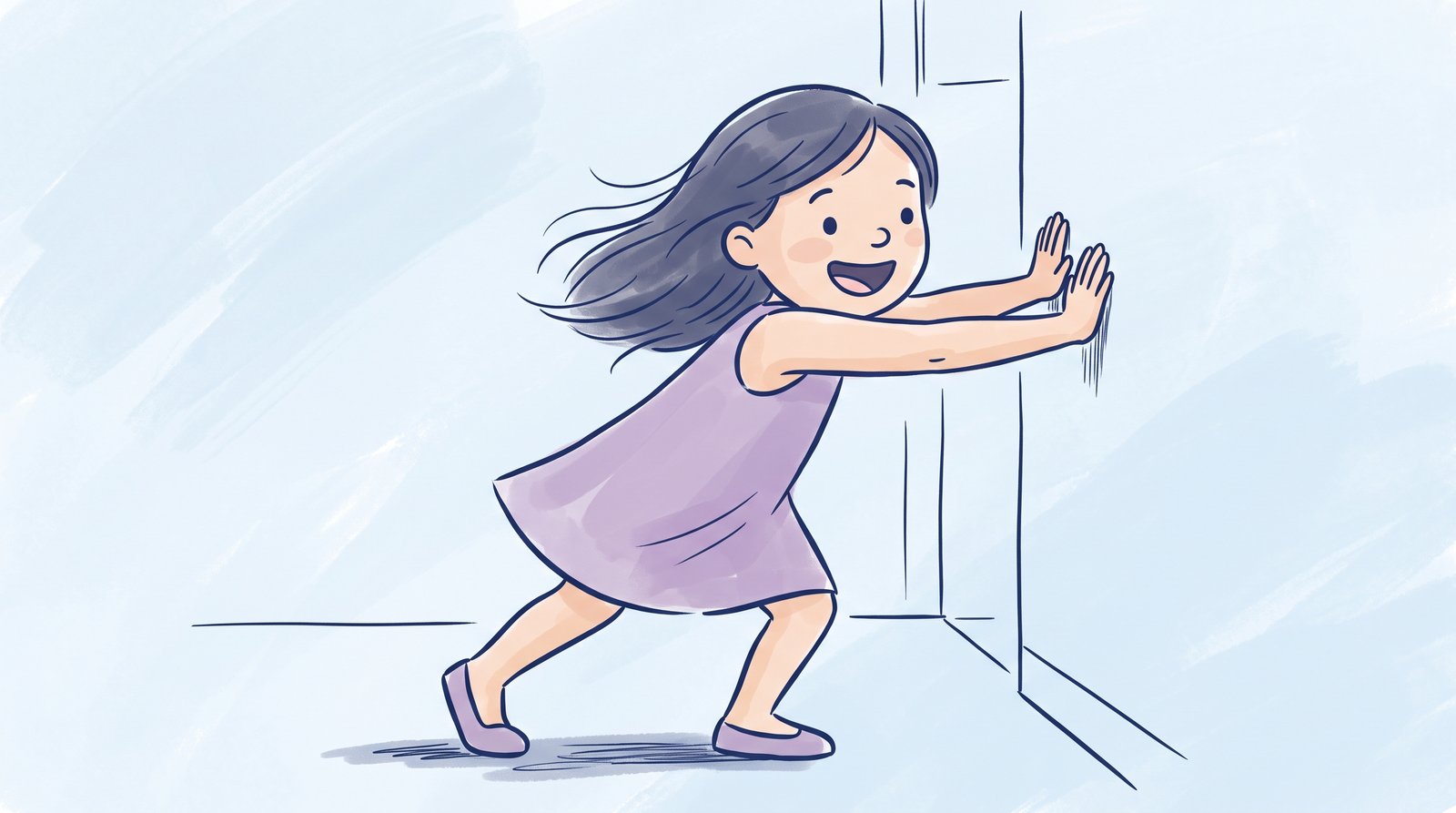
That morning, instead of repeating an instruction she could not take in, I set my keys on the table, knelt on the floorboards and put my palms flat against the wall. I chose quiet co-regulation strategies over demands.
“The front door is locked by heavy stone,” I whispered, keeping my voice low and steady. “We have to push this wall with all our strength for five seconds before it will open.”
She looked at my hands. Slowly, she crawled over on her knees, pressed her palms flat into the plaster beside mine, dug her toes into the runner and pushed with her whole body.
Her breathing slowed and settled, and the panic seemed to leave her eyes. She stood up, picked up her bag and walked out to the car without a single tear.
In this guide:
Plain-Language Terms I Use for Transitions
When you read developmental literature as a parent, the vocabulary can feel distancing. These are three phrases I use at home and in rooms. They are my own plain-language readings, not formal definitions, and I have not sourced them here.
- Stuck in the activity How hard it can be to pull away from something absorbing. It is not stubbornness, and in my experience it looks like friction when a child has to switch to an everyday instruction.
- Crossing into a busier space Stepping out of a quiet, contained play space into a bright, echoing corridor. I suspect the sudden change adds to the load, but I have not seen this measured.
- Seeking firm pressure Some children crash into walls, spin or collapse on the floor during shifts. Occupational therapists sometimes describe this as seeking proprioceptive input. I treat it as one possible reading, not a certain cause.
In our broader guide to the daily routine for neurodivergent children, I look at routines built around how a child is feeling, not only around clock times.
Why Spoken Countdowns Are Not Always Enough
In preschool rooms and parenting guides, we are often told to use verbal countdowns: “Five minutes left, three minutes left, one minute left.” Warnings like these can help many children, and I still use them.
But a spoken warning asks a child to stop what they are doing, take in the words, remember them and plan what to do next. In my experience, a child deep in play may find that a lot to manage, especially in a noisy room.
The Center on the Developing Child at Harvard University describes executive function skills, such as working memory and flexible thinking, and says that stress can make them harder to use.[1] That does not prove that countdowns fail. It is one reason I pair words with something the child can see or do.
Predictability helps too. The Victorian Early Years Learning and Development Framework includes making sequences and procedures clear and predictable among its practices.[2] A visual routine, a clear next step and a movement task can all make a transition easier to follow than words alone.
I used to think repeating the warning would help. For some children it does not, and the repeated prompt can start to feel like pressure. In my experience a child who is already struggling may bolt or shut down, so I now try a movement task before I say the same words again.
In practical sensory micro transitions preschool practice, I offer a simple, concrete movement task during the shift. It builds on the shared-start ideas in our guide on the ADHD start together task trick.
Bridge 1: The Heavy Palm Wall Press
The Heavy Palm Wall Press for Sensory Micro-Transitions Preschool Moments
Proprioception is the sense of where your joints and muscles are without looking. A wall press uses the chest, back and shoulders against firm resistance. Occupational therapists often call this kind of effort heavy work. I use it as a short, shared task, and I do not claim it has been shown to calm children.
- When to Use: Moving from quiet floor building or drawing to seated snack times, group sessions, or gathering belongings.
- How to Cue It: Have the child place both palms flat against a solid wall at shoulder height, step their feet back a little, and push as though trying to slide the wall back. Count slowly to five together.
- Why I Use It: It gives a child something clear and physical to do, and a definite end after five seconds. In my experience, some children settle and some do not. Stop if a child is uncomfortable.
Bridge 2: Weight Bearing Animal Walks
Weight Bearing Animal Walks Across Room Pathways
Open floor spaces often invite sprinting, spinning or bumping into furniture. Turning the walk across the room into a slow animal crawl gives children a clear job to do on the way.
- When to Use: Moving from one part of the room to another, such as from the carpet to the washroom sink, cubbies or verandah.
- How to Cue It: Offer a slow bear walk: hands and feet flat on the floor, hips up, quiet heavy paws. For more ideas, see our guide to animal walks for sensory regulation.
- Why I Use It: A slow crawl takes the place of running and gives the journey a playful purpose, much like an indoor obstacle course for preschoolers does on rainy days. Keep it short, and stop if wrists, knees or shoulders hurt.
Bridge 3: The Delivery Helper Challenge
The Delivery Helper Challenge for Hard-to-Leave Activities
When a child is deeply absorbed, being told to stop can feel abrupt. The Delivery Helper idea offers a purposeful job to do with their hands instead, so the change feels like a new task and not a loss.
- When to Use: Stepping away from absorbing fine motor tasks, screens or complex building toys.
- How to Cue It: Ask the child to carry something light and safe across the room, such as a small basket of wooden blocks or a few picture books. Match the load to the child’s age and strength, and keep it easy to put down.
- Why I Use It: A real job with a clear destination gives the shift a purpose. In my experience, children often like being trusted to help. It is similar to the ideas in our article on the sensory seeking toddler and proprioception.
Bridge 4: The Bilateral Palm Squeeze
The Bilateral Palm Squeeze for Narrow Thresholds
Busy doorways, lines and waiting areas are common trouble spots where children bump into others or pace restlessly. This quiet squeeze needs no floor space.
- When to Use: Waiting at the classroom door, standing in line for the washroom, or pausing in the hallway before leaving the house.
- How to Cue It: Press the palms together in front of the chest, squeeze firmly for four seconds, then release with a slow breath out.
- Why I Use It: It gives restless hands something to do without disturbing the group. Keep the squeeze comfortable, and let a child stop if it hurts or they do not like it.
Safety First: Before You Try These
- Supervision: An adult should be able to see every child during movement games. Services are required to supervise children adequately, and this is separate from ratios.
- Surfaces: Use non-slip surfaces such as carpet, rugs or grass. Avoid slick timber or tiled floors, especially in socks.
- Clear space: Keep play spaces free of sharp corners, electrical cords and hard objects.
- Bodies: Watch wrists, shoulders, knees and backs. Keep each movement short and stop if a child is in pain or does not want to continue.
- Carrying: Choose light, safe items suited to the child’s age and strength. Avoid anything breakable, hot or heavy.
- Choice: Offer, do not force. Never use these movements as a punishment or to hold a child in place.
- Your service’s own rules: Check with your approved provider, centre director or regulatory authority about layout, supervision and risk assessment.
This list is general and does not replace a risk assessment of your own room.
What the Evidence Does and Does Not Show
I want to be honest about this. I have not found studies that test these four movement bridges for transitions, so what I describe comes from practice.
A 2025 systematic review of 21 studies of sensory-based interventions for children found mixed results overall. It reported stronger evidence for deep pressure touch input for sleep and motor outcomes. Proprioceptive input appeared only within programs that combined several kinds of sensory input.[3]
That does not mean movement tasks cannot help. It means I cannot tell you they work, or for whom. If you try one, watch how your own child responds, and keep what helps and drop what does not.
The 4 Movement Bridges at a Glance
The table below sets out my own thinking from practice, not research findings.
| Movement Bridge | What I Think It Offers | Classroom & Home Cue | Best Timing |
|---|---|---|---|
| 1. Wall Press | A short, shared physical task with a clear end. | “Palms flat on the wall. Let us push the wall back together.” | Before moving from carpet play to table tasks or mealtimes. |
| 2. Animal Walk | A playful way to cross a room that replaces running. | “Slow, heavy bear paws across the hallway. No sound on the floorboards.” | Crossing open rooms, hallways, or entering the washroom. |
| 3. Delivery Helper | A purposeful job that gives the shift a reason. | “I need a strong helper to carry this basket over to our reading rug.” | Leaving an absorbing activity or a screen. |
| 4. Palm Squeeze | A quiet task for hands in tight spaces. | “Press your palms together firmly for four seconds, then breathe out.” | Waiting at doorways, queues, or transition thresholds. |
Pairing Movement Bridges with Structured Landing Zones
A movement bridge is only half of the journey. If a child crosses the room like a bear but arrives at a crowded, unclear space, I think they may struggle just as much as before.
I try to make the movement lead toward a clear visual landing zone:
- Keep our visual Pocket Heavy Work Cards on a lanyard or low shelf so children can point to a movement without having to answer a spoken question.
- Pair movement with our printable Visual Routine Cards for ADHD Kids to show the order of the day.
- Anchor the finish line with our First Then Regulation Reset Mats, a clear visual target that shows what comes next.
Need Portable Cues for Smoother Transitions?
Our printable Pocket Heavy Work Cards show child friendly line drawings of animal walks, wall pushes and other movement tasks. They clip onto an educator’s lanyard or a home keyring, so you can offer a choice without lots of words.
Explore Pocket Heavy Work CardsWhen Transitions Are Very Hard
Movement bridges are small supports. They do not replace a plan for a child who finds most transitions overwhelming.
If a child is often very distressed, is hurting themselves or others, or you are worried about their balance, coordination or sensory responses, talk with their family, teacher or GP. Depending on the concern, a paediatrician or an accredited paediatric occupational therapist may be able to help.
Looking back on those mornings when we first arrived in Melbourne, I realise that we did not need more charts, timers or disciplinary systems. We needed a calmer way through the hard moments.
For us, a solid wall to push, a slow crawl across the boards and a quiet spot to land softened the day. That is one family’s experience, and I hope it gives you something to try, not something to measure yourself against.
- Build a state based family rhythm in Daily Routine for Neurodivergent Children: 4 Grounding Stages That Work →
- Explore movement ideas in Animal Walks for Sensory Regulation in Early Childhood →
- Soften room sound in Classroom Noise Sensory Overload: Four Ways to Soften a Loud Room →
- Think about light in Lighting Fluorescent Flicker ADHD: 4 Ways to Soften a Harsh Room →
- Build an opt in quiet retreat with Calm Corner Design Early Childhood: 4 Ways to Build a Quiet Retreat →
- Read about uneven days in Spiky Profiles in Neurodivergent Children: Why Skills Vary →
- Return to our overarching framework on the Sensory Environment in Early Childhood Hub →
Research: the Center on the Developing Child at Harvard University on executive function and stress; and a 2025 systematic review of sensory-based interventions, which found mixed results. Guidance: the Victorian Early Years Learning and Development Framework on predictable sequences.
Experience: the family story, the four movement bridges, the plain-language terms and the table come from my own practice and have not been tested. Last reviewed: 19 October 2026.
Readings and References
- National Scientific Council on the Developing Child. (2011). Building the brain’s “air traffic control” system: How early experiences shape the development of executive function (Working Paper No. 11). Center on the Developing Child at Harvard University. https://developingchild.harvard.edu/resources/building-the-brains-air-traffic-control-system/
- Department of Education and Training Victoria. (2016). Victorian early years learning and development framework: For all children from birth to eight years. State of Victoria.
- Piller, A., et al. (2025). Systematic review of sensory-based interventions for children. Frontiers in Pediatrics, 13.
This article reflects personal family experience and professional early childhood education practice. It is shared for supportive and educational purposes only and is not paediatric, medical or occupational therapy advice. Every child develops at their own pace, with different physical abilities and sensory preferences. If you have ongoing concerns about your child’s balance, coordination, sensory processing or emotional development, please seek individual guidance from your GP, a paediatrician or an accredited paediatric occupational therapist.