
Fight Flight Freeze Children ADHD: 4 Powerful Signs of Autonomic Overload
Recognising fight flight freeze children ADHD patterns shifts our role from disciplinary monitors to biological detectives, decoding how the autonomic nervous system reacts when cognitive demands exceed physiological bandwidth.
In early childhood development, fight flight freeze children ADHD behaviours represent involuntary survival responses triggered by subcortical threat detection. When sensory input, executive demands, or interpersonal interactions overwhelm an ADHD child’s window of tolerance, the sympathetic nervous system or dorsal vagal complex takes immediate control, disabling prefrontal executive function.
- Neuroception: Why the ADHD Nervous System Misinterprets Safety
- 4 Powerful Signs of Autonomic Overload in ADHD Children
- Deconstructing the Trio: Fight, Flight, and Freeze in Action
- Sensory Overload vs. Executive Dysfunction Triggers
- Adult Response Protocol: What to Do in Each Autonomic State
- Connected Guides in the Regulation Cluster
- Academic References & Empirical Frameworks
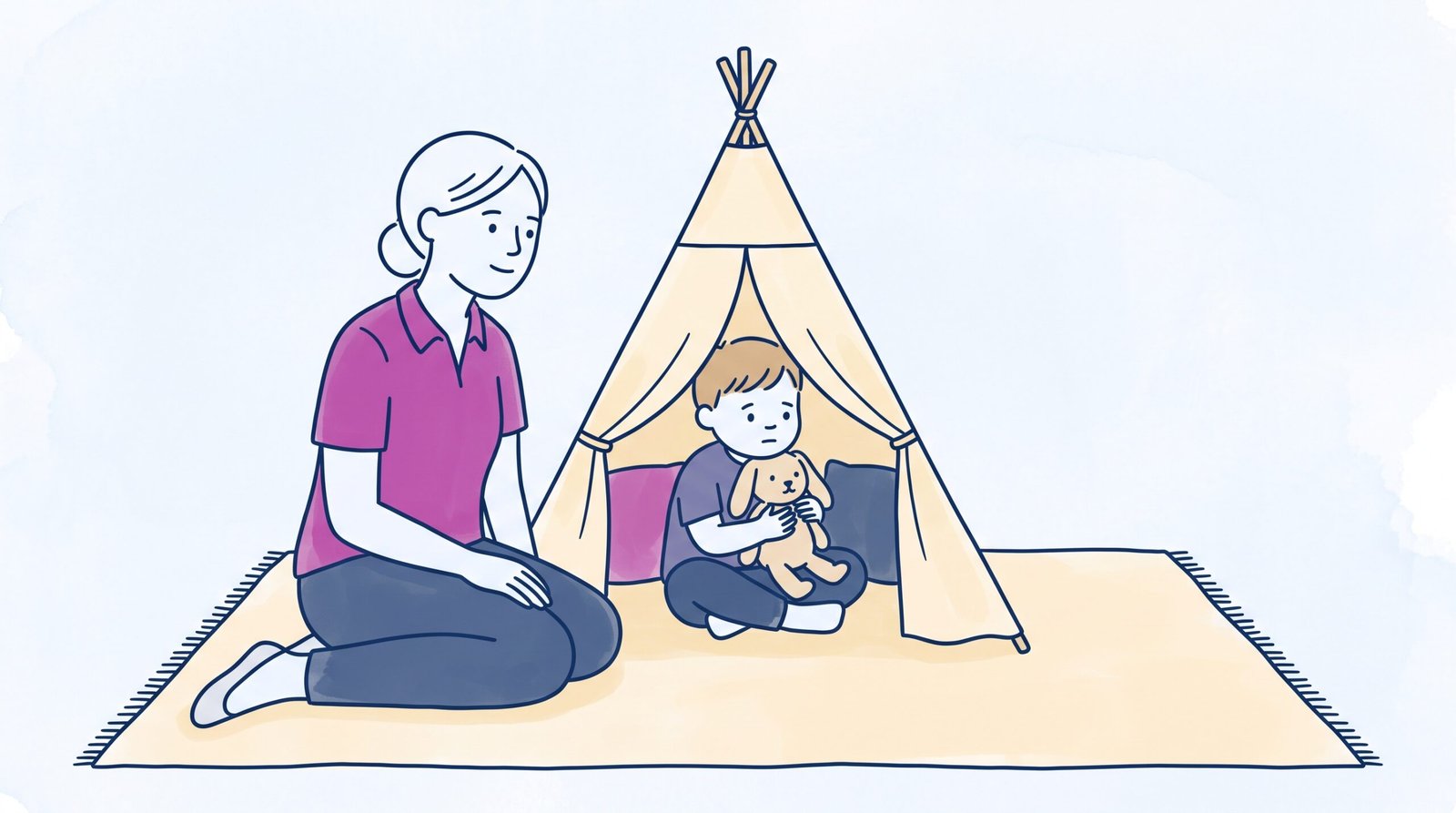
Neuroception: Why the ADHD Nervous System Misinterprets Safety
To understand fight flight freeze children ADHD presentations, we have to look deeper than observable behaviour. We must examine Stephen Porges’ concept of neuroception: the subconscious neural process through which our nervous system continuously evaluates environmental safety, danger, and life threat.[1]
In neurotypical children, neuroception operates with calibrated proportionality. A sudden loud noise or a complex multi-step instruction might cause a momentary spike in arousal, but the social engagement system (ventral vagal complex) quickly evaluates the context, soothes the arousal, and keeps the thinking brain online.
In children with Attention Deficit Hyperactivity Disorder (ADHD), neuroception is frequently hypersensitive or distorted. ADHD brains feature baseline differences in dopamine regulation, altered sensory gating, and heightened reactivity in the amygdala.[2] Routine everyday occurrences—such as a chair scraping loudly across a floor, a sudden transition away from an engaging game, or a sharp tone of voice from an adult—are frequently misidentified by the subconscious brain as existential threats.
As developmental neuroscience from Harvard’s Center on the Developing Child emphasizes, toxic or chronic autonomic stress directly halts higher-order executive processing. Within Australia’s national early education framework administered by ACECQA, creating environments of genuine physical and emotional safety is the non-negotiable prerequisite for all meaningful learning.
4 Powerful Signs of Autonomic Overload in ADHD Children
Before a full behavioural storm manifests, an ADHD nervous system communicates its distress through specific somatic signals. Recognising these 4 powerful signs of fight flight freeze children ADHD reactions allows educators and parents to intervene long before meltdowns become inevitable:
| Autonomic Sign | Somatic Indicator | Common Classroom or Home Misinterpretation |
|---|---|---|
| 1. Ocular Dilatation & Fixation | Pupils visibly dilate; gaze either darts erratically or fixes into an unblinking, hyper-focused stare. | Misdiagnosed as “ignoring the teacher” or “refusing to make respectful eye contact.” |
| 2. Motor Acceleration or Rigidity | Sudden pacing, spinning, clenching fists, or sudden whole-body posture stiffening. | Misdiagnosed as “hyperactive misbehaviour” or “refusing to sit still on the mat.” |
| 3. Pitch Elevation & Word Truncation | Vocal pitch rises into sharp, rapid tones, or expressive speech collapses into one-word answers. | Misdiagnosed as “being rude,” “backchatting,” or “passive-aggressive defiance.” |
| 4. Somatic Defensive Posturing | Shoulders draw upward toward the ears; chin tucks into chest; torso curls inward defensively. | Misdiagnosed as “sulking,” “bad posture,” or “poor attitude.” |
Deconstructing the Trio: Fight, Flight, and Freeze in Action
When observing fight flight freeze children ADHD reactions in the classroom or living room, the survival cascade generally sorts into three clear physiological branches.
1. The “Fight” Response
When the ADHD nervous system determines that danger can be overpowered, it mobilises adrenaline to fight back. In early childhood, this does not typically look like calculated malice; it looks like raw, undirected motor defence.
- Physical Actions: Pushing materials off tables, biting, kicking walls, throwing shoes, or tearing up worksheets.
- Verbal Markers: Screaming “I hate you!”, “You are stupid!”, or argumentative loop repetition where the child refuses to let an adult finish speaking.
- Underlying Biology: Cortisol and adrenaline spike. The heart rate exceeds 140 beats per minute. The child’s brain is literally preparing their muscles to survive an assault.
2. The “Flight” Response
When the subconscious brain calculates that the threat is too large to fight, sympathetic energy shifts into immediate evasion.
- Physical Actions: Bolting from the classroom, sprinting into traffic, hiding behind bookshelves, crawling under heavy tables, or darting away in busy shopping centres.
- Silliness and Clowning: A subtle, frequently misunderstood form of flight is sudden, manic “silliness”—making absurd noises, falling over deliberately, or laughing hysterically during serious moments. This is social flight: fleeing the high-demand situation through relational distraction.
- Underlying Biology: Massive blood flow shunts to the quadriceps and calves. The child experiences an overwhelming, urgent biological impulse to run.
3. The “Freeze” Response
When neither fighting nor fleeing is possible—or when the sensory and emotional environment is so overwhelmingly loud or hostile that the nervous system runs out of energy—it deploys the most ancient survival system: dorsal vagal collapse.
- Physical Actions: Dropping dead-weight to the floor, resting head down on the table, staring blankly through people, or exhibiting selective mutism.
- Behavioural Presentation: The child cannot follow a one-step command. When asked a simple question, they offer zero response. Adults frequently label this as “willful refusal to participate” or “ignoring instructions.”
- Underlying Biology: The vagus nerve drops heart rate and respiration sharply. Blood pressure lowers. Endorphins flood the system to numb physical pain. The brain is effectively playing dead to survive.
Sensory Overload vs. Executive Dysfunction Triggers
Understanding fight flight freeze children ADHD behaviours requires identifying the root pressures that initiate autonomic threat. In ADHD profiles, these triggers rarely emerge from deliberate choices; they stem from two primary vulnerabilities:
- Sensory Overload Cascades ADHD children struggle with sensory filtering. When an early learning space has relentless background noise, flickering fluorescent lighting, or heavy foot traffic, the brain burns immense cognitive fuel just suppressing irrelevant sensory data. Once that reserve runs dry, a tiny sensory nudge pushes the system into fight, flight, or freeze.
- Executive Function Bottlenecks Demanding that an ADHD child transition away from an activity they are hyper-focused on, hold three verbal instructions in working memory, or initiate an uninteresting task creates profound neurological friction. The feeling of cognitive paralysis feels physiologically dangerous, immediately activating a survival response.
- Rejection Sensitive Dysphoria (RSD) Public criticism, such as having a peg moved down a behaviour chart or receiving an exasperated reprimand in front of peers, triggers instantaneous sympathetic arousal. For an ADHD child, emotional rejection registers in the brain through the exact same neural pathways as physical injury.[3]
When an educator or parent assumes the child is “just seeking attention,” our interventions inevitably fail. When we realise the child is in survival defence, our entire pedagogical strategy transforms.
Adult Response Protocol: What to Do in Each Autonomic State
Effective de-escalation of fight flight freeze children ADHD patterns requires matching adult actions to the specific autonomic state the child is inhabiting. Using the wrong tool—such as using physical touch during a fight response or demanding words during a freeze response—actively escalates the crisis.
| Autonomic State | What Escalate the State (DON’T DO) | What Restores Safety (DO THIS) |
|---|---|---|
| FIGHT | Standing over the child, arguing back, issuing warnings, or restraining them physically when safety isn’t compromised. | Lower your body, maintain a 2-metre distance, remove dangerous items, speak in short, low-volume statements: “You are safe. I will keep us safe.” |
| FLIGHT | Chasing aggressively while shouting commands, cornering them into a tight space, or grabbing their wrists. | Shadow at a safe distance to ensure physical safety, keep exit paths clear of hazards, position yourself between the child and real danger (e.g. roads), and wait quietly. |
| FREEZE | Demanding verbal responses: “Look at me, answer me!”, pulling them to their feet, or moving markers on a behavior chart. | Sit down quietly beside them, reduce all language, provide a heavy blanket or proprioceptive pressure if welcomed, and offer unlimited time to unfreeze. |
Once the nervous system re-enters the social engagement zone, real learning and repair can take place. To understand the exact physiological mechanics of post-meltdown recovery, review our step-by-step procedure in Child Meltdown Co-Regulation: 3 Powerful Steps →
Similarly, replacing punitive tracking systems with visual and somatic scaffolding prevents these survival responses from being triggered in the first place. Read our detailed breakdown in ADHD Behaviour Strategies: Why Behaviour Charts Fail →
• Master our practical somatic de-escalation protocol in Child Meltdown Co-Regulation Guide →
• Discover why traditional rewards trigger acute survival states in ADHD Behaviour Strategies Guide →
• Return to our cluster foundation for broader models on Regulation and Behaviour in Early Childhood →
Academic References & Empirical Frameworks
- Porges, S. W. (2011). The Polyvagal Theory: Neurophysiological Foundations of Emotions, Attachment, Communication, and Self-Regulation. W. W. Norton & Company. [Autonomic nervous system mapping, neuroception, and social engagement mechanics].
- Barkley, R. A. (2015). Attention-Deficit Hyperactivity Disorder: A Handbook for Diagnosis and Treatment (4th ed.). Guilford Press. [Amygdala hyper-reactivity, executive dysfunction, and emotional dysregulation in ADHD].
- Eisenberger, N. I., & Lieberman, M. D. (2004). Why rejection hurts: A common neural alarm system for physical and social pain. Trends in Cognitive Sciences, 8(7), 294-300. [Neurobiological basis of rejection sensitive dysphoria and autonomic alarm].
- Shanker, S. (2016). Self-Reg: How to Help Your Child (and You) Break the Stress Cycle and Successfully Engage with Life. Penguin Random House.
- Delahooke, M. (2019). Beyond Behaviors: Using Brain Science and Compassion to Understand and Solve Children’s Behavioral Challenges. PESI Publishing.