
Calm Corner Design in Early Childhood: 4 Simple Steps to Build a Safe, Quiet Calm Corner
A calm corner is a small, quiet, opt-in space where an overwhelmed child can rest and reset. Good calm corner design in early childhood usually means a solid back, soft materials, gentle light and clear adult sightlines, and it means no child is ever sent there as a punishment.
It’s a safe place to rest without shame or an audience. These ideas come from my own practice and family life. I haven’t found studies that directly test calm corners, and I say so throughout.
Thoughtful calm corner design in early childhood starts with setting aside the traditional time out chair. A real calm corner isn’t a place where a child goes to think about their choices. It’s a quiet place where an overwhelmed child can rest and come back to themselves.
I still remember the late afternoon storms in our home soon after we moved to Melbourne in 2010. My eldest daughter was seven and had just started primary school, and her little sister, nearly five, was waiting to start Prep.
I didn’t have the words or the community around neurodivergence back then, and I didn’t yet know that my eldest and I were both living with undiagnosed ADHD.
By four o’clock, our open plan dining area was too much for her. She’d stand by the bright dining window, small hands clenched into fists, sobbing and kicking the skirting boards.
Earlier that term, I’d followed conventional parenting advice. I’d set up a bright little table in the open corner of our dining space, complete with a laminated emotion wheel, an hourglass sand timer and a plastic tub of squishy neon toys.
When I gently suggested she sit at her little table, she didn’t feel comforted. She screamed, swept the hourglass off the table so it shattered on the floorboards, and threw the emotion wheel across the room before wedging her whole body into the narrow, shadowy gap behind our heavy sofa.
Standing there among the scattered plastic, parenting felt like wading through deep water. Only much later, after my daughter was diagnosed with ADHD as an adult and I had my own diagnosis, did I start to read about why that gap behind the sofa might have felt safer to her than my little table.
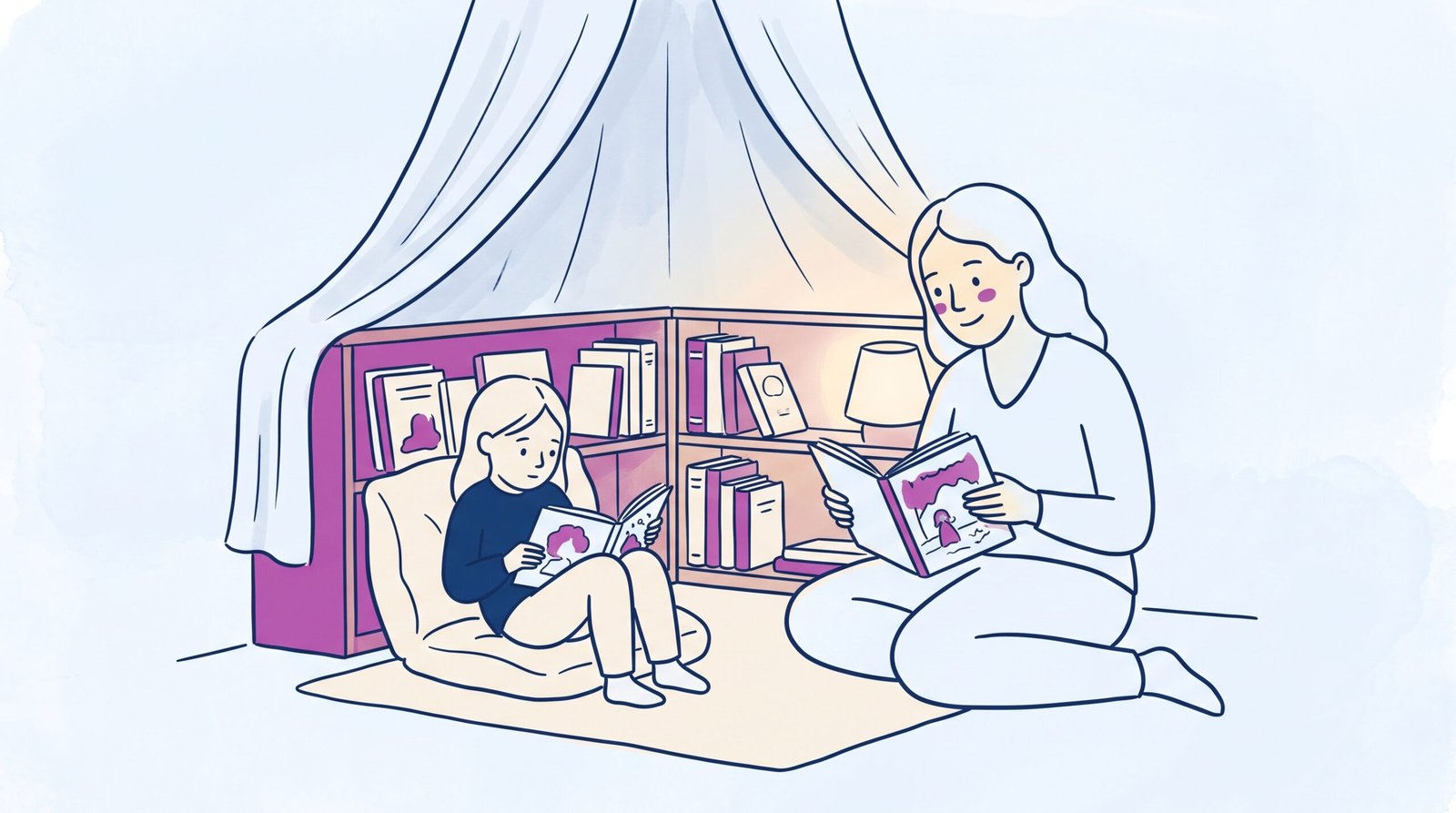
Watching her wedge herself behind the couch taught me to follow her lead. We packed away the laminated charts, cleared the sheltered spot behind the sofa, laid down a thick second hand wool rug, stacked firm calico floor cushions against the solid wall and, at the time, hung a low fabric canopy overhead to shade her eyes. (Knowing what I know now about fire and safety, I’d skip the canopy, and I explain why in the safety section below.)
The next time the world felt unbearable, she didn’t kick the skirting board. She slipped quietly into her nook, pulled a knit blanket over her shoulders and pressed her back against the solid wall. Within minutes, her breathing softened.
My understanding of calm corners comes from that hindsight, from my training, and from my later years working in early learning rooms. It isn’t from a study, and I’ll be clear throughout about what’s research and what’s experience. Along the way you’ll find nine free printables for parents and educators, phrases to use, and a calm corner audit you can print.
In this guide:
Why Standard Calm Corners Can Fall Short
Walk into almost any early learning centre, kindergarten or primary classroom in Australia and you’ll probably see a space labelled as a calm down zone. In my experience, some children refuse to use them, and a visit to the corner can end in tears.
I think three misunderstandings are behind most of these cases:
- They Expose the Child to the Whole Room A small rug or chair in the middle of a room, or right beside an educator’s desk, leaves a child in full view of everyone. A child who already feels vulnerable may find it much harder to settle when twenty peers can see them.
- They Ask for Complex Thinking Laminated feelings charts, breathing dials and reflection sheets assume that distress is something a child can work out on paper. The Center on the Developing Child at Harvard University describes how stress can make executive function skills harder to use.[1] In my experience, a child in that state often can’t use an emotion wheel. Those tools tend to work much better when practised on calm days.
- They’re Used as Hidden Discipline Sending a child to the calm corner because they grabbed a toy turns a retreat into a punishment. The child may then link the space with shame, exclusion and anger.
Quality Area 3 of the National Quality Standard covers the physical environment. It asks that facilities are safe, well maintained and fit for purpose, and that the environment is inclusive, with adjustments that support every child to take part.[2] A calm corner is one way a service might act on that. As far as I know, there’s no requirement to have one.
Calm Corner vs Time Out: What’s the Difference?
People often ask whether a calm corner is just a nicer name for time out. It isn’t, though the two can look similar from the outside.
| Feature | Calm Corner | Time Out |
|---|---|---|
| Purpose | Rest and recovery when a child feels overwhelmed. | A brief, planned consequence for a specific behaviour. |
| Who decides | Ideally the child chooses it, or accepts an invitation. | The adult decides. |
| Adult role | Stays close, calm and available. | Steps back briefly, then reconnects. |
| How it should feel | Cosy, private and safe. | Short, calm and not harsh. |
It’s worth being fair about time out. Australian researchers Mark Dadds and Lucy Tully reviewed the evidence and argued that time out, used calmly, briefly and within a warm relationship, is an effective part of many parenting programs and isn’t harmful for most children.[11] So this isn’t about judging families who use it. It’s about keeping the calm corner as a separate, safe place for recovery, so children never confuse the two.
If you’re thinking about behaviour more broadly, my post on ADHD behaviour strategies looks at charts, rewards and limits, and regulation and behaviour is the hub for this whole topic.
Why a Small, Enclosed Calm Corner May Help
Why might a small, semi enclosed space help a distressed child settle faster than an open room? I don’t have a tested answer. What I have is my daughter wedging herself behind our sofa, and a few ways of thinking about it.
Architect Magda Mostafa’s ASPECTSS framework for designing schools for autistic children includes “escape” spaces, quiet places a child can retreat to from busy areas, alongside ideas like acoustics, sensory zoning and safety.[7] It’s a design framework for autistic learners rather than a study of calm corners, but it shows designers have been thinking about retreat spaces for a long time.
Another lens comes from polyvagal theory, developed by Stephen Porges, which proposes that our nervous system constantly scans for signs of danger or safety, a process he calls neuroception.[3] The theory is popular but contested, and some researchers dispute its biology.[4],[5] I use it as one way of describing what I see, not as established fact. I explore it more in polyvagal theory and early childhood meltdowns.
Through that lens, a child in the middle of a big, open room with lots of doorways, moving peers and scraping chairs has a lot to keep track of. A nook with a solid back and sides cuts down how much they need to watch.
Whatever the explanation, I’ve often seen children settle more easily in a small, quiet, enclosed space. I’ve seen others who don’t, and a child who is frightened of small spaces should never be sent into one. Noisy, echoing rooms can be tiring for many children, which I explore in the sensory environment in early childhood.
4 Simple Steps of Calm Corner Design in Early Childhood
These four steps come from what has worked for me at home and in early learning rooms. They’re practical ideas, not a tested program. Safety comes first, so please read the safety section after the steps before you build.
1. Spatial Nesting: The Shape of a Calm Corner
In my experience, a corner with a solid back and some enclosure helps many children settle. The shape must still let an adult see the child at all times. Australian guidance expects services to supervise children adequately, and premises to be designed to make that possible.[6]
- Enclose up to three sides: Place the retreat against two walls, and use a low bookshelf or storage unit as a third side. The open side should face a calmer part of the room.
- Give them a solid back: When the child sits or curls up, their back should rest against something firm and steady. Many children seem to like this.
- Keep adult sightlines: The bookshelf should be about child shoulder height. A seated child has privacy from standing peers, while an educator across the room can still see them at a glance.
- Never close it off: Leave a wide, clear opening. A child must be able to leave easily, and an adult must be able to reach them quickly.
Supervision and fire safety rules vary by service, so check with your approved provider, centre director or regulatory authority before changing your layout.
2. Softer Sound and Light
An open corner surrounded by bare walls and lit by harsh overhead tubes can feel loud and bright. In a study of 153 UK primary school classrooms, Barrett and colleagues found that light, along with six other design features, was associated with pupils’ academic progress.[8] That’s an association in primary schools, not proof that changing one feature changes a child’s comfort, and it says nothing about calm corners specifically.
- Soft, non-slip flooring: A thick rug with a non-slip underlay and a few firm floor cushions can make the space feel quieter and more comfortable. Check the edges so the rug isn’t a trip hazard.
- Flat fabric wall panels: Fabric panels or framed fabric canvases may take the edge off echoes. Fix them flat to the wall, out of reach, with no loose cords or loops, and check they meet your fire safety rules. See classroom noise and sensory overload for more.
- Gentler light: If overhead tubes are harsh, ask your facilities manager about switching some off or fitting approved diffusers. Never hang fabric over or under light fittings, and don’t hang canopies over a child’s space. A small, stable lamp with a warm globe, cord out of reach and nothing draped on it, is a lower risk option where your service allows lamps. More in fluorescent lighting and ADHD.
3. Body Anchors and Weight
When an emotional storm peaks, words rarely get through. My daughter chose a blanket in our sofa nook, and many children like firm cushions and a feeling of being snug. But I want to be honest about the evidence.
The Royal College of Occupational Therapists’ guide says the research on weighted blankets is mixed, and recommends individual risk assessment and supervision.[9] A 2024 review of eight trials in people with mental health conditions found a small reduction in anxiety, but many studies had a high risk of bias and the authors called for more research.[10] That review wasn’t about young children.
- Firm floor cushions and a wedge: A firm foam or kapok wedge lets a child lean into the space. Keep cushions firm enough that a child’s face can’t sink into them.
- Light knit blankets: A light blanket over the shoulders gives a sense of cover. Keep faces uncovered.
- Weighted items only with advice: If you’re thinking about a weighted lap pad or toy, ask your child’s occupational therapist first. Follow the manufacturer’s weight guidance (the RCOT guide notes the usual limit is no more than 10 percent of body weight), never use weight to hold a child in place, and always keep the child in sight.[9]
Many children who seek lots of body input find big movement calming before or after rest. See sensory seeking and proprioception, animal walks and my free pocket heavy work cards.
4. Low Demand Calm Corner Resources
Materials in a calm corner shouldn’t ask a child to solve a problem, show a skill or reach a goal. Look for things that are open ended, pleasant to touch and safe for the youngest child who might use them.
- Smooth natural objects: A small basket of wooden eggs, felted wool balls or large smooth stones offers calm touch without batteries, beeps or lights. Choose items too big to swallow, and leave small objects out wherever children under three can reach them.
- Sealed liquid motion tubes: Some children love watching droplets slowly fall. Choose a well made, child safe product, check it often for cracks or leaks, and keep it where an adult can see it in use.
- Familiar wordless books: Two or three familiar, beautifully illustrated books with few words. Sensory friendly literacy has more ideas for calm reading.
- A simple picture card: One picture showing “sit, breathe, rest” can help some children, as long as it’s an option, not a task. My first then reset mats work well here.
Taking away demands fits the unhurried approach in how to foster a love of learning without overcomplicating things.
What to Put in a Calm Corner: A Simple Checklist
You don’t need to buy much. Here’s a simple checklist to start with, then adjust for your children:
- Base: A thick rug with non-slip underlay, or a firm floor mat.
- Seating: Two or three firm floor cushions or a wedge to lean against.
- Cover: A light blanket, kept away from faces.
- Touch: A small basket of large, smooth, safe objects.
- Watch: One sealed, sturdy motion tube or a simple picture book.
- Hearing: Noise reducing earmuffs for children who find sound hard.
- Light: Softer room light, or a safe lamp where allowed.
What to leave out: bright laminated charts, timers, screens, flashing or noisy toys, and anything small enough to swallow. Less really is more. If you’re on a tight budget, low cost sensory classroom setup and making learning fun without breaking the bank have plenty of cheap ideas.
Calm Corner Safety: What to Check Before You Build
- Supervision: An adult must be able to see the child, and the corner mustn’t create a blind spot. ACECQA explains that adequate supervision is a legal requirement under section 165 of the National Law, separate from educator to child ratios, and that educators should identify and monitor blind spots.[6]
- Fabric and fire: Don’t hang fabric over or near lights or heat sources, and don’t hang canopies, cords or loops where a child can reach them. Check your fire safety rules before adding wall textiles.
- Lamps and cords: Keep cords out of reach, lamps stable and nothing draped on or near them.
- Small parts and age: Check every item against the youngest child who could use it. Leave small objects out around children under three.
- Weighted items and soft bedding: Use only with advice from the child’s occupational therapist, and never to restrain. Keep faces uncovered and cushions firm.
- Other children: A quiet space can become a hiding or rough play space. Agree on the rules and supervise them.
- Your service’s own rules: Your approved provider, centre director or regulatory authority has the final say on layout, materials and risk assessment.
This list is general and doesn’t replace a risk assessment of your own room.
Commercial Setups and Quiet Calm Corners at a Glance
The table below sets out my own preferences from practice, not research findings.
| Design Feature | Common Commercial Setup | Quiet Retreat | Why I Choose It |
|---|---|---|---|
| Placement | Open, near educator desks, doors or busy paths. | An edge of the room with a solid back, partial enclosure and an adult sightline. | Gives some privacy from peers while an adult can still see the child. |
| Walls | Laminated feelings wheels, emotion faces and breathing charts. | Plain, flat, fire safe coverings in muted tones. | Keeps things visually quiet and asks nothing of the child. |
| Sensory items | Tubs of noisy neon squish toys and pop tubes. | Firm cushions, smooth natural objects, and weighted items only with advice. | Offers calm touch without bright lights or noise. |
| Lighting | Harsh overhead fluorescent tubes. | Softer light: tubes switched off or diffused with approval, plus a stable warm lamp where allowed. | Reduces glare. Check the safety notes first. |
| Access | Sent there: “You made a poor choice, go to the corner.” | Opt-in: always open, freely chosen, never used as discipline. | Protects dignity and treats settling as a skill to learn, not a punishment. |
Calm Corner Design by Age
A calm corner looks a bit different depending on who’s using it.
| Age | What Helps | Adult Role |
|---|---|---|
| Toddlers (1 to 3) | A soft, very simple space with big, safe items only. Nothing small enough to mouth. | Toddlers rarely calm alone. An adult usually sits in or right beside the space, offering comfort. |
| Preschoolers (3 to 5) | A cosy nook, a few calm objects, maybe a simple picture card showing “sit, breathe, rest”. | Stay close and quiet. Many preschoolers start choosing the space themselves once it feels familiar. |
| Early school years (5 to 8) | A slightly more private retreat, some books, and calming tools they’ve practised on good days. | Stay nearby and available, then talk things through once they’re calm. |
Whatever the age, an adult’s calm presence matters as much as the space itself. My post on coregulation strategies in early childhood explains how to sit with a child while they settle, and toddler hair pulling and frustration looks at big feelings in the youngest children.
Calm Corners for Neurodivergent Children
For many autistic children and children with ADHD, a calm corner can be a real lifeline in a busy room. But neurodivergent children aren’t all the same, and good design follows the individual child.
- Some need less input: Darker, quieter and plainer, with earmuffs and nothing busy to look at.
- Some need more input: A child who seeks movement may calm faster with a quick heavy work break first, then a rest. Rocking, squeezing a cushion or pushing against a wall can all be part of calming.
- Some don’t want small spaces: If a child finds enclosed spaces frightening, offer a quiet seat at the edge of the room instead.
- Predictability helps: Showing the calm corner on visual routine cards or in the daily routine helps some children know it’s always there.
- Capacity changes: A child who needs the corner a lot one week may hardly use it the next. That’s normal, and I explain why in why your child can do it some days and not others and spiky profiles in neurodivergent kids.
Girls in particular may use a calm corner quietly, to recover from masking all day, so it’s easy to miss how much they need it. My posts on signs of ADHD in girls and autism in girls explain more.
How to Make a Calm Corner at Home
At home, you don’t need a whole corner. Like our gap behind the sofa, a calm spot can be very small.
- Use what you’ve got: The space beside a bookshelf, under a sturdy table with a blanket over the sides (open at one end), or a corner of the bedroom can all work.
- Make it easy to see: Choose a spot you can glance at from the kitchen or lounge.
- Let your child help: Choosing the cushions or the blanket gives them ownership.
- Use it in the hard moments: Many families find after school and before dinner are the toughest times. A calm spot nearby can soften that crash. See child meltdown co-regulation.
- Think about bedtime too: A calm corner can be part of a gentler wind down. I talk about evenings in toddler sleep resistance ADHD.
A big cardboard box with cushions inside, open at both ends, can make a lovely temporary den too. My post on cardboard box activities at home has the safety checks.
A Calm Corner in Action: Inside a Victorian Kindergarten Room
Here’s a scene that shows how the same moment can go differently with and without a calm corner. It’s based on a real moment in a community kindergarten in Melbourne, with the child’s name changed.
I’ve written it two ways: the first as I saw it, and the second as I think it could have gone. Please treat it as an illustration, not a record.
The Traditional Time Out Approach (The Escalation):
It’s half past ten on a rainy Thursday. The room is bustling with twenty four children. Four year old Noah is building a tall wooden bridge in the block area.
A passing friend accidentally bumps his tower, sending the blocks clattering across the bare lino. Noah screams, knocks over the next building and shoves his classmate into a shelf.
The educator strides over, takes Noah by the arm and says: “We don’t push. Go and sit in the calm corner and look at the emotion chart until you’re ready to say sorry.” Noah sits on the exposed rug in full view of everyone, red faced and sobbing.
He tears the feelings chart off the wall and throws it at the door.
A Quiet Retreat Approach (How It Could Have Gone):
Same rainy Thursday, same falling tower. Noah screams and raises his hands to shove his classmate. The educator steps between the children and lowers herself to the floor: “The blocks made an enormous crash. That was a shock. Your body is telling you it’s time for a quiet rest.” She points to the three sided nook: “The big cushions are waiting in the quiet corner. Let’s walk over together.”
Noah goes into the nook, lies on the thick rug and leans into the cushions. The educator sits just outside the bookshelf, where she can see him, and says nothing.
After about five minutes, Noah sits up, picks up a smooth stone and takes a slow breath. He rejoins the group a little later, calmer and ready to reconnect. Later, they talk about what happened and help rebuild his friend’s tower together.
A scene like this can’t prove that calm corners work. One example proves nothing. For me it shows a difference in approach, which I explore in regulation before learning. It’s hard to teach cooperation to a child in the middle of a storm, and much easier once they’re calm. To understand Noah’s reaction, fight, flight and freeze in children is a helpful read.
How to Introduce and Run Your Calm Corner
Even a lovely physical space won’t help if the culture around it isn’t right. These are the rules I’d start with. Adjust them for your room and your children:
- Introduce it on a calm day: Try not to show a child the calm corner for the first time in the middle of a meltdown. Introduce it on a quiet morning. Sit inside together, feel the cushions, touch the smooth objects, and explain that it’s a place for anyone whose body feels fast or tired.
- Practise calming tools when calm: Slow breathing, squeezing a cushion or looking at a book are much easier to use in a hard moment if you’ve practised them on good days.
- Hold back the questions: When a child goes into the corner, resist following them in with “What made you upset?” or “How are you feeling?” Save the talking for later, when they’re rested. Stay close enough to supervise.
- One child at a time, at first: The calm corner isn’t a cubby or clubhouse. Agree as a group that when one child is resting, others don’t lean over, talk to them or climb in. Adjust this to what you can safely supervise.
- Let children see you use it: Model it out loud: “My ears are tired from all our busy play. I’m going to take a slow breath by the quiet corner.” Seeing adults use it makes it feel less like a place for children in trouble.
- Share with families: Let families know about the calm corner so they can use similar language at home. Connecting with parents without endless meetings has simple ways to do this.
Getting into and out of the corner is a transition too. Sensory micro transitions has gentle ways to help children move back into the group.
Free Calm Corner Printables for Parents and Educators
A calm corner works best with very little on the walls, so think of these as tools to keep nearby rather than posters to put up. All are free PDFs from this site. Print one or two that suit your children, practise with them on calm days, and keep them in a basket just outside the nook.
Calm Shapes Breathing Cards
Trace a shape with a finger while breathing slowly. Simple enough for preschoolers once practised.
Download A4 PDF For home and roomsFirst Then Reset Mats
A gentle picture of what comes next: “first rest, then play”. Helpful for leaving the corner.
Download PDF For home and roomsPocket Heavy Work Cards
Six movement breaks for children who need to move before they can rest.
Download PDF For home and rooms“Big Feelings” Storybook
A simple book to make together on a calm day, then keep in the calm corner basket.
Download A4 PDF For home and roomsVisual Routine Cards
Show the calm corner as part of the day, so children know it is always there.
Download PDF For home and roomsDaily Routine Chart
Add a “quiet time” or “rest” picture to your family’s day.
Download A4 PDF Best for familiesSensory Space Audit Checklist
Walk the whole room for noise, light and clutter, not just the calm corner.
Download PDF Best for educatorsWeekly Lesson Plan Template Pack
Plan when to introduce and practise the calm corner, and note what you observe.
Download A4 PDF Best for educatorsCalm Corner Space Audit
Our one-page check of nesting, sound, light and tools, with safety prompts.
Print it below For home and roomsYou’ll find more on our free printables page. A tip from practice: introduce one new card at a time, and never use a printable as a task the child must finish before leaving the corner.
What to Say When a Child Uses the Calm Corner
The words around a calm corner matter as much as the cushions. These are phrases I have found helpful, and some to avoid.
| Instead of | Try |
|---|---|
| “Go to the calm corner and think about what you did.” | “The quiet corner is there if your body needs a rest.” |
| “What’s wrong? Why are you upset?” | Nothing yet. Sit nearby quietly, then later: “That was a big feeling.” |
| “You can come out when you say sorry.” | “Come out whenever you’re ready. I’m right here.” |
| “Use your breathing card now.” | “I’m going to take a slow breath too.” (Then model it.) |
| “Stop crying.” | “It’s okay to cry. You’re safe.” |
| “You’ve been in there too long.” | “When you’re ready, the playdough is waiting at the table.” |
Short, warm and low in demands usually works best. There is more on sitting with a child through big feelings in child meltdown co-regulation.
When a Calm Corner Isn’t Enough
A calm corner is one small support. It doesn’t replace a plan for a child who is often very distressed.
If a child is regularly aggressive, hurts themselves, or spends much of the day in the corner, talk with the family and your team about what’s going on. Depending on the concern, an occupational therapist, psychologist, speech pathologist or paediatrician may be able to help. For educators planning for several children, how to stop writing a separate plan for every kid is a practical read. And if you’re feeling stretched yourself, parent and teacher burnout is for you.
Free Printable: Calm Corner Space Audit
A landscape A4 checklist for preschool rooms and family homes. Walk through your quiet retreat from child eye level and note what you see, including safety.
Calm Corner Space Audit
Look at your quiet retreat from child eye level.
Nesting and Sightlines
Is there a solid back and an easy exit, and can an adult always see the child?
Softer Sound
Are rugs non-slip, and are wall textiles flat, fire-safe and out of reach?
Gentler, Safer Light
Is glare softened, with cords out of reach and no fabric near lights?
Low Demand Tools
Is every item safe for the youngest child, with weighted items only on advice?
Rooting a calm corner in comfort and respect, not compliance, is where I’d start. I want children to learn that feeling overwhelmed isn’t a character flaw, and that taking a pause to rest is a sensible, healthy thing to do.
Looking back on those early Melbourne years, that simple spot behind our sofa carried our family through many after school storms, long before we knew about Bella’s ADHD or my own.
There were no timers, no star charts and no expectations inside that nook. Just a soft wool blanket, a firm cushion, and the quiet promise that there was always a safe place to rest.
Calm Corner FAQs
What is a calm corner in early childhood?
A calm corner is a small, quiet, opt-in space where an overwhelmed child can rest and reset. It usually has a solid back, soft materials and gentle light, and an adult can always see the child. It’s a place for recovery, never a punishment.
What should I put in a calm corner?
Keep it simple: a non-slip rug, a few firm cushions, a light blanket, a small basket of large smooth objects, a sealed motion tube or picture book, and earmuffs. Leave out charts, timers, screens, noisy toys and anything small enough to swallow.
Is a calm corner the same as time out?
No. A calm corner is a space for rest that a child chooses or is gently invited to, with an adult close by. Time out is a brief, adult-led consequence. Research suggests calm, brief time out can be helpful within a warm relationship, but it’s best kept separate from the calm corner so children don’t confuse the two.
Do calm corners work?
There’s very little research testing calm corners directly. Many educators and families find them helpful, especially when they’re opt-in, private and supervised, and when calming tools are practised on good days. Treat a calm corner as one support among many.
Are weighted blankets safe in a calm corner?
Only with advice from your child’s occupational therapist. Research on weighted blankets is mixed, and the Royal College of Occupational Therapists recommends individual risk assessment and supervision. Never use weight to hold a child still, and keep faces uncovered.
- The bigger picture: the sensory environment in early childhood
- Softening echo and clatter: classroom noise and sensory overload
- Softening harsh light: fluorescent lighting and ADHD
- On a budget: low-cost sensory classroom setup
- Movement resets: sensory micro-transitions in preschool
- Sitting with a child: co-regulation strategies
- Why calm comes first: regulation before learning
- Rethinking charts and rewards: ADHD behaviour strategies
- Children who sit apart at group time: when a child won’t sit for circle time
- All our free tools: printables page
Research: the Center on the Developing Child at Harvard University on executive function and stress; an association between classroom design and pupils’ progress in UK primary schools (Barrett and colleagues); mixed evidence on weighted blankets; and a review of time out (Dadds and Tully). Design: Mostafa’s ASPECTSS framework, which includes escape spaces.
Guidance: the National Quality Standard and ACECQA’s supervision requirements. Contested: polyvagal theory, which is widely used but disputed. Experience: the four steps, the tables, the phrases, the family story and the kindergarten scene come from my own practice and haven’t been tested.
The child in the kindergarten scene has a changed name. Last reviewed: 7 November 2026.
References and Readings That Guided Me
- National Scientific Council on the Developing Child. (2011). Building the brain’s “air traffic control” system: How early experiences shape the development of executive function (Working Paper No. 11). Center on the Developing Child at Harvard University. developingchild.harvard.edu
- Australian Children’s Education and Care Quality Authority. Quality Area 3: Physical environment. acecqa.gov.au
- Porges, S. W. (2011). The polyvagal theory: Neurophysiological foundations of emotions, attachment, communication, and self-regulation. W. W. Norton & Company. [A contested model, used here as a descriptive lens].
- Grossman, P. (2023). Fundamental challenges and likely refutations of the five basic premises of the polyvagal theory. Biological Psychology, 180, Article 108589. https://doi.org/10.1016/j.biopsycho.2023.108589
- Neuhuber, W. L., & Berthoud, H.-R. (2022). Functional anatomy of the vagus system: How does the polyvagal theory comply? Biological Psychology, 174, Article 108425. https://doi.org/10.1016/j.biopsycho.2022.108425
- Australian Children’s Education and Care Quality Authority. Supervision requirements under the NQF. acecqa.gov.au
- Mostafa, M. (2014). Architecture for autism: Autism ASPECTSS™ in school design. Archnet-IJAR: International Journal of Architectural Research, 8(1), 143-158. https://doi.org/10.26687/archnet-ijar.v8i1.314 [Seven design principles: acoustics, spatial sequencing, escape, compartmentalisation, transition spaces, sensory zoning and safety].
- Barrett, P., Davies, F., Zhang, Y., & Barrett, L. (2015). The impact of classroom design on pupils’ learning: Final results of a holistic, multi-level analysis. Building and Environment, 89, 118-133. https://doi.org/10.1016/j.buildenv.2015.02.013 [An association in UK primary school classrooms].
- Royal College of Occupational Therapists. (2023). Weighted blankets for children and adults: A guide for occupational therapists. rcot.co.uk
- Zhao, Y., Zhang, Q., Liu, Z., Zhao, Z., & Zhu, Q. (2024). Safety and effectiveness of weighted blankets for symptom management in patients with mental disorders: A systematic review and meta-analysis of randomized controlled trials. Complementary Therapies in Medicine, 87, Article 103104. https://doi.org/10.1016/j.ctim.2024.103104
- Dadds, M. R., & Tully, L. A. (2019). What is it to discipline a child: What should it be? A reanalysis of time-out from the perspective of child mental health, attachment, and trauma. American Psychologist, 74(7), 794-808. https://doi.org/10.1037/amp0000449
