
Why Child Can Do It Some Days Not Others: ADHD Skills Inconsistency Explained
If you find yourself asking why child can do it some days not others after watching your little one complete a routine task on Tuesday only to fall apart over the identical expectation on Thursday, you are witnessing the core reality of neurodivergent capacity swings. This inconsistency is not defiance, laziness, or calculated manipulation. It is the visible sign of fluctuating neurological energy where physical and cognitive fuel changes based on environmental noise and internal stamina.
Understanding why child can do it some days not others begins by challenging an assumption common in homes and schoolrooms: the idea that once a young learner demonstrates a developmental skill, that ability becomes a permanent, reliable baseline every single morning.
When an adult sees a child tie their shoes, write sentences neatly, or pack a school bag on Tuesday, we expect them to reproduce that performance on Thursday. When that performance collapses into tears, refusal, or frantic running, relatives and educators often assume the child is choosing when to cooperate and when to be obstinate.
Having lived through these uneven days as an early childhood researcher holding a doctorate from Deakin University and as a parent with ADHD raising two daughters in Victoria, I know how heavy that misunderstanding feels. My own adult brain experiences the same swings: on full fuel days I can organise academic datasets and coordinate community projects, yet when sensory fatigue drains my battery, buttering toast or answering a phone call feels like wading through wet cement.
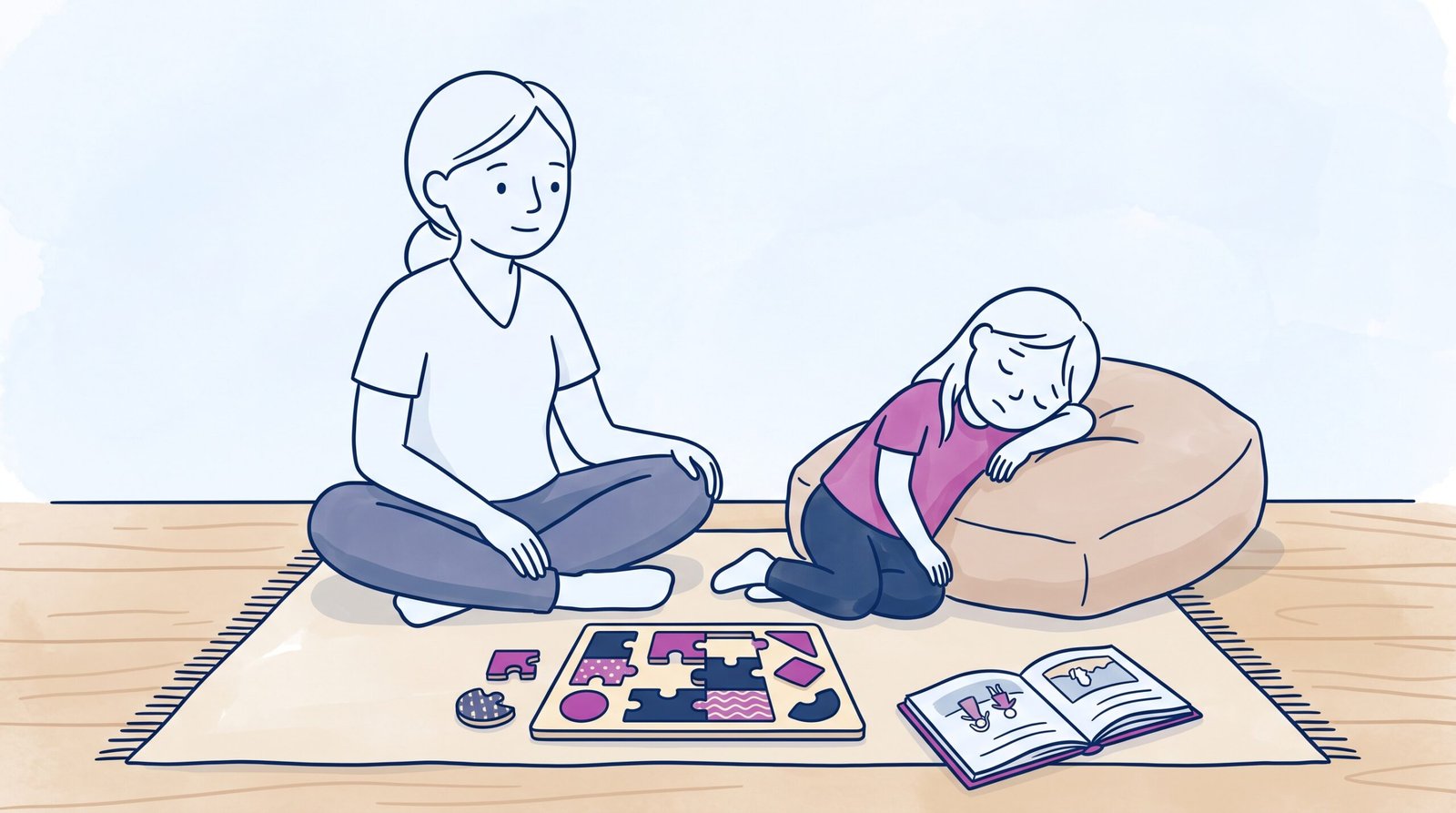
In this comprehensive capacity guide:
Why Child Can Do It Some Days Not Others in the Hallway
In our home, Tuesday and Thursday morning often look as though they belong to two completely different families.
On Tuesday morning, my daughter woke with energy to spare. She dressed herself down to her socks, buttered her own toast, and chatted away about the family of wattlebirds outside her bedroom window. She had her hat in her bag and her shoes on before I even picked up my car keys. As a mother, those mornings make you exhale with relief. You tell yourself that the household rhythm has finally clicked into place.
Then Thursday arrived. Same hallway. Same pair of blue runners sitting by the front door. Same time of the morning.
I handed her the shoes, and her entire posture folded. She dropped straight onto the timber floorboards, shoved the runners away, and began sobbing that her feet felt too hot, that the tongue of the shoe was hurting her ankle, and that she could not do it.
In my early years of parenting, that sudden collapse made my stomach knot. Old advice from conventional parenting books echoed in my head: She did this without help two days ago. If you kneel down and put those runners on her feet now, you are rewarding a tantrum and letting her manipulate the morning.
It took understanding the biological foundations of executive energy to see what was really happening. My daughter had not forgotten how to pull a velcro strap. She was not trying to make us late out of spite. Her nervous system was running on empty. She had spent Wednesday coping with loud classroom chatter, filtering overhead light buzz, sitting upright on a mat, and holding her body together. By Thursday, her sensory and cognitive battery was completely flat.
The Writing Book That Confused the Classroom
This friction is just as common at school. During preparatory year, my daughter brought home her school writing folio.
On page fourteen, dated a Tuesday morning, she had drawn a detailed echidna with dozens of fine pencil spikes. Beneath it, she had written three neat sentences about how echidnas dig for ants in the bush. Her pencil grip was steady, the letters sat neatly along the dotted thirds, and her punctuation was accurate. Her teacher had placed a proud little star at the top of the page.
On page fifteen, dated forty eight hours later, there was a single wobbly word: the. The pencil line was pressed so hard into the page that the paper had torn. The rest of the sheet was completely blank, save for a few dark scribbles in the bottom corner where she had pushed the lead until it snapped.
Beside that wobbly word, the teacher had written in red pen: Refused to write today. Chose to look out the window instead. Needs to show more effort.
Reading that note made my chest ache. The teacher saw a moral refusal. What they could not see was that Thursday morning had begun with an unannounced fire drill right before reading groups. The classroom was warm and sticky from rain on the windows. The fluorescent tubes had an irritating buzz, and her best friend was home sick. Her nervous system had spent every drop of dopamine and working memory just staying seated on the mat. By the time the writing book was placed in front of her, she did not have the physical fuel left to hold a pencil.
The Myth of Linear Mastery in Early Childhood
Traditional educational benchmarks rely on a linear staircase model: a child learns a step, demonstrates proficiency, and stands permanently on that new level of independence.
In neurodivergent development, executive function is not a permanent concrete step. It is a fluctuating tide that rises and falls with physiological energy, sensory load, and chemical regulation in the brain.
Clinical research by Russell Barkley highlights that individuals with ADHD do not have a deficit of knowledge; they have an issue with the timing and transmission of that knowledge at the point of performance. The child knows what to do, but their executive system lacks the immediate metabolic resources to deliver that action on demand.
Emotional Load Versus Skill: The Electrical Grid Model
To understand why child can do it some days not others, think of skill ability as an appliance, and emotional load as the electrical current in an old weatherboard house.
A child might have a high powered blender sitting on the bench. It has sharp blades and can puree soup in thirty seconds. That is their intelligence, their vocabulary, and their conceptual understanding.
However, if the house already has an electric heater running, the washing machine spinning, and the oven baking, turning on that blender will trip the circuit breaker. The blender is not broken. It does not need to be repaired. The electrical grid simply cannot carry another demand.
When a young child walks into a preschool or classroom, their internal electrical grid is often already running at maximum capacity:
- Sensory Demands: Polished vinyl floors bounce sound like an echo chamber. Fluorescent ballasts hum continuously. Woollen uniform jumpers itch against sensitive skin. Filtering this ambient clatter consumes substantial energy, as we explore in our guide on classroom noise sensory overload.
- Social Vigilance: Children with ADHD are acutely aware that they move faster, talk louder, and get corrected far more frequently than peers. That background scanning creates a low level tension that siphons energy away from learning tasks.
- Cognitive Transitions: Shifting attention from an unfinished drawing to a structured task requires flexible set shifting. For an ADHD brain, slamming the brakes on one activity to accelerate into another feels like grinding gears, an experience we break down in our article on sensory micro transitions preschool.
When an educator looks at a child who cannot pick up their pencil, they are only looking at the tip of the iceberg. They see a five minute writing task. What they do not see is the twenty four other tasks the child has already navigated since eight o’clock that morning just to keep their body sitting in that plastic chair.
The Masking Hangover: Why Thursday Pays for Tuesday
Another biological factor driving skill inconsistency is the cumulative cost of performance, often referred to as the masking hangover.
When a child expends every ounce of self control to manage a demanding social day on Tuesday, their autonomic reserves are heavily drawn down. They borrowed energy from future reserves.
On Thursday, the biological invoice arrives. The child exhibits lower tolerance for tactile irritation, decreased working memory, and heightened emotional vulnerability. Recognising these post effort cycles helps adults predict low capacity mornings and proactively reduce demands before friction erupts.
Will Not versus Cannot: Reading the True Signs
| Observed Child Response | Defiance Assumption (Will Not) | Capacity Reality (Why Child Can Do It Some Days Not Others) | Supportive Action |
|---|---|---|---|
| Freezes at the doorway with shoes in hand | Deliberately stalling to delay leaving the house. | Working memory dropped while navigating hallway glare and transition fatigue. | Sit together to start the first shoe using the start together task trick. |
| Writes neatly on Tuesday, tears page on Thursday | Rushed, careless work showing poor effort. | Motor planning and prefrontal fuel collapsed under environmental noise. | Switch to oral storytelling or scribe their words onto the page. |
| Deep focus on Lego, screams at packing away | Only cooperates when entertained; refuses family chores. | Attentional inertia makes disengaging from high dopamine play physically painful. | Join the activity physically and pack away the first three pieces side by side. |
| Independent unpack at nine, tears at pickup | Putting on a performance to get out of carrying their backpack. | Six hours of sensory filtering and masking has exhausted their regulatory reserves. | Take the backpack without a lecture, offer water, and give quiet car space. |
Translating Skill Inconsistency into School Accommodations
Under Australia’s early learning guidelines overseen by ACECQA, educational programmes must be responsive to each child’s individual strengths, interests, and developmental rhythms.
When sitting down with educators, we can replace defensive arguments with practical accommodations:
Separate Cognitive Ideas from Motor Output
When a child has rich oral language but freezes when handed a pencil, avoid forcing them to spend all their energy on handwriting. Allow an educator or learning assistant to scribe their thoughts, or let the child use speech to text tools. Let their intellect shine without demanding that tired motor muscles carry the entire cognitive weight.
Provide Point of Performance Visual Scaffolding
Do not assume that because a child unpacked their bag independently on Monday, they will not need support on Thursday. Place simple visual cues on their locker using our printable Visual Routine Cards for ADHD Kids. When working memory drops, the visual prompt quietly guides them without any adult raising their voice.
Schedule Movement Breaks Before Demands Peak
Waiting for a child to melt down before offering a break is an ambulance at the bottom of the cliff. Schedule short proprioceptive breaks before high focus tasks: carrying a book basket, pushing against a solid wall, or using our printable Pocket Heavy Work Cards to reset the nervous system.
How We Protect and Support Our Children at Home
When the outside world misunderstands our children, home must be their sanctuary. When my daughter walks through the front door with slumped shoulders after a hard day, I do not ask her why she did not finish her workbook.
Here is how we handle low capacity moments without escalating tension:
Drop Every Demand That Is Not About Safety
When capacity is flat, simplify everything. If putting on a stiff school jumper causes distress, put it in the bag and let them wear a soft cotton shirt in the car. If eating with cutlery feels overwhelming, cut food into simple finger portions. Protecting their remaining fuel matters far more than rigid compliance.
Loan Them Your Hands Without a Lecture
The biggest mistake we make as tired parents is adding a lecture to our help. Saying “I will put your shoes on this time, but you did this fine yesterday so you better do it tomorrow” heaps shame onto an already depleted child.
Instead, sit on the floorboards with them. Soften your posture, take a slow breath, and say something simple: “Your hands feel really tired this morning, mate. That is okay. I will do your shoes today.” Loaning your hands does not create helplessness. It creates a child who knows they are safe when life feels heavy.
Check the Physical Engine First
When a basic skill suddenly vanishes, check physical baselines. Hand the child a glass of cold water through a straw. Offer a piece of cheese or half a banana. Turn off background screens. Often, a noticeable portion of their capacity returns simply because their body received hydration, quiet, and glucose.
By releasing the expectation of flat, mechanical consistency, we align ourselves with our children’s true developmental biology. We celebrate the high energy peaks without punishing the low capacity valleys, providing grounded safety through every uneven day.
- Explore the overarching profile framework in Spiky Profiles in Neurodivergent Kids: Fluctuating Stamina Explained →
- Discover predictable state rhythms in Daily Routine for Neurodivergent Children: 4 Grounding Stages That Work →
- Learn how to de-escalate autonomic shutdowns in Fight Flight Freeze Responses in Children →
- Audit your home and classroom layout using the Sensory Environment Early Childhood Hub →
- Understand why milestones fall short in Why Milestones Do Not Fit Neurodivergent Children →
Readings and Developmental Research
- Barkley, R. A. (2012). Executive Functions: What They Are, How They Work, and Why They Evolved. Guilford Press. [The neurology of dopamine regulation, task initiation, and variable performance in ADHD].
- Silverman, L. K. (2002). Upside-Down Brilliance: The Visual-Spatial Learner. DeLeon Publishing. [Examining asynchronous development and uneven learning profiles in children].
- Dunn, W. (2014). Sensory Profile 2: User’s Manual. Pearson. [How environmental noise and sensory thresholds drain nervous system reserves].
- Greene, R. W. (2014). Lost at School: Why Our Kids with Behavioral Challenges Are Falling Through the Cracks and How We Can Help Them. Scribner. [The foundational principle that children do well when they have the capacity to do so].
- Shanker, S. (2016). Self-Reg: How to Help Your Child (and You) Break the Stress Cycle and Successfully Engage with Life. Penguin Random House. [Understanding the hidden stressors that undermine daily regulation].
- Department of Education and Training Victoria. (2016). Victorian Early Years Learning and Development Framework (VEYLDF). State of Victoria. [Pedagogical guidelines on responsive environments and inclusive learning].
This article reflects lived parenting experience within a neurodivergent household alongside professional early childhood education research. It is provided for educational and supportive purposes only and does not constitute paediatric, clinical, or occupational therapy advice. Every child develops with distinct physical capabilities and sensory thresholds. If you have concerns regarding your child’s developmental trajectory, balance, or emotional regulation, please consult your GP, a paediatrician, or an accredited paediatric occupational therapist.