
Cardboard Box Activities at Home: 5 Brilliant No Toy Ideas
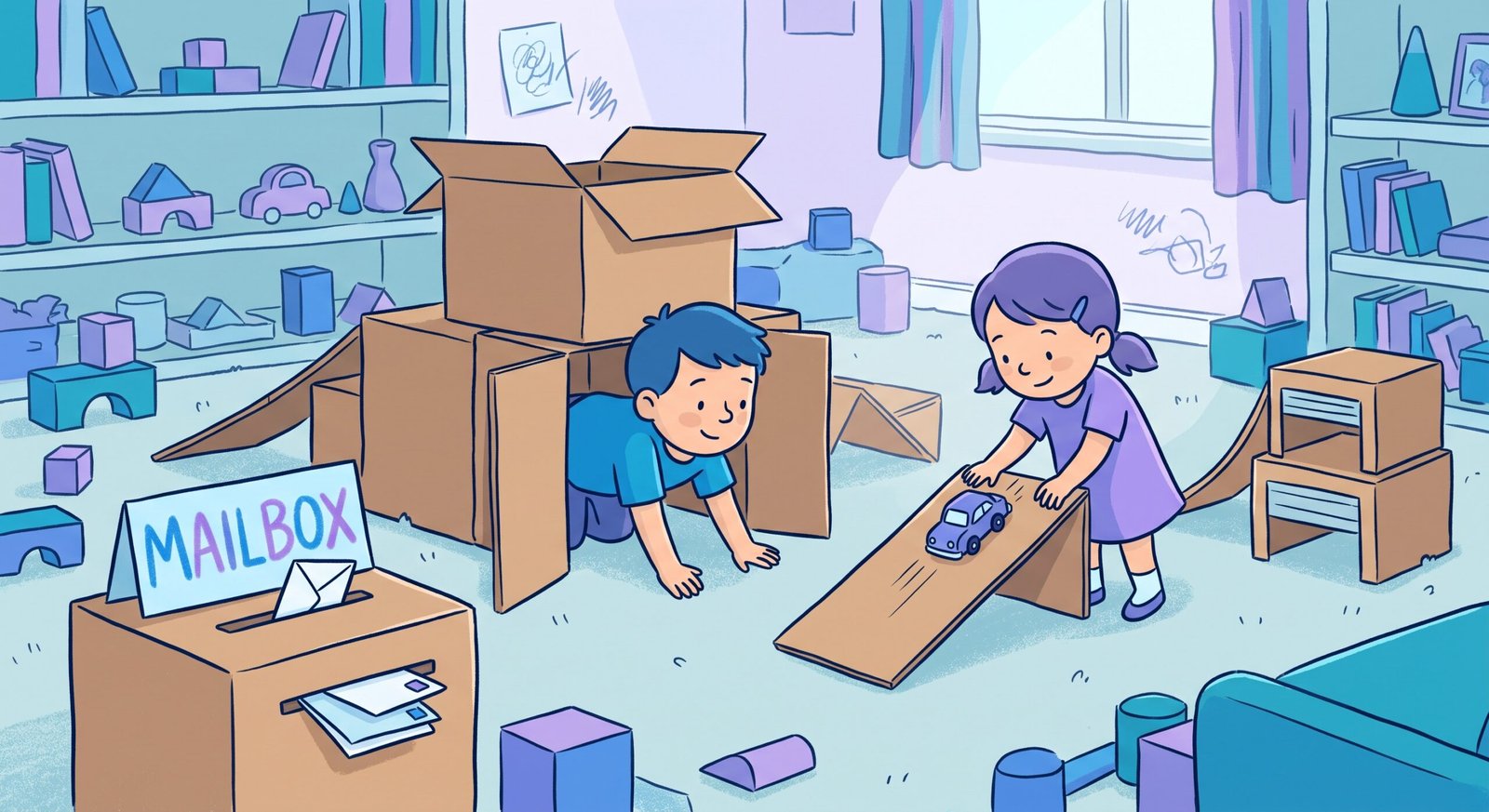
Exploring simple cardboard box activities at home begins with a familiar domestic paradox: a room full of expensive plastic toys and a child who insists they have nothing to do. When parents look for genuine alternatives, simple cardboard box activities at home offer an instant, low-cost solution that builds creativity without clutter.
The living room carpet looked like a plastic factory had exploded across it. There were neon stacking rings under the armchair, a battery-operated singing dinosaur face-down near the skirting board, and three separate bins of interlocking plastic bricks spilled into a colourful hazard zone across the floor. In the centre of all this bright stimulation sat my girl, slumped sideways against the couch cushions with one foot kicking the coffee table at monotonous two-second intervals.
“Mum. I am bored.”
My own ADHD brain, running on its usual chaotic frequency, was trying to track three trains of thought at once. I was mentally outlining tutorial content for my tertiary early childhood teacher education students, calculating whether I had enough clean laundry for tomorrow, and feeling that sharp, familiar prick of working-parent guilt. At the time, I was lecturing in early childhood teacher education and spending my working days researching out on the floor in childcare centres. I knew every piece of developmental literature inside out. Yet here we were on a damp Tuesday afternoon, surrounded by a mountain of commercial toys, completely stuck in neutral. (Years later, when she turned six, she was officially diagnosed with ADHD, right around the time I began my PhD research into child development. Looking back at that living room floor, the signs of both our racing, easily overwhelmed minds were already there in plain sight.)
Then the front door rattled. The postie dropped a delivery on the porch.
I hauled the heavy brown carton inside, cut the packing tape, pulled out the bulk grocery order, and tossed the empty cardboard box onto the rug near the kitchen archway. I fully intended to break it down and drag it to the yellow recycling bin.
Before I could even find the utility knife, the kicking stopped.
My daughter sat up, locked eyes with the open carton, and slid off the couch. Without a single word, she crawled across the carpet, ignoring the musical dinosaur entirely, and pushed her head right through the open top. Within forty seconds, she was completely folded inside, giggling at the muffled sound of her own voice bouncing off the brown corrugated walls.
The plastic toys stayed scattered on the rug for the rest of the afternoon. The box stayed in our living room for three weeks. That spontaneous moment proved to me why purposeful cardboard box activities at home consistently outperform commercial plastic gadgets.
Why simple materials beat commercial plastic toys
There is a persistent commercial pressure telling parents that engaged childhoods come in brightly coloured packaging. Toy catalogues are filled with items stamped with developmental claims: gadgets that supposedly accelerate phonics, interactive contraptions promising spatial intelligence, and plastic consoles designed to build STEM readiness.
In practice, high-tech toys do nearly all the thinking for the child. When a toy sings, rolls, or tells a story with a single button press, the child becomes an audience member rather than an active creator. Once every button has been pushed, the novelty collapses, bringing you straight back to: “I am bored.”
When we substitute high-tech toys with simple cardboard box activities at home, something fundamentally different happens in a child’s brain. Unstructured materials require children to generate their own narratives, rules, and movements. Less structure demands more thinking.
As landmark research from the Harvard Center on the Developing Child emphasizes, self-directed play is the primary vehicle through which young children build essential executive function skills.[1] Working memory, mental flexibility, and self-regulation do not develop through repetitive digital games; they are strengthened when a child must hold a goal in mind, navigate physical obstacles, and adjust their plans when a cardboard structure collapses.
Engaging in open-ended cardboard box activities at home gives children room to run their own experiments without an adult managing the outcome. When a child realises they can transform an ordinary object into a game of their own making, they develop internal agency. They stop waiting to be entertained and start shaping their physical world.
| Dimension | Commercial Plastic Toys | Cardboard Box Activities at Home |
|---|---|---|
| Play Direction | Adult-directed or pre-programmed; buttons dictate the sequence of play. | Entirely child-led; the box transforms based on the child’s internal narrative during cardboard box activities at home. |
| Cognitive Demand | Low active problem-solving; child serves as a passive recipient of stimulation. | High executive function; child must imagine, design, balance, and iterate. |
| Sensory Regulation | Often loud, flashing, and visually overstimulating for sensitive nervous systems. | Calming, tactile, neutral, and provides enclosed proprioceptive comfort. |
| Resilience to Failure | Rigid plastic either functions or breaks permanently; little room for modification. | Tears and folds invite immediate troubleshooting with tape and structural supports. |
| Financial & Mental Toll | Expensive to purchase and creates persistent visual clutter in living areas. | Zero cost, readily recyclable, and carries no parental guilt when flattened after play. |
The everyday wonder of corrugated packaging: loose parts in practice
Cardboard is humble, cheap, completely unpretentious, and arrives on our doorsteps almost weekly. Because it costs nothing, cardboard box activities at home form the backbone of genuine no toy play ideas that require zero trips to the department store.
In early childhood theory, we call these items “loose parts”, a concept originally formulated by architect Simon Nicholson.[2] Loose parts are open-ended materials that can be moved, carried, redesigned, combined, and taken apart. A plastic toy kitchen will always be a toy kitchen. But during creative cardboard box activities at home, a medium-sized carton can be an oven at 10:00 AM, a boat on stormy seas at 11:30 AM, and a hiding den for stuffed toys by mid-afternoon.
Cardboard naturally invites a “maker mindset.” Educational research from Project Zero at Harvard Graduate School of Education demonstrates that engaging with low-cost, manipulable materials empowers children to see the world as malleable rather than fixed.[3] Because cardboard holds no precious monetary value, children are not intimidated by it. When setting up cardboard box activities at home, an expensive wooden toy comes with implicit adult pressure to keep it pristine and play with it correctly. A delivery carton carries no such baggage. Kids know they can sit on it, kick it, peel the paper edges, fold the flaps, and draw directly onto the sides.
Working with cardboard also provides immediate lessons in structural physics. Children discover that bending along the corrugated grain creates a clean fold, while bending against it crushes the material. They discover that a box stood on its end can bear weight, while a box on its side might buckle. Through regular cardboard box activities at home, they continuously explore, redesign, and troubleshoot.
When children have access to materials that flex and adapt, repetitive play drops away, replaced by genuine, sustained physical inquiry. This principle is central to our work with the Reggio Emilia approach at home, where ordinary physical materials become expressive instruments of learning.
5 brilliant cardboard box activities at home (child-led and open-ended)
Cardboard play does not need to look like an elaborate craft tutorial with hot glue and painted scalloped roof tiles. That is adult crafting, not child-led play. Real cardboard box activities at home are messy, lopsided, and usually secured with generous amounts of masking tape. If you need low-prep kids activities at home that cost nothing, here is how ordinary packaging transforms naturally into engaging cardboard box activities at home.
1. Tunnels, forts, and tight hiding spaces
Whether you have a giant appliance carton or three grocery boxes joined end-to-end with the flaps pushed flat, tunnels are irresistible. As one of the most natural cardboard box activities at home, tunnels invite whole-body physical movement.
Crawling provides profound physical and developmental benefits well past the toddler stage. Navigating a low, dark cardboard corridor requires bilateral coordination, moving opposite arms and legs in tandem while supporting full body weight. It also stimulates the proprioceptive system, which helps the brain gauge where the body is in space. We explored this deeply when examining the needs of a sensory-seeking toddler and proprioception: heavy physical work and tight spaces ground an over-aroused nervous system.
Children must tuck their elbows, duck their heads, negotiate tight turns, and estimate spatial boundaries. For neurodivergent children, particularly those prone to sensory overwhelm from bright lights and noisy rooms, crawling into a dim, enclosed cardboard den during these cardboard box activities at home provides an immediate, grounding reset.
2. Parking garages and car ramps
Turn a medium shoebox or shipping box upside down. Use kitchen scissors to snip three sides of a flap along the top edge, folding it downward to form an angled ramp from the roof to the carpet. Stack another smaller box on top to create a second storey.
Grab a few toy cars, balls, or figures, and let your child explore. As they push objects up and down the inclines during these cardboard box activities at home, they engage with fundamental physical principles:
- Which cars roll smoothly and which slide sideways down the cardboard slope?
- How steep does the ramp need to be before a vehicle flips over?
- What happens when a heavy die-cast car bows the cardboard ramp in the middle?
Rather than stepping in to build an engineered support column, let them work out the solution. They might slide a wooden block underneath or bunch up a tea towel to prop up the drooping slope. That trial-and-error adjustment is early mechanical thinking in action, showing how effective cardboard box activities at home can be for building STEM intuition.
3. Ramp experiments and living room physics
Flatten a long cardboard box completely to create a sturdy, corrugated plank. Prop one end up on a couch cushion, coffee table, or chair, letting the other end rest on the floor.
Collect an assortment of everyday items: an apple, a plastic jar lid, a cardboard tube, a tennis ball, an eraser, and a toy car. These simple ramp games prove that cardboard box activities at home do not require commercial kits to teach real physics.
Take turns releasing items from the top. You are demonstrating friction, gravity, momentum, and slope angle without textbook jargon:
- Does the apple roll faster than the tennis ball down the cardboard plank?
- Why does the flat eraser stop halfway while the round lid rolls all the way to the skirting board?
- What happens if you lay a textured bath towel over the cardboard?
Children love the predictability of gravity, but they learn the most from anomalies, like an uneven plastic cup that wobbles and tumbles off the edge. They form a hypothesis, observe the outcome, and immediately retest. These low-demand experiments are brilliant examples of cardboard box activities at home that spark genuine curiosity.
4. The pretend mailbox and posting games
For toddlers and preschoolers, few things are as universally compelling as pushing an object through a slot and watching it disappear. Making a posting box is one of the easiest cardboard box activities at home for developing fine motor precision.
Tape the lid of a shoe box down firmly. Cut a narrow horizontal slit across the top or front panel, and a small flap near the bottom to serve as a collection door. Supply your child with discarded junk mail, postcards, playing cards, or scrap paper.
Posting builds fine motor control, wrist rotation, and hand-eye coordination. Aligning a flimsy sheet of paper with a narrow slit requires genuine concentration and grip regulation, similar to the foundational hand mechanics we discussed in our guide to fine motor skills for neurodivergent preschool learners.
For older preschoolers, these cardboard box activities at home evolve into imaginative communication. They will scribble letters, fold up paper parcels, and deliver them around the house to different family members. This connects early mark-making and symbolic thought to real-world relationships, bridging naturally into neurodivergent early literacy foundations without tears or tracing drills.
5. Open-ended building: letting the child lead
Provide a box, a roll of paper masking tape, and some crayons or markers. Then step back entirely. When it comes to cardboard box activities at home, unstructured builds yield the deepest learning.
The box might become a rocket, a vet clinic for stuffed animals, an ice cream counter, or simply a safe cubby to sit in while drawing on the interior walls. When adults step in with suggestions, children shift their focus toward meeting adult expectations. When children lead their own cardboard box activities at home, they are free to take creative risks, handle structural collapses without self-consciousness, and learn from physical miscalculations. Using child-led play models inspired by DIR Floortime play at home ensures the parent joins the child’s emotional world rather than imposing an adult agenda.
What children learn through cardboard box activities at home
Beneath the scattered scraps of tape and torn cardboard lies rich, multi-layered development. Clinical guidelines from the American Academy of Pediatrics highlight that child-driven play acts as a buffer against toxic stress while actively enhancing cognitive, social, and emotional resilience.[4]
- Executive Function and Persistence: Children formulate a plan during cardboard box activities at home, adapt when a wall collapses, and persist through frustration to keep their structure standing.
- Bilateral and Fine Motor Skills: Pushing, dragging, and climbing through boxes develops gross motor core strength. Peeling tape, tearing paper, and balancing items builds hand strength and finger dexterity.
- Early STEM and Spatial Reasoning: Stacking boxes introduces foundational principles of geometry, balance, weight distribution, and gravity long before formal schooling begins.
- Emotional Autonomy: In a daily schedule largely structured by adults, cardboard box activities at home offer a rare space where the child holds total ownership over the rules, the pace, and the narrative.
A parent’s reality: the collision of research and chaos
When I was lecturing future educators and researching in early learning rooms, everything looked tidy on paper. Development was documented in neat observations, play provocations were carefully curated, and pedagogical frameworks made complete sense.
Then I would come home to my own intense, energetic toddler with my own executive-function-depleted ADHD brain.
One afternoon, we had an enormous packing carton from a flat-pack furniture order. I had an elaborate vision: we would cut out wheels, build an engine grille, attach a paper-towel smokestack, and create a magnificent train.
My daughter took one look at this pristine five-foot box, climbed on top of the side panel, and began using it as a trampoline.
Within sixty seconds, the structural integrity of my theoretical train was flattened into a squashed, creased pile of brown paper. My immediate, gut-level adult reaction was intense frustration. I wanted the satisfying project. I wanted the neat, photogenic play that validated my professional knowledge.
Instead, I had a crushed box taking up the middle of the floor and a child whooping with laughter.
I paused, leaned against the wall, took a breath, and let it go. Once she had finished stomping the box flat, she noticed the folded crease created a natural ramp off the edge of the rug. She ran to get her toy animals and spent the next forty minutes seeing how far they would slide across the floorboards.
It was completely different from what I had mapped out, and infinitely more valuable because it was hers. When we accept our child’s authentic impulses during cardboard box activities at home, we align with the neurological principles behind polyvagal theory and meltdowns in early childhood: safety and co-regulation emerge when adult demands step aside.
Living with cardboard box activities at home also means accepting a few practical truths:
- The cutting barrier: Cutting thick corrugation is hard work for adult hands and impossible for child-safe scissors. Prep large incisions yourself beforehand so you are not juggling a sharp knife with an eager child leaning over your shoulder.
- The inevitable collapses: Tape will peel and structures will cave in. When a build falls down during cardboard box activities at home, tears often follow. It takes real patience to sit through the frustration, co-regulate, and offer a fresh piece of tape rather than taking over.
- The debris: Cardboard leaves fine brown dust, shredded edges, and discarded tape on your rugs and furniture. Embracing cardboard box activities at home means accepting that your floor will look chaotic for a few days.
What does not work: avoiding the common traps of cardboard play
Over the years, both in early learning settings and in my own living room, I have watched well-meaning adults accidentally derail play before it starts. If you want cardboard box activities at home to succeed, keep these boundaries in mind:
1. Over-directing the project
If your child says a box is a bus, resist the urge to measure out eight symmetrical windows and a steering wheel. Let their abstract interpretation stand. As soon as an adult takes over with adult standards of realism, the child disengages and wanders off, leaving the adult crafting alone on the rug.
2. Insisting on permanence and perfection
Cardboard builds are temporary by nature. Avoid wet craft glue that requires hours of drying time and stalls the momentum of the game. Stick to masking tape or paper tape so ideas can be built, altered, and dismantled in real time during your cardboard box activities at home.
3. Expecting adult-sized attention spans
A child might play intensely inside a box for eight minutes, abandon it to inspect a bug on the windowsill, and return to it an hour later. Open-ended play is cyclical, not linear. Standard child development milestones remind us that attention spans fluctuate naturally based on regulation, fatigue, and interest.
Making cardboard box activities at home manageable for tired parents
If the idea of turning your living space into a recycling depot fills you with dread, you do not need to dive in headfirst. A few simple boundaries keep cardboard box activities at home rich for your child while keeping the chaos manageable for your own nervous system:
- Maintain a hidden stash: Keep two or three good, sturdy cartons flattened behind a wardrobe or in the garage. Pull one out when energy levels dip or afternoon boredom hits so you can start quick cardboard box activities at home without preparation.
- Introduce materials slowly: Avoid dumping boxes, tape, paint, and fabric on the rug all at once. Offer just the box first. Introduce tape or markers later when the initial exploration needs a fresh spark.
- Rely on serve-and-return communication: You do not have to sit on the floor acting as an entertainer for two hours. Position yourself nearby with a cuppa. As research on serve and return interactions from Harvard demonstrates, simple responsive acknowledgments wire developing brains.[5] When your child looks up and says, “Look, Mum, it is a cave!” (the serve), look over and respond: “It is! Look how dark it is inside” (the return). Offer brief, grounding support when they need an extra hand, then step back and let them carry on.
- Flatten without guilt: When the box is bent, drawn all over, and loses its structural appeal after a week or two, recycle it together. Your cardboard box activities at home have fulfilled their educational purpose.
Need Low-Demand, Calming Tools for Busy Days?
When sensory fatigue hits and you need quiet, grounded activities that honour your child’s pace, our gentle, Montessori-inspired tracing and story bundles offer low-pressure exploration without the overwhelm.
Explore QuietSprout Learning BundlesReferences
- Center on the Developing Child at Harvard University. (2014). Enhancing and Practicing Executive Function Skills with Children from Infancy to Adolescence. Harvard University.
- Nicholson, S. (1971). How NOT to cheat children: The theory of loose parts. Landscape Architecture, 62(1), 30–34.
- Agency by Design / Project Zero. (2015). Maker-Centered Learning and the Development of Self: Preliminary Findings. Harvard Graduate School of Education.
- American Academy of Pediatrics. (2018). The power of play: A pediatric role in enhancing development in young children. Pediatrics, 142(3), e20182058.
- Center on the Developing Child at Harvard University. (2011). Serve & Return Interaction Shapes Brain Circuitry. Harvard University.
- Clapp, E. P., Ross, J., Ryan, J. O., & Tishman, S. (2016). Maker-Centered Learning: Empowering Young People to Shape Their World. Jossey-Bass / Wiley.
This article is based on my personal parenting experience, reflections on late-diagnosed adult ADHD, and my background in early childhood education as a former university lecturer, childcare educator, and doctoral researcher. It is shared for educational, supportive, and informational purposes only and does not constitute medical, paediatric, occupational therapy, or developmental assessment advice. Every child develops along their own unique trajectory with distinct sensory and physical needs. If you have concerns regarding your child’s gross motor coordination, sensory processing, or emotional regulation, please consult with your GP, a paediatrician, or a qualified paediatric occupational therapist for individualised guidance.
Related topics for parents
- Child development milestones: what every parent should know
- Reggio Emilia approach at home: fostering curiosity and calm
- Sensory-seeking toddler and proprioception: calming the chaos
- DIR Floortime play at home: 5 powerful shifts for parents
- Fine motor skills neurodivergent preschool: 5 powerful shifts for reluctant hands
- Neurodivergent early literacy foundations: 5 powerful shifts for reluctant readers
- Polyvagal theory & meltdowns in early childhood: beyond the tantrum label
- Early math number sense neurodivergent: 5 powerful shifts for reluctant learners
- Signs of ADHD in girls: recognizing subtle early cues
- Autism in girls closing the gender gap: practical guide
- Toddler hair pulling & frustration tolerance: what’s really happening
- Toddler sleep resistance & ADHD: 5 real bedtime shifts
- Autism and attachment myths: 5 powerful truths for parents
- Montessori and QuietSprout story tracing bundles