
Parent Teacher Burnout in Neurodivergent Care: 4 Ways to Lighten the Load
This post is about parent teacher burnout in neurodivergent care: what it is, what the research says, and four ways to lighten the load. It shares my own experience as an educator and a mother with ADHD, raising two daughters with ADHD before any of us knew. It is educational, not clinical or mental health advice. If you are struggling to cope, the help list is near the end of the page, or please talk to your GP.
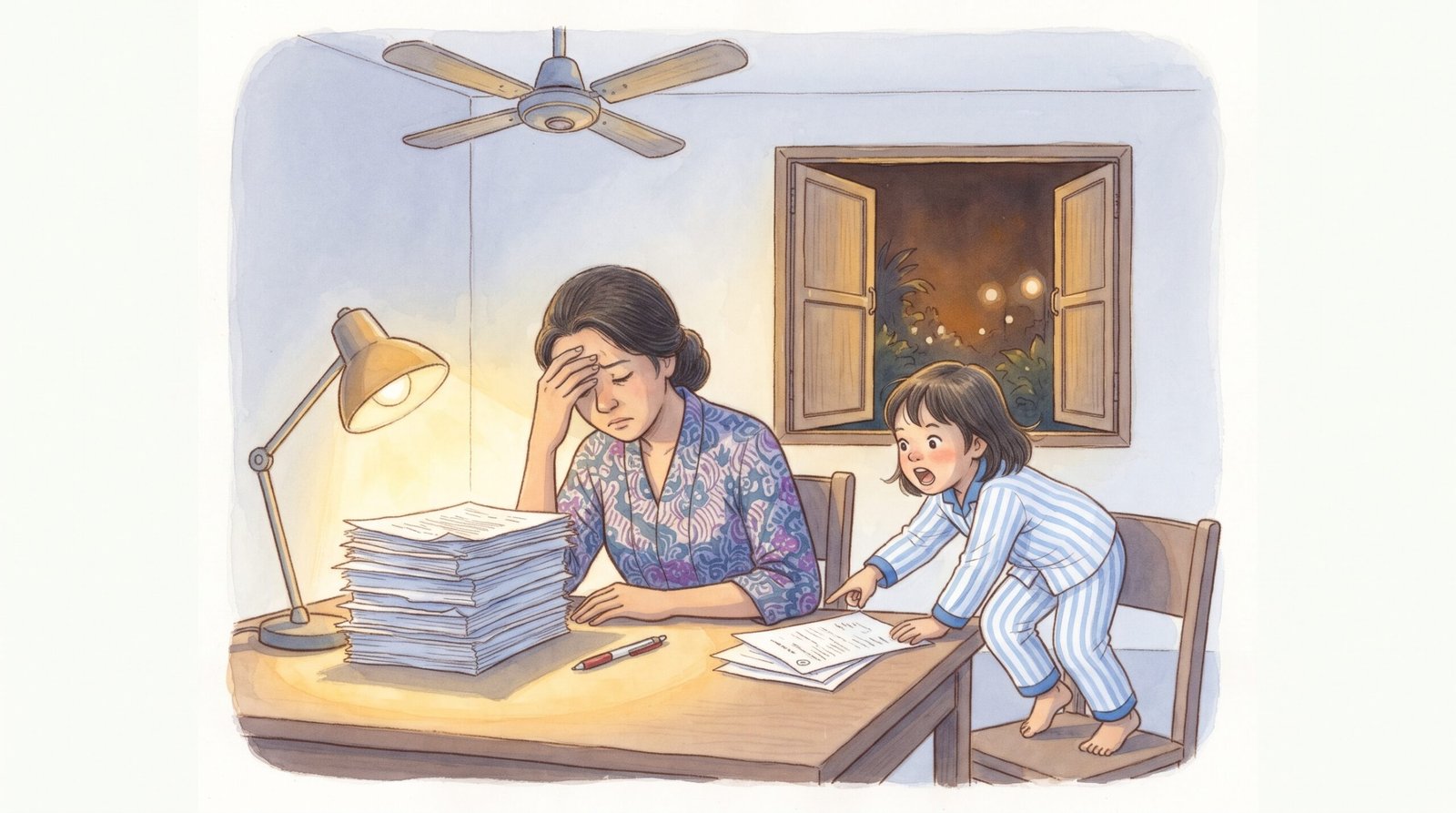
When my daughters were small, I was lecturing at a university in Indonesia, and I remember being tired in a way I didn’t have words for. Looking back, I was burnt out. I just didn’t know it, and I didn’t know why.
My older daughter was born in 2003, and my younger daughter in 2005. By the time they could walk they were moving, and by the time they could talk they were asking. Why is the sky that colour. What does that sign say. Where does the water go. Why, why, why. At the market they would stop at every stall and spell out the handwritten boards letter by letter, D, I, J, U, A, L, and then turn to me for the answer.
At home the questions followed me from room to room. I would sit down at night with a pile of student papers to mark, and they would still be awake, still asking, still climbing.
I loved their curiosity. I still do. But I also remember the particular exhaustion of being needed every minute, at work by my students and at home by children whose engines never seemed to switch off. People told me they were just bright and busy, and that I was lucky. They weren’t wrong. They also weren’t the ones who had been answering questions since six in the morning.
It was another seventeen years before we had a name for what was going on. We had moved to Melbourne by then, and both daughters were eventually diagnosed with ADHD. So many things made sense at once: the questions, the climbing, the total focus on whatever caught their eye and the way they drifted from everything else.
And so did the tiredness I had carried all those years and quietly blamed on myself, because I have ADHD too, and back then I had no idea. None of us knew, and my own diagnosis came only years after we had settled in Melbourne. In those years ADHD wasn’t a word anyone around me used, least of all about two lively girls or their busy mother. I was raising ADHD children with an ADHD brain, burning out, and nobody in the house had a name for any of it.
I’m writing this for the parents and educators who are tired in that same wordless way. Some of you are caring for a child who already has a diagnosis. Some of you are caring for a child nobody has a name for yet. Some of you, like me, are also neurodivergent yourselves. What we have in common is that everyone talks about the child’s regulation, the child’s needs and the child’s plan, and almost nobody asks how the adults are holding up. That gap is where parent teacher burnout in neurodivergent care grows.
In this post:
The 4 pm Hallway Floor
The moment I finally admitted I was running on empty came later, in Melbourne. It was a Friday afternoon in late November, the last term of my younger daughter’s first year of school.
That week had been relentless. Two sensory meltdowns over sock seams. Three long emails from educators about pushing in the playground. A paediatrician appointment on the other side of the city. My own work deadlines, juggled with a busy brain that never seemed to switch off. I didn’t know yet that it was an ADHD brain.
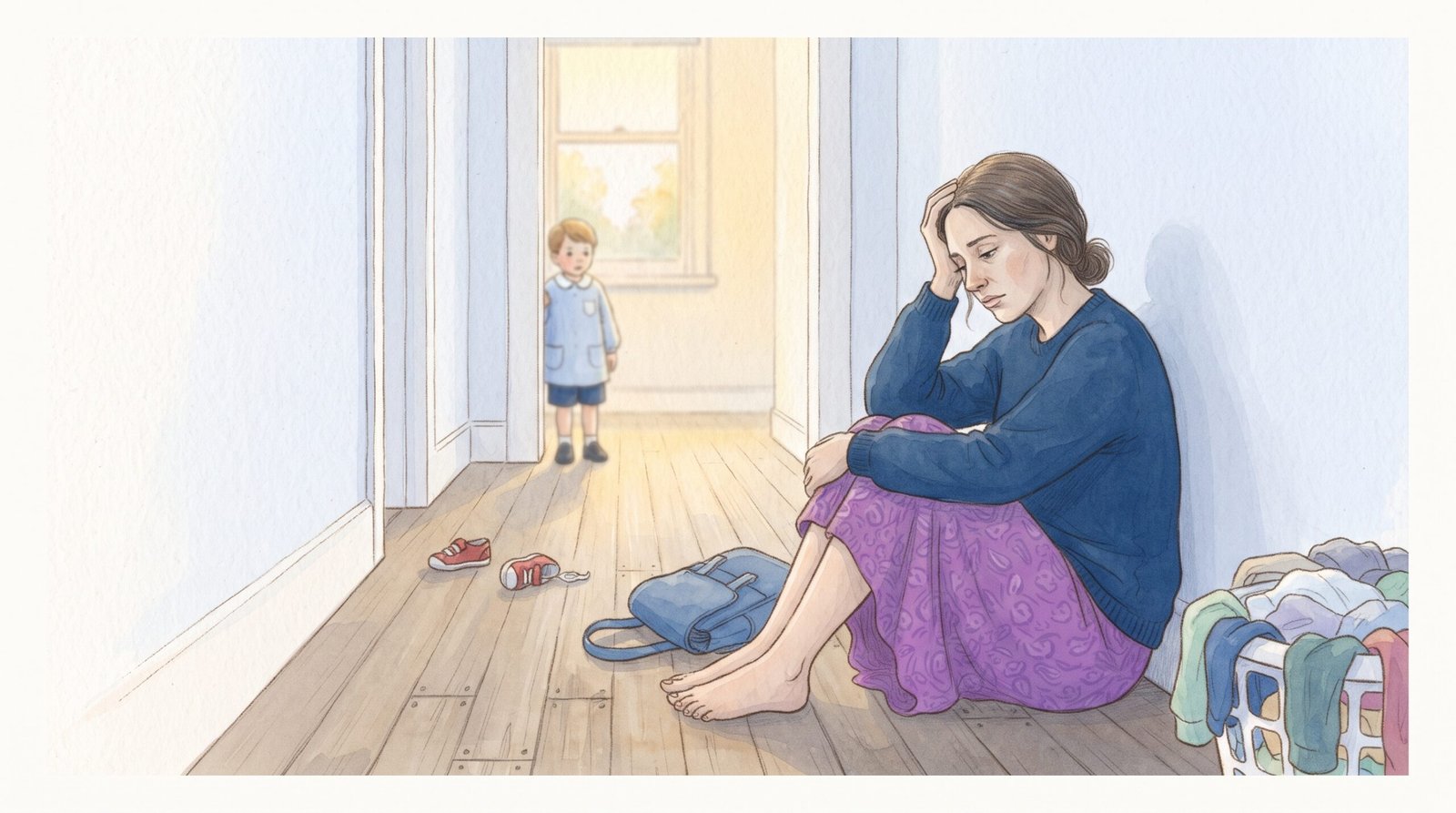
We walked through the front door at half past three. She dropped her bag, kicked her runners down the hallway and dissolved into screams because the banana in the fruit bowl had a bruise on it.
I didn’t raise my voice. I didn’t give a speech about gratitude. I slid my back down the hallway wall and sat on the floorboards, and the tears came before I could stop them. She was screaming, the laundry basket was overflowing, my phone kept pinging with work messages, and I had nothing left to give anyone.
Sitting there, I understood something I had been teaching other families for years without fully living it. It is very hard to be calm for a distressed child when you are completely depleted yourself. We talk about co-regulation as if adults have an endless supply of calm to lend. We don’t. Adult capacity is a real resource, it runs down, and nobody hands out refills at the school gate.
I’d been tired like this before, years earlier and a long way away, with her big sister. I just hadn’t noticed it adding up.
What Parent Teacher Burnout in Neurodivergent Care Actually Is
Parent teacher burnout is a phrase we throw around a lot, so it helps to know what researchers actually mean by burnout.
Parental burnout has been studied seriously for about a decade, much of it by Isabelle Roskam and Moïra Mikolajczak in Belgium. They describe it as a syndrome that grows out of chronic parenting stress, not a bad week. Their Parental Burnout Assessment measures four things: being exhausted by the parenting role, feeling a sharp contrast with the parent you used to be, being fed up with parenting, and pulling away emotionally from your children.[2] The third and fourth are the ones nobody likes to admit. I certainly didn’t, sitting on that floor.
Their theory of why it happens is simple and, for me, very freeing. They call it the balance between risks and resources. Burnout develops when the things that raise stress outweigh the things that relieve it, for a long time.[1] Risks can be things like perfectionism, low support, a demanding child or a heavy workload. Resources are anything that eases the load: time, help, sleep, a partner who shares the mental list, a kind educator. It isn’t about how much you love your child. It’s arithmetic.
That arithmetic tends to be harder for families like ours. A review that pooled studies of parenting stress in families of children with ADHD, by Joanna Theule and colleagues, found that these parents reported clearly higher stress than parents of children without ADHD.[3] The burnout research was mostly done with parents in general, so I’m careful not to stretch it too far. But it matches what I lived and what I hear from other parents every week.
Educators carry their own version of parent teacher burnout in neurodivergent care. In a 2023 study of Australian early childhood leaders, Marg Rogers, Wendy Boyd and Margaret Sims described services as “burnout central” during the pandemic years.[4] The paper reports earlier sector surveys too: in one, close to 40% of educators had taken extra sick leave because of mental health and exhaustion, and in a union survey of around 4,000 workers, 73% named overwork and time pressure as a reason they wanted to leave. Add a room with several children who need high levels of support, hard surfaces, tight staffing and a pile of documentation, and the risks side of the scale fills up fast.
This is how the pressure tends to land, at home and in the room.
| Pressure Point | What Systems Tend to Expect | What It Can Feel Like |
|---|---|---|
| Constant co-regulation | Adults stay calm and patient through every meltdown, all day. | Being the calm one all day is tiring. For me it left nothing in the tank by late afternoon. |
| Paperwork and advocacy | Support plans, meetings, funding forms and justifying needs every term. | Hours of defending a child’s needs against a checklist, often after work or bedtime. |
| Being watched | Visible control of a child’s behaviour in supermarkets, parks and group times. | Hypervigilance, and worry about people who read overload as poor parenting. |
| Your own brain | Adults with flawless planning, sensory tolerance and stamina. | Many parents and educators, me included, are neurodivergent too. A child’s loud distress can be very hard for us to be around. |
None of this means the adults are weak. It means the load is real, and that most of the support in our systems flows towards the child and stops short of the people holding them.
The Diagnosis That Came Years Late
When my daughters were diagnosed, the first thing I felt wasn’t relief. It was a strange grief, followed by a long list of moments I wanted to go back and redo.
I thought about the evenings in Indonesia when I was trying to prepare lectures and they were on their fourth “one more question”. I thought about how often I had told myself I just needed to be more organised, more patient, more on top of things. I’d assumed the tiredness was a personal failing.
Looking back, I was burnt out from a busy life and a busy brain, and I had no idea. I was parenting children with ADHD, without knowing it, while working full time. And I was doing it with an ADHD brain of my own that I didn’t know about either, one that struggles with the very things everyone kept telling me to do better. I couldn’t see their ADHD because I couldn’t see mine. So much of what they did felt normal to me, because it was how my own mind worked. I write about that busy mind from the inside in understanding my busy mind.
This is very common, and there’s a reason for it. ADHD runs strongly in families. A review by Patricia Quinn and Manisha Madhoo notes that having a first-degree relative with ADHD raises a child’s risk two to eight times, and twin studies put heritability at around 76%.[5] The same review explains why girls in particular are so often missed: they more often show the quieter, inattentive side, they work hard to compensate, and they tend to be compared with hyperactive boys and judged as fine. My daughters were busy and chatty, but they were also doing well. So nobody joined the dots, including me, a trained educator who should have known what to look for.
If you are a parent who has started to recognise yourself in your child’s struggles, you’re far from alone. I write more about that in a parent with ADHD, and about the signs that are so easy to miss in signs of ADHD in girls.
What matters here is what it does to the load. A neurodivergent parent caring for neurodivergent children is often using their weakest muscles all day. Remembering forms and appointments, holding a calm face through noise, switching tasks the second a child needs you. These are the exact things many of us find hardest. It isn’t a lack of love or effort. It’s nervous systems sharing one house, and one of them is expected to be the steady one around the clock, which is a fast road to parent teacher burnout in neurodivergent care.
Some of us also find it hard to notice our own feelings until they spill over, which I’ve written about in alexithymia and ADHD mothers. That was me on the hallway floor. I didn’t feel it building. I just suddenly had nothing left.
The kindest thing I can say to my younger self, and to you, is this. You were not failing. You were carrying more than anyone could see, often without the names that would have helped you ask for support.
4 Ways to Lighten Parent Teacher Burnout in Neurodivergent Care
I’m not going to tell you to take a bubble bath. When you’re this tired, a bubble bath is one more thing to organise. If parent teacher burnout in neurodivergent care comes from risks outweighing resources, there are only two ways to shift the balance: take something off the risk side, or add something to the resource side. Everything below does one or the other.
1. Notice Your Battery Before It Hits Zero
On the hallway floor I went from “fine” to empty in what felt like a second. It wasn’t really a second, of course. It was weeks of small drains I hadn’t counted.
What helped me most, much later, was simply checking in with myself once a day. Not a journal, not a wellness app. Just a number. How full is the battery today, out of five? What drained it? What topped it up, even a little? After a week or two the pattern starts to show. For me it was Thursdays, appointment days, and any day with more than two emails from school. Once I could see it, I could plan around it instead of being ambushed.
Our Weekly Battery Check-In is exactly that, one line a day, and it is often the earliest warning sign of parent teacher burnout in neurodivergent care you will get. If you find it hard to name how you feel, as I do, a number is often easier than a word.
2. Shrink the Day on Purpose
The second shift sounds simple and is the hardest for most of us: decide what not to do.
When I look back at my weeks in those years, they were full of things that didn’t need to happen. Homemade lunches when a sandwich would do. Answering every email the day it arrived. Signing up for the extra activity because the other parents had. Saying yes to the committee. None of them was big, but together they ate the margin I needed for the hard moments.
These days, when the battery is low, I sort the week’s jobs into four piles. Drop it, because it doesn’t actually matter. Shrink it, because a smaller version is good enough. Share it, because someone else could do it. Keep it, because it truly has to be me. You’ll be surprised how little lands in the last pile. The Lighten the Load Planner gives you a page to do this with a partner, a co-educator or just a cup of tea.
This isn’t lowering your standards for your children. It’s protecting the part of your energy that your children actually need, which is the calm, present you, not the one who baked the muffins.
3. Share the Invisible List
Much of the load in neurodivergent families is invisible. Remembering which socks are tolerable. Knowing that Tuesday swimming will mean a harder evening. Chasing the therapy report, booking the review, filling in the funding form, noticing that the new teacher hasn’t read the support plan. It often sits in one person’s head, and that person is usually the most tired one in the house.
Sharing it starts with saying it out loud. Write the list down. Hand over whole jobs, not just tasks, so the other person owns the remembering too. If you’re parenting alone, look at who else could hold one piece: a grandparent, a friend, the educator who already knows your child well.
Many parents of children with disability can also get support as carers. In Australia, Carer Gateway (1800 422 737) can connect unpaid carers with counselling, coaching and respite, and it’s worth a call to ask what fits your situation.
At school and kinder, it helps to agree on how you’ll communicate, so you aren’t drowning in long emails. One short update a week, or a shared notebook, can take a surprising amount of pressure off both sides. We write about that from the educator’s side in how to connect with parents without endless meetings.
4. Refill in Small Doses That Actually Fit
The resources side of the scale doesn’t have to be a weekend away. In my experience, tiny refills scattered through the day do more than one big rest you can never quite schedule.
Think in three sizes. Five minutes: tea in the garden before school pickup, one song in the car with the windows down, lying on the floor with your eyes closed while the kettle boils. Fifteen minutes: a walk around the block, a phone call with someone who makes you laugh, a shower nobody interrupts. An hour or more: something you’d have chosen before you became a parent or an educator, even once a month. The Small Refills Menu has spaces to write your own, so on a bad day you don’t have to think, just pick.
And when you do snap, or cry, or say something you wish you hadn’t, repair matters more than perfection. My daughters didn’t need a mother who never cried on the floor. They needed one who could come back afterwards, sit with them, and say, “That was a hard afternoon for all of us. I’m sorry I got so tired.” Children learn a great deal about regulation from watching an adult recover. We write more about that in co-regulation strategies in early childhood and child meltdown co-regulation.
Easing Parent Teacher Burnout in Early Learning Rooms
I’ve sat on both sides of the kinder fence, as the educator writing the long email and as the parent reading it at 10 pm. So this part is for the people in the room.
On the educator side, parent teacher burnout isn’t only a personal problem, and it can’t be fixed only with personal strategies. Rogers and colleagues point to constant change, low pay and status, and work spilling into private time as major drivers. In the same paper they cite a systematic review by Ng, Rogers and McNamara, which found that coaching and reflective practice programs reduced educator burnout. That fits what I’ve seen. The rooms that cope best aren’t the ones with the most resilient individuals. They’re the ones where the adults look after each other on purpose.

In practice, that can look like a few small habits.
A tag-out arrangement, agreed in advance, so any educator can say “I need five minutes” during a hard moment and a colleague steps in without judgement. The child gets a calmer adult, and nobody has to pretend.
A short debrief after a big day or a serious incident, even ten minutes at the end of the shift. What happened, what helped, what we’ll try next time, and how everyone is feeling. Then it’s put down, not carried home.
Protected time for documentation, rather than squeezing support plans into lunch breaks and evenings. If your team is writing a separate plan for every child, there may be ways to simplify, which we explore in how to stop writing a separate plan for every kid and how to plan engaging lessons without the stress.
A room that is easier on adult nervous systems as well as children’s. Noise and harsh light drain educators too, especially those who are neurodivergent themselves. Softening sound and light, as we describe in classroom noise and sensory overload and a low cost sensory classroom setup, helps everyone in the space.
Kinder and school leaders matter enormously here. When a leader asks “how are you going?” and means it, rosters time for reflection, and backs staff when a family relationship gets hard, the whole team’s resources go up. Australian educators can also use Be You, the national mental health initiative for early learning services and schools, for training and wellbeing resources.
Families and educators are also each other’s best resource against parent teacher burnout in neurodivergent care, if the relationship is built that way. Most of the parents I know aren’t asking for perfection from educators. They want to be told the truth kindly and to feel that someone is on their child’s side. Most educators want the same from families. When that trust is there, some of the weight comes off both ends.
If You Are Not Coping
Sometimes tired turns into something heavier. If you feel numb or hopeless most days, if you’re thinking about hurting yourself, or if you’re frightened you might hurt someone else, please reach out now. You don’t need to be sure it’s “bad enough”.
- Emergency: 000, if you or anyone is in immediate danger.
- Lifeline: 13 11 14, crisis support 24 hours, 7 days.
- Beyond Blue Support Service: 1300 22 4636, 24 hours, 7 days.
- Parentline Victoria: 13 22 89, 8 am to midnight, 7 days.
- Medicare Mental Health: 1800 595 212, weekdays 8.30 am to 5 pm, for help finding the right support.
- Carer Gateway: 1800 422 737, weekdays 8 am to 5 pm, for unpaid carers.
Your GP is also a good place to start. They can talk with you about a mental health treatment plan, which can give you access to subsidised sessions with a psychologist.
Forgiving Yourself on the Hallway Floor
I think a lot now about both versions of me: the young lecturer in Indonesia answering her hundredth question of the day, and the mother on the floorboards in Melbourne with a screaming child and a bruised banana. Neither of them was failing. Both of them were carrying a load nobody could see, without the words that would have helped.
If you take one thing from this post about parent teacher burnout in neurodivergent care, let it be that looking after yourself is part of looking after the child. Not after everything else is done. Part of it. Your children need a calm adult far more than a perfect one, and calm adults are made from rest, help and a bit of kindness, including your own.
Free Printables for Parent Teacher Burnout in Neurodivergent Care
Three A4 sheets go with this post, for parents and educators. They’re free for home and classroom use.
- Weekly Battery Check-In (PDF, 2 pages) One line a day: how full is your battery out of five, what drained it, what topped it up. A second page explains how to spot patterns, and where to call if the battery stays empty.
- Lighten the Load Planner (PDF, 2 pages) Sort the week’s jobs into drop it, shrink it, share it or keep it. The second page, Share the Invisible List, helps co-parents, families and teaching teams hand over whole jobs, including the remembering.
- Small Refills Menu (PDF, 1 page) Five-minute, fifteen-minute and longer refills to circle or add to, so on a hard day you can just pick one. It includes a space for the person you’ll call when a refill isn’t enough.
A First Step Against Parent Teacher Burnout in Neurodivergent Care
The Weekly Battery Check-In takes less than a minute a day and shows you where your energy really goes.
Download the Check-In- Understand uneven days in Spiky Profiles in Neurodivergent Kids →
- See yourself in your child with A Parent With ADHD →
- Notice feelings before they spill in Alexithymia and ADHD Mothers →
- Step inside a busy brain with Understanding My Busy Mind →
- Know what to look for in Signs of ADHD in Girls →
- Find calm together with Co-Regulation Strategies in Early Childhood →
- Read more on the blog →
Research: Mikolajczak and Roskam on the balance between risks and resources; Roskam, Brianda and Mikolajczak on the Parental Burnout Assessment; Theule and colleagues on parenting stress in ADHD families; Rogers, Boyd and Sims on Australian early childhood leaders; and Quinn and Madhoo on ADHD in women and girls.
Experience: the family story, the four ways to lighten the load, the educator habits and the printables come from my own life and practice. They are not a tested program. Help line details were checked on 5 November 2026. Last reviewed: 5 November 2026.
References
- Mikolajczak, M., & Roskam, I. (2018). A theoretical and clinical framework for parental burnout: The balance between risks and resources (BR2). Frontiers in Psychology, 9, 886. https://doi.org/10.3389/fpsyg.2018.00886
- Roskam, I., Brianda, M.-E., & Mikolajczak, M. (2018). A step forward in the conceptualization and measurement of parental burnout: The Parental Burnout Assessment (PBA). Frontiers in Psychology, 9, 758. https://doi.org/10.3389/fpsyg.2018.00758
- Theule, J., Wiener, J., Tannock, R., & Jenkins, J. M. (2013). Parenting stress in families of children with ADHD: A meta-analysis. Journal of Emotional and Behavioral Disorders, 21(1), 3–17.
- Rogers, M., Boyd, W., & Sims, M. (2023). “Burnout central”: Australian early childhood educational leaders’ experiences during the Covid-19 pandemic. Issues in Educational Research, 33(1), 284–306. iier.org.au
- Quinn, P. O., & Madhoo, M. (2014). A review of attention-deficit/hyperactivity disorder in women and girls: Uncovering this hidden diagnosis. The Primary Care Companion for CNS Disorders, 16(3). https://doi.org/10.4088/PCC.13r01596
This article reflects personal family experience and professional early childhood education practice. It is shared for supportive and educational purposes only and is not medical, psychological or mental health advice. If you are worried about your own wellbeing or your children’s, please talk to your GP or one of the services listed above. In an emergency, call 000.
