
Sensory Environment Early Childhood: What Actually Changes Behaviour
A sensory environment early childhood design is often the invisible decider between a calm afternoon and a child in crisis. When a room buzzes with echoing noise, harsh overhead lights, and visual clutter, a neurodivergent child’s stamina drains away long before anyone asks them to sit down.
- The Preschool Doorway: An Everyday Reality Check
- The Sensory Cup: Why the Same Instruction Fails in Different Rooms
- 4 Hidden Energy Thieves in Australian Early Years Spaces
- Sensory Seeking Versus Sensory Avoiding Profiles in Daily Life
- Practical Modifications for Home and Centre (Without Big Budgets)
- Step-by-Step: Setting Up an Effective Reset Haven
- Adult Nervous Systems and Co-Regulation Inside Shared Rooms
- The 10-Minute Sensory Environment Early Childhood Checklist
- How This Fits Our Neurodivergent Learning Approach
- References and Connected Resources
The Preschool Doorway: An Everyday Reality Check
A sensory environment early childhood space hit home for me on a brisk Thursday morning when my daughter was four. We walked into her early learning room in suburban Melbourne. To any casual visitor, the room looked vibrant and cheerful. Laminated student artwork was taped across every window, colourful plastic tubs lined open steel shelves, and music played over a ceiling speaker while twenty children called out to one another.
Yet within twenty seconds of crossing the threshold, my daughter froze. Her shoulders hitched up toward her ears. When her educator smiled warmly and said, “Good morning! Come over to the mat and hang your bag up,” my daughter dropped to her knees on the linoleum, tucked her chin into her chest, and clamped her hands over her head.
An untrained eye sees a child being uncooperative or refusing to participate in a morning routine. But because I live with ADHD myself and spend my academic life researching early childhood development, I could see how this sensory environment early childhood setup overwhelmed her nervous system.
The room was an acoustic echo chamber. The fluorescent strip lights hummed at an imperceptible frequency that sensitive auditory systems register as physical pressure. The visual noise of fifty bright posters meant her eyes had nowhere neutral to rest.
She was not rejecting her teacher. Her brain was physically over capacity. When you ask a child with sensory processing differences or ADHD to listen in an unregulated space, the surrounding room takes away their ability to hear you. A well-considered sensory environment early childhood layout protects children from this constant overload.
You can read more about how our family journey shaped this work on the how this began reflection page.
Walking through early learning centres across Victoria, New South Wales, and Queensland, I see this exact scene play out every morning. Educators are working tirelessly, setting up complex invitations to play and writing thoughtful lesson plans. Yet by mid-morning, children are bolting across the floorboards, snatching materials, or bursting into tears during brief transition windows.
We often jump to behaviour charts, reward tokens, or social stories to address these disruptions. But if we do not first audit the physical surroundings, we are treating the symptom while ignoring the fuel. When we refine a sensory environment early childhood spaces become supportive allies rather than an unceasing source of physiological stress.
The Sensory Cup: Why the Same Instruction Fails in Different Rooms
Why does a child happily tidy up their blocks on the lounge room rug at home, but collapse into tears when asked to pack away in a preschool room? The answer lies in how a sensory environment early childhood context influences a child’s internal threshold for demands.
Think of every child as having a finite “sensory cup”. Every sensory input across the morning—the seam running across their toes, the hum of a split-system heater, the scraping of chair legs against hard laminate, the smell of warm sunscreen—pours water into that cup.
In a thoughtfully arranged room, the baseline sensory input remains low, leaving plenty of room in the cup for processing spoken instructions, social compromises, and unexpected transitions. Maintaining a low-friction sensory environment early childhood space ensures that everyday expectations do not tip children over the edge.
In a chaotic or poorly tuned space, the room itself fills ninety percent of the cup before the child even hangs up their hat. When an adult adds a simple request like “Please wash your hands,” the cup overflows into an immediate meltdown or defensive withdrawal. A chaotic sensory environment early childhood setup shrinks a child’s daily capacity without anyone realising it.
In occupational therapy, pioneer Dr A. Jean Ayres established that sensory integration—the brain’s ability to organise sensations from our own body and from the physical environment—is the absolute foundation for motor planning, emotional stability, and higher-order learning. Creating a supportive sensory environment early childhood educators can maintain is key to reducing stress for everyone.
When sensory input is unmanaged, the brain treats the input as an ongoing stressor. As we explored in our guide on regulation before learning, a nervous system trapped in a state of sensory defence cannot access the cognitive reserves required for self-regulation or social communication. By calming a sensory environment early childhood professionals give children their thinking brains back.
When sensory input exceeds the nervous system’s filtering threshold, the amygdala signals a survival alert. The brain cannot determine whether the screeching metal chair legs or the flickering tube light are dangerous wild predators or harmless background noise. It simply senses threat. In response, peripheral blood vessels constrict, digestion slows, and pupils dilate. When a child’s autonomic system is working overtime just to tolerate the sensory environment early childhood learning spaces must shift from testing compliance to providing physical sanctuary.
4 Hidden Energy Thieves in Australian Early Years Spaces
Whether you are an educator setting up an early childhood room or a parent trying to reduce late afternoon chaos at home, four environmental factors consistently drain a neurodivergent child’s stamina. Evaluating your sensory environment early childhood spaces will help you pinpoint where friction begins.
- 1. Acoustic Reverb and Hard Surface Bounce Open-plan timber, tile, or polished concrete floors turn everyday voices, scraping chairs, and dropped wooden toys into a cacophony. An auditory system with sensory sensitivities cannot filter background chatter from an educator’s direct instruction, causing quick cognitive fatigue in an unbuffered sensory environment early childhood setting.
- 2. Visual Clutter and Window Blocking Covering every inch of wall space with bright bunting, alphabet charts, and hanging mobiles creates constant peripheral distraction. When windows are blocked with paper displays, rooms lose restorative natural daylight and feel visually claustrophobic. An overloaded sensory environment early childhood room strains the visual cortex continuously.
- 3. Overhead Flickering and Fluorescent Buzz Many Australian services rely on cool-white fluorescent or unshielded LED panels. Autistic children and kids with ADHD often pick up on the rapid 50Hz flicker and electrical hum, which keeps their autonomic nervous system on high alert. Softening this sensory environment early childhood light load brings immediate relief to tired eyes.
- 4. Undefined Floor Circulation and Movement Blockers When open spaces lack clear physical boundaries, children wander aimlessly or bump into one another. Restricting natural movement or forcing long periods of static sitting on the floor makes internal restlessness worse. An adaptive sensory environment early childhood room plans for movement pathways.
Consider the auditory profile of an Australian early learning centre at ten in the morning. A staff member is blending fruit in the kitchenette, two children are building with wooden blocks that crash onto uncarpeted boards, an electric hand dryer runs in the washroom, and fifteen conversations criss-cross the room. For a child with auditory processing differences, these sounds do not arrange themselves into neat background layers. They hit the eardrum at equal, competing volumes.
When an educator speaks from three metres away, their voice is drowned out in that acoustic soup. The child is not deliberately ignoring the educator; the signal has simply vanished inside the noise. If we examine this sensory environment early childhood educators quickly see that muffling the room’s sound bounce achieves far more than repeating the child’s name with increasing frustration.
Visual overload is equally insidious. Early childhood educators are often taught that bright, vibrant rooms signal a rich learning environment. However, research into visual processing in autism indicates that excessive peripheral stimulation causes rapid visual fatigue. When a child cannot find a blank surface to rest their gaze upon, their visual system remains continuously stimulated. Designing a balanced sensory environment early childhood setting means understanding that empty space on a wall is not wasted real estate; it is neurological breathing room.
Sensory Seeking Versus Sensory Avoiding Profiles in Daily Life
One of the greatest challenges in setting up an early childhood room or family living area is balancing different sensory preferences. Within a single group of children, you will invariably have sensory avoiders alongside sensory seekers. A poorly planned sensory environment early childhood layout can leave avoiders feeling bombarded while seekers feel starved of the movement feedback they require to stay regulated.
Dr Winnie Dunn’s Model of Sensory Processing provides a helpful way to understand this dynamic by looking at two factors: a child’s neurological threshold (high or low) and their behavioural response strategy (active or passive).
| Sensory Processing Profile | Neurological Threshold | What This Looks Like in the Room | How the Environment Can Support Them |
|---|---|---|---|
| Sensory Avoider | Low (registers input very quickly) | Covers ears, hides under tables, retreats from crowds, resists unexpected touch or messy textures. | Create low-stimulus nooks with muted lighting, sound-dampening panels, and clear boundary lines. |
| Sensory Sensitive | Low (registers input very quickly) | Easily distracted, startles at sudden noises, complains about sock seams, labels, or bright sun. | Keep wall clutter low, offer sunglasses or brimmed hats outdoors, and remove tags from cushions. |
| Sensory Seeker | High (needs intense input to register) | Crashes into furniture, runs rather than walks, touches every surface, vocalises loudly, seeks heavy resistance. | Provide proprioceptive heavy work: weighted cushions, climbing mats, resistance bands, and movement paths. |
| Low Registration | High (needs intense input to register) | May not notice when their face is dirty, misses verbal instructions, appears daydreamy or sluggish. | Introduce multi-sensory cues: contrasting visual borders, tactile floor boundaries, and energetic movement bursts. |
When sensory avoiders and sensory seekers share an unzoned room, conflict is practically inevitable. The seeker runs and shouts to get the input their brain craves, which directly triggers the avoider’s threat response. In an unconsidered sensory environment early childhood rooms become battlegrounds between competing nervous systems.
The solution is not to force the seeker to sit still or expect the avoider to toughen up. The solution lies in environmental zoning. By creating distinct spaces for heavy movement and quiet restoration, a sensory environment early childhood team can meet both needs simultaneously without exhausting the educators.
Practical Modifications for Home and Centre (Without Big Budgets)
Improving a sensory environment early childhood setting does not require ten thousand dollars of specialist therapy furniture or purpose-built sensory rooms. In fact, many clinical “sensory rooms” fail because they are separated from the child’s real learning and living spaces.
Real support happens by making small, practical adjustments to the rooms where children spend their day.
| Environmental Area | What Overwhelms the Nervous System | Calming, Low-Cost Modification |
|---|---|---|
| Acoustic & Noise | Hard laminate floors, high ceilings, echoing voices, background pop radio playing. | Place thick wool or cotton rugs under active zones; stick felt pads under chair legs; introduce soft curtains to absorb echo. |
| Lighting Quality | Harsh overhead fluorescent tubes, flickering strip lights, glare bouncing off whiteboards. | Turn off overhead banks where possible; use warm floor lamps at eye level; open natural blinds to let daylight in. |
| Visual Layout | Every wall plastered with high-contrast primary colours, open wire baskets spilling toys. | Leave 30 to 40 percent of wall space blank; store toys in solid canvas or timber boxes; keep children’s eye-line calm. |
| Physical Movement | Expecting children to sit cross-legged on a crowded mat with hands in laps. | Allow children to sit on low stools, lie on their bellies, or use a weighted cushion to gain grounding body feedback. |
Look closely at your floor transitions. In many Australian homes and preschools, children move abruptly from soft carpet to slick timber or cold tile. For a child with sensory modulation challenges, this abrupt change in foot temperature and tactile texture can be jarring. Adding runner rugs or clearly defined timber borders eases that transition. In every detail of a sensory environment early childhood educators and parents can embed subtle physical predictability that keeps arousal levels steady.
Consider storage as well. Open wire baskets or clear plastic bins display hundreds of colourful toy pieces simultaneously. To an adult, that looks like neat organisation. To a child with ADHD who struggles with visual filtering, every single item in that transparent container calls out for attention. Swapping clear bins for solid canvas boxes or wooden drawers immediately cleans up the sensory environment early childhood children look at, dramatically reducing decision fatigue.
Step-by-Step: Setting Up an Effective Reset Haven
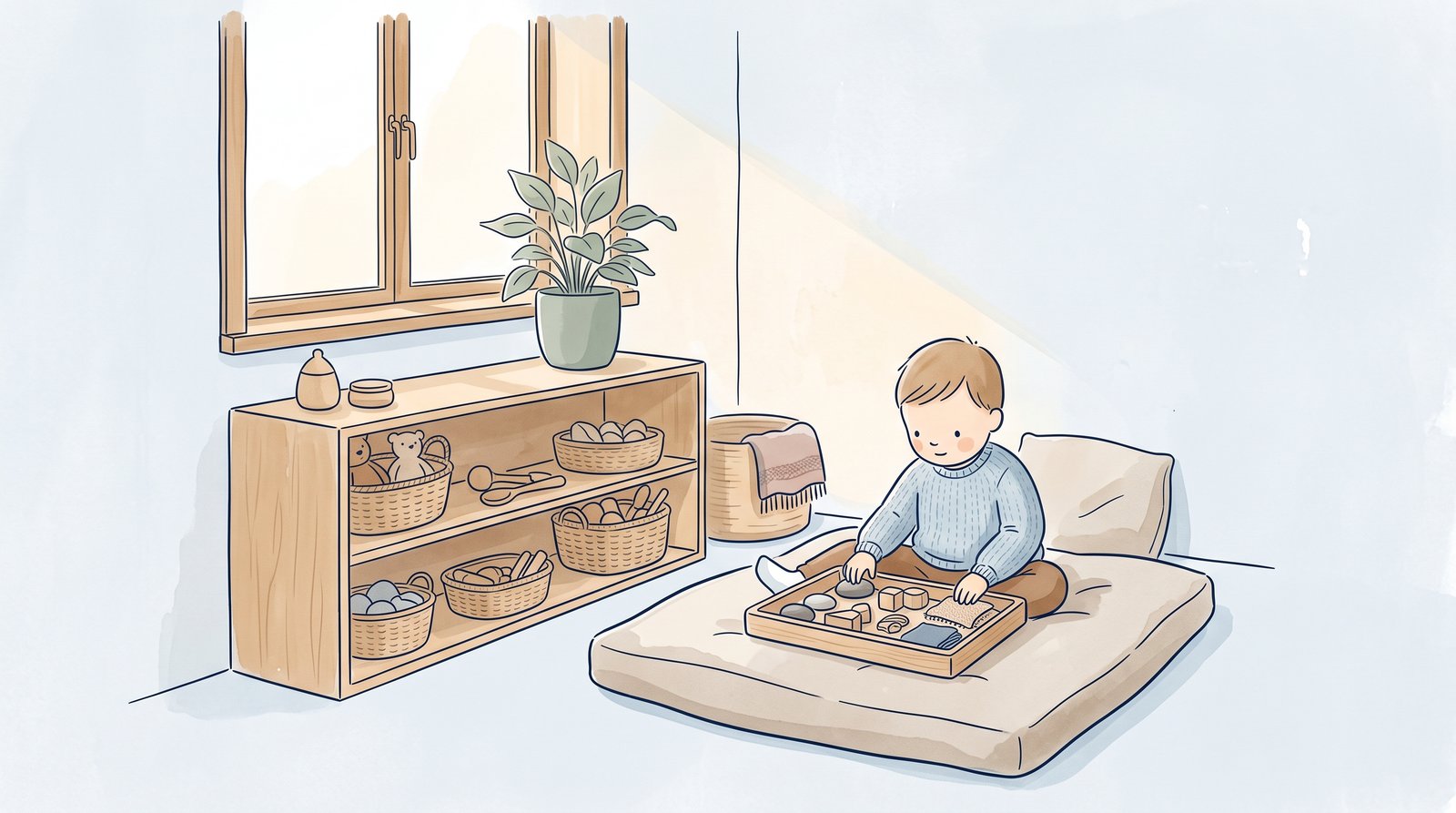
Instead of using quiet spaces as a consequence (“You need to go sit by yourself until you are calm”), a sensory environment early childhood design includes an open, voluntary reset nook.
Here is how to build a functional haven in your living room or classroom:
- 1. Choose a Protected, Low-Traffic Corner Avoid placing the haven near the front entrance, bathroom door, or kitchen pathway. Look for an alcove or corner that has solid walls on at least two sides. This provides natural architectural containment, which gives an anxious nervous system an immediate feeling of physical safety.
- 2. Establish Soft, Grounded Seating Lay down a low mattress, a wide beanbag, or several neutral-toned floor cushions. Opt for fabrics with natural textures like cotton canvas, linen, or soft corduroy rather than slippery polyester or crinkly vinyl. In a high-quality sensory environment early childhood spaces prioritise tactile comfort.
- 3. Provide Low-Demand Sensory Tools Include a small woven basket holding two pairs of noise-cancelling headphones, a soft weighted lap pad (roughly five to ten percent of a child’s body weight), and a few quiet tactile items such as smooth river stones, velvet swatches, or squishy resistance balls. Avoid noisy battery-operated toys that introduce fresh sensory demands.
- 4. Soften the Light Source Ensure this area is not directly under an unshielded overhead light. A small, warm-white LED lamp with a heavy fabric shade or a paper lantern placed on a low shelf creates a warm glow that encourages physiological rest.
Teach the use of this space during moments of calm, not in the middle of a storm. Introduce it during a relaxed morning: “This is our quiet nest. Whenever the room feels too loud or your body feels busy, you can come sit here and rest your ears.”
When a child feels their sensory cup nearing the brim, they can step into this retreat without feeling singled out or punished. For body-based regulation ideas that pair with this space, explore our guide on sensory seeking and proprioception in early childhood. Designing this dedicated zone completes a compassionate sensory environment early childhood plan.
Adult Nervous Systems and Co-Regulation Inside Shared Rooms
We often talk about the environment as though it consists purely of walls, lights, and floor rugs. But the most powerful sensory element in any room is the adult standing in it.
Children possess mirror neuron systems that continuously monitor the physiological state of the grown-ups around them. If an educator or parent is hurried, tense, or overwhelmed by noise, their voice tightens, their breath becomes shallow, and their facial muscles stiffen. A neurodivergent child’s neuroception reads those cues instantly. Even if the adult speaks kind words, the child’s body senses danger and matches that elevated arousal.
An unmanaged sensory environment early childhood educators work in does not just overwhelm the children; it depletes the adults as well. When an educator spends eight hours a day in an echoing room with fluorescent lighting and constant visual clutter, their own executive function reserves wear thin. By three in the afternoon, their patience is exhausted, making co-regulation nearly impossible.
By adapting the sensory environment early childhood professionals are actively protecting their own mental health and regulatory stamina. When the room is quieter, softer, and more predictable, the adult’s heart rate stays lower, their voice remains grounded, and their capacity to offer calm co-regulation increases tenfold.
The 10-Minute Sensory Environment Early Childhood Checklist
Before you reorganise a playroom or write an accommodation plan, take ten minutes when the room is empty to complete this practical sensory environment early childhood audit:
- Crouch to Child Height: Sit on the floor in the middle of the room. Look around. Is the visual space overwhelming? Can you see clear, tidy pathways to rest areas and bathrooms?
- Listen to the Static Hum: Close your eyes for thirty seconds. Can you hear the air conditioner whistling, a buzzing light ballast, or traffic reverberating through the walls? Where can you add soft furnishings to absorb that resonance in your sensory environment early childhood layout?
- Check the Wall Load: Look at your walls. Are student works, rules, and schedules competing for attention? Aim to keep half of your wall space at child eye-level completely free of posters.
- Test Alternative Seating: Are there options for children who need proprioceptive grounding during story time? Do you have low stools, floor cushions, or carpet boundaries ready?
- Audit the Light Glare: Walk around the room at different times of the day. Does the afternoon sun reflect harshly off polished tables or glossy laminated worksheets?
- Smell the Air: Are strong chemical disinfectants, scented air fresheners, or heavy hand soaps lingering in the air? Switch to fragrance-free products to relieve sensitive olfactory systems.
- Examine the Pathways: Can children move from the block corner to the reading area without crashing through another child’s play space? Clear boundary markers prevent unnecessary physical collisions.
If you are an educator struggling to adapt spaces for diverse learners while juggling routine demands, read our practical framework on supporting all children without writing separate plans. Auditing your sensory environment early childhood routine provides immediate relief without adding paperwork.
How This Fits Our Neurodivergent Learning Approach
In many educational frameworks, the physical room is treated as a passive backdrop, and children are expected to adapt their bodies to whatever space they are placed in. If a child cannot cope, their distress is labelled as poor behaviour or a lack of attention.
In our neurodivergent learning approach, we recognise that the room is an active participant in child regulation. A responsive sensory environment early childhood setup works alongside the educator.
This article acts as direct evidence for two of our foundational design principles:
Principle 3: Sensory Environments Shape Capacity. A child’s stamina, focus, and emotional resilience are not static traits. By systematically reducing acoustic fatigue, visual clutter, and physical restrictions, we expand a child’s available capacity for learning and connection. Understanding how a sensory environment early childhood space functions is fundamental to our approach.
Principle 4: Grounded in Real Homes and Classrooms. We do not advocate for expensive, clinical overhauls that place pressure on family budgets or early learning centre finances. These changes work with everyday furniture, natural lighting, and simple adjustments that any parent or room leader can make tomorrow to establish an effective sensory environment early childhood learners can thrive in.
Start with Our Free Low Frustration Sampler
Designed with reduced visual clutter and low cognitive demand to support early learning at home or in class.
Download Free SamplerReferences and Further Reading
- Ayres, A. J. (2005). Sensory Integration and the Child: Understanding Hidden Sensory Challenges. Western Psychological Services.
- Dunn, W. (2007). Living Sensationally: Understanding Your Senses. Jessica Kingsley Publishers.
- Fisher, A. G., Murray, E. A., & Bundy, A. C. (1991). Sensory Integration: Theory and Practice. F.A. Davis Company.
- Australian Children’s Education and Care Quality Authority [ACECQA] (2023). National Quality Standard – Quality Area 3: Physical Environment. ACECQA Quality Area 3 Guidelines
- Mostafa, M. (2008). An Architecture for Autism: Concepts of Design Intervention for the Autistic User. International Journal of Architectural Research, 2(1), 189-211.
- Shanker, S. (2013). Calm, Alert, and Learning: Classroom Strategies for Self-Regulation. Pearson Canada.
Explore More on EarlyChildhoodEduNet
- Return to our core framework on Learning Design for Neurodivergent Early Childhood.
- Understand nervous system states during meltdowns in our Polyvagal Theory in early childhood guide.
- Discover why developmental progress fluctuates in our guide to spiky developmental profiles and adult capacity.
- Read our practical sleep transition guide on toddler sleep resistance and ADHD routines.