
5 Low Mess Sensory Bins for Preschoolers (That Won’t Ruin Your Carpet)
Contained, low-stress sensory alternatives that soothe busy nervous systems, protect living room floors, and cut cleanup time down to under three minutes.
Table of Contents
- The Lingering Dread: Why Parents Avoid Sensory Bins
- Why Low Mess Sensory Bins for Preschoolers Still Matter
- The Architecture of Low Mess Sensory Bins for Preschoolers
- 5 Low Mess Sensory Bins for Preschoolers That Actually Work
- What Children Learn When the Clutter Drops Away
- What Happened in My Own Living Room
- What Does Not Work (Common Traps to Skip)
- How to Reduce Mess Without Killing the Fun
- A 5-Minute Starter Plan for Overwhelmed Days
- References & Research Foundations
The big plastic under-bed storage tub was sitting on the bottom shelf of the linen cupboard, right behind the spare bath towels. I looked at it, reached my hand out, and immediately pulled back.
It was 4:10 pm on a blustery Thursday. The daylight outside was fading into that flat grey gloom that usually signals an hour of intense preschooler restlessness. My four-year-old daughter was in the lounge room, spinning in circles on the rug and dropping a plastic tambourine onto the floorboards with rhythmic, ear-splitting crashes.
Her nervous system was running hot. My own brain, navigating the end-of-day fog of adult ADHD, was desperately craving twenty minutes of quiet, grounded stillness.
A tactile station was the obvious developmental answer. I knew the educational theory inside and out. Yet my stomach tightened at the memory of our previous attempt six months prior. That afternoon involved two kilograms of dyed green long-grain rice that ended up scattered across every carpet fibre and skirting board in the room. The vacuum cleaner had choked, and I had spent nearly an hour on my hands and knees.
I stood there in front of the cupboard, frozen by mess anxiety.
If I pull out a tub, will I spend the next forty-five minutes on my knees with a dustpan while dinner burns? Is twenty minutes of play worth two hours of sensory irritation from crunching floorboards?
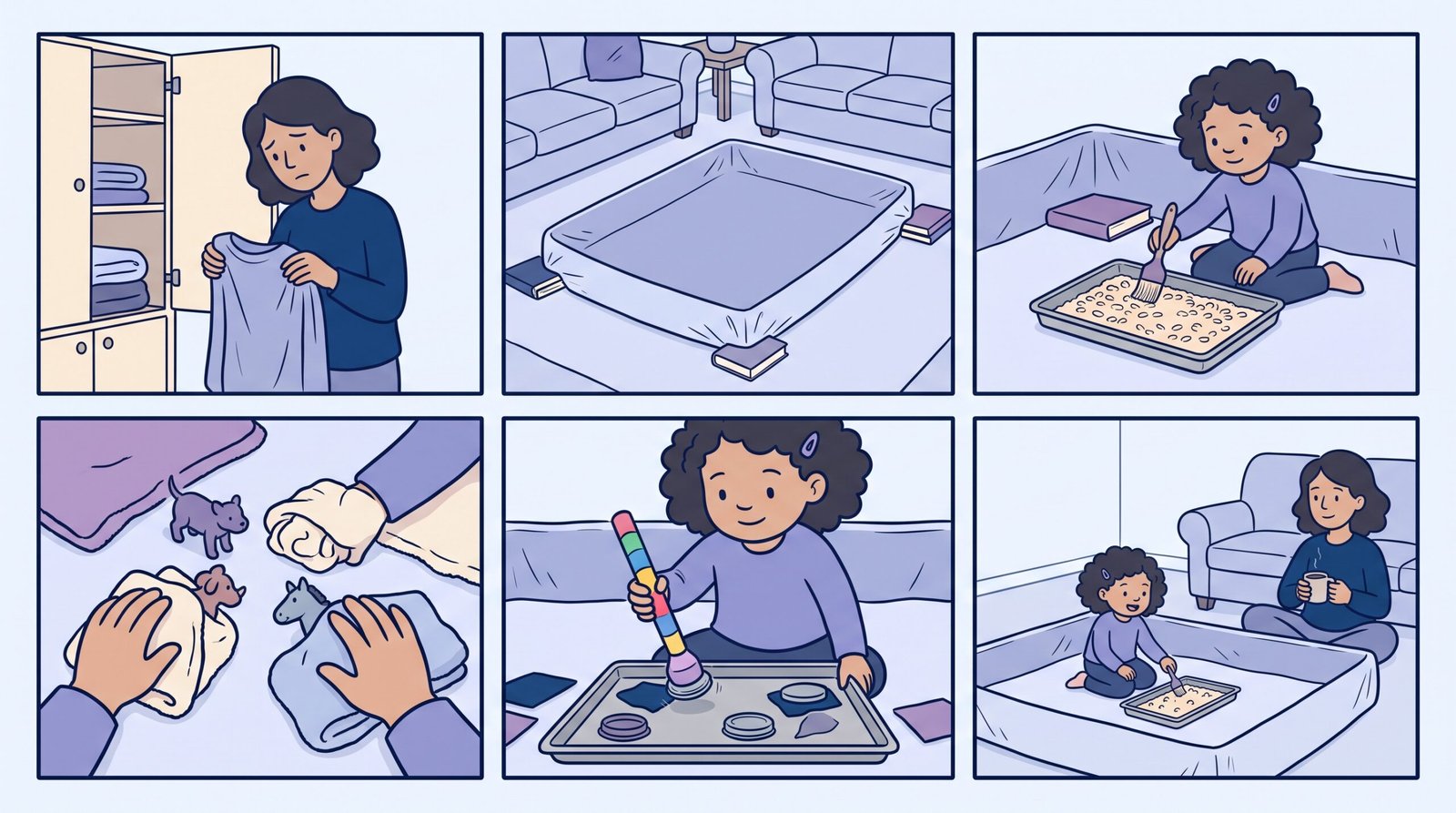
I took a breath, reached past the plastic tub, and pulled out a single fitted single-bed sheet from the linen pile. Then I walked into the kitchen and grabbed a half-empty cardboard box of plain rolled oats.
No coloured rice. No tiny plastic beads. No deep buckets of liquid.
I stretched the fitted sheet out upside-down on the living room floor, hooked four heavy books into the elastic corners to create a low cloth barrier, and set a flat baking tray with three cups of dry rolled oats right in the centre.
My daughter stopped spinning. She walked over, stepped into the sheet perimeter, dropped to her knees, and plunged both hands into the soft, flat flakes. There was no bouncing. No flying projectiles. The room went quiet, and my carpet was entirely safe. Creating practical low mess sensory bins preschoolers can actually use had turned an overwhelming evening into a haven of calm.
Why Low Mess Sensory Bins for Preschoolers Still Matter Sensory down-regulation, neural pathways, and sustained focus
When parents hear the words “sensory bin”, they often picture the high-maintenance aesthetic from social media: pastel-dyed chickpeas, tiny wooden scoops, hand-carved resin figures, and children sitting in pristine linen smocks without dropping a single speck.
Real life with a preschooler looks nothing like that. In a normal home, traditional fillers spread like wild seeds. If an activity takes five minutes to play with but forty minutes to clean up, your hesitation is completely rational.
Yet abandoning tactile exploration entirely cuts out one of the most effective ways to regulate a young child’s nervous system. Designing intentional low mess sensory bins preschoolers can enjoy bridges this gap:
- Autonomic Nervous System Regulation: Preschoolers spend their days processing verbal instructions, sensory noise, and social expectations. Direct tactile feedback bypasses complex verbal centres, offering immediate physiological grounding. Clinical guidance from the American Academy of Pediatrics (AAP) highlights that sensory exploration is vital for building robust neural pathways, supporting emotional balance, and helping young children manage daily environmental stress.
- Attention Through Flow States: The repetitive physical feedback of feeling gentle textures provides steady sensory input that keeps a busy mind tethered to the moment. Research from the Harvard Center on the Developing Child shows that child-led, exploratory play strengthens core executive function and self-regulation, helping children build focus without constant adult intervention.
- Fine Motor Scaffolding: Every time a child pinches a small object out of a base or wraps a washcloth around a toy, they strengthen finger isolation, wrist stability, and bilateral coordination. Guidelines from the National Association for the Education of Young Children (NAEYC) show that hands-on play provides the foundational spatial and motor groundwork needed for later handwriting, scissor skills, and early mathematical reasoning.
The Architecture of Low Mess Sensory Bins for Preschoolers Materials that physically resist scattering before play begins
A successful setup does not rely on reminding a four-year-old to “be careful.” Truly practical low mess sensory bins preschoolers use rely on selecting materials that naturally resist mess through their own physical properties.
Flat, Flaked Materials (Zero Bounce)
The primary reason dry rice and beans create chaos is kinetic bounce. Rolled oats, felt pieces, and fabric scraps land flat and absorb impact, staying where they fall without scattering under furniture.
Minimal Volumes on Shallow Trays
Deep plastic bins encourage children to dig, fling, and dump. Using two to three cups of material spread thinly across a flat baking tray provides the same tactile reward with only a fraction of the cleanup footprint.
By substituting rigid plastic shovels with soft tools like washcloths, silicone brushes, or magnetic wands, you fundamentally change how children move their bodies. The play shifts from wide, impulsive throwing to deliberate, slow exploration. This makes low mess sensory bins preschoolers love far more sustainable for busy living rooms.
5 Low Mess Sensory Bins for Preschoolers That Actually Work Carpet-safe invitations using materials you already own
You do not need to buy specialty commercial fillers. These variations of low mess sensory bins preschoolers love use everyday items, contain the mess, and keep cleanup under three minutes.
1. The Rolled Oats Sensory Base (The Anti-Rice Alternative)
If you have sworn off grain bins because of a rice disaster, plain rolled oats are the ultimate domestic solution when building low mess sensory bins preschoolers can explore safely.
- Why It Works: Rolled oats are soft, flat flakes that do not roll across timber floors or bounce into deep carpet pile. When pushed around, they make a gentle swishing sound rather than the loud, grating clatter of dry beans. If stray flakes escape, your vacuum picks them up in one pass without clogging.
- The Setup: Scatter two cups of standard rolled oats across a shallow baking tray or metal roasting dish. Add three small plastic animal figures and hand your child a clean pastry brush or dry basting brush.
- The Prompt: “Can you use the soft brush to sweep the oats off the bear’s back until he is completely clean?” The soft sweeping motion naturally slows their physical impulses.
2. Washcloth Scooping and Wrapping (Zero-Filler Play)
Tactile sensory experiences do not actually require loose, pourable grains. Some of the most effective low mess sensory bins preschoolers enjoy rely entirely on soft fabric textures.
- Why It Works: The mess factor is absolute zero. There are no grains, no powders, and no crumbs.
- The Setup: Take a shallow storage box or cardboard shoebox. Add four to six small face washers, tea towels, or cloth napkins of different textures (terry towelling, waffle weave, flannel). Add three plastic figures or vehicles.
- The Prompt: “The animals are cold and need to go to sleep. Can you fold them into their own blankets and tuck them into bed?” Wrapping and folding builds finger strength, wrist rotation, and spatial planning without a single crumb escaping.
3. The Magnetic Wand Retrieval Lab (STEM Without the Scatter)
Children are drawn to invisible physical forces. Introducing a magnetic wand turns simple low mess sensory bins preschoolers use into engaging physics stations.
- Why It Works: Because the physical objective is magnetic connection, children move the wand slowly and deliberately. They are not dumping; they are gliding.
- The Setup: Take a flat baking tray and scatter five or six safe, chunky metal objects: clean metal jar lids, large steel washers from the toolbox, or oversized paperclips threaded securely onto a metal ring. Cover them lightly with a handful of large fabric scraps, ribbon lengths, or pom-poms.
- The Learning: Educational research from Project Zero at the Harvard Graduate School of Education demonstrates that physical exploration of cause-and-effect fosters early scientific thinking routines. Children test invisible forces, evaluate physical resistance, and refine motor precision.
4. The Fitted Sheet Boundary Method (The Containment Hook)
The single best containment strategy for low mess sensory bins preschoolers use on carpet is a standard single-bed fitted sheet.
- How to Set It Up: Lay a fitted bed sheet upside-down on your rug so the elastic rim faces up. Place a heavy book, shoe, or canned good inside each of the four elastic corners. The tension pulls the elastic edges up into an automatic fabric wall ten to fifteen centimetres high. Place your child and their tray inside.
- Why It Protects Sanity: Any stray oat flakes or loose items that fall out of the tray are caught by the fabric wall. When play is done, lift the four corners together like a sack, take it outside to shake off, and fold it away. The carpet underneath stays untouched.
5. Contained Shallow Tray Bins (Trace and Reveal)
Deep plastic tubs invite chaotic digging; shallow trays create ideal low mess sensory bins preschoolers can use for mark-making.
- The Setup: Sprinkle just enough rolled oats, coarse cornmeal, or breadcrumbs to lightly cover a metal baking sheet in a single thin layer (less than half a centimetre deep). Give your child a clean dry paintbrush or let them use their index finger.
- The Prompt: “Can you draw a winding road through the flakes to uncover the shiny metal bottom?” Children can sketch shapes, wipe the tray smooth with their palm, and draw again. Keeping the movements flat against the tray keeps all materials contained.
What Children Learn When the Clutter Drops Away Cognitive schema, early physics, and fine motor control
When you strip away the chaos of flying filler, low mess sensory bins preschoolers use allow children to engage more deeply with developmental concepts.
| What the Child Does on the Tray | The Underlying Cognitive / STEM Concept | Long-Term Developmental Benefit |
|---|---|---|
| Sweeping oats with a soft pastry brush | Friction, displacement, and material resistance. | Fine motor control, wrist extension, and tactile processing. |
| Retrieving metal lids with a magnet | Magnetic polarity, invisible forces, and density. | Early scientific inquiry, hypothesis testing, and spatial tracking. |
| Wrapping toys tightly in washcloths | Spatial transformation, symmetry, and volume. | Bilateral coordination, motor planning, and finger separation. |
| Keeping materials inside the fitted sheet | Physical boundary recognition and body awareness. | Inhibitory control, focus duration, and executive regulation. |
Much like the water principles we explore in our guide to sink water play for preschoolers, providing a bounded physical setup allows children to explore physical properties without feeling overwhelmed by an unmanageable environment.
What Happened in My Own Living Room Realities, adjustments, and domestic lessons
Despite my background in early childhood education, managing late-afternoon domestic stress with an active, sensory-seeking child was an immense learning curve. My daughter has high sensory needs and an ADHD profile that makes traditional quiet activities difficult when she is tired.
I learned what works through trial and error. Early on, I tried using shredded paper from our home office shredder, thinking it would be light and harmless. Within three minutes, static electricity turned our living room into a confetti field. Tiny diamond pieces of paper clung to my daughter’s socks, the couch, and our family cat. Another time, I tried dried black beans; when dropped, they rolled under our upright piano and took six months to fully retrieve.
The turning point came when I stopped trying to make bins exciting and focused on making them calm.
One afternoon when she was overstimulated and near tears, I set out a flat cake pan with half a cup of rolled oats and a wooden pastry brush. She sat quietly on the carpet, slowly brushing the oats from one corner to the other. The soft swishing sound of the bristles acted like an acoustic anchor. She stayed absorbed for twenty-two minutes, completely regulated. That simple setup convinced me that low mess sensory bins preschoolers enjoy do not need to be elaborate; they just need to be physically grounding.
“Sensory play only works if the adult can breathe during it. When I stopped fighting the mess and started designing boundaries that actually protected my home, sensory play shifted from a source of dread into one of our most reliable calming tools.”
Dewi Griffith, PhD, Founder
What Does Not Work (Common Traps to Skip) Save your carpet, your vacuum, and your patience
To keep low mess sensory bins preschoolers love sustainable, avoid these common design mistakes:
- Round, Spherical Fillers: Chickpeas, dried black beans, and plastic beads roll when dropped. They bounce off mats and hide beneath heavy furniture. Stick to flat flakes or textiles.
- High-Altitude Pouring Tools: Tall plastic cups and funnels invite children to lift their arms high, causing wide scatter. Use flat brushes, washcloths, or magnetic wands to keep movements low to the tray.
- Unsupervised Play Too Early: Bounded sensory play requires your nearby presence while boundaries are learning. Sit nearby with a cuppa or fold laundry. Your calm presence provides the social security children need to stay settled.
How to Reduce Mess Without Killing the Fun Three simple household rules that protect your space
You do not need to hover and say “Careful!” every thirty seconds. Use these practical boundaries to keep your low mess sensory bins preschoolers activities contained:
- Measure and Cap the Volume: Never bring the whole box of oats into the room. Measure two cups into a small bowl. When the volume is limited, even an accidental tip takes less than a minute to tidy.
- The Boundary Rule: State the expectation clearly once before play starts: “The oats stay on the tray and inside the sheet. If flakes get thrown onto the carpet on purpose, the tray takes a rest.” If they fling materials, calmly pack it away without scolding. The natural outcome is clear, and children quickly learn to protect their play space.
- Child-Led Wrap Up: Keep a small dustpan and hand brush nearby. When finished, invite your child to help sweep stray flakes into the centre of the sheet. Participating in pack-down develops spatial awareness and everyday responsibility.
A 5-Minute Starter Plan for Overwhelmed Days A low-friction plan when energy is low
If setting up tactile play feels daunting, remember that low mess sensory bins preschoolers explore do not need to be complicated:
- Pull a single metal baking tray from the oven.
- Sprinkle half a cup of rolled oats across the surface.
- Add one plastic animal and a clean pastry brush.
- Sit with your child on the floor for just five minutes.
- When finished, tip the oats into the bin or compost.
That is a complete, developmentally rich sensory session. No carpet was damaged, no vacuum was needed, and you created a pocket of quiet connection right when your home needed it most.
For outdoor days when your child needs heavier resistance and outdoor elements, explore our practical guide to mud kitchen play ideas at home for ways to protect your garden beds while embracing outdoor sensory fun.
Looking for Grounding, Low-Mess Activities for Restless Days?
When you need quiet, table-based activities that soothe busy minds and strengthen fine motor control, our Montessori-inspired story tracing printables offer a peaceful, structured transition.
Explore Calm Story Tracing BundlesReferences & Research Foundations Credible developmental, paediatric, and early learning research
- Center on the Developing Child at Harvard University. (2014). Enhancing and Practicing Executive Function Skills with Children from Infancy to Adolescence. Harvard University. developingchild.harvard.edu
- American Academy of Pediatrics (AAP). (2018). The Power of Play: A Pediatric Role in Enhancing Development in Young Children. Clinical Report. aap.org
- National Association for the Education of Young Children (NAEYC). (2020). Early Math and Science Inquiry Through Everyday Materials in Early Childhood Classrooms. naeyc.org
- Project Zero, Harvard Graduate School of Education. (2023). Pedagogy of Play: Playful Thinking and Inquiry Routines in Early Childhood. Harvard University. pz.harvard.edu
- Raising Children Network (Australia). (2024). Play, learning and development: Preschoolers. Australian Government Department of Social Services. raisingchildren.net.au
This article is based on personal family experience and reflections from an early childhood education research background. It is shared for educational and supportive purposes only and does not constitute paediatric, clinical, or occupational therapy advice. Every child has unique sensory thresholds and developmental patterns. If you have concerns about your child’s sensory processing or fine motor development, please consult your GP, a paediatrician, or an accredited paediatric occupational therapist.