
ADHD and Work: Why I Chose a More Flexible Working Life (and the Honest Trade Offs)
ADHD and work don’t always fit the nine to five shape. For me, a fixed office day under fluorescent lights left me drained in a way a weekend didn’t fix. Over time I moved toward a working week with more variety and more say over how each day unfolds: independent SEO consulting alongside disability support work.
This is my story, not career advice. It covers the office role that wasn’t me, how I got here, what my ADHD diagnosis did and didn’t change, what research and Australian workplace rights say, what flexible work asks of me in return, small changes to try if you’re in a fixed job, questions to ask yourself, a free printable Work Energy Map and twelve free PDFs.
I was tired in a way a weekend didn’t fix. It took me years, and a diagnosis in my forties, to understand that the problem wasn’t the work. It was the shape of the work.
- Who This Page Is For
- The Office Role That Wasn’t Me
- My Working Life Was Always a Mix
- Independent Work: Shaping My Own Days
- Support Work: Movement and Connection
- What My Diagnosis Did and Didn’t Change
- What Research and Australian Rights Say
- Why Flexibility Suits the Way I Work
- What Flexible Work Asks of Me
- How I Recharge
- What I’m Not Saying
- If You’re in a Fixed Job Right Now
- Questions to Ask Yourself
- What I’d Tell My Office Self
- Free Printable: Work Energy Map
- More Free PDFs
- FAQs
Who This ADHD and Work Page Is For
Most of this site is about young children. But many of the parents and educators who read it have ADHD themselves, often diagnosed late, like me. If you’ve ever wondered why a job that looked fine on paper left you exhausted, this page might help you:
- Put words to what drains you and what gives you energy at work.
- See one real example of building a more flexible working week, including the parts that are hard.
- Know your rights to ask for flexible arrangements in Australia.
- Try small changes first, before making any big decision.
- Map your own energy with a free printable.
I’ll also share the part nobody warned me about when I left the office: flexibility didn’t mean less work. It meant a different kind of hard. That’s further down, in what flexible work asks of me.
ADHD and Work: The Office Role That Wasn’t Me
Some years ago I worked in a corporate office as a digital marketing manager, nine to five, for a little over a year. There was nothing wrong with the workplace. My colleagues were supportive and the work was meaningful.
What didn’t work was the fixed shape of it. The same desk every day. Open plan noise. Fluorescent lights. Every day looking much like the one before. I was tired in a way that a weekend didn’t fix.
What I remember most is the dip in the early part of the day. If my focus dropped, I had few options. I couldn’t switch to something physical, step outside to reset, or move to a completely different kind of task. The hours kept me at the desk, however my mind was working.
I’ve written about the lighting side of this in fluorescent flicker, lighting and ADHD focus. In that office, constant overhead light and steady background chatter slowly drained my energy across the day.
The role still taught me a lot. I still rely on the practical skills it gave me. And it showed me clearly what kind of working rhythm didn’t suit me: I need variety, practical problems to solve and some say over how my day unfolds. Without those, staying engaged was an uphill battle. With them, I can work for hours with real interest.
My Working Life Was Always a Mix
Looking back, my working life had never been one straight line, and maybe that should have been a clue.
During my PhD at Deakin, I worked three casual jobs: VCE marking, cleaning and a newspaper delivery run from 3am to 6am, not all on the same day. I wrote about how I actually got the PhD done in I did my PhD in bed.
After graduating in 2016, I completed a Diploma of Early Childhood so I could work in childcare settings, and spent about two years as a casual relief educator in centres across Melbourne’s east. Relief work has variety built in: a different centre, a different room, different children and a different rhythm, often from one day to the next.
Then I completed a Certified Digital Marketing Professional course, funded through the Victorian Government. The subject caught my interest, and it led to the marketing manager role I described above.
Over the years I’ve also completed qualifications in adult training and assessment and social media marketing, alongside my Master of Education. Each one felt like opening another door: more practical choices for how to shape a working life.
Independent Work: Shaping My Own Days
After the corporate role, I moved into independent consulting. I began helping people with their websites and building my own projects, including EarlyChildhoodEdu.net and GriffithProMarketing.
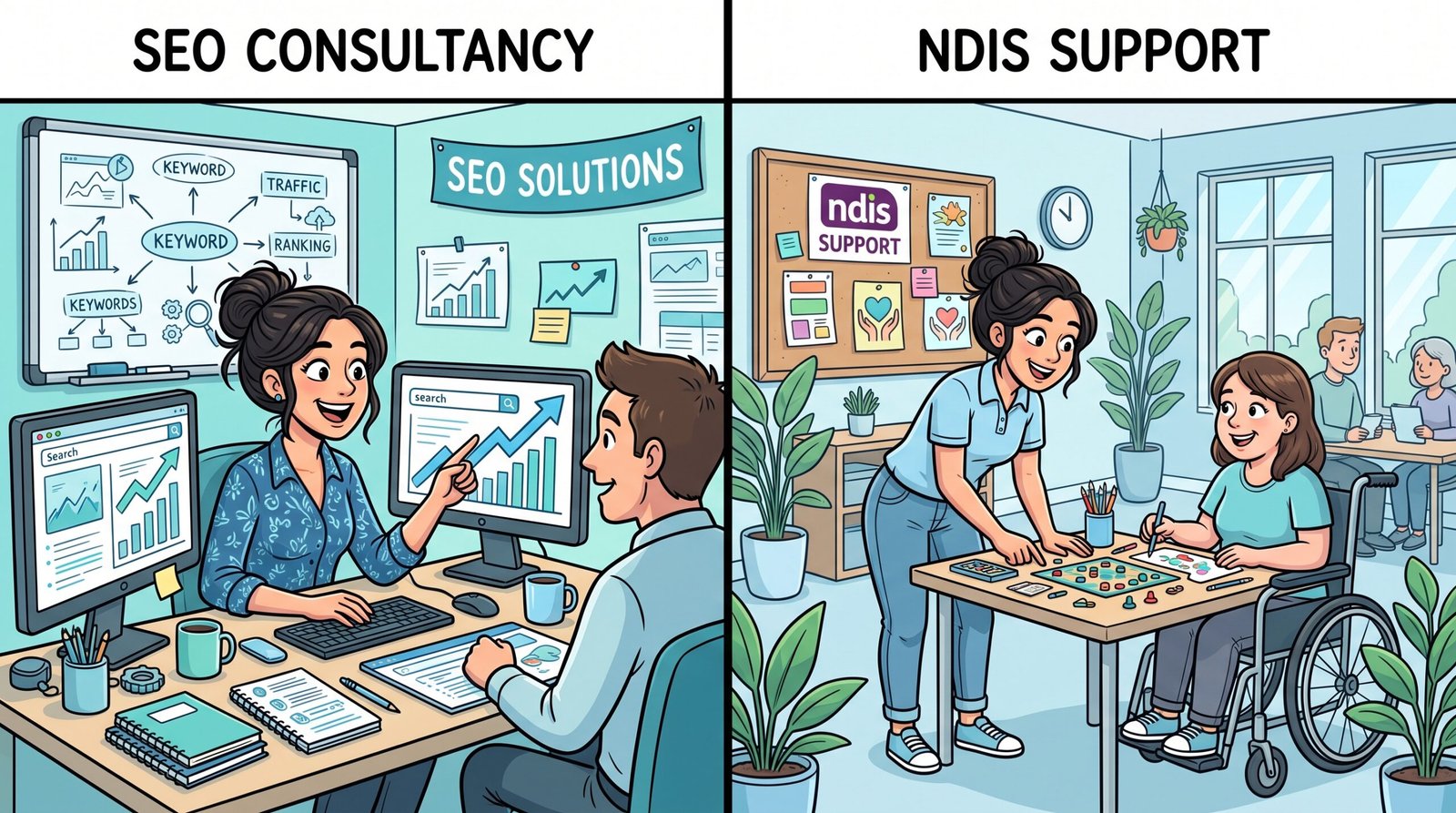
SEO suits me because it’s practical problem solving. When a page isn’t performing, I can investigate why, test a change and see the result. It’s varied and hands on, and I can arrange my hours around when my focus is strongest.
If my energy dips on a thinking heavy task, I can switch to technical maintenance, or step away for an hour, without running into office rules. Being able to switch is the part that matters most to me.
Support Work: Movement and Connection in My Week
Working entirely on a laptop brought its own problem. Long stretches of solitary screen time left me missing physical movement and face to face connection.
So I completed NDIS training and started disability support work. It brings direct human connection and physical activity, and each day brings a different routine and different needs.
Support work balances the quieter, screen based side of consulting. It gives my week a natural rhythm of movement that I couldn’t have designed sitting at a desk. Right now, my working week is that mix: SEO consulting and support work.
What My ADHD Diagnosis Did and Didn’t Change
The honest answer is: a bit of both. I’d started moving toward more varied, flexible work before my diagnosis, simply by noticing what drained me and what didn’t. The diagnosis in my forties didn’t make the decision for me. It helped me understand why the decision made sense, and it gave me permission to keep going in that direction instead of feeling like I’d failed at a “normal” job.
I’ve written more about this in understanding my busy mind and a parent with ADHD. My arrangement isn’t a blueprint for ADHD and work for anyone else. It’s one arrangement that keeps my mind engaged.
What Research and Australian Rights Say About ADHD and Work
ADHD Can Affect Work, and Support Is Often Patchy
An international consensus paper by Marios Adamou and colleagues noted that ADHD often continues into adulthood and that its symptoms can affect employment. The group found clear weaknesses in how workplaces and occupational health services support adults with ADHD, and called for better tools and support schemes.1
You Can Ask for Flexible Arrangements
In Australia, the Fair Work Ombudsman explains that employees with disability who’ve worked for the same employer for at least 12 months can request flexible working arrangements, such as changes to hours, patterns or location. This includes regular, systematic casual employees who expect to keep working. Employers must respond in writing within 21 days.2 Whether ADHD counts as a disability for this purpose depends on your situation, so it’s worth checking with Fair Work or an adviser.
Free Advice on Workplace Adjustments
JobAccess, the Australian Government’s disability employment service, publishes a guide on supporting neurodivergent workers, including people with ADHD, with advice on tailoring adjustments to each person.3
A note on the evidence: research on what kinds of work suit adults with ADHD is still limited, and people with ADHD are very different from each other. Nothing here says flexible work is better for ADHD in general. It’s what worked for me.
Why Flexibility Suits My ADHD and Work Style
For me, flexibility has never been about working fewer hours. I often work as much as I did in the office. It’s about variety and independence: different kinds of work across the week, so no two days look the same.
| What I need | The office day | My week now |
|---|---|---|
| Variety | Same desk, same tasks, every day | Screen work and hands on support work across the week |
| A way to reset when focus dips | Stay at the desk | Switch task, move, step outside |
| Movement | Mostly sitting | Built into support work |
| Connection | Open plan, but noisy | Face to face, one person at a time |
| Sensory comfort | Fluorescent light, background chatter | Natural light, more control over noise |
| Practical problems | Some | Plenty, in SEO and in support work |
And here’s the part I promised earlier, the part nobody warned me about.
ADHD and Work: What Flexible Work Asks of Me in Return
Flexible work isn’t the easy option. It swaps one set of challenges for another.
Every Decision Is Mine
In an office, someone else sets your schedule and your task list. Working independently, those decisions are yours every single day. Choosing priorities takes real mental effort, and on scattered days, tasks can stall. I wrote about that in I have plenty of ideas, so why is finishing them so hard? and ADHD and deadlines.
Boundaries Don’t Build Themselves
When work can happen anywhere, any time, it creeps into evenings and weekends unless you actively stop it. I have to decide when the day ends.
Noticing When It’s Too Much
Managing yourself means recognising when you’ve taken on too much, knowing when to pause, and asking for an outside view when a project feels stuck. The start together task trick and ADHD and forgetfulness share some of the tools I lean on.
Less Certainty
Independent work usually comes with less predictable income and no one else holding the structure. That’s a real cost, and it’s one reason this path isn’t right for everyone.
How I Recharge
Outside work, sewing and Indonesian traditional dance are how I recharge. One is quiet and focused, the other is music and movement. Having flexibility in my week means I can protect time for both, rather than running on empty. If you’re running low yourself, parent and teacher burnout and the Small Refills Menu might help.
What I’m Not Saying About ADHD and Work
I’m not saying everyone with ADHD should leave steady employment. Fixed jobs offer security, and many people with ADHD do well with clear, predictable structure. For many, family commitments, money or visas make a fixed job the only practical option.
Flexibility also isn’t right for every person. Some people find fewer outside boundaries make focus harder, and that’s a completely valid thing to learn about yourself.
I had the chance to build this change slowly, alongside study and qualifications. I know that kind of space isn’t available to everyone.
ADHD and Work: If You’re in a Fixed Job Right Now
You don’t need to change careers to change how work feels. These are small things worth trying or asking about first:
| If this drains you | Something to try or ask about |
|---|---|
| Harsh overhead lights | A desk near a window, a desk lamp, or asking about lighting options |
| Open plan noise | Noise reducing headphones, a quiet room for focused work, set “heads down” times |
| Sitting all day | Walking meetings, standing for calls, a short walk at your dip time |
| Same task for hours | Batch tasks into shorter blocks and switch between two types of work |
| Fixed start time when mornings are hard | A request to adjust start and finish times |
| Losing track of tasks | A visible list, timers, and a short daily check in with a colleague |
For more on sound and space, see classroom noise and sensory overload and sensory environments. They’re written for early learning rooms, but the ideas carry into offices too.
Questions to Ask If You’re Considering a Change
| Question | What it helps you see |
|---|---|
| When do I feel most focused during the day? | Your natural energy rhythm, and the settings that support it |
| What drains me that I’ve been treating as normal? | Specific friction points, like lighting, noise or fixed seating |
| What gives me energy at work? | The parts of work to protect or grow |
| How much outside structure do I really need? | Whether you rely on deadlines from others or can build your own |
| What can I change where I am? | Adjustments to try before a big move |
| Can I try a smaller version first? | A short course, volunteer role or side project before a major change |
For ADHD and work decisions, the free Work Energy Map PDF turns these questions into one page you can fill in over a week, or you can print it from this page.
ADHD and Work for Parents and Educators
If you’re a parent with ADHD, work energy and home energy come from the same tank. A draining work week shows up at bedtime and in the morning rush. Many of the ideas on this site for children, like visual routines, movement breaks and calm spaces, help adults too. ADHD parent literacy support and alexithymia and ADHD mothers are written with you in mind.
If you’re an educator, the same principle that helps children, designing the environment rather than just trying harder, applies to your own working day. How to stop writing a separate plan for every kid is about cutting planning load without cutting quality.
ADHD and Work: What I’d Tell My Office Self
If I could sit down with the version of me at that desk, under those lights, I wouldn’t tell her to quit. I’d tell her to start noticing. Which hours felt good? Which tasks made time fly? What made the afternoon so heavy? Those notes would have saved her years of thinking she was just bad at coping.
I’d also tell her that needing variety isn’t a character flaw. For many people, ADHD and work fit together best when the job has some movement, some problem solving and some say over the order of things. That might come from a new role. It might come from small changes in the role she already had.
And I’d tell her not to wait for a diagnosis to take her own experience seriously. The diagnosis helped. But the noticing came first, and the noticing is something anyone can start this week.
ADHD and Work: Where Things Stand Now
My working life wasn’t a master plan. I got here by noticing, over many years, what left me depleted and what gave me energy, and moving slowly toward more variety. My ADHD diagnosis came partway through and helped me trust what I’d already noticed.
It takes ongoing decisions and firm boundaries. But it gives me the variety and say over my days that I need to stay well and engaged, and time for sewing and dance on the side.
Free Printable: Work Energy Map for ADHD and Work
Notice what fuels and drains you, map your energy across a week, and plan one small trial. One page, filled in over seven days.
Download the Free PDFMy Work Energy Map
Notice first. Change one small thing. Notice again.
| Mon | Tue | Wed | Thu | Fri | Sat | Sun | |
|---|---|---|---|---|---|---|---|
| Morning | |||||||
| Midday | |||||||
| Afternoon | |||||||
| Evening |
How to Use the Work Energy Map
- Print the map and keep it somewhere you’ll see it every day, like next to your laptop, on the fridge or in your work bag.
- For one week, colour the energy grid at the end of each part of the day: green if you felt good, yellow if okay, red if drained. Quick is fine. Missed boxes are fine too.
- As things come up, jot them in the two left boxes. What gave you energy? What drained you? Be specific, like “fluorescent lights after lunch” or “solving a fiddly problem”.
- At the end of the week, look for patterns: your red times, your green times, and what was happening then. Choose one small trial to test for two weeks, and one boundary you’ll protect.
- Print a fresh map and repeat while you run your trial. Compare the two weeks. If something helped, keep it and try another small change. If you’re in a job, bring your map to a conversation about flexible arrangements.
More Free PDFs for Parents and Educators With ADHD
Good Enough Reading Week
Reading routines that survive busy weeks.
Download PDFFor ADHD parentsCalm Shapes Breathing Cards
A quick reset at your dip time.
Download A4 PDFFor adults and children- Personal: understanding my busy mind
- Study: I did my PhD in bed
- Finishing: plenty of ideas, hard to finish
- Light: fluorescent flicker and ADHD focus
- Parenting: a parent with ADHD
- Girls and women: signs of ADHD in girls
- About me: how this began
ADHD and Work FAQs
Is flexible work better for people with ADHD?
Not always. Some people with ADHD do best with variety and control over their day, while others need clear outside structure to stay on track. It depends on the person, the job and their situation. Noticing what drains and fuels you is a good first step.
Can I ask my employer for flexible arrangements because of ADHD?
In Australia, employees with disability who have worked for the same employer for at least 12 months can request flexible working arrangements, and employers must respond in writing within 21 days. Whether ADHD counts as a disability for this depends on your situation, so check with the Fair Work Ombudsman or an adviser.
What small changes help with ADHD at work?
Common ideas include better lighting, noise reducing headphones or a quiet space, movement breaks, shorter task blocks, visible task lists and timers, and adjusted start or finish times. JobAccess offers free advice on workplace adjustments.
Does flexible work mean working less?
Not necessarily. Many people with flexible work, including me, work similar hours. The difference is more variety and more say over when and how the work happens, which also brings more decisions and a need for firm boundaries.
Is this career or medical advice?
No. This is a personal reflection. If you’re thinking about a work change, talk with people who know your situation, and if you have health concerns, see your GP or another qualified professional.
Experience: my three casual jobs during my PhD at Deakin, my Diploma and two years of relief work after 2016, the Victorian Government funded digital marketing course, a little over a year as a digital marketing manager in a corporate office, my move into SEO consulting and disability support work, my qualifications, my ADHD diagnosis in my forties, and sewing and Indonesian traditional dance are all from my own life.
Research and rights: Adamou and colleagues on occupational issues for adults with ADHD, the Fair Work Ombudsman on flexible working arrangements for employees with disability, and JobAccess on supporting neurodivergent workers. The small changes and questions are general ideas, not tested programmes.
This is personal reflection, not career, legal or medical advice. Last reviewed: 10 November 2026.
References
- Adamou, M., Arif, M., Asherson, P., Aw, T. C., Bolea, B., Coghill, D., Guðjónsson, G., Halmøy, A., Hodgkins, P., Müller, U., Pitts, M., Trakoli, A., Williams, N., & Young, S. (2013). Occupational issues of adults with ADHD. BMC Psychiatry, 13, Article 59. https://doi.org/10.1186/1471-244X-13-59
- Fair Work Ombudsman. (2023, October 25). Flexible working arrangements for employees with disability. https://www.fairwork.gov.au/newsroom/news/flexible-working-arrangements-employees-disability
- JobAccess. (n.d.). How to support a neurodivergent workforce. Australian Government. https://www.jobaccess.gov.au/news/support-neurodivergent-workforce
