
Mapping Identity and Belonging: Why EAL Progress Starts at the Home Core
Five year old Zara sat on the edge of the mat, her hands tucked neatly into the lap of her dress. Around her, twenty four kindergarten children were singing a morning welcome song in rapid English, clapping their hands in rhythm and calling out their names with easy familiarity. Zara kept her lips pressed tightly together. Her eyes moved slowly across the carpet, following the bright stripes on her classmate’s socks, then up to the wooden shelves filled with plastic blocks and picture books. She did not clap, and when her turn came in the greeting circle, she simply lowered her head and turned her feet inward.
At home in our kitchen, our world was full of vibrant sound. In the evenings, Zara would chatter non stop in Indonesian while helping mix rice, telling long, dramatic stories about her soft toys and assigning each of them elaborate voices. But the moment she walked through the kindergarten gate in Melbourne, that confident, expressive child vanished completely.
Our family had arrived in Melbourne from Jakarta in October 2010 so I could begin my PhD in early childhood education. I was navigating my own massive life shift, juggling university seminars, reading piles of dense academic research, and adapting to a new culture. Yet, despite holding qualifications in early childhood and spending my days reading about developmental frameworks, dropping Zara off at kindergarten every morning left me feeling helpless.
I would stand outside the glass doors of the classroom, watching her stand quietly near the art space, surrounded by a fast moving blur of unfamiliar words. The knot in my stomach was not just the worry of a mother seeing her child isolated. It was also the quiet frustration of an educator who realised that all the academic theories in my university library felt strikingly different when it was my own five year old daughter holding back her tears on the carpet.
The Gap Between Academic Theory and Living Room Reality
There is a strange irony in researching early childhood theory while raising a child who is living that theory in real time. In academic textbooks, concepts like language acquisition, sociocultural theory, and code switching sound clean, logical, and structured. Researchers write about the silent period in second language learning as a natural, predictable developmental stage. They draw neat diagrams of child development, showing how children smoothly transition from home to school.
In living room reality, theory feels messy, unpredictable, and deeply emotional.
When you read about early EAL learning in a research paper, the silence of a child is described as cognitive processing time. But when you are a mother watching your daughter retreat into her shell day after day, that silence feels heavy and worrying. I caught myself falling into the very traps I criticised in academic literature. I wanted quick fixes. I caught myself wondering if I should speak more English at home, if I should drill her on basic phrases, or if I should push her to try harder at drop off.
The truth I had to confront, both as a mother and as an early childhood researcher, is that we frequently misunderstand child theory in practice because we try to separate a child’s brain from their heart. We treat language as a set of mechanical skills to be mastered rather than an extension of a child’s identity and emotional safety.
When a multilingual child enters a new cultural space, they are not just trying to figure out English vocabulary. They are grappling with fundamental questions of self: Who am I here? Is my home language allowed in this room? Do I still belong to my family if I learn to speak like these new people?
Understanding EAL identity and belonging means recognising that language is tied to psychological security. A child cannot build a new language if they feel that doing so requires them to tear down the bridge to who they already are.
The Silent Mapping Phase: What Is Really Happening?
It is easy to look at a quiet child in a new classroom and assume they are stuck or overwhelmed. But silence in early childhood is rarely empty space.
When Zara stood on the edge of the mat, her brain was engaged in intense, high level social mapping. She was reading subtle non verbal cues, studying how the teacher moved around the room, noticing how her peers negotiated shared toys, and listening to the rhythm of English speech long before attempting to produce it herself.
In developmental psychology, particularly when looking at ecological systems theory, a child’s ability to navigate new environments depends entirely on the strength and stability of their primary home relationship. The home environment, the primary language, and the core family unit form the primary microsystem. It is the emotional anchor of a child’s world.
When the primary microsystem feels completely secure, celebrated, and untouched by the pressures of the outside world, the child develops the internal resilience needed to step out into the wider mesosystem of school, playground games, and new social groups.
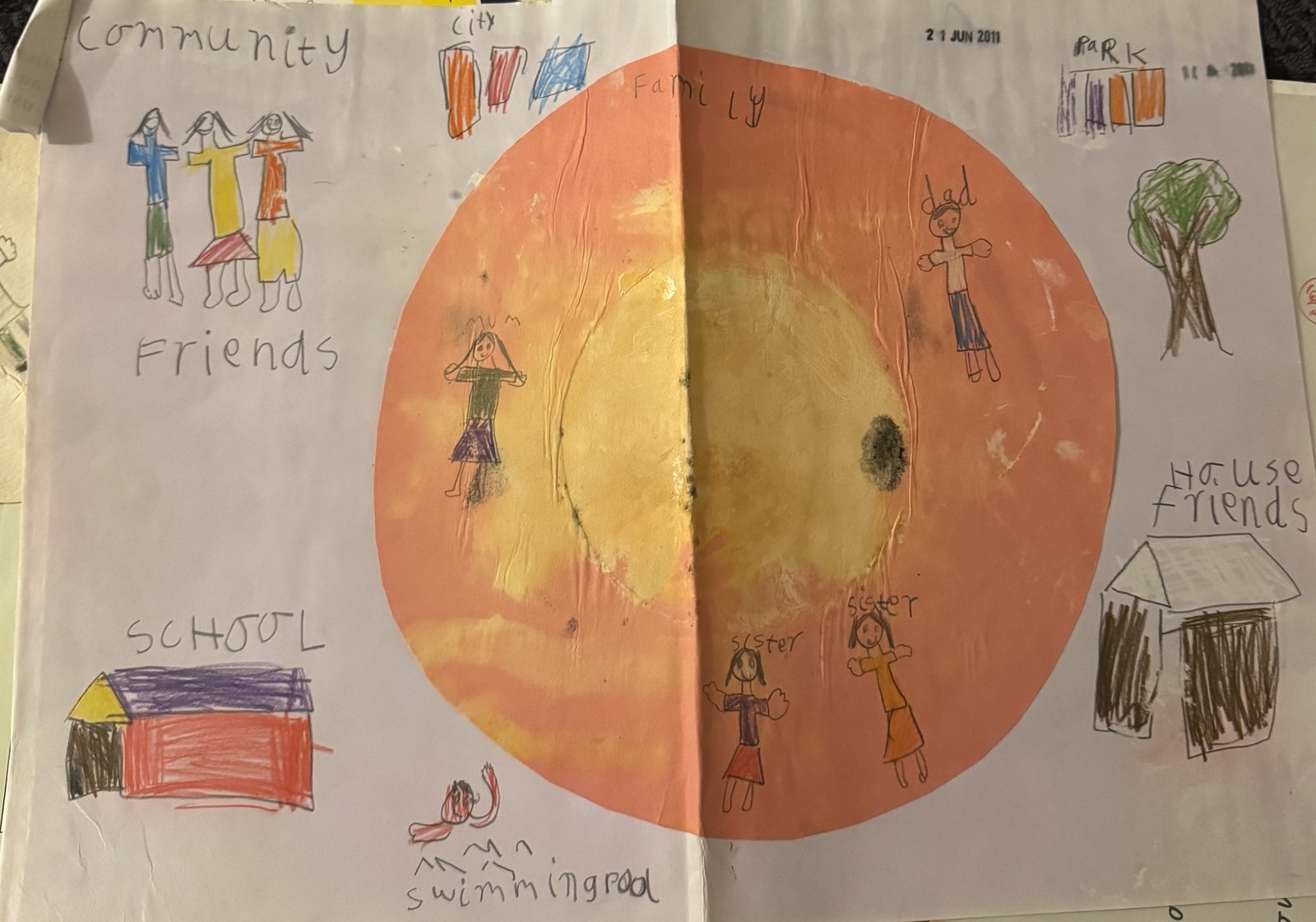
A beautiful moment of clarity came home in Zara’s portfolio a few months into the school year. Her teacher had set up a simple drawing activity using concentric circles to help the children map their sense of belonging.
When I opened the portfolio at our kitchen table, I saw that right at the very center of the page, drawn with thick, deliberate strokes of orange and yellow crayon, were four distinct figures: Mum, Dad, and her two sisters. Surrounding that inner circle was a wide outer ring filled with new places and people from her Melbourne life: her kindergarten, the city buildings, the local park, and the swimming pool.
Looking at her drawing through both a mother’s eyes and an educator’s lens, I felt a wave of relief. That simple sheet of paper was visual proof of how her mind was organising her transition. She was not abandoning her identity to survive in an Australian classroom. She was keeping her family core anchored securely at the center, using that safety as a launchpad to map out her expanding world.
Misunderstanding Practice: Why Pressuring Early Speech Backfires
One of the most common misunderstandings parents and educators make during early EAL learning is rushing the child to speak. Because speech is the most visible sign of language learning, we treat it as the only metric of progress.
When parents worry, the immediate impulse is often to start speaking English at home, hoping it will speed up the process. But early childhood language research, particularly the work of Professor Jim Cummins on bilingual development, demonstrates that a child’s conceptual understanding built in their first language serves as the primary engine for acquiring a second language.
If we abandon the home language in an attempt to fast track English, we disrupt the child’s primary conceptual foundation. We also send an unintentional message that their home culture is inadequate or secondary, which directly threatens their sense of belonging.
Furthermore, in educational research on emotional regulation and second language acquisition, Stephen Krashen identified the concept of the affective filter. When a child experiences high levels of stress, anxiety, or self consciousness, an emotional wall goes up in their brain. This filter prevents incoming language from being processed effectively.
When we prompt a quiet child with constant demands to say it in English or ask them why they did not speak to their friends today, we unintentionally raise their affective filter. The child feels evaluated rather than supported.
A Practical Shift: Visual Anchors Over Verbal Demands
Realising this at home changed how I supported Zara. I decided to stop worrying about her daily verbal output at kindergarten and focus entirely on making her feel anchored, seen, and emotionally secure.
If you are supporting a young child navigating a similar language transition or cultural shift, a simple, low pressure shift can make a profound difference: focus on visual anchors rather than verbal demands.
Here is how you can put this relationship based strategy into practice at home without making it feel like a structured lesson:
1. Create a Home-and-World Belonging Map
Take a plain sheet of paper and draw two simple circles, one inside the other. In the center circle, help your child draw or paste photos of your family, favourite home meals, and special cultural traditions. Talk about these in your home language with warmth, joy, and pride.
In the outer ring, draw or paste pictures of their school gate, their teacher, the classroom reading corner, or the local park slide. Label these together naturally using simple words in both your home language and English. This visual structure gives the child a tangible map showing that their home self and their school self exist on the same page, peacefully coexisting.
2. Protect the Home Language Environment
Keep your home a sanctuary for your native language. Read rich, expressive picture books in your primary language, tell family stories from your own childhood, and sing familiar songs together. A child who possesses a deep, nuanced vocabulary in their first language will transfer those underlying concepts smoothly into English once their confidence blooms.
3. Use Parallel Visual Play
At home after school, offer open ended drawing, clay modelling, or block building activities where your child can process their day visually without needing to talk about it immediately. Let them draw their teacher, their friends, or their classroom layout. Often, children will work through complex social observations through play long before they can articulate them in a second language.
In neurodiversity affirming and child centred emotional regulation frameworks, such as those highlighted in resources like Understanding Autism: A Neurodiversity Affirming Workbook for Children and Teens, visual predictability, personal agency, and honouring a child’s intrinsic communication style are recognised as vital tools for lowering anxiety. The same core principle applies to young multilingual children: when a child feels safe in their identity, their capacity for connection naturally expands.
Return to the Child: Watching the Bridge Form
A few weeks after we spent time looking through Zara’s circle drawing and focusing on keeping our home language vibrant, I arrived at kindergarten a few minutes before the afternoon pickup bell.
I looked through the glass paneling of the classroom door. Zara was sitting at the low craft table beside two classmates. The table was covered in scrap paper, glue pots, and coloured buttons. She was holding a glue stick, carefully placing small red buttons along the edge of a card.
She did not speak in long, elaborate English sentences. But as her classmate reached across the table looking for the scissors, Zara picked them up, handed them over with a calm smile, and whispered softly, “Here.”
The boy took the scissors, nodded, and continued cutting out his paper shape side by side with her. There was no performance, no anxiety, and no rush. Zara did not need to speak fluent English paragraphs to feel that she belonged at that table. She knew that her family was waiting for her, that her home culture was safe and cherished, and that she had a valid, respected place in her Australian classroom.
Belonging Takes Time and Roots
Looking back on those early PhD years in Melbourne, I realise that the most valuable lesson I learned did not come from an academic journal or a university lecture hall. It came from watching my five year old daughter quietly map her world on a sheet of paper.
Supporting a child through a major cultural or language transition is not about rushing them to sound like everyone else in the room as quickly as possible. It is about protecting their root system so they feel strong enough to grow in new soil.
When we honour a child’s home identity, protect their first language, and offer simple visual tools that bridge their two worlds, we give them permission to move at their own natural pace. A child who feels securely anchored at the center of their home world will always find the confidence to reach outward and embrace the expanding world around them.
Explore Our Visual Literacy & Tracing Bundles
Discover printable activity packs built around story-based drawing, visual vocabulary, and low-anxiety pre-writing practice for young learners.
Explore Early Literacy Bundles