
Learning English Through Daily Routines: A Gentle Guide for EAL Families
Young children often pick up a new language most easily in the everyday moments that repeat every day, like getting dressed, eating, bathing and going to the shops, because the words come with real objects, real actions and lots of repetition.
This guide is for families whose home language isn’t English, and for the educators who work with them. You don’t need flashcards or to give up your home language. You need ordinary days, and a few simple ways to talk through them.
When we moved from Jakarta to Melbourne, my five year old had almost no English. She didn’t learn it from worksheets. She learned it through jumpers, lunchboxes, bath time and trips to the shops.
- Our Story: English in the Ordinary Moments
- Why Learning English Through Daily Routines Works
- The Words Hidden in Every Routine
- 6 Daily Routines for Learning English at Home
- 5 Simple Ways to Talk Through Routines
- Songs and Rhymes in Every Routine
- Which Language, When?
- From First Words to Sentences: What to Expect
- A Week of English Routines
- Routines for Neurodivergent EAL Children
- Routine Language in Early Learning Rooms and Prep
- Common Mistakes to Avoid
- Free Printables for Parents and Educators
- Learning English Through Daily Routines FAQs
- Readings That Guided My Thinking
Our Story: English in the Ordinary Moments
Our family moved from Jakarta to Melbourne in October 2010 so I could begin a PhD in early childhood education. My eldest was seven and my youngest, Zara, was nearly five. In February 2011, Zara started Prep, speaking almost no English.
Life was busy and a little chaotic. I was juggling seminars, reading and a household in a new country. There was no time for formal English lessons at home, and honestly, I didn’t want to turn our family time into a classroom. Our home stayed Indonesian.
But English found its way in anyway, through the small, repeated moments of every day. Melbourne’s changeable weather meant we talked about jumpers and raincoats every morning. Packing lunchboxes, catching transport, visiting the shops and getting ready for bed all came with words she started to hear again and again.
Looking back now, with years of working alongside families and educators, I can see why those routines worked so well. They gave her the same words, in the same places, at the same time, every single day. That’s exactly what a young brain needs to make sense of a new language.
Why Learning English Through Daily Routines Works
Routines Give Repetition Without Boredom
Children need to hear a new word many times before it sticks. Routines repeat naturally. You put shoes on every day, eat breakfast every day and brush teeth every day. Each time, the same words come round again, without anyone having to drill them.
The Meaning Is Right There
When you say “put on your jumper” while holding the jumper and helping your child into it, they don’t need a translation. The object, the action and the words all arrive together. Psychologist Jerome Bruner described learning as moving from doing, to seeing, to words.[1] Routines give children all three at once.
Predictable Language Feels Safe
Because routines follow the same order, children can guess what’s coming next and what words go with it. That predictability lowers worry, which matters a lot for EAL children who may feel unsure in a new language. Patton Tabors, who studied young children learning English, noted how much children rely on familiar, repeated phrases as they start speaking.[2]
Everyday English Comes First
Jim Cummins described the difference between everyday conversational language and the more complex language used for school learning. He suggests that conversational English often develops within a couple of years, while academic English usually takes longer.[3] Routines are where conversational English grows best, and it’s the foundation everything else builds on.
It Fits Australian Early Learning Frameworks
Both the national Early Years Learning Framework and Victoria’s Early Years Learning and Development Framework recognise that children learn through everyday routines and relationships, and that their home languages and cultures should be valued.[4][5] Learning English through daily routines is very much in line with how Australian early childhood education works.
The Words Hidden in Every Routine
Each routine comes with its own small set of words and phrases. You don’t need to teach them all at once. Pick a few, use them every day, and let them grow.
| Routine | Key Words | Useful Phrases |
|---|---|---|
| Waking up | morning, bed, blanket, window, sun | “Good morning!” “Time to get up.” |
| Getting dressed | shirt, pants, socks, shoes, jumper, hat | “Put on your…” “Arms up!” “Which one?” |
| Breakfast | bowl, spoon, cup, milk, toast, hungry | “More please.” “All finished.” |
| Leaving the house | bag, lunchbox, keys, door, car, bus | “Let’s go!” “Got your bag?” |
| Shopping | apple, banana, bread, trolley, pay | “Can you find the…?” “How many?” |
| Cooking | pour, stir, cut, hot, cold, wash | “Your turn to stir.” “Careful, it’s hot.” |
| Bath time | water, soap, bubbles, towel, wet, dry | “Wash your hands.” “All clean!” |
| Bedtime | pyjamas, teeth, book, light, sleep | “Brush your teeth.” “Night night.” |
Our free Daily Routine Chart gives you pictures for each part of the day to point to and name together.
6 Daily Routines for Learning English at Home
Getting Dressed: Clothes and Weather
Getting dressed is one of the richest English routines, especially in a place like Melbourne where the weather changes so much. Stand at the window for thirty seconds first and talk about what you see, then choose clothes together.
Offering two choices gives your child the words inside the question. They can point, repeat or just choose. I wrote about how Zara’s weather wheel showed her learning these words in early EAL weather vocabulary, and buttoning, zipping and self dressing skills covers the physical side.
Mealtimes and Cooking: Doing Words
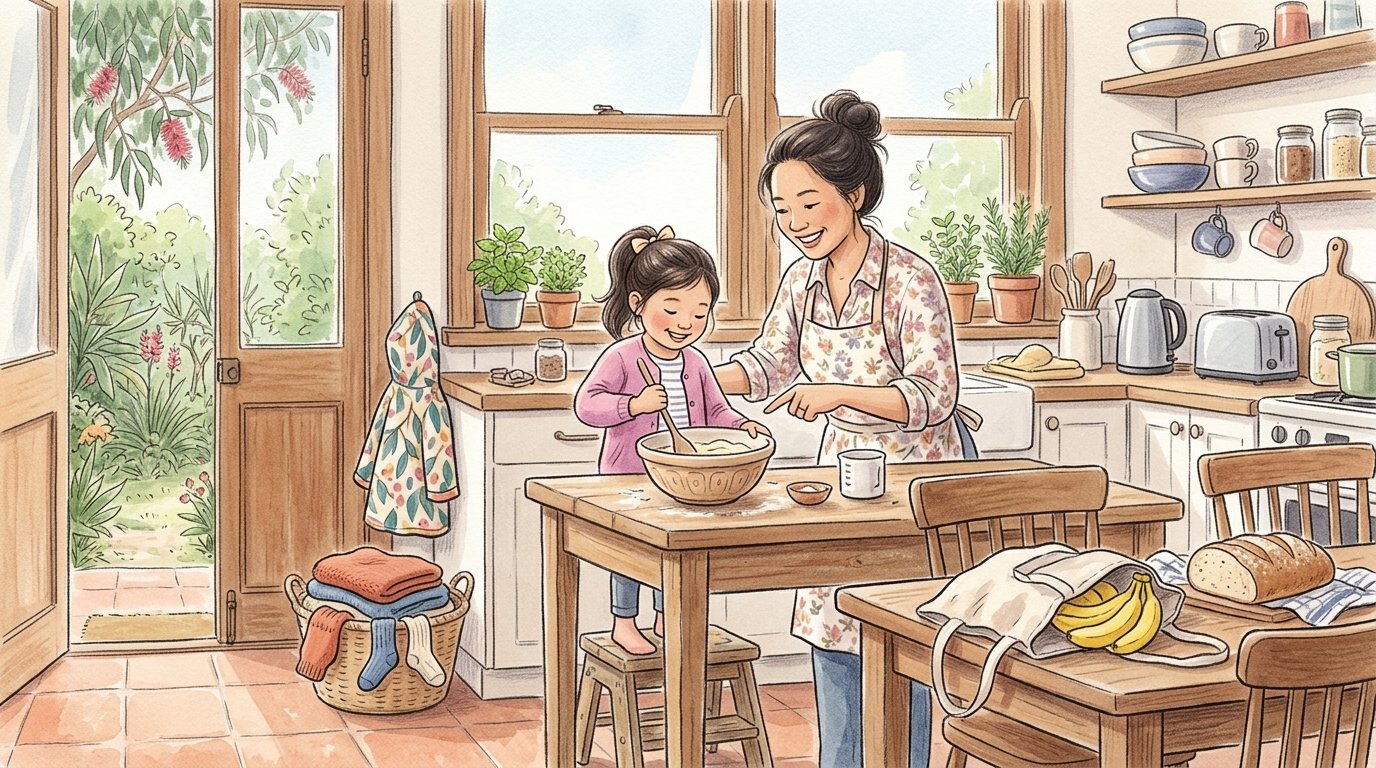
Cooking is full of action words, which children often find hard to learn from pictures. Pour, stir, cut, wash, mix, taste. Let your child help with a simple job and name each step as you do it.
Mealtimes also give natural practice with “more please”, “all finished” and food names. If your child likes to help in the kitchen, practical life activities for preschool at home has more ideas for real jobs little hands can do.
Shopping Trips: Finding and Counting
Shops are full of words, pictures and numbers. Give your child a small job: find the bananas, count four apples, spot the letter on the sign. It turns a trip that can be tiring into a game, and builds English and early maths at the same time.
Our Letter Spotting Walk and Number Hunt work well on the way to the shops and inside.
Laundry and Tidying: Sorting Words
Folding washing and tidying toys are perfect for sorting and describing words. Sort clothes into “hot day” and “cold day” piles, match socks, or put toys away by colour or size.
Handling real things while naming them helps the words stick, and children often enjoy feeling useful.
Bath Time and Bedtime: Calm, Repeated Language
Evenings are naturally slower and more predictable, which makes them lovely for language. Name body parts while washing, play with “wet” and “dry”, and keep the bedtime steps the same every night.
A short English picture book or song at bedtime can sit happily beside stories in your home language. Our visual routine cards can show the bedtime steps in pictures.
The Walk, Bus or Drive: Noticing Words
Travelling to school, kinder or the park is a chance to notice things together: dogs, trees, trucks, signs, colours. Name what you see, ask simple questions and wait.
Our nature scavenger hunt for kids has easy footpath ideas, and the Sound Hunt Cards turn the walk into a listening game.
5 Simple Ways to Talk Through Routines
How you talk matters as much as what you talk about. These five simple strategies are used by speech pathologists and educators everywhere, and they fit easily into any routine.
| Strategy | What It Means | Example |
|---|---|---|
| Self talk | Describe what you’re doing, out loud. | “I’m cutting the apple. Cut, cut.” |
| Parallel talk | Describe what your child is doing. | “You’re putting on your shoe. One shoe on!” |
| Either or questions | Give two choices so the words are in the question. | “Apple or banana?” |
| Expanding | Say back what your child said, a little longer and correct. | Child: “Big dog.” You: “Yes, a big brown dog!” |
| Pause and wait | Leave a gap so your child has time to respond. | “Ready, set…” (wait) “Go!” |
The most important one is probably the last. Many EAL children need extra time to understand, find a word and gather the courage to say it. A warm pause can do more than a lot of talking.
Songs and Rhymes: The Secret Helpers in Every Routine
Many young children sing English before they speak it. Songs slow language down, repeat it and attach it to rhythm and movement, which makes it easier to remember. Adding a short song to a routine can turn a battle into a game and give your child a ready made chunk of English.
| Routine | Song Idea | Words It Builds |
|---|---|---|
| Getting dressed | “This is the way we put on our socks” to a familiar tune. | Clothes, “put on”, body parts |
| Hand washing | Sing “Row, Row, Row Your Boat” while rubbing hands. | Wash, rub, water, soap |
| Tidy up | A simple “tidy up, tidy up, put the toys away” chant. | Tidy, put, away, toys |
| Bath time | “Heads, Shoulders, Knees and Toes” while washing. | Body parts |
| Bedtime | “Twinkle, Twinkle, Little Star” as the lights go down. | Star, sky, night, sleep |
Songs from your home language belong in routines too. They’re just as much a part of language learning as English ones. Children who have lots of songs in both languages have more ways to join in.
Which Language, When?
This is one of the biggest questions bilingual families ask, and there’s no single right answer. Here’s what I’ve found helpful.
- Keep your home language strong: Speak the language you know best for most of your day. Rich, warm conversation in any language builds your child’s thinking and vocabulary, and Cummins suggests that what children learn in one language supports learning in another.[3]
- Add English gently: Some families choose one routine to do in English, like bath time songs or the walk to school. Others mix naturally. Both are fine.
- Don’t worry about mixing: Children often mix languages while they learn, and many adults do too. It’s a normal part of being bilingual, not a sign of confusion.
- Use English you feel comfortable with: You don’t need perfect English. Simple, warm English is more useful than none. Songs, picture books and audiobooks can fill in the rest.
For more on why the home language matters for confidence and identity, see EAL identity and belonging. And for a lovely example of a child who learned English through his own passions, read about my nephew in a child learning English as a second language.
From First Words to Sentences: What to Expect
Children learning English through daily routines usually move through similar steps. Every child goes at their own pace, and many have a quiet listening time first, which I explain in the silent period in EAL children.
| Step | What You Might Hear | How to Respond |
|---|---|---|
| Listening and pointing | No English words yet, but pointing, nodding and following routines. | Keep naming things. Accept pointing as an answer. |
| Single words | “Shoe.” “Milk.” “Hot.” | Expand: “Yes, your shoe. Put on your shoe.” |
| Two word phrases | “Big rain.” “More milk.” “Me go.” | Model a slightly longer sentence back. |
| Memorised chunks | “All finished.” “My turn.” “Let’s go!” | Celebrate! These chunks are building blocks. |
| Own sentences | “I wear jumper because cold.” | Respond to the meaning and model gently. |
A Week of English Routines
If you’d like a simple place to start, focus on one routine each day for a week, alongside your usual home language. Five minutes of playful English is plenty.
| Day | Routine Focus | Try This |
|---|---|---|
| Monday | Getting dressed | Window check, then two clothing choices. |
| Tuesday | Breakfast | Name three foods and practise “more please”. |
| Wednesday | Shopping | Find three yellow things and count them. |
| Thursday | Cooking | Name each step: pour, stir, taste. |
| Friday | Laundry | Sort hot day and cold day clothes. |
| Weekend | A walk | Name five things you see on the way. |
The Two Week Literacy Play Planner can help you keep track and add your own ideas.
Routines for Neurodivergent EAL Children
Children who are multilingual and neurodivergent, including children with ADHD or autism, often find predictable routines especially helpful. Knowing what comes next lowers the load of a busy day, leaving more energy for language.
- Show it as well as say it: Picture routines and visual cues help children follow along without relying only on words. Visual routine cards for ADHD kids explains how to set them up.
- Keep the words the same: Use the same short phrase for each step every day. “Shoes on.” “Bag on.” “Let’s go.”
- Start together: If getting started is hard, do the first step side by side. The ADHD start together task trick shows how.
- Follow their interests: A child who loves trains or animals will often learn English words about them first. Lean into it.
For a full routine guide, see daily routines for neurodivergent children, and for literacy, multilingual neurodivergent literacy.
Routine Language in Early Learning Rooms and Prep
Early learning rooms and Prep classrooms are full of routines too, and educators can use them to give EAL children a steady stream of everyday English.
- Narrate routines: “Time to wash hands. Water on. Soap. Rub, rub, rub.” The same words every day help EAL children follow along.
- Use transition songs: A tidy up song or a lining up chant gives children a predictable chunk of English they can join in with.
- Show the day: A picture schedule at child height helps children know what comes next without needing every word.
- Teach key phrases early: “Help please”, “toilet please”, “my turn” and “I’m finished” give children a way to communicate their needs.
- Share routine words with families: Let families know the phrases you use, so they can use them at home too. The Home and Kinder Snapshot makes this easy.
The EAL identity and belonging guide also has a key words card educators can ask families to fill in with home language words for basic needs.
Common Mistakes to Avoid
- Turning routines into tests: “What’s this called? Say it!” can make routines stressful. Model words instead of quizzing.
- Dropping the home language: It’s where your child’s richest language and connection live.
- Correcting every mistake: “Me go park” is progress. Expand it warmly rather than correcting.
- Too many words at once: Short, repeated phrases work better than long explanations.
- Rushing: When routines are hurried, there’s no room for talk. Even one slow routine a day helps.
- Comparing: Every child, even siblings, learns at their own pace.
Free Printables for Learning English Through Daily Routines
These free PDFs from this site help families and educators bring English into everyday routines in simple, playful ways.
Daily Routine Chart
Pictures for each part of the day to point to and name together.
Download A4 PDF Best for familiesVisual Routine Cards
Picture cards for morning and bedtime steps, with the same words every day.
Download PDF For home and roomsFirst Then Reset Mats
“First shoes, then park.” Clear routine language in pictures.
Download PDF For home and roomsLetter Spotting Walk
Spot letters and words on signs and shops on the way.
Download PDF Best for familiesNumber Hunt
Find and count numbers at the shops, on letterboxes and on the bus.
Download A4 PDF For home and roomsShape Hunt
Look for circles, squares and triangles around the house and street.
Download A4 PDF For home and roomsSound Hunt Cards
Playful listening games for walks, bath time and the car.
Download PDF For home and roomsOne Minute Phonics Week
Tiny sound games that fit into the gaps between routines.
Download PDF For home and rooms“All About Me” Storybook
Draw and talk about family, food and favourite things, in both languages.
Download A4 PDF For home and roomsInterview My Mum Keepsake
Simple questions to ask at home, in any language.
Download PDF Best for familiesTwo Week Literacy Play Planner
Plan a routine focus for each day and note new words.
Download PDF For home and roomsHome and Kinder Snapshot
Share routine words and phrases between home and the room.
Download PDF For families and educatorsMore free tools are on our printables page.
Looking Back
When I think about how Zara learned English, I don’t think about lessons. I think about jumpers on cold mornings, lunchboxes, the shops and bath time. The ordinary rhythm of our days gave her the words she needed, a little at a time, while our home language kept her grounded.
If you’re a family new to English, please don’t feel you have to become an English teacher. Keep talking in the language you love, add a few English words to the routines you already have, and give your child time. The everyday is more than enough.
- The quiet months first: the silent period in EAL children
- Her belonging circle: EAL identity and belonging
- Her weather wheel: early EAL weather vocabulary
- Her weekend recount: drawing before writing for EAL children
- Her “hot wathers” sentence: invented spelling in early EAL
Learning English Through Daily Routines FAQs
How can I help my child learn English at home if English isn’t our home language?
You don’t need to switch your home language to English. Keep your home language rich, and add small, playful English moments to everyday routines, like naming clothes while getting dressed, counting while cooking or singing an English song at bath time. Short, repeated phrases tied to real actions are easier for young children to pick up than word lists.
Why do daily routines help children learn English?
Routines happen every day, in the same order, with the same objects and actions. That repetition and context make new words easier to understand and remember. Children hear phrases like “put on your shoes” again and again while doing it, so the meaning is clear without translation.
Is it okay to mix languages with my child?
Yes. Many bilingual families mix languages, and children commonly mix them too while they learn. There’s no single right approach. What matters most is that your child hears plenty of warm, rich language, and that your home language stays strong alongside growing English.
How long does it take a young child to learn English?
It varies a lot. Researcher Jim Cummins suggests that everyday conversational English often develops within a couple of years, while the language needed for school learning usually takes longer. Many young children go through a quiet listening period first. Steady progress matters more than speed.
What English words should I teach my child first?
Start with words your child needs every day: toilet, drink, help, hungry, stop, and the names of family, food, clothes and toys. Useful short phrases like “my turn”, “help please” and “I’m finished” are also very helpful, especially for starting school or kinder.
Research and guidance: Bruner’s ideas about learning through doing, seeing and words, Tabors’ research on young children learning English, Cummins on conversational and academic language, the Early Years Learning Framework and the Victorian Early Years Learning and Development Framework.
Experience: Zara’s story is from our family. The routine tables, the six routines, the week plan and the example phrases come from my life and practice. The talk strategies are widely used by educators and speech pathologists.
This is educational content, not speech pathology advice. If you’re worried about your child’s language in any of their languages, talk with your GP, maternal and child health nurse or a speech pathologist. Last reviewed: 8 November 2026.
Readings That Guided My Thinking
- Bruner, J. S. (1966). Toward a theory of instruction. Harvard University Press.
- Tabors, P. O. (2008). One child, two languages: A guide for early childhood educators of children learning English as a second language (2nd ed.). Paul H. Brookes.
- Cummins, J. (2000). Language, power and pedagogy: Bilingual children in the crossfire. Multilingual Matters.
- Australian Government Department of Education. (2022). Belonging, being and becoming: The Early Years Learning Framework for Australia (V2.0). Available via ACECQA.
- Department of Education and Training, Victoria. (2016). Victorian early years learning and development framework: For all children from birth to eight years. State of Victoria.
