
From Jakarta to Melbourne: What My Five-Year-Old’s Kindergarten Drawings Taught Me About Early EAL Learning
The rain in Melbourne hits the tin roof differently than it does in Jakarta. In Jakarta, downpours are loud, warm, and brief, a sudden curtain of water that clears the humid air before giving way to heat again. Melbourne rain in October is cold, relentless, and grey.
When we arrived in October 2010, I spent the first few weeks carrying an ache in my chest that had nothing to do with the weather and everything to do with my daughters. I had just moved our entire life across the ocean to start a doctoral degree. My daily reality was a messy juggle: rushing between university seminars, pouring over academic papers late into the night, squeezing in part time work to help keep us afloat, and somehow keeping a household running.
Amidst that scramble, my biggest worry was quiet and persistent: Zara.
Zara was born in Indonesia right at the end of December 2005. Back home, English was a distant background noise. I spoke very basic English with her, simple words like apple, cat, sun, or good morning. But our home, our thoughts, and our lives were thoroughly Indonesian.
When February 2011 rolled around, it was time for Zara to start kindergarten in Melbourne. Having just turned five at the end of December, she was not only facing a completely foreign language, she was also one of the absolute youngest children in her cohort. On her first day, I held her hand at the school gate, feeling an overwhelming surge of motherly guilt. I was sending my little girl into a room full of children and teachers whose words sounded like a fast, foreign blur. She did not speak English. She did not know how to ask to go to the toilet in English, how to say she was cold, or how to explain that she wanted to join a game.
I used to sit in the university library, staring at research methodologies, while my mind drifted back to her classroom: Is she sitting in a corner alone? How can a child who is barely five and speaks no English learn to read and write when she does not even know the words yet?
What happened over the next six months completely changed how I understood learning, literacy, and child development. It did not happen through flashcards or strict grammar drills. It happened through paper, coloured pencils, and two remarkable drawings that showed me how her mind was bridging her two worlds.
The Power of the Crayon: Drawing Before Writing
When Zara brought home her early school portfolio in mid 2011, I sat down at our kitchen table with a hot cup of tea and started flipping through the pages. I expected to see struggles. Instead, I saw a visual map of a young mind making sense of a brand new world.
Here is a piece she created on 27 June 2011, just five months after stepping into an Australian classroom with almost no English:
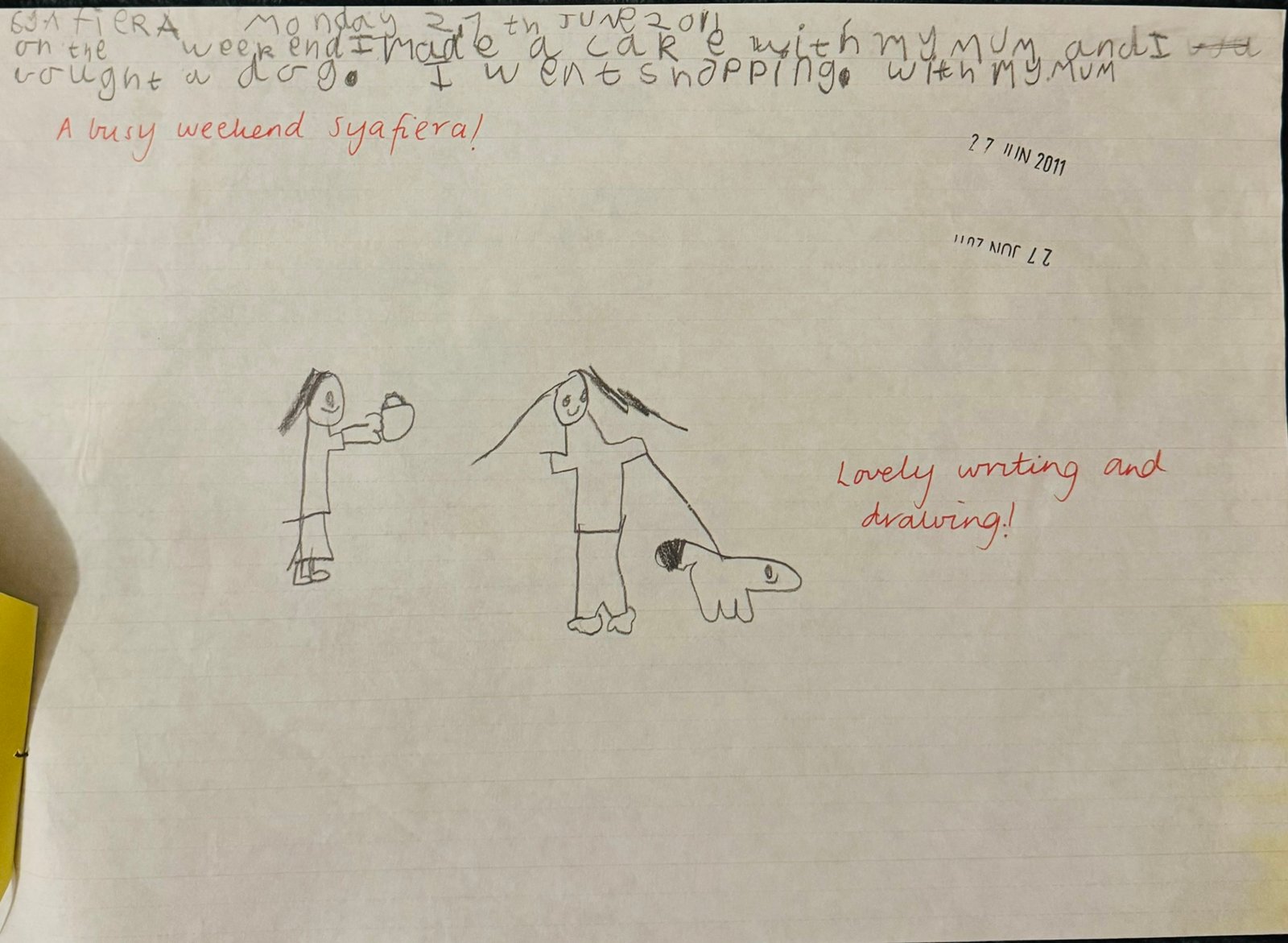
Look closely at what is happening on that page. At the top, in large, deliberate handwriting, she wrote:
“On the weekend I made a cake with my mum and I bought a dog. I went shopping with my mum.”
Underneath her words, her teacher wrote in red pen: “A busy weekend Syafiera!” and “Lovely writing and drawing!”
When I looked at her drawing, the two figures standing side by side, one holding a mixing bowl and spoon, the other holding a leash attached to a little dog, I realised something profound. In my hectic life as a doctoral student, our main quality time together was taking the girls to the grocery store. It was our routine, our sweet escape from university papers and work stress. The girls loved going because, without fail, after we finished getting our groceries, we would treat ourselves to ice cream.
That small, joyful memory translated directly onto her page. Zara had not started with the grammar rules of past tense verbs. She started with the vivid picture in her head of our special weekend outings.
For a child learning English as an Additional Language (EAL), drawing is not just a creative pastime. Drawing is thinking made visible.
Long before an EAL child can recall the exact English word for whisk, shopping basket, grocery, or leash, they can hold a pencil and sketch the experience. Developmental psychologist Lev Vygotsky explained this exact transition when he described drawing as a graphic speech system that acts as a vital bridge between symbolic thought and written language.[1] The drawing acts as cognitive scaffolding within a child’s Zone of Proximal Development, giving them an immediate, low anxiety way to anchor their thoughts. Once the image of our grocery run and cake making was on paper, the English words had something solid to attach to.
When children are forced to focus purely on letter mechanics and correct spelling in a language they do not yet speak, their brains freeze up under cognitive load. Jean Piaget noted that during the preoperational stage of development, young children rely heavily on concrete symbols and visual representations to process complex ideas.[2] When you give them permission to draw first, you unlock their natural desire to tell a story. Writing simply becomes the label for the picture they have already brought to life.
Mapping Identity and Belonging
Language acquisition is deeply personal. It is not just about vocabulary; it is about identity. A child who feels unsafe, invisible, or out of place will rarely step out of their comfort zone to experiment with new sounds and words.
On 21 June 2011, Zara came home with another drawing that focused directly on her family and her expanding social world:
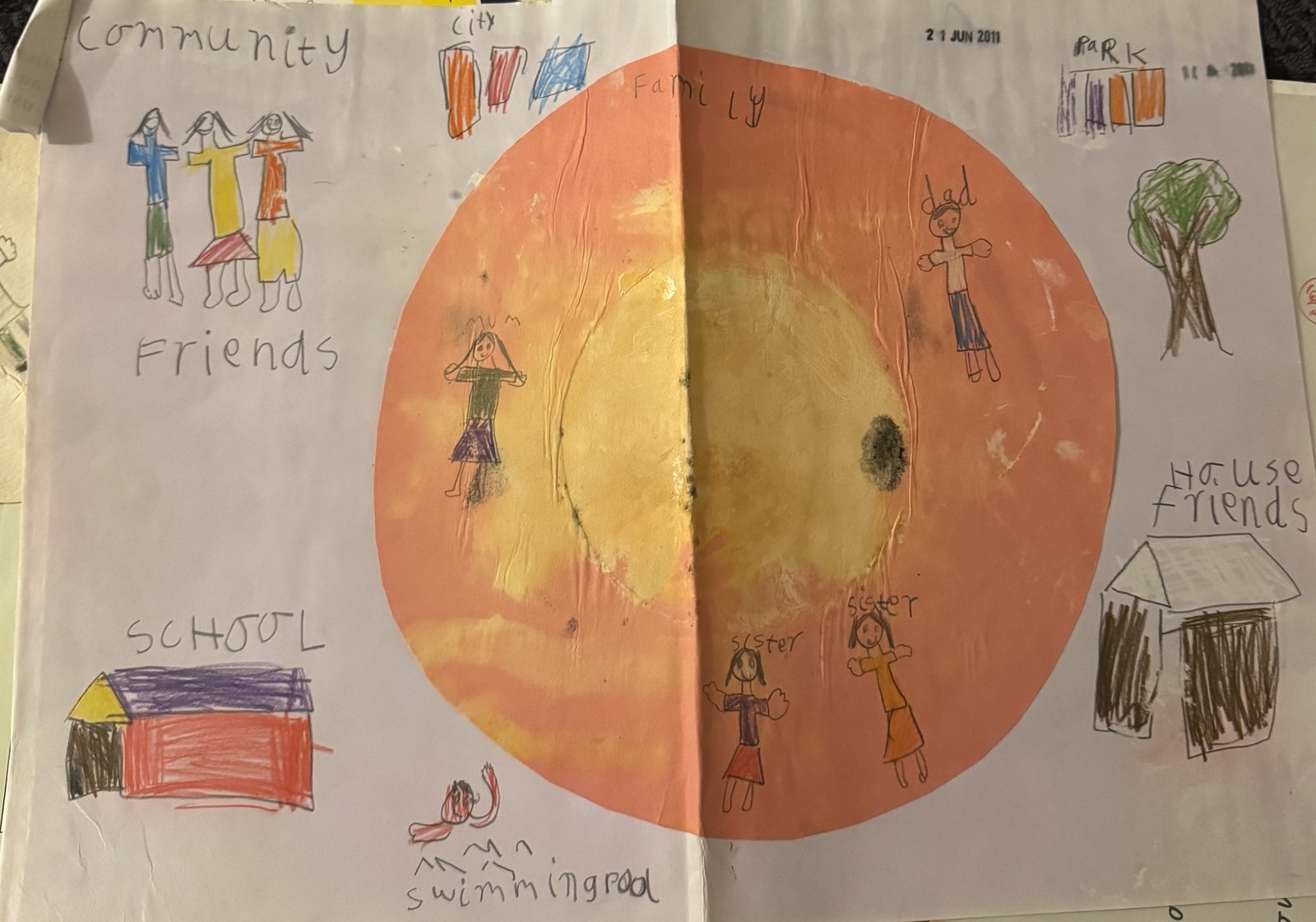
This simple exercise used concentric circles to help children map out their lives. When I looked at Zara’s page, I saw a beautiful snapshot of how an EAL child processes transition:
- At the absolute core (The Family Circle): Right in the middle, rendered in bright orange and yellow tones, were her anchors: Mum, Dad, Sister, Sister.
- The Outer Environment (The New World): Sprouting around the edges were the new places and people she was encountering daily in Melbourne: School, Friends, House Friends, Park, City, and even the Swimming Pool.
Notice how she labeled every element: “Friends”, “Dad”, “Mum”, “Sister”, “School”, “Park”, “House Friends”, “City”.
For an immigrant mother juggling postgraduate studies and worry, seeing this was deeply emotional. It aligned with Bronfenbrenner’s Ecological Systems Theory, which shows that a child’s development is most strongly influenced by their immediate microsystem, particularly the family.[3] Zara felt secure at home, which gave her the psychological safety necessary to explore her expanding mesosystem across school, parks, and peer relationships.
If you are raising a bilingual child or teaching an EAL student, never underestimate the power of social emotional security. Professor Jim Cummins, a leading expert in second language acquisition, famously highlighted that a child’s first language and home identity form the underlying conceptual foundation for learning a second language.[4] A child does not learn English by replacing their original language or identity; they learn English by building a bridge from their secure home core outward to the wider community.
Lessons for Parents and Educators Supporting EAL Learners
Reflecting on those intense early months in Melbourne, balancing doctoral seminars, part time jobs, and parenting, I learned valuable lessons about supporting young children learning English as an additional language.
If you are an educator, a bilingual family, or a parent navigating a language transition, here are four grounded strategies supported by developmental research that truly work:
1. Let Drawing Lead the Way
Never force an early EAL learner to start with a blank page and a pencil, expecting full sentences right away. Encourage them to draw their idea first. As Vygotsky observed, drawing serves as a powerful mediator between internal thought and written expression.[1] Ask them about their picture in simple English: “Tell me about this person,” or “What is happening here?” Once they explain it visually, help them write one or two key words underneath.
2. Embrace Phonetic Attempts and Approximate Spelling
In Zara’s early writing, you can see phonetically sound attempts at spelling as she worked out the relationships between English sounds and letters. Celebrate these attempts! Linguist Stephen Krashen emphasized the importance of a low “Affective Filter” in language learning.[5] When anxiety is low and confidence is high, children acquire language naturally. Correcting every spelling mistake early on creates anxiety and blocks communication. Accuracy comes with exposure; confidence must be protected from day one.
3. Build Word Power Through Real Life Routines
Notice how Zara’s best writing came from simple, everyday experiences: going for groceries, enjoying ice cream afterwards, making a cake with her mum, or visiting the park. You do not need fancy workbooks to build literacy. Talk through your daily routines, baking, walking to the park, grocery shopping, looking at the rain through the window. Rich, real life conversation provides the raw material for early writing.
4. Protect Their First Language and Home Identity
Zara’s ability to pick up English in Melbourne was built on the strong foundation of the love, stories, and conversations we shared in Indonesian at home. Jim Cummins’ Linguistic Interdependence Hypothesis proves that literacy skills developed in a child’s native language directly transfer to and accelerate literacy in a second language.[4] Never feel pressured to drop your home language to make room for English. A strong first language gives the brain the cognitive structure it needs to acquire a second one effortlessly.
Supporting an Early EAL Learner at Home?
Download our free Visual Tracing & Pre-Writing Starter Sample, designed with large shapes, generous white space, and low-anxiety drawing prompts for bilingual preschoolers.
Download Free Sample (PDF)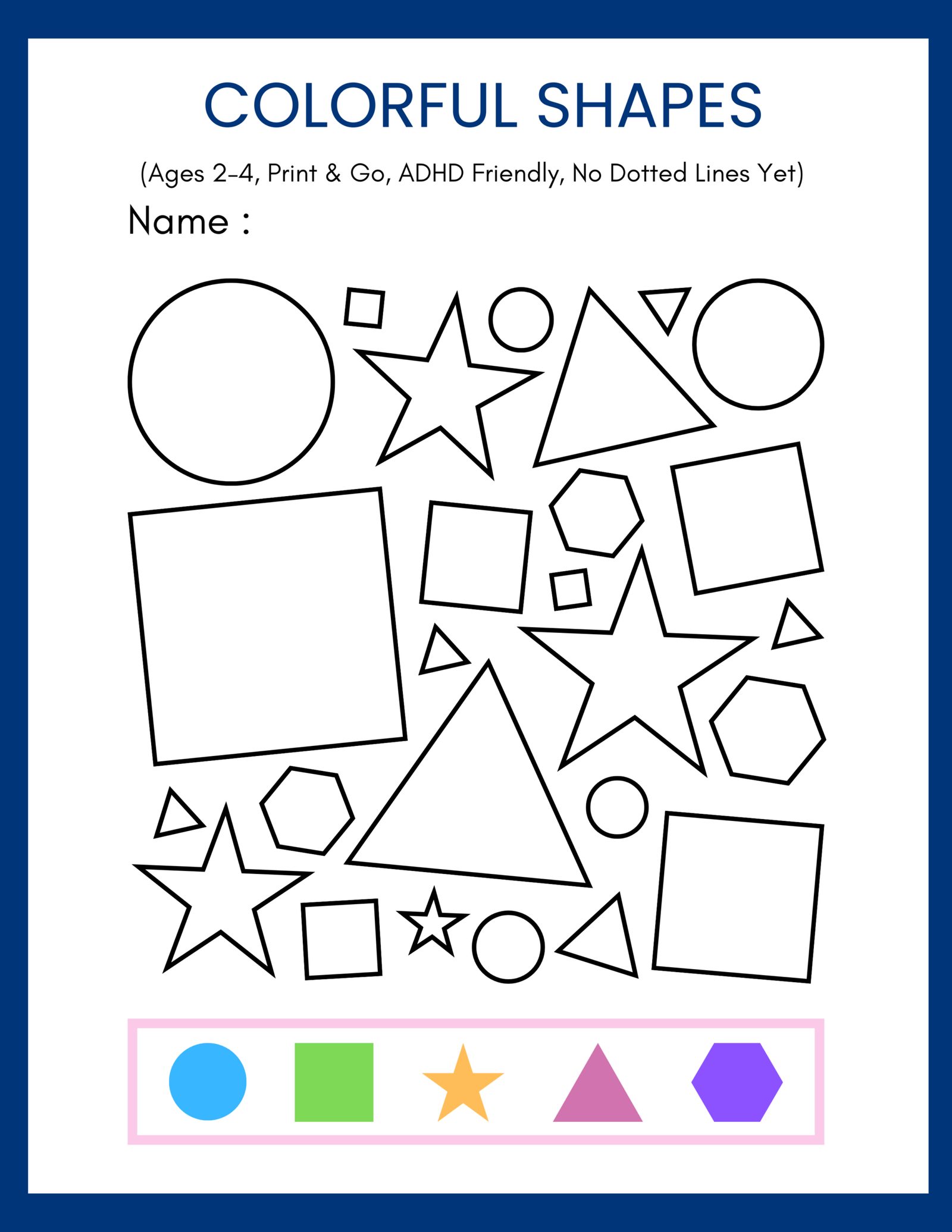
Looking Back
When I look at those faded sheets of school paper from 2011, I no longer see just a child’s kindergarten work. I see the quiet resilience of a five year old girl who stepped into a strange room in a strange country and found her voice through crayons and paper.
And I remind myself of the busy mum who sat at the kitchen table late into the night, worrying if her kids would be okay while she chased her doctorate, taking breathers only to walk them down the street for groceries and ice cream.
We made it through. Zara did not just learn English, she thrived, grew, and found joy in reading and writing.
If you are currently sitting where I was back in 2010, wondering how your child will ever bridge the gap between their home language and a new school environment, take a deep breath. Hand them a stack of paper, a set of pencils, and let them draw their world. You will be amazed at how quickly the words follow.
Explore Our Visual Literacy & Tracing Packs
Explore printables built specifically around visual storytelling, pre-writing drawing prompts, and gentle vocabulary building for multilingual children.
View Early Literacy BundlesReferences
- Vygotsky, L. S. (1978). Mind in Society: The Development of Higher Psychological Processes. Harvard University Press.
- Piaget, J. (1952). The Origins of Intelligence in Children. International Universities Press.
- Bronfenbrenner, U. (1979). The Ecology of Human Development: Experiments by Nature and Design. Harvard University Press.
- Cummins, J. (2000). Language, Power and Pedagogy: Bilingual Children in the Crossfire. Multilingual Matters.
- Krashen, S. (1982). Principles and Practice in Second Language Acquisition. Pergamon Press.