
7 Ways to Support Neurodivergent Literacy Task Initiation
I learned about neurodivergent literacy task initiation sitting beside my own child at our kitchen table long before I ever wrote about it as an educator. My little girl had a pencil resting loosely in her fingers. The paper was completely blank. She was not acting out. She was not off in her own world. She had just stopped.
She looked down at the white page, looked up at me, and looked back down. Her breathing slowed. Her body stayed still. It looked to me as though she was gathering the energy she needed to make a start. Navigating neurodivergent literacy task initiation means giving that pause the time it deserves rather than rushing to fill the silence.
7 Ways to Support Neurodivergent Literacy Task Initiation
When an autistic child or a child with ADHD freezes before reading or writing, these small steps can make starting easier:
- Sit together quietly: Be there without pushing so their body settles before looking at words.
- Pick a tiny starting point: Ask them to touch just one picture or find one single letter.
- Use simple visual cues: Try window cutouts or cards showing what comes next to clear away clutter.
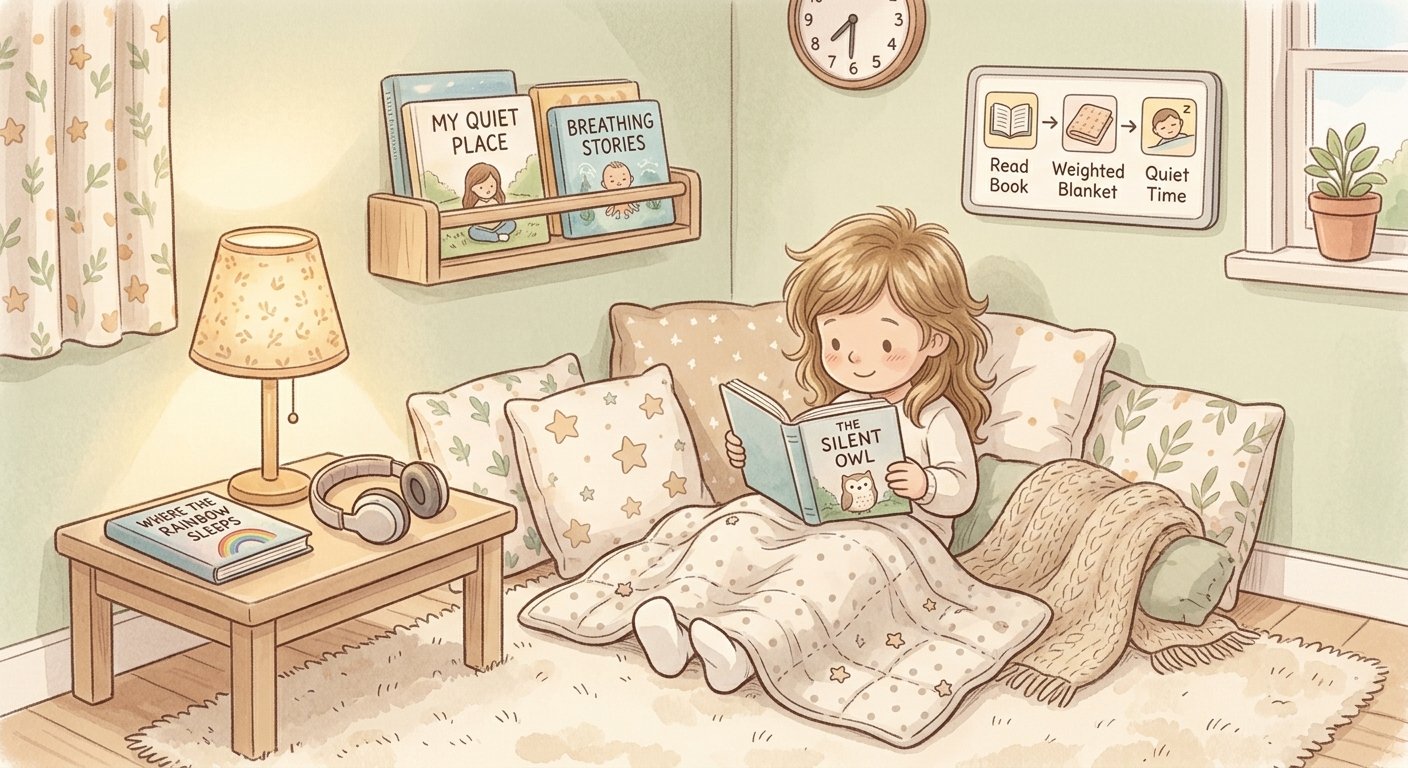
- Set up a cosy spot: Soften harsh overhead lighting and let them curl up with cushions or blankets.
- Offer easy choices: Let them pick between reading on the rug or sitting under a table with a torch.
- Follow their passions: Use words and books about their favourite animals, games, or transport.
- Give plenty of warning: Let them know two or three minutes ahead of time so they can wrap up what they are doing.
These are ideas from my own experience as a parent and educator, not a tested programme. If reading is still hard once your child has started, see the section on getting extra support.
When our family first arrived in Melbourne, our daughters started school with English as an additional language. Their teachers looked closely at how they picked up English, but none of us saw that we were also navigating neurodivergence.
My eldest was diagnosed with ADHD much later, as an adult, and my youngest spent hours building her own visual codes just to link English sounds with the language she already knew.
Those hard afternoons taught me something important. For my children, the biggest hurdle was rarely whether they could sound out a word or recognise a letter. It was making that first move from doing nothing to taking action.
That won’t be true for every child, as I explain below. But without a warm, patient way to cross that line, any lesson you have planned can fall flat.
Why Getting Started Feels So Hard
As a parent, watching that pause can bring up plenty of worry. You might wonder if your child is confused, falling behind, or just digging their heels in. In my experience, neurodivergent literacy task initiation has more to do with how much a child has left in the tank than with the clock on the wall.
For many neurodivergent kids, taking that first step can be the hardest part of the entire afternoon. When the effort of starting feels like too much, a child can look frozen.
In my experience that is usually overwhelm, not defiance. We look at this more closely in our guide on why some ADHD children find it hard to start tasks.
What Might Be Happening
Starting a reading task asks a child to hold instructions in mind, stop other thoughts, and shift from one activity to another. These are executive function skills: working memory, inhibitory control and cognitive flexibility.[1]
They are still developing in the early years, and long-term stress can get in the way of that development.[2] Many parents and clinicians find they take more effort for children with ADHD or autism.
Opening a reader or picking up a pencil can bring friction from several directions at once:
- Mental effort: Trying to sort through instructions, remember letter sounds, and ignore busy thoughts all at the same time.
- Emotional worry: Fearing a mistake, feeling silly, or staring at a page that looks far too full of words.
- Sensory noise: Dealing with the hum of the fridge, glare from fluorescent bulbs, or the rough feel of paper.
- Physical tiredness: The effort needed to balance in a hard chair, steady a pencil, and keep eyes tracking across small lines.
I haven’t found research that tests these four together, so please treat them as a way of looking, not a diagnosis.
Many children settle better if they can run around and jump before they sit. In my experience it helps shake off physical tension, though I haven’t cited research on it.
Outdoor play with simple stop and go rules, like the ideas in our guide to classic playground games for kids, gives kids a natural way to practise pausing and starting their bodies.
Old Habits versus Supportive Ways Forward
The table sets out my own experience, not research findings. Countdowns and charts help some children.
| Common Approach | What May Be Happening | A Gentler Way |
|---|---|---|
| Counting down (“Starting in three, two, one”) | Can feel like sudden pressure, and for some children leads to freezing or tears. | Runway warnings: Give plenty of gentle notice so they can finish their thoughts. |
| Sticker charts (“Read this and get a reward”) | A reward doesn’t make the first step lighter in the moment, though rewards do help some children (see our guide to ADHD behaviour strategies). | Being there: Sit close by and share the quiet so they feel safe. |
| Saying “Just read this one page” | Can still feel far too big when a child is already overloaded. | Tiny steps: Ask for one simple movement, like touching the first letter. |
| Sitting upright at a proper desk | Staying still and upright can use up energy a child needs for reading. | Comfortable spots: Lying on the carpet, using beanbags, or holding a soft toy. |
7 Ways to Ease Into Reading at Home
1. Settle Together First
Children often pick up on our breathing and posture. When you stay calm and unhurried beside them, it may help them settle, and the page in front of them may feel less like a threat. The Early Years Learning Framework names secure, respectful and reciprocal relationships as a core principle.[3]
- Get down low: Sit beside your child or down on the floor so you are not hovering above them.
- A steady hand: Place a hand gently on their back or shoulder if physical touch helps them settle.
2. Start With One Tiny Action
When an activity looks enormous, shrink the very first step down until it feels almost effortless to do.
- For reading: “Let us just turn the cover together” or “Show me where the dog is in this picture.”
- For writing: “Pick up your favourite colour” or “Put a dot right here.”
- For numbers and sorting: If looking at sequences on paper causes tears, try physical movement like our number line jumping game.
3. Show What Is Coming Next
Visual aids can take some pressure off working memory. When kids can see where a task finishes, they do not have to worry that reading will go on forever.
- Window cards: Cut a small strip out of cardboard to show only one sentence at a time, hiding the rest of the text.
- First and then cards: A simple card showing “First point to three words, then have afternoon tea.”
- Hands on order: Practising order with everyday objects helps too. Have a look at our pattern activities for kids at home for hands on ideas.
4. Build a Calming Space
In my experience, a child can find it hard to concentrate on letters if their skin feels irritated or the room sounds too loud. Our Sensory Environment hub looks at light, sound and clutter in more detail, and our guides to lighting and classroom noise go further.
- Softer lighting: Switch off harsh overhead lights and use a warm lamp instead. Keep cords out of reach. This is a comfort idea, not a treatment.
- Good seating: Let them lean back into floor cushions, lie on their tummy, or sit on a soft rug.
- Cosy corners: Building a private hideaway out of packaging boxes can work well. Our cardboard box activities at home show how to turn a spare box into a quiet cubby. Keep it where you can see your child.
5. Hand Over Real Choices
Some children push back when they feel they have little say in their day. Offering two genuine choices can hand some of that control back:
6. Use What They Already Love
Interest often brings natural focus. When you connect letters to things your child talks about all day, resistance often eases.
- Swap generic sight words for names of native birds, heavy machinery, or video game characters.
- Let them write a secret code or a sign for their bedroom door instead of filling in a worksheet.
7. Give Plenty of Warning
Calling out for reading time right in the middle of a game can often bring tears. Give your child a gentle heads up: “In two minutes, I will bring your reader over to the couch.” That gives them time to wrap up what they were doing without a shock.
When Starting Isn’t the Only Issue
Everything above is about getting started. It is not a substitute for finding out whether a child also finds reading itself hard. Difficulty with decoding words, language, vision or hearing can all make a child avoid reading, and avoiding can look just like difficulty starting.
If your child still struggles once they have begun, or the avoidance goes on for weeks, talk with their teacher and your GP or child and family health nurse. Depending on the concern, an optometrist, speech pathologist, educational psychologist, occupational therapist or paediatrician can help.
If your child is learning English as an additional language, it also helps to ask about their skills in their home language. We explore this in our guide on multilingual neurodivergent literacy.
Questions Parents Often Ask
What is the core hurdle in neurodivergent literacy task initiation?
For many of the children I know, the hurdle is rarely decoding words or knowing phonics sounds. In neurodivergent literacy task initiation, the bottleneck is often executive function friction, where moving from rest to engagement asks for more effort and regulation than a child has available at that moment.
That isn’t true for every child, so see the section above on when to seek support.
What if my child refuses even the smallest step?
Refusal can mean the task still asks for more energy than your child has right now. Take the pressure off. Read a page aloud to yourself or draw something silly nearby without asking them to join until things feel relaxed again.
What if they start reading but stop after two seconds?
That can happen when we step back too soon. Stay right there beside them. Take turns reading every second line and keep your supportive presence steady until they find their rhythm.
How do I talk about this pause with my child’s teacher?
Let them know your child finds transitions tricky and does best when tasks start with tiny, clear steps. Mention that you are reading together in short, low stress bursts at home to build stamina over time.
Does trouble getting started mean my child has a severe learning disability?
Not necessarily. Trouble getting started is common in children with ADHD or autism, and it often has more to do with executive function, energy levels and sensory comfort than with understanding the story. But it can also be a sign of a reading difficulty, or a vision or hearing problem, so if it continues, ask for an assessment.
Home Setup for Neurodivergent Literacy Task Initiation
Making a few small adjustments around the house can give children the safety they need for smoother neurodivergent literacy task initiation:
- Clear the table: Put away loose bills, clutter, and loud toys before sitting down.
- Softer lighting: A side lamp can be gentler than a bright overhead globe. Keep cords out of reach.
- Sit together: Pull up a chair and sit beside your child quietly.
- Let them move: Allow lying on the floor, sitting on cushions, or holding a smooth pebble.
- Know the first step: Decide on that tiny opening movement before you call them over.
Related Guides
How to read this page
Research: the Center on the Developing Child at Harvard University on executive function and stress, and a review of executive functions. Guidance: the Early Years Learning Framework V2.0. Experience: the seven ideas, the table and the family stories come from my own practice.
I haven’t found research that tests these seven ideas, so please treat them as things to try. Last reviewed: 19 October 2026.
References and Further Reading
Diamond, A. (2013). Executive functions. Annual Review of Psychology, 64, 135–168. https://doi.org/10.1146/annurev-psych-113011-143750
National Scientific Council on the Developing Child. (2011). Building the brain’s “air traffic control” system: How early experiences shape the development of executive function (Working Paper No. 11). Center on the Developing Child at Harvard University. https://developingchild.harvard.edu/resources/building-the-brains-air-traffic-control-system/
Australian Government Department of Education. (2022). Belonging, Being and Becoming: The Early Years Learning Framework for Australia (V2.0).
This article shares educational guidance from early childhood research and lived parenting experience. It does not replace medical or developmental advice. If you have concerns about your child’s learning, vision, hearing or sensory needs, please talk with your GP, child and family health nurse, or an allied health professional such as an optometrist, speech pathologist, occupational therapist or paediatrician.