
How to Build Literacy Skills Without the Drill-and-Kill Feeling
How my busy, curious daughter learned to read from shop signs before she was three, what the research says about building literacy skills through everyday print, talk and play, and why I only understood her years later, when she was diagnosed with ADHD at twenty. Three free printables are included.
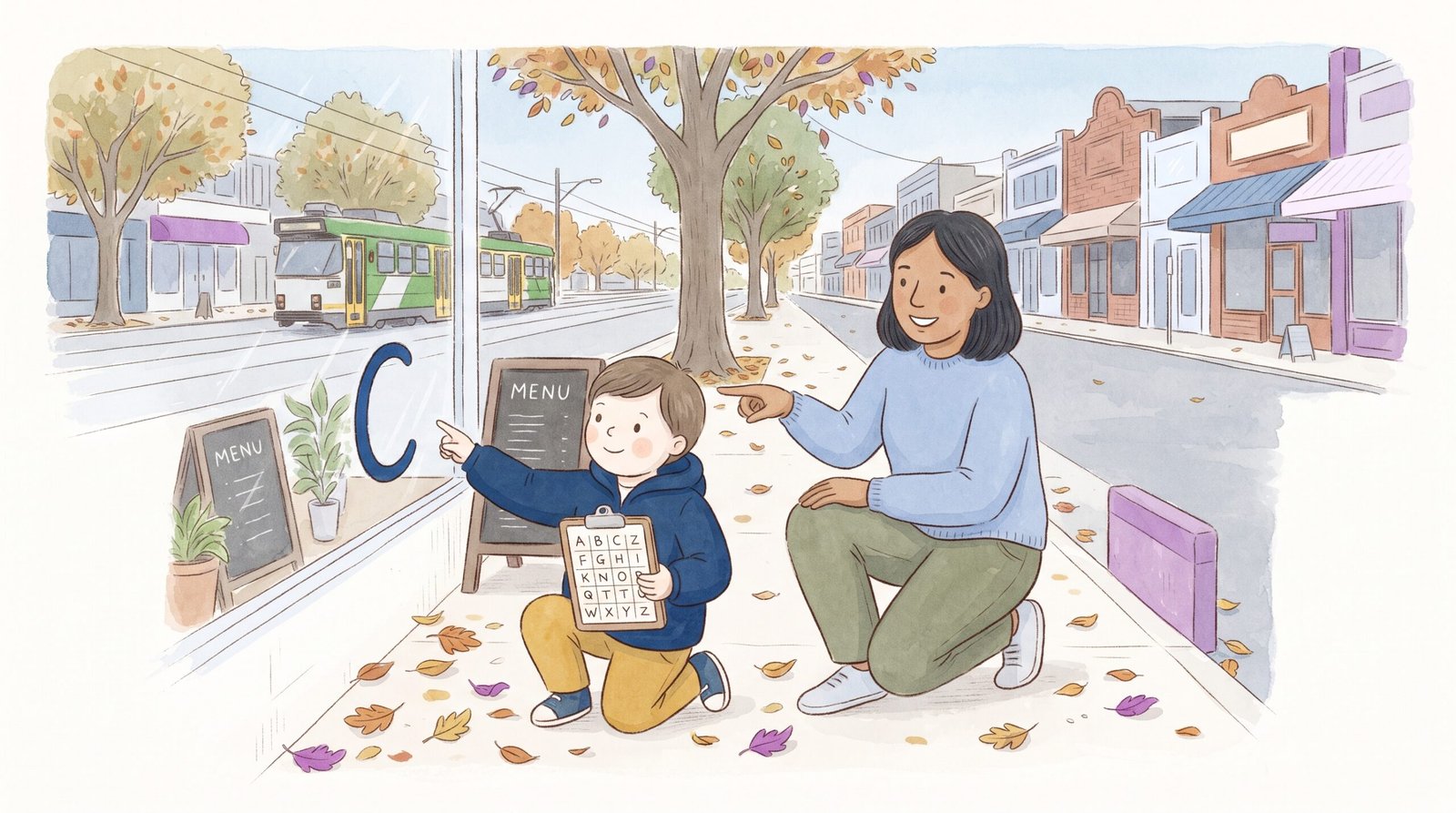
My eldest daughter could not walk past a sign without reading it to me. Or trying to.
This was in Indonesia in the mid-2000s, when I was lecturing and she was a small, fast, endlessly curious girl who wanted to know what everything said. At the market she’d stop in front of a stall and spell out the handwritten board letter by letter, loudly, in Indonesian letter names. D, I, J, U, A, L. Then she’d look up at me. “Mama, what does it say?”
Then the next stall. Then the banner over the road, the label on the rice sack, the advertising painted on the side of a shop, the price stickers. Every trip took twice as long as it needed to.
She never asked to practise letters. She never sat still long enough for anything that looked like a lesson. But she was reading by the time she was three. She knew that letters made words, that words meant things, and that reading was the key to the whole noisy world around her. Nobody drilled that into her. The signs did.
It was another fifteen years before I understood the rest of it. We were living in Melbourne by then, and she was twenty when she was diagnosed with ADHD. When I look back now, the girl at the market makes complete sense. The questions that never stopped, the body that never stopped, the way she’d lock onto letters with total focus and then drift off the moment something more interesting went past. I didn’t see it then. I’m not sure many people would have.
I’ve been thinking about her a lot while rewriting this post, because she taught me most of what I believe about early literacy before I’d read a single study on it.
In this post:
The Third Letter A
You’ve probably seen this happen. A child traces the letter A once, quite happily. By the third A in the same sitting the pencil is barely touching the paper and they’re asking if they’re finished yet. Nothing is wrong with that child. The repetition just ran out of reasons to matter.
Letters are strange little shapes when you stop and think about them. There’s no obvious reason a curve and a line should mean anything at all. Drilling the same shape over and over doesn’t explain why it matters. It mostly asks a small child to sit still and comply, and some children will do that for a while. My daughter would have lasted about forty seconds.
I’m not arguing against practice, though. Children really do need to meet a letter many times before it sticks, and some need far more meetings than others. That’s normal and it says nothing about how bright a child is. What changes everything is whether each repeat is attached to something the child actually cares about.
The letters on those market signs were the same letters on any alphabet worksheet. My daughter saw D and J and U hundreds of times a week, which is a lot of repetition. But every one of them was sitting inside something she wanted to know: what’s for sale, what’s that shop, what does that banner say. A child who loves dinosaurs will hunt for every letter in “stegosaurus” long after they’d have given up on a page of the same letters. Same repetition, completely different child.
What the Research Actually Says About Building Literacy Skills
When I started studying early childhood properly, I went looking for evidence that what I’d watched at the market was real and not just a proud mother’s memory. Some of it was there, and some of it was more complicated than I expected.
The biggest single review I know of is the US National Early Literacy Panel report from 2008. The panel looked at hundreds of studies to find which early skills best predicted later reading and writing. Near the top were alphabet knowledge, phonological awareness (hearing the sounds inside words, like rhyme and syllables), rapid naming of letters and objects, writing letters or one’s own name, and phonological memory. Concepts about print, such as knowing that print carries meaning and runs in a direction, and oral language also mattered, though less strongly once other factors were taken into account.
What struck me is how few of those need a worksheet. Alphabet knowledge can come from signs. Phonological awareness comes from rhymes, songs and silly word games. Concepts about print come from being read to and from noticing writing everywhere. Name writing comes from a child wanting to put their name on their own drawing.
The print on signs, packets and labels has a name in the research: environmental print. An Australian study by Michelle Neumann and colleagues at Griffith University found that teaching preschoolers with environmental print helped print awareness and print motivation more than the same teaching with plain print. Children seem to care more about words that belong to their world. That fitted my daughter perfectly.
The one honest caveat is that simply being surrounded by print isn’t enough. The gains come when an adult talks about it with the child, points, asks and answers. In those years, that adult was usually me, being dragged from stall to stall.
The old version of this post leaned on the famous “word gap” study by Hart and Risley, which claimed children from poorer families heard about 30 million fewer words by age three. I’d still point people to NAEYC’s summary for its practical ideas, but I want to be fair about it now. A 2019 follow-up by Sperry, Sperry and Miller did not find the same gap when they counted talk more broadly, including speech children overheard and different ways families communicate. What both sides agree on is that rich back-and-forth conversation with young children matters. That’s the bit I hold onto.
Conversation around books has decent evidence too. Dialogic reading, an approach first tested by Grover Whitehurst and colleagues in 1988, simply means the adult asks questions while reading and lets the child do more of the telling. The early studies found it boosted young children’s expressive language. It’s also a gift for a child who asks a hundred questions anyway, because it turns all that curiosity into the lesson.
Looking Back With ADHD in Mind
I wish someone had told me then that girls with ADHD are very often missed. A review by Patricia Quinn and Manisha Madhoo explains some of the reasons. Girls more often show the inattentive side, which is quieter and less disruptive in a classroom. Many work hard to compensate, so their marks look fine. Teachers and parents tend to compare them with hyperactive boys and decide they don’t fit the picture. Women are, on average, diagnosed later than men.
My daughter was a busy, chatty, active little girl, but she was also doing well, so nobody, including me, joined the dots.
This is what her early literacy looked like, and what I’d recognise now. I’m describing one girl, my own, not a checklist. ADHD looks different in every child, and none of this on its own means anything.
Before she turned three, letters were a hunt, and by three she was reading. She was intensely interested in print, but only print that was out in the world and moving past her. Signs, packaging, the writing on buses. Asked to sit and look at letters on a page, she’d slide off the chair within a minute. I took that as her being little, and because she was learning so quickly I never worried. Now I’d call it what it probably was: her attention following interest, not instruction.
By five and six she was reading fluently and fast, and she skipped. She’d guess the end of a word from its first letter and race on, because the story mattered more than getting every word right. Her talk was ahead of her writing. She could tell you a long, detailed story out loud, and then produce two messy lines when asked to write it down. Writing was slow, and slow was torture for her.
At school the pattern held. Reading something she chose, she’d disappear into it for hours. Reading something she was given, she’d read the same page three times and not take in a word. Her teachers described her as bright, a bit dreamy, sometimes careless. Nobody said ADHD. In fairness, it wasn’t a word many people used for girls back then.
There’s one more thing worth knowing. ADHD and reading difficulties often travel together. A large US birth cohort study found that around half of children with ADHD also met criteria for a reading disability by age 19, at similar rates for boys and girls. My daughter wasn’t one of them, as far as we know. But if your busy, curious child is finding reading genuinely hard, it’s worth looking at both.
What It Looks Like Day to Day
Most of it isn’t formal at all, and most of it happens on the way to somewhere else.
Start with the print that’s already around you. On a walk or at the shops, point at a sign and wonder about it out loud. “That one starts with the same letter as your name.” “I wonder what that shop sells?” Let the child find letters for you, and don’t correct every guess. If they spot an M and call it a W, turn it upside down together and laugh. Cereal boxes, street names, number plates and junk mail all count. Our Letter Spotting Walk sheet turns this into a little game you can stick on the fridge.
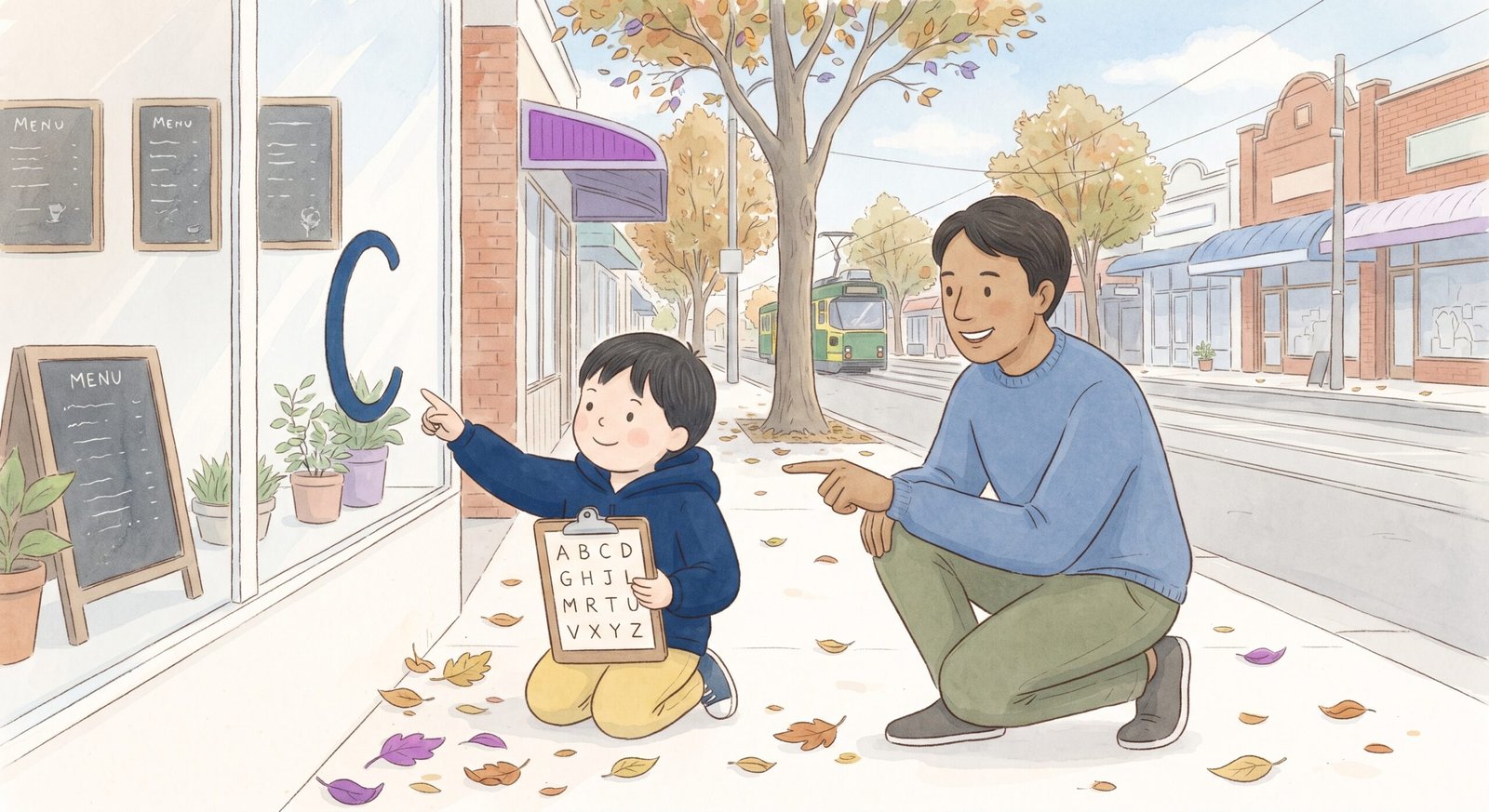
Use their name. A child’s own name is usually the first word they truly care about, and the National Early Literacy Panel listed name writing among the strongest early predictors. Point out “their” letter when it turns up in a story or on a sign. Let them sign their drawings, even if it’s a wobbly first letter and a squiggle. Our personalised storybooks are built on the same idea. There are four, My Big Adventure, All About Me, My Big Feelings and My Big New Step, and every one stars your child.
Talk about books rather than just reading them. Stop and ask what might happen next, what a character is feeling, what the child would do. Let them point and tell you. For a child full of questions, this is the easiest literacy there is, because you’re just answering and asking back.
Sing and play with sounds. Rhymes, clapping songs and silly made-up words build the ear for sounds that phonics depends on later. “Banana, fanana, panana” counts. So does the song you make up in the car.
Draw first, then write. Ask a child to draw a character from a story, then write the name underneath, scribbled or spelled wrong. Now the letters belong to something they made. Our storytelling wheel gives them a simple way to invent and tell their own story before they pick up a pencil at all, and the Draw It, Name It page gives the writing part a home.
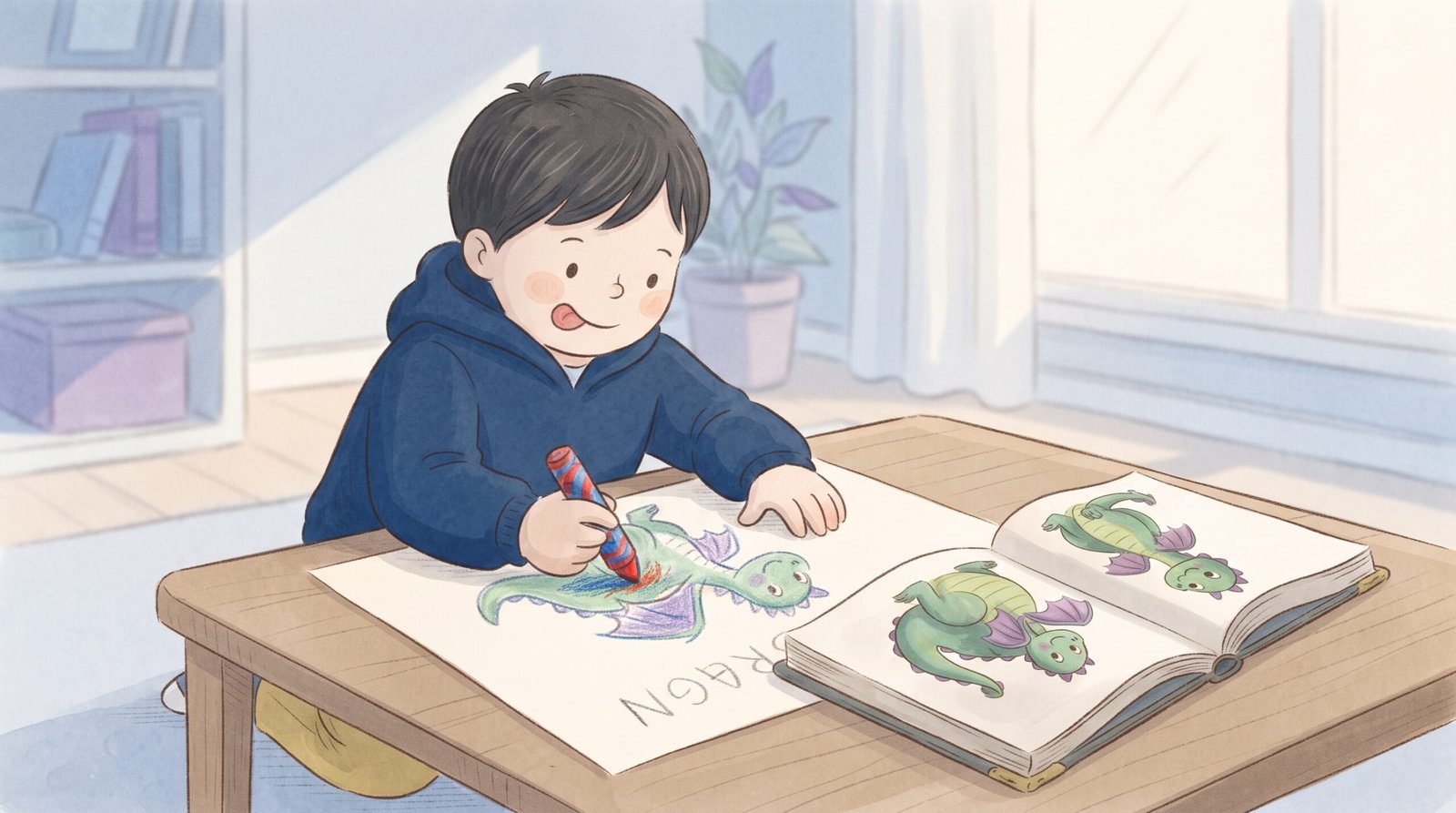
Keep the practice, just give it a reason. If you use tracing sheets, attach each letter to something, a tiny story, an animal, a person they love. That’s the thinking behind our alphabet tracing worksheets, where Wobblin, our soft glowing little character, asks children to help with each letter. There are A to Z story pages, Wobblin’s Letter Hunt for the SATPIN sounds that many phonics programs start with, and pre-writing paths with a “my name” page for children who aren’t ready for letters yet. You’ll find the rest in our printables and the wider early literacy section.
Some days this will click and some days it won’t. A child can know a letter perfectly on Tuesday and seem to have lost it by Thursday. That’s how the connections form, in fits and starts, not a straight line upward. Little and often, through games, stories and noticing, does more over a term than any long sit-down session.
If your child is growing up with more than one language, as mine was, none of this needs to wait for English. Spotting letters in one language feeds the other, especially when both use the same alphabet. We write more about that in supporting a child learning English as a second language.
For the Busy, Curious Ones
If you’re raising or teaching a child like my daughter, the most useful shift I can offer is this: stop trying to bring them to the letters, and take the letters to wherever they already are.
Let literacy move. Spell a word with your feet on the footpath, hunt for letters on the way to the car, write a giant letter in the air or in the sand. A child who can’t sit for a worksheet might happily trace a letter with a stick for ten minutes, if it’s their idea.
Follow the questions. A child who asks “what does that say?” forty times a day is handing you forty literacy lessons. Answer, then sometimes ask back: “What do you think it says? What letter does it start with?” It’s slower than just reading it out. It’s also the whole point.
Keep it short and finish while it’s still fun. Five minutes of letter spotting in the supermarket queue beats twenty minutes of reluctant tracing. If a child is already buzzing or flat, a bit of movement first often helps more than another instruction. Our pocket heavy work cards give you six quick movement ideas, and a first-then reset mat can show “first a wall push, then the letter hunt” in pictures, so there’s less to explain. We write more about this in regulation before learning.
Don’t mistake fast for careless. Children who race ahead and skip words are often hungry for meaning. Slow them down gently with questions about the story, not with corrections on every word.
And go easy on yourself. I missed my daughter’s ADHD for twenty years while being, I think, a fairly attentive mother and a trained educator. As a parent with ADHD myself, I know how easy it is to normalise the patterns you grew up with. If you want to know what to look for in girls in particular, signs of ADHD in girls is a good place to start, and neurodivergent early literacy foundations goes further into reading support.
Talk to your child’s educator, teacher or GP if a child is still finding letters and sounds very hard after plenty of relaxed, everyday exposure, if reading or writing is causing real distress, if there are concerns about speech or hearing, or if ADHD, dyslexia or language difficulties run in the family. A speech pathologist, a paediatrician or an educational psychologist may be able to help, depending on the concern. Asking early is never an overreaction.
Free Literacy Printables
Three A4 sheets go with this post. They’re free for home and classroom use.
- Letter Spotting Walk (PDF, 2 pages) An A to Z hunt for letters on signs, packets and labels, with space to note where each one turned up, plus a page of notes for grown-ups.
- Two-Week Literacy Play Planner (PDF, 3 pages) A five-minute idea for each day, with a tick box and a line for what your child noticed. There’s also a blank week to fill in yourself.
- Draw It, Name It (PDF, 2 pages) Draw a character from a story, then write its name and one thing that happened. A second page tells a story in three pictures. Scribbles welcome.
They sit happily alongside the rest of the collection. If your child does better when the day has a shape, the daily routine chart or visual routine cards make it easy to give a five-minute story or letter game the same spot every day. For the writing side, pair Draw It, Name It with the pre-writing paths in the alphabet tracing pack, and when your child wants to tell a longer story, the storytelling wheel gives it a beginning, middle and end.
Try Wobblin’s Alphabet Tracing Worksheets
A to Z story pages, a SATPIN letter hunt and pre-writing paths, where every letter comes with a reason to trace it.
Get the Free Tracing PacksMy girls are adults now. I’m glad I followed my eldest’s questions rather than sitting her down with a worksheet, even though I didn’t know why at the time.
- Start with the big picture in Early Literacy for Neurodivergent Kids →
- See how literacy grows from three in Emergent Literacy in Preschoolers Aged 3 to 5 →
- Go deeper on reading support in Neurodivergent Early Literacy Foundations →
- Shape letters well in Letter Formation →
- Make up stories together with The Storytelling Wheel →
- Support two languages in A Child Learning English as a Second Language →
- Know what to look for in Signs of ADHD in Girls →
- Find more posts on the blog →
Research: the National Early Literacy Panel on early predictors of reading; Neumann and colleagues on environmental print; Sperry, Sperry and Miller and NAEYC on the word gap; Whitehurst and colleagues on dialogic reading; Quinn and Madhoo on ADHD in girls; and Yoshimasu and colleagues on ADHD and reading disability.
Experience: the family story, the description of my daughter’s reading and writing, the day-to-day ideas and the printables come from my own parenting and practice. They are not a tested program, and my daughter’s story is one child’s story. Last reviewed: 4 November 2026.
Literacy Skills Readings and References
- National Early Literacy Panel. (2008). Developing early literacy: Report of the National Early Literacy Panel. National Institute for Literacy. Executive summary
- Neumann, M. M., Hood, M., & Ford, R. M. (2013). Using environmental print to enhance emergent literacy and print motivation. Reading and Writing, 26(5), 771–793.
- Sperry, D. E., Sperry, L. L., & Miller, P. J. (2019). Reexamining the verbal environments of children from different socioeconomic backgrounds. Child Development, 90(4), 1303–1318. https://doi.org/10.1111/cdev.13072
- NAEYC. (2014). The word gap: The early years make the difference. Teaching Young Children. naeyc.org
- Whitehurst, G. J., Falco, F. L., Lonigan, C. J., Fischel, J. E., DeBaryshe, B. D., Valdez-Menchaca, M. C., & Caulfield, M. (1988). Accelerating language development through picture book reading. Developmental Psychology, 24(4), 552–559.
- Quinn, P. O., & Madhoo, M. (2014). A review of attention-deficit/hyperactivity disorder in women and girls: Uncovering this hidden diagnosis. The Primary Care Companion for CNS Disorders, 16(3). https://doi.org/10.4088/PCC.13r01596
- Yoshimasu, K., Barbaresi, W. J., Colligan, R. C., Killian, J. M., Voigt, R. G., Weaver, A. L., & Katusic, S. K. (2010). Gender, ADHD, and reading disability in a population-based birth cohort. Pediatrics, 126(4), e788–e795. https://doi.org/10.1542/peds.2010-1187
This article reflects personal family experience and professional early childhood education practice. It is shared for supportive and educational purposes only and is not medical, psychological, speech pathology or other allied health advice. My daughter’s story is one child’s experience, and ADHD looks different in every child. If you have concerns about your child’s language, reading, attention or development, please seek individual guidance from your child’s educator, your GP or a paediatrician.
