
Math Games for Kids: 6 Brilliant Ways Play Sparks Early Numeracy
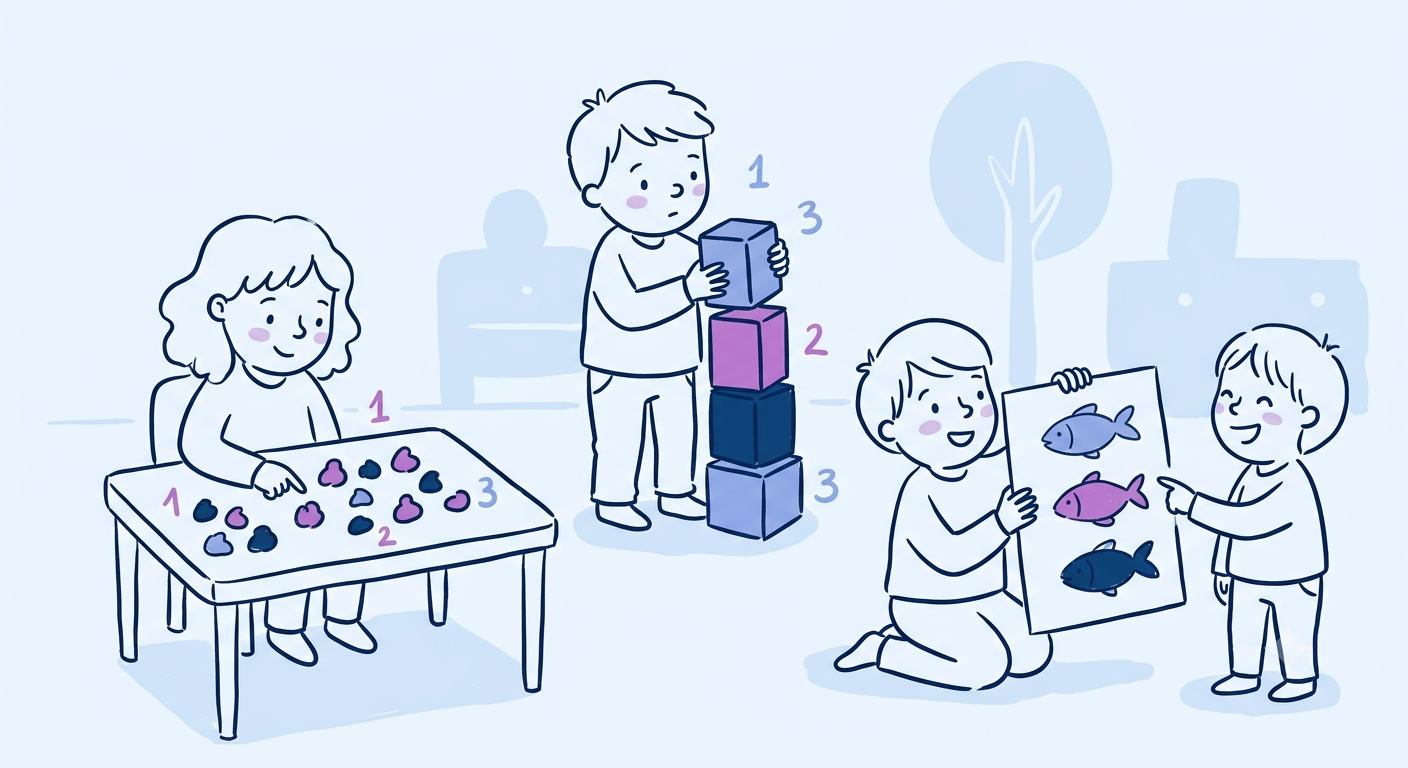
I remember sitting at our kitchen table on a rainy Tuesday afternoon, watching my four year old daughter slowly slide down her chair until her chin was resting on the timber tabletop. In front of her sat a counting worksheet featuring little rows of smiling ducks. All she had to do was count the birds and write the correct number in the box. Within two minutes, her legs were kicking the chair legs rhythmically, her hands were twisting her shirt into tight knots, and the pencil was flicked across the kitchen tiles.
As both a parent and an early childhood educator who has spent years working alongside neurodivergent children, my initial feeling was that familiar heavy sigh. We often wonder why something as simple as counting four ducks can feel like such an uphill battle. But when I put the paper away, grabbed a cardboard egg carton and a handful of gum nuts from our nature basket, her whole posture shifted. Sitting on the floor and tossing nuts into numbered cups, she counted effortlessly up to twelve. That simple afternoon reminded me that meaningful math games for kids are not about drills or getting things right on paper, but about letting growing bodies and curious minds touch, move, and experience how numbers work in the physical world.
Table of contents
- What parents and educators usually notice first
- What is often misunderstood about math games for kids
- What is happening underneath behaviourally and neurologically
- Why math games for kids work best in everyday life
- What does not work even though it is commonly recommended
- Small adjustments that reduce stress for both child and adult
- Expectations versus reality in neurodivergent development
- Foundational principles for early learning
- References used
What parents and educators usually notice first
In early learning rooms and Australian family living rooms alike, numeracy activities often start with good intentions and quickly spiral into emotional tension. We see a preschooler guess wild numbers at random just to make the questions stop. We watch her freeze up when asked how many sultanas are left on her snack plate, or scatter board game tokens across the carpet the second her turn does not go as planned.
At the same time, we notice that these exact same children can show remarkable concentration under different conditions. A child who melts down over a flashcard will happily spend twenty minutes lining up plastic animal figurines from smallest to biggest, or organizing toy cars into pairs along the edge of the hallway rug. It can look like stubbornness from the outside. Yet this contrast shows us that children are drawn to authentic mathematical patterns when their nervous system feels safe, grounded, and free from testing.
What is often misunderstood about math games for kids
A widespread misconception in early childhood education is the belief that flashcards, rote counting, and paper worksheets are the most direct path to learning mathematics. Well meaning adults often assume that if a child can recite numbers from one to twenty like a song, she understands what those numbers mean. In reality, chanting numbers in sequence is a language memory task, while true number sense is a spatial and relational understanding.
When a child resists sitting down for formal math practice, her hesitation is frequently misunderstood as a lack of focus, poor cooperation, or math anxiety. Parents are often told to practice more often or use stricter routines. However, turning every moment into a pop quiz quickly drains the joy from learning.
Early childhood research demonstrates that genuine mathematical reasoning develops through tactile experience and playful problem solving. Children do not build spatial intuition by staring at flat digits on a worksheet. They build it by feeling the weight of four heavy blocks compared to two light ones, and discovering that moving forward three spaces on a board game physically moves their body closer to the finish line.
What is happening underneath behaviourally and neurologically
To understand why traditional math instruction can feel so overwhelming for young children, especially those with ADHD, autism, or sensory processing differences, we have to look at what the brain is doing during these tasks. Translating a printed numeral into an abstract quantity requires multiple areas of the brain to talk to each other simultaneously. A child must hold the count in her working memory, coordinate visual tracking across a page, and inhibit the natural urge to move.
When children feel pressured to perform, their nervous system perceives a subtle threat of failure. For a neurodivergent child who may already be coping with sensory overload from background noise or fluorescent lighting, that evaluation pressure triggers a survival response. Her body seeks fight, flight, or shutdown. What appears on the outside as silliness, defiance, or giving up is often an overwhelmed brain trying to protect itself.
This is where thoughtfully designed math games for kids make such a profound physiological difference. Playing an engaging game with a dice or a simple linear track activates intrinsic motivation and releases dopamine in a natural, low pressure setting. When a child rolls a four, moves four steps, and counts aloud, she receives immediate sensory feedback through touch, sight, and hearing. The physical movement grounds her vestibular and proprioceptive systems, which calms the nervous system and frees up executive function capacity so real learning can occur.
Why math games for kids work best in everyday life
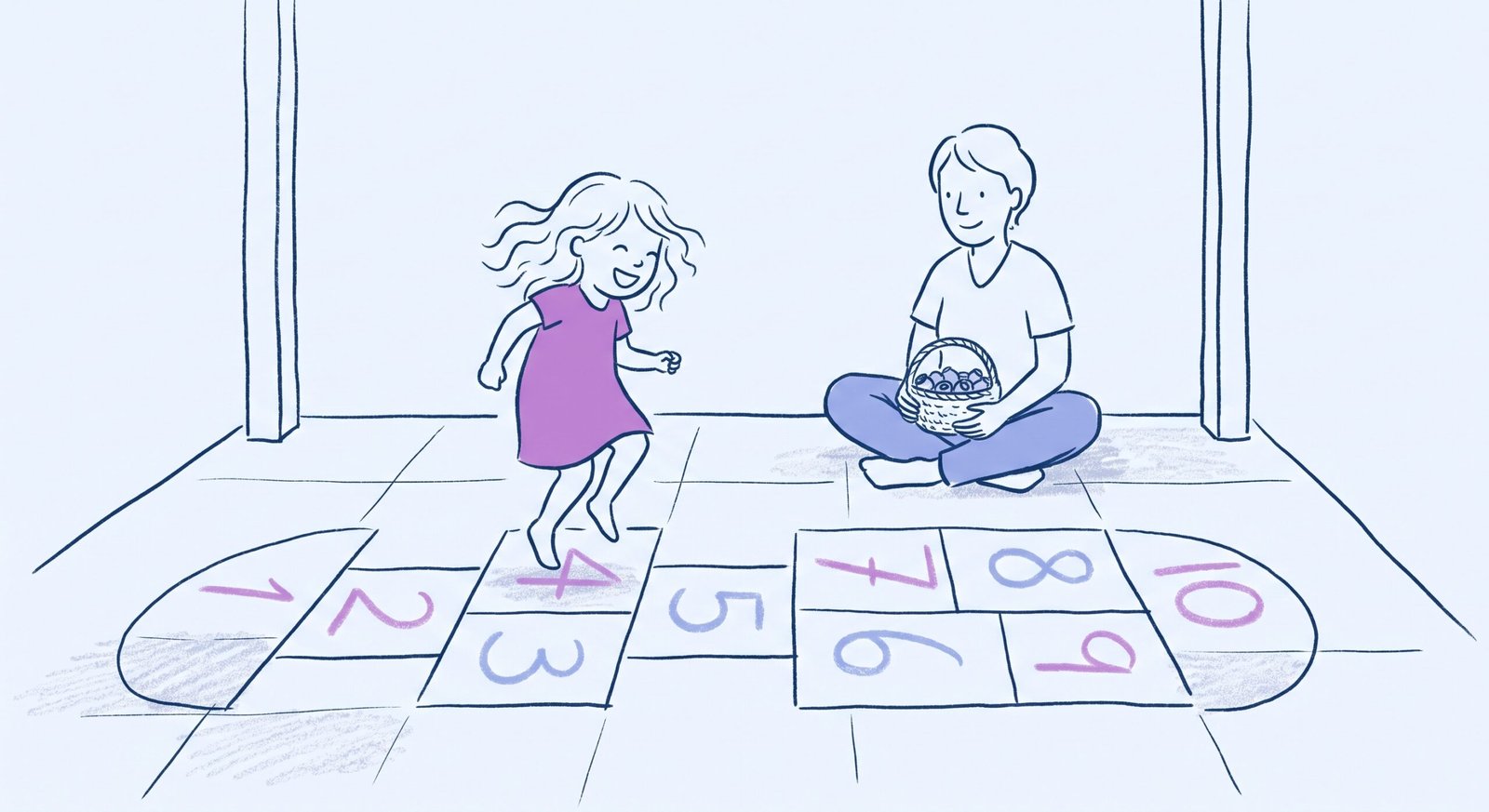
Over the years, landmark research has shown how simple games can transform early mathematical understanding. Back in 2007, researchers Geetha Ramani and Robert Siegler demonstrated that young children who played a basic numbered board game for just a few short sessions made substantial, lasting gains in counting, number identification, and comparing quantities. What made the game work was not fancy packaging, but the simple physical mechanic of moving a marker along a numbered line while counting forward.
When exploring math games for kids in everyday family life or early childhood settings, the goal is to make the mathematics an active part of the play rather than a chore tacked on to earn a reward. Here are six practical, sensory friendly ways to bring play based numeracy into your everyday routine:
- The classic linear path game: Draw ten squares in a row on a strip of cardboard, numbered 1 to 10. Players take turns rolling a six sided dot die and hopping a pebble or button forward. Encourage counting forward from the current square rather than starting from one each time. That simple counting on action strengthens a child mental number line.
- Heavy work laundry sort: Scatter rolled up socks or small plush toys across the carpet. Place numbered wash baskets along the wall and challenge your daughter to toss three blue socks into basket three and five white ones into basket five. The heavy gross motor movement keeps active bodies regulated while practicing quantity comparison.
- Verandah chalk jumping: Draw a giant number line from 1 to 10 with outdoor sidewalk chalk on your concrete driveway or verandah pavers. Instead of moving a plastic token, your child physically jumps from square to square as you call out movements. Combining gross motor vestibular movement with counting grounds high energy learners.
- Nature tray comparison: During an outdoor bushwalk or park visit, gather an assortment of gum nuts, seed pods, and smooth stones. Back at home, place two bowls on a low table. Ask your daughter to grab a handful of items in each hand and guess which hand holds more before counting them out to check. Comparing physical weights gives tangible meaning to concepts of more and less.
- Baking measuring cups: Cooking afternoon morning tea provides effortless measurement practice. Let your toddler scoop cups of flour or oats into a mixing bowl, counting each scoop aloud as the bowl fills up. The warm tactile textures and smells make numbers feel comforting and practical.
- Simple card comparison: Take an ordinary deck of playing cards and remove the face cards. Turn over two cards at a time and see which number is bigger. For younger kids, cards with clear dot arrangements make it easy to subitise, recognizing small quantities at a glance without having to count each individual dot.
Notice how none of these ideas rely on red pens or quiet table compliance. When we weave math games for kids into ordinary, unhurried family moments, children discover that numbers are tools that help us navigate our daily world.
Hands-On Early Numeracy Starter Pack
Looking for gentle, low pressure numeracy play? Download our simple printable path games and tactile counting mats designed for busy hands and neurodivergent learners.
Explore the Play PackWhat does not work even though it is commonly recommended
Plenty of popular educational advice circulates in parent chat groups and teacher lounges that can unintentionally raise the temperature at home. Learning to step back from these common traps protects both your child confidence and your household peace.
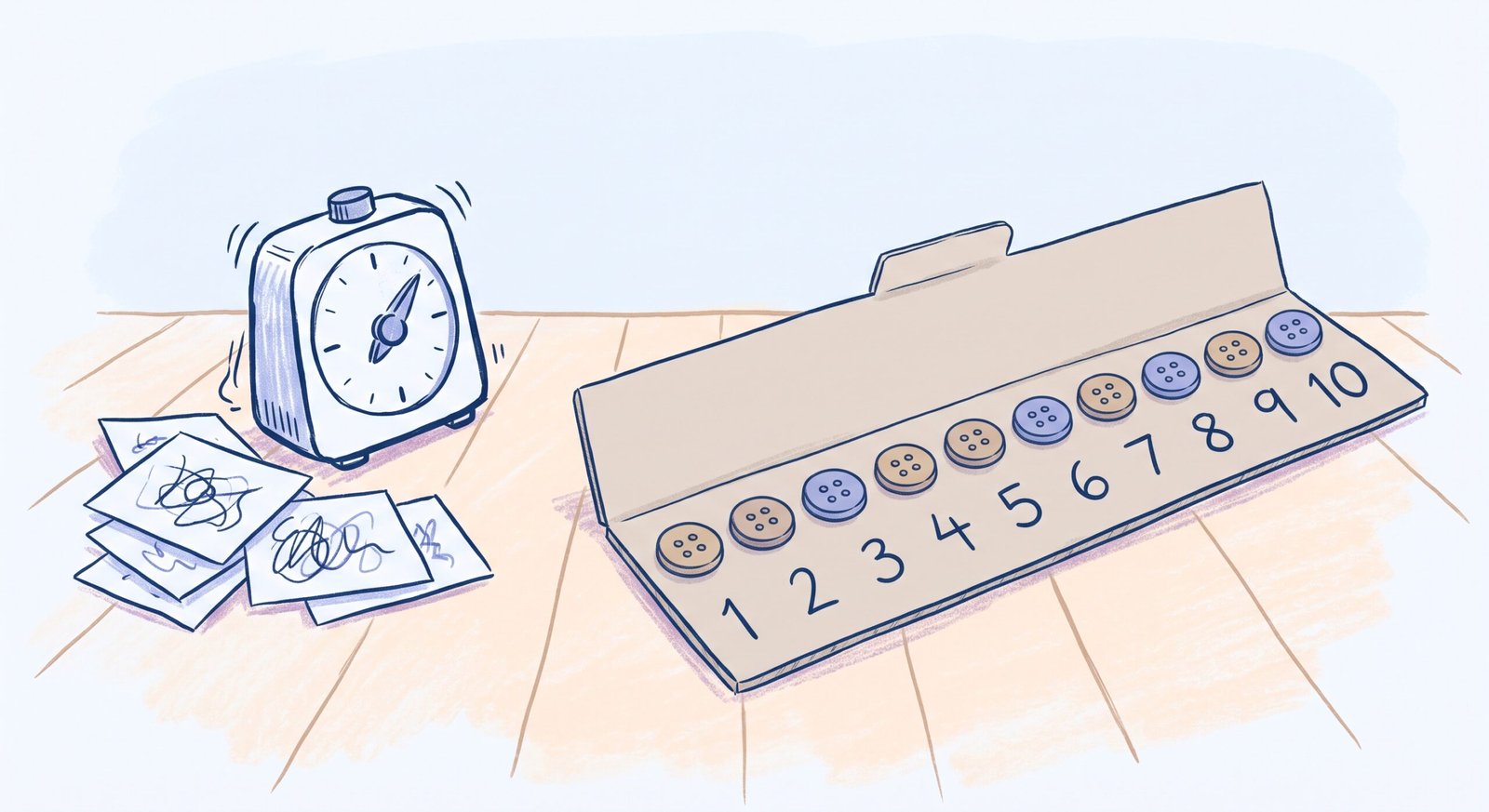
Drilling with flashcards is one of the most persistent recommendations. Parents are often encouraged to hold up cards with numerals or dot patterns, asking children to shout out the answer as quickly as possible. For children who struggle with processing speed or emotional regulation, flashcard drills quickly induce anxiety. It turns learning into an interrogation where the child constantly fears giving the wrong answer.
Timed challenges and speed games are another frequent pitfall. While some highly competitive neurotypical children may enjoy beating a sand timer, timed math games can trigger sensory dysregulation in children with ADHD or autism. The pressure of a ticking clock activates the sympathetic nervous system, making it nearly impossible for the prefrontal cortex to access working memory.
Overly stimulating digital learning apps are also widely marketed as games. While colourful animations and chime sounds may keep a child glued to a tablet screen, these apps often focus on rapid tapping rather than deep reasoning. The loud sensory stimulation can leave sensitive nervous systems agitated, without building the physical, spatial intuition that comes from handling actual objects.
What to watch out for in early math resources:
- Timed tasks that prioritize speed over exploration
- Flashcard drills that rely purely on memorization
- Worksheets disguised as games by adding decorative cartoons
- Apps with high sensory noise, sudden flashing lights, and loud chimes
Small adjustments that reduce stress for both child and adult
Transforming math time from a daily battle into a connective experience does not require expensive curriculums. It begins with simple, thoughtful shifts in our environment and our expectations.
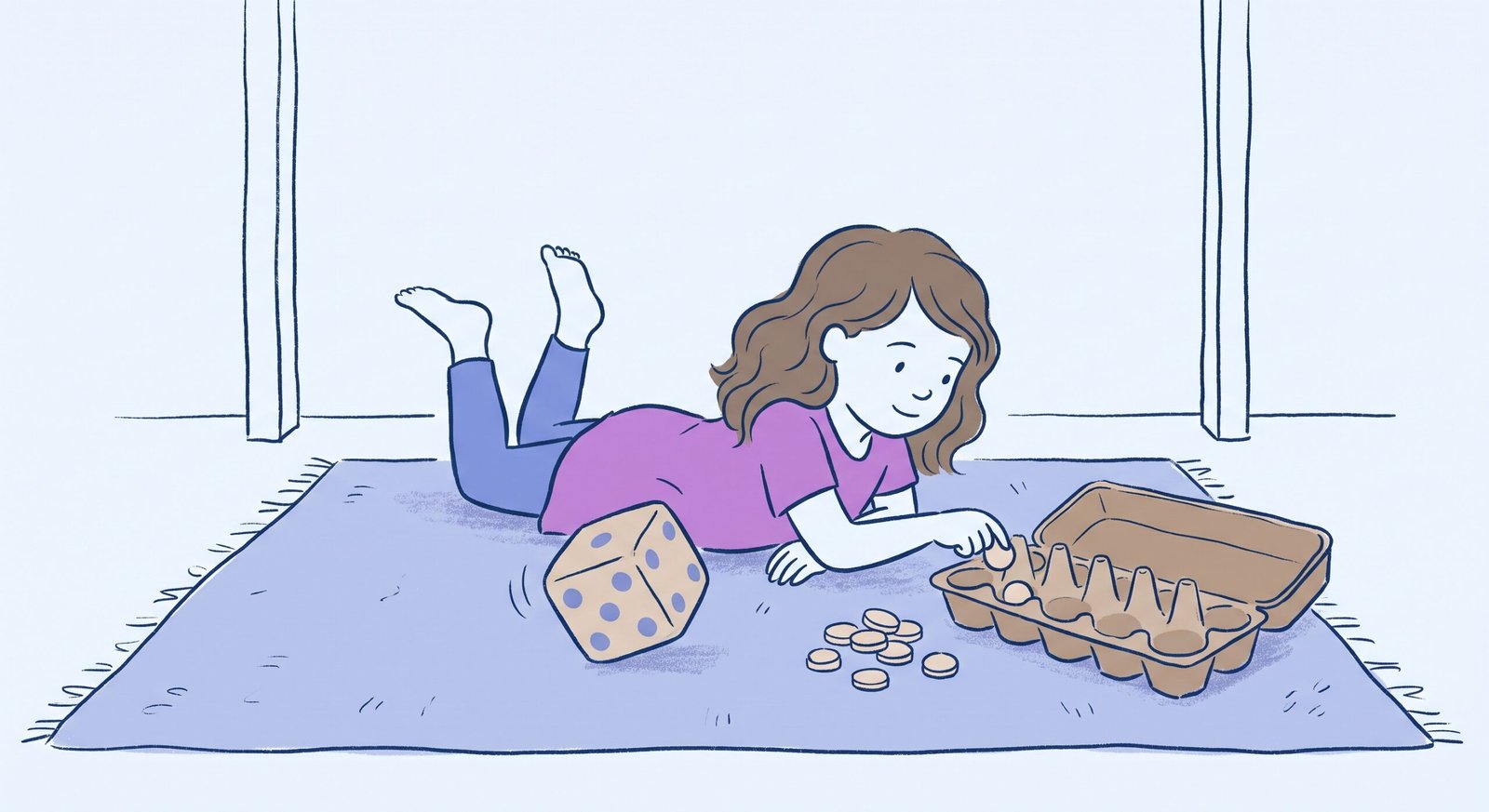
First, rethink how your child body is supported during play. Sitting upright at a high kitchen bench with dangling legs can make a child feel ungrounded, draining the physical energy she needs to think. Try taking the game to the floor. Playing while lying on her tummy on a soft rug or sitting cross legged with an adult provides deep proprioceptive grounding through the joints, which naturally settles an active nervous system.
Second, shift from asking testing questions to using descriptive commentary. When adults constantly ask questions like “What number is that?” or “How many are there?”, children can feel on trial. Instead, try narrating what you notice during play: “You rolled a five, so your token is hopping past my three,” or “Look at that, these two bowls have the exact same number of stones.” This observational language models mathematical thinking while keeping the emotional stakes completely safe.
Third, embrace short bursts of engagement. A game of simple path racing does not need to last for forty minutes. Five to ten minutes of joyful, connected play does far more for mathematical confidence than an hour of tearful table battles. When your child body shows signs of restlessness or fatigue, validate her need for a break and gently pack the pieces away.
Expectations versus reality in neurodivergent development
In parenting spaces, it is easy to feel unsettled by neat developmental milestone charts. We see social media posts of four year olds writing out addition equations or quickly adding sums in their heads, and we wonder if our own daughter is falling behind because she still counts on her fingers or loses track of her count after four.
For neurodivergent children, development is often asynchronous. A child may possess a sophisticated intuitive understanding of mechanical symmetry, balance, and spatial relationships while building elaborate Lego creations, yet struggle with the sequential memory needed to name numerals in order. This uneven profile is completely normal in neurodivergent childhood.
Letting go of conventional expectations allows us to meet our children where they actually are today. Number sense is not a race. When a child spends her early years manipulating tactile objects, tossing tokens, and discovering quantity through supportive math games for kids, she builds a robust internal foundation. When her cognitive maturity aligns with formal schooling later on, her understanding of mathematics will be rooted in lived, spatial experience rather than fragile memorization.
Foundational principles for early learning
As you navigate early numeracy at home or in the classroom, keep these guiding principles close at hand:
- Keep the math inside the action: Choose activities where the mathematics is central to how the game is played, such as moving spaces or collecting tokens, rather than an arbitrary quiz before taking a turn.
- Prioritize nervous system regulation: A child who feels calm, safe, and connected will learn naturally. If tears or avoidance begin, pause the activity and reconnect before worrying about the math.
- Value concrete objects over paper marks: Manipulating physical stones, wooden blocks, and pastry dough builds spatial neural networks that flat worksheets cannot replicate.
- Narrate rather than interrogate: Model mathematical ideas by talking aloud about your own moves, removing the anxiety of constant questioning.
- Protect your relationship above the lesson: No counting exercise is worth damaging the sense of safety and trust between you and your child. Joyful connection is the greatest catalyst for lifelong learning.
By weaving low stress math games for kids into everyday routines, we honour our children unique developmental paths while nurturing a lifelong, curious relationship with numbers.
References used
- Australian Government Department of Education. (2022). Belonging, Being and Becoming: The Early Years Learning Framework for Australia (EYLF V2.0). Australian Government. https://www.acecqa.gov.au/eylf
- Ramani, G. B., & Siegler, R. S. (2008). Promoting broad and stable improvements in low-income children’s numerical knowledge through playing number board games. Child Development, 79(2), 375–394. https://doi.org/10.1111/j.1467-8624.2007.01131.x
- Clements, D. H., & Sarama, J. (2014). Learning and teaching early math: The learning trajectories approach. Routledge. https://www.routledge.com
- UNICEF & The LEGO Foundation. (2018). Learning through play: Strengthening learning through play in early childhood education programmes. UNICEF Education Section. https://www.unicef.org/documents/learning-through-play
- Alotaibi, M. S. (2024). Game-based learning in early childhood education: A systematic review and meta-analysis. Frontiers in Psychology, 15, 1307881. https://doi.org/10.3389/fpsyg.2024.1307881
- Boaler, J. (2016). Mathematical mindsets: Unleashing students’ potential through creative math, inspiring messages and innovative teaching. Jossey-Bass. https://www.youcubed.org
- Raising Children Network. (2023). Developing early numeracy and maths skills. The Australian Parenting Website. https://raisingchildren.net.au
- Royal Children’s Hospital Melbourne. (2021). Kids Health Info: Child development in the preschool years. https://www.rch.org.au/kidsinfo