
10 Classic Playground Games for Kids: Joyful Rules & Screen-Free Outdoor Play
These ten classic playground games for kids require little to no equipment, relying mostly on chalk, a skipping rope, or a group of children ready to move together. Each activity nurtures essential developmental milestones, from gross motor coordination and single-leg balance to number sequencing, spatial judgment, and social impulse control.
The Best Classic Playground Games for Kids
Here are traditional, high-engagement playground games that require zero to minimal equipment:
- Hopscotch: Chalk grid hopping that builds number sequencing and single-leg balance.
- Jump Rope: Cardio rhythm game enhancing timing and bilateral coordination.
- Hide and Seek: Spatial exploration classic teaching perspective-taking and patience.
- Tag: Fast-paced pursuit developing speed, evasion, and agility.
- Marbles: Precision target game developing thumb pincer control and trajectory estimation.
- Jacks: Fast-reaction floor game building hand-eye reflex and fine motor capture.
- Simon Says: Auditory command game reinforcing working memory and impulse control.
- Red Light, Green Light: Stop-and-go racing teaching physical braking and self-regulation.
- Duck, Duck, Goose: Group circle game building anticipation, sprinting, and turn-taking.
- Cat’s Cradle: Two-player string sequence developing finger dexterity and bilateral motor skills.
Why classic playground games for kids are worth bringing back
Every game on this list predates smartphones by decades, and many by centuries. They earned their lasting popularity because they required nothing more than an open patch of concrete, a willing group of children, and perhaps a stick of chalk or a length of twine.
That simplicity is a comforting reminder on busy days when digital screens feel like the only default option. Traditional games provided the original low-cost, high-engagement entertainment long before structured curricula began analysing their benefits.
The research firmly supports what children have always known intuitively. The World Health Organization recommends that children aged three and four get at least three hours of physical activity spread throughout the day, including at least an hour of moderate to vigorous energetic play, while keeping sedentary screen time under an hour.[1]
Every game explored below fits comfortably into that vigorous movement category without requiring complex rules, expensive sporting gear, or stressful adult organisation.
1. Hopscotch
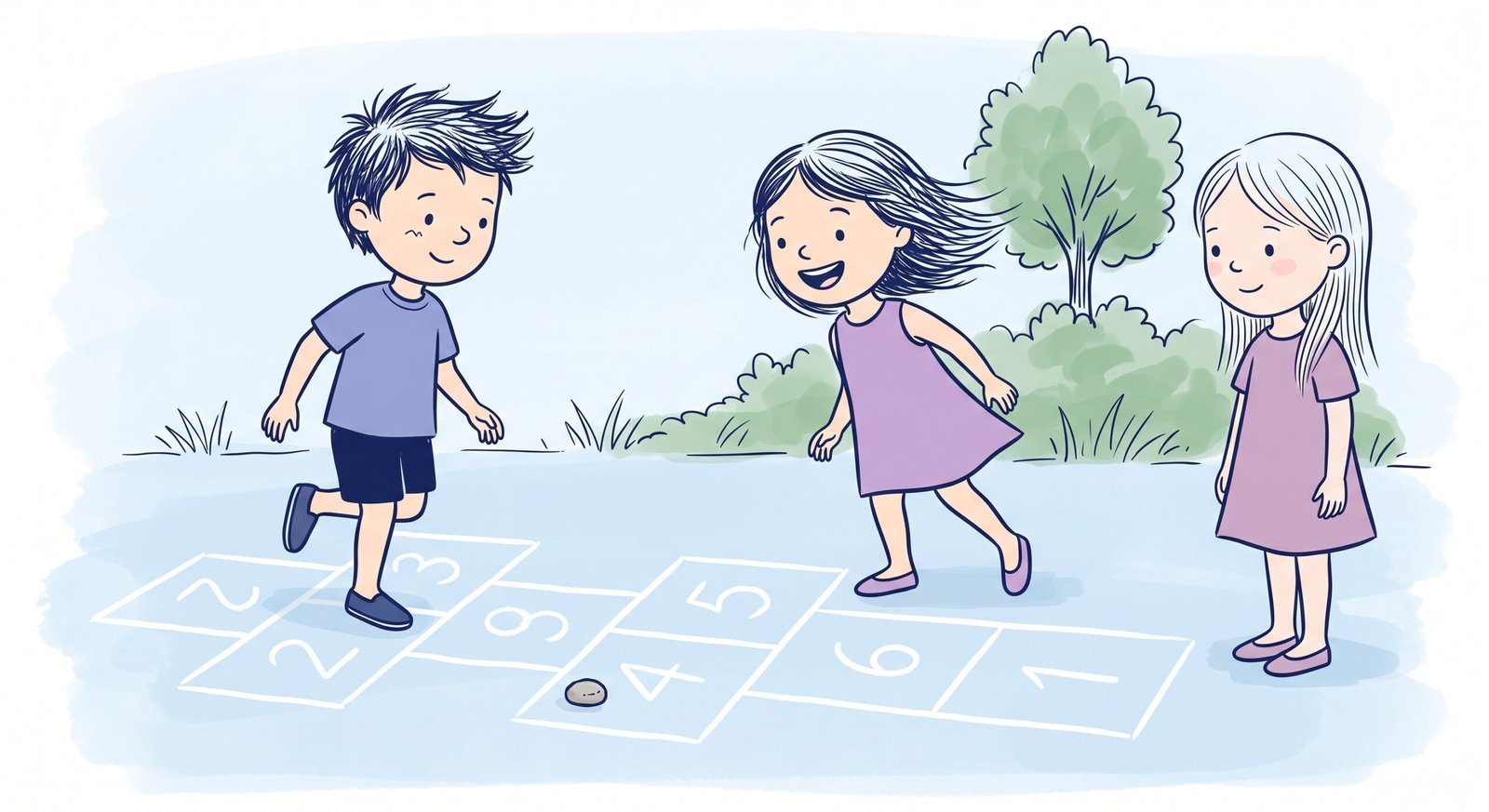
A numbered chalk grid that children hop through on one foot, tossing a marker stone ahead each round. Draw a single square, then a pair of side-by-side squares, alternating up to nine or ten squares total, each numbered in order.
Players toss their marker onto square one, hop through the course while skipping that square, turn around at the top, and hop back, balancing on one leg to collect their marker on the way home. If your child enjoys gross motor counting games, combine this with our number line jumping game or explore our comprehensive guide on hopscotch for kids.
Best for: Ages three and up, with younger children skipping the marker toss and practicing two-footed jumps through the numbers.
Tip: Sidewalk chalk wears away cleanly with rain or garden water, making it easy to redraw the grid with different number ranges, letter sounds, or geometric shapes whenever play needs a fresh twist.
2. Jump rope
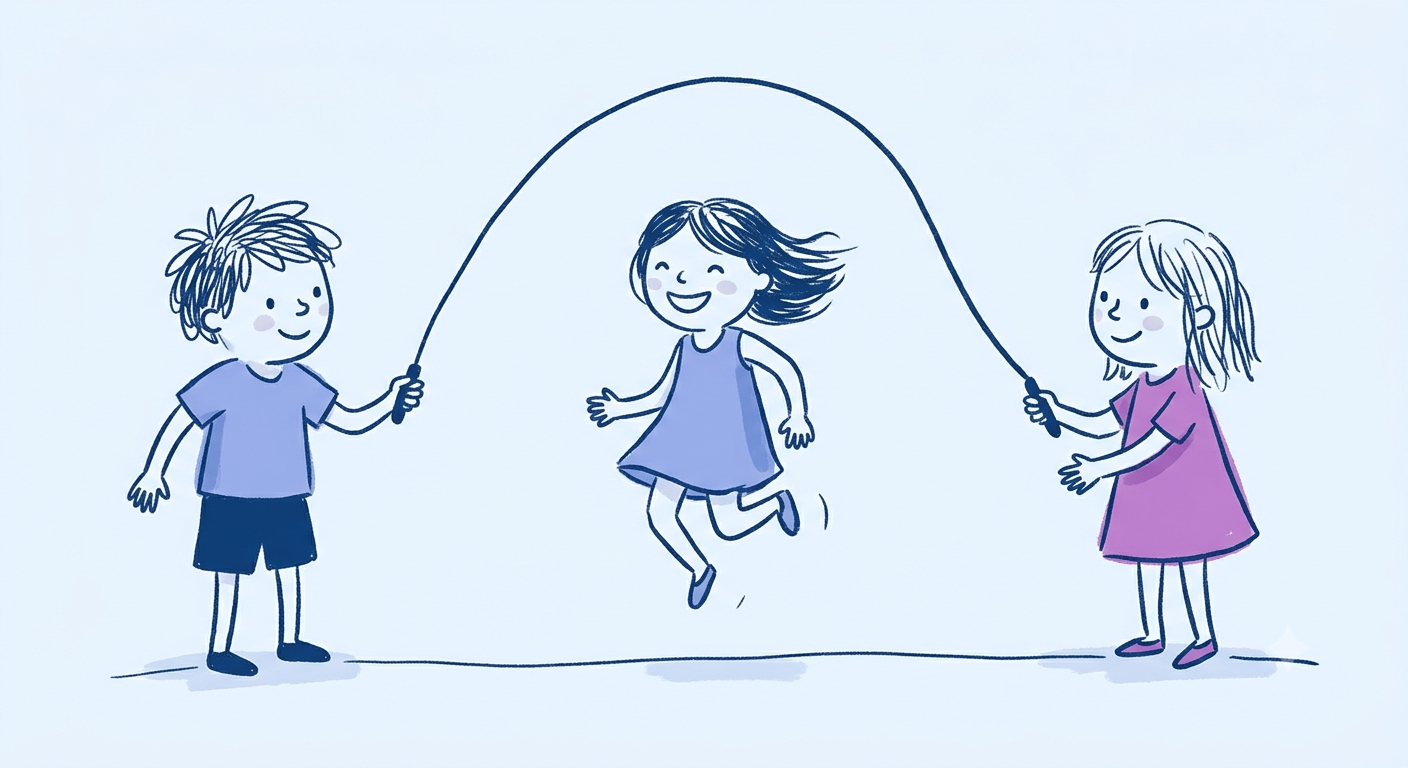
One of the most effective cardiovascular games disguised as play, skipping ropes build rhythm, timing, and gross motor coordination. Start with a single child turning their own rope, then progress to two adults or older children turning a long rope while others practice running into the turn.
Rhythmic rhymes chanted while jumping double up as early literacy and counting practice, while simple challenges, such as counting how many clean jumps a child can make, offer natural personal goals without competitive pressure.
Best for: Ages four and up for an individual rope; group turning games become manageable around age six, once timing an entry run is comfortable.
Tip: A rope that reaches from armpit to floor when a child stands on its centre is the ideal length; an overly long rope drags on the pavement and creates unnecessary timing frustration for beginners.
3. Hide and seek
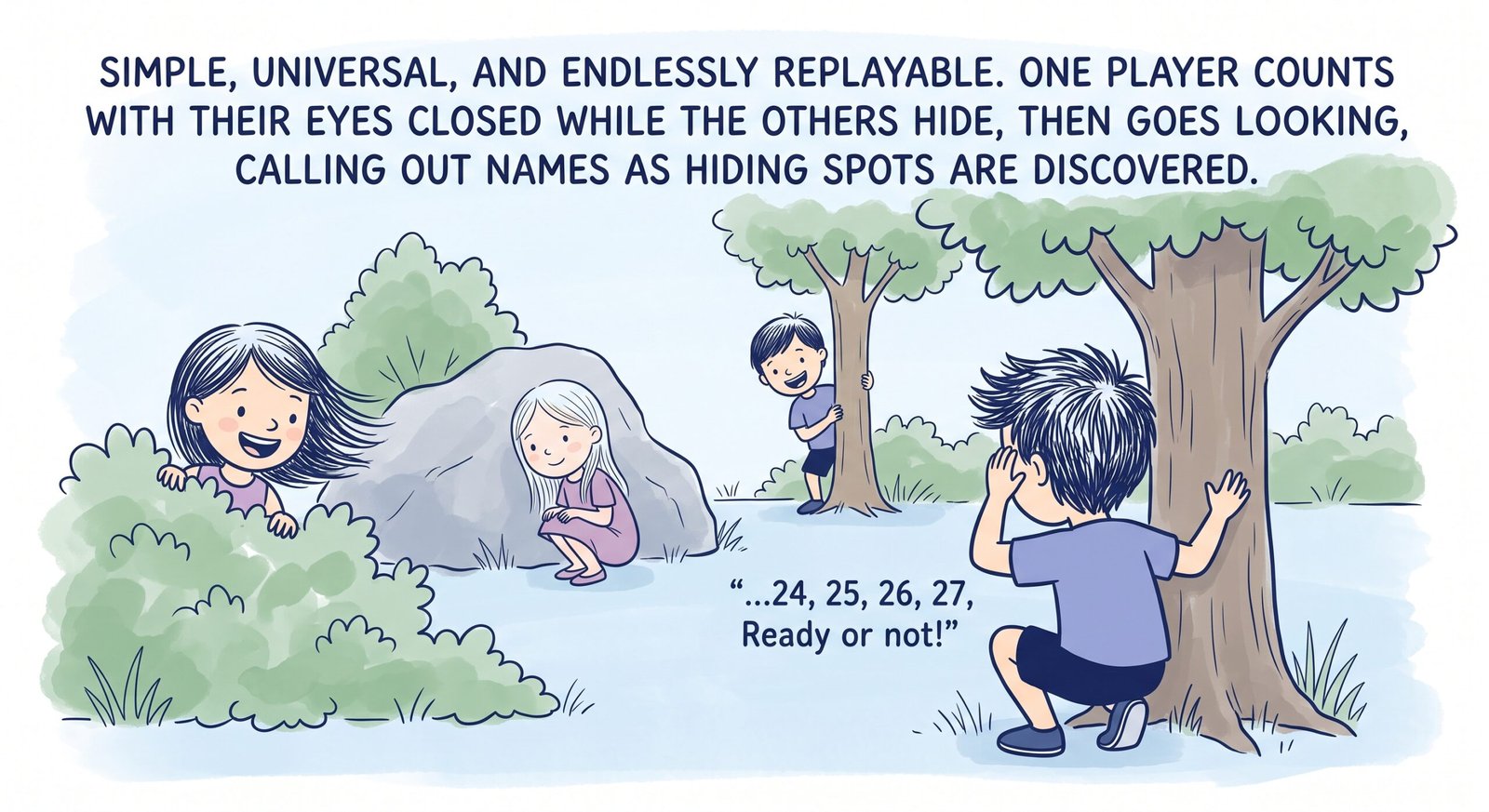
Simple, universal, and endlessly replayable across generations. One player covers their eyes and counts out loud while the others find hiding spots, then sets off to discover them, calling out names as each spot is found.
Hide and seek develops spatial reasoning, patience, and visual perspective taking. Working out whether a hiding spot conceals your entire body from another person’s line of sight is a complex cognitive milestone for young preschoolers.
Best for: Ages three and up indoors with gentle hints; ages five and up for outdoor play with agreed boundaries.
Tip: Establishing clear, physical boundaries before the round begins, such as staying within the fenced lawn or between two garden paths, prevents confusion and keeps the game safe.
4. Tag
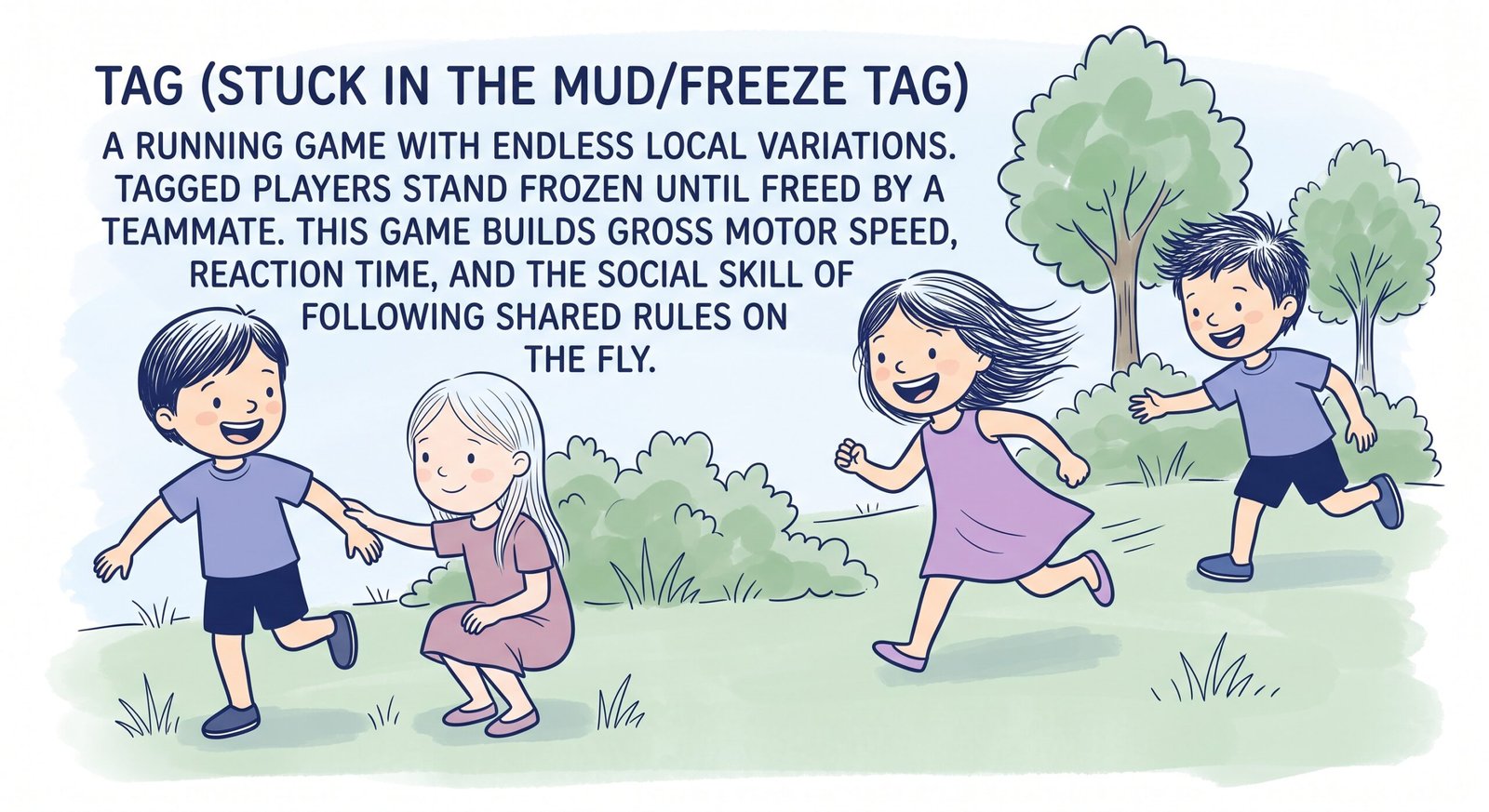
A running pursuit game with dozens of cultural variations, including freeze tag, where a tagged runner stands frozen until a teammate taps their arm, and stuck-in-the-mud. Tag builds sprinting speed, evasive footwork, and the social ability to respect shared rules on the move.
Best for: Ages four and up, once a child can run at full speed without stumbling over uneven ground.
Tip: Creating a small sanctuary base that cannot be tagged, like a specific timber bench or garden step, gives younger or easily overwhelmed children a quiet space to catch their breath without feeling excluded.
5. Marbles
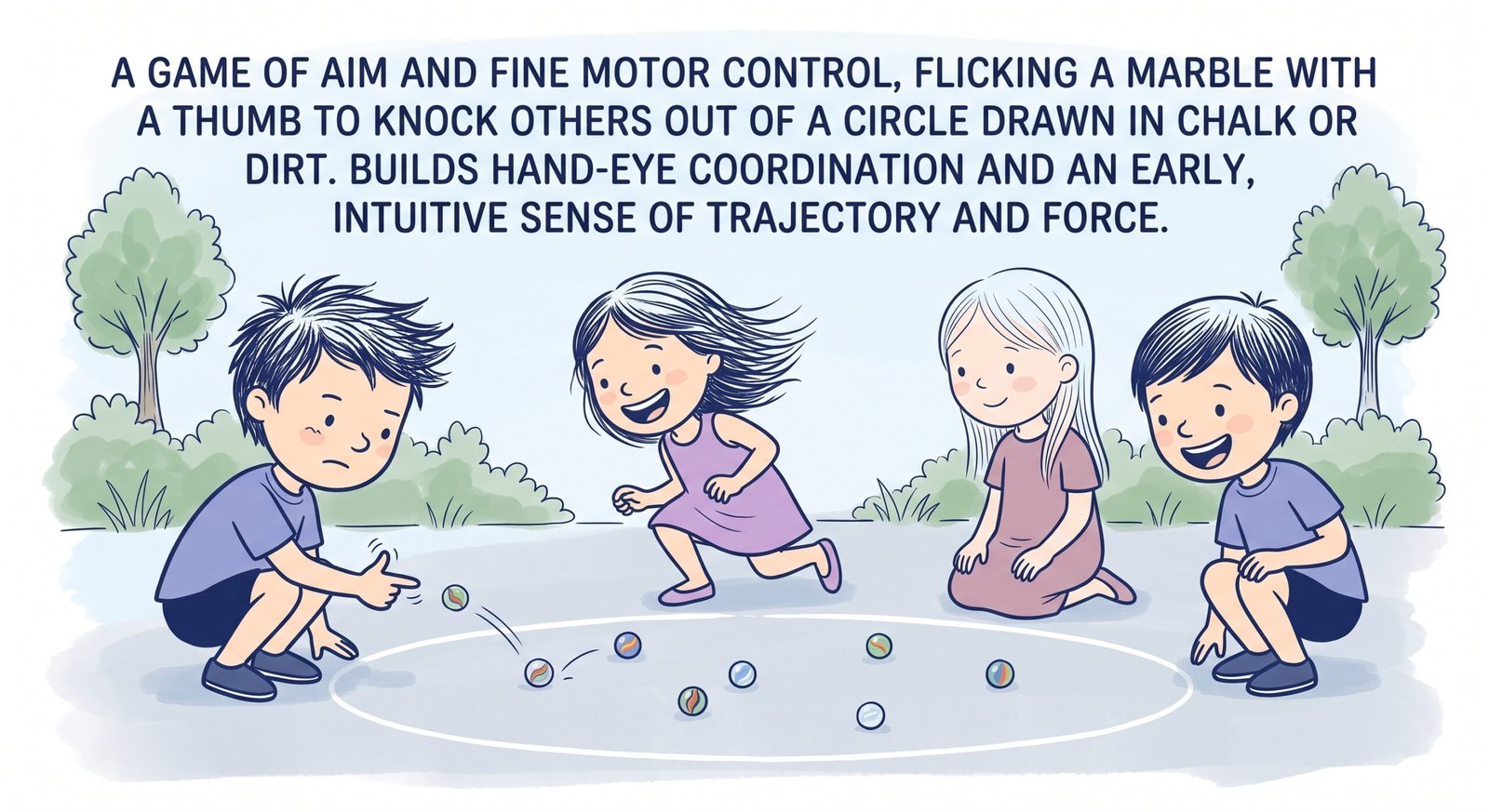
A traditional game of precision and fine motor control, flicking a larger shooter marble with the thumb to knock smaller marbles out of a chalk circle drawn on the driveway or packed garden soil.
It sharpens hand-eye coordination, trajectory estimation, and fine motor finger separation, reinforcing the exact pinch muscles we explore in our guide on pincer grasp activities.
Best for: Ages five and up, once the thumb flicking motion is steady and children are past the stage of placing small objects in their mouths.
Tip: Start with a generous chalk ring and move players closer to the edge during initial practice rounds to build confidence before introducing competitive rules.
6. Jacks
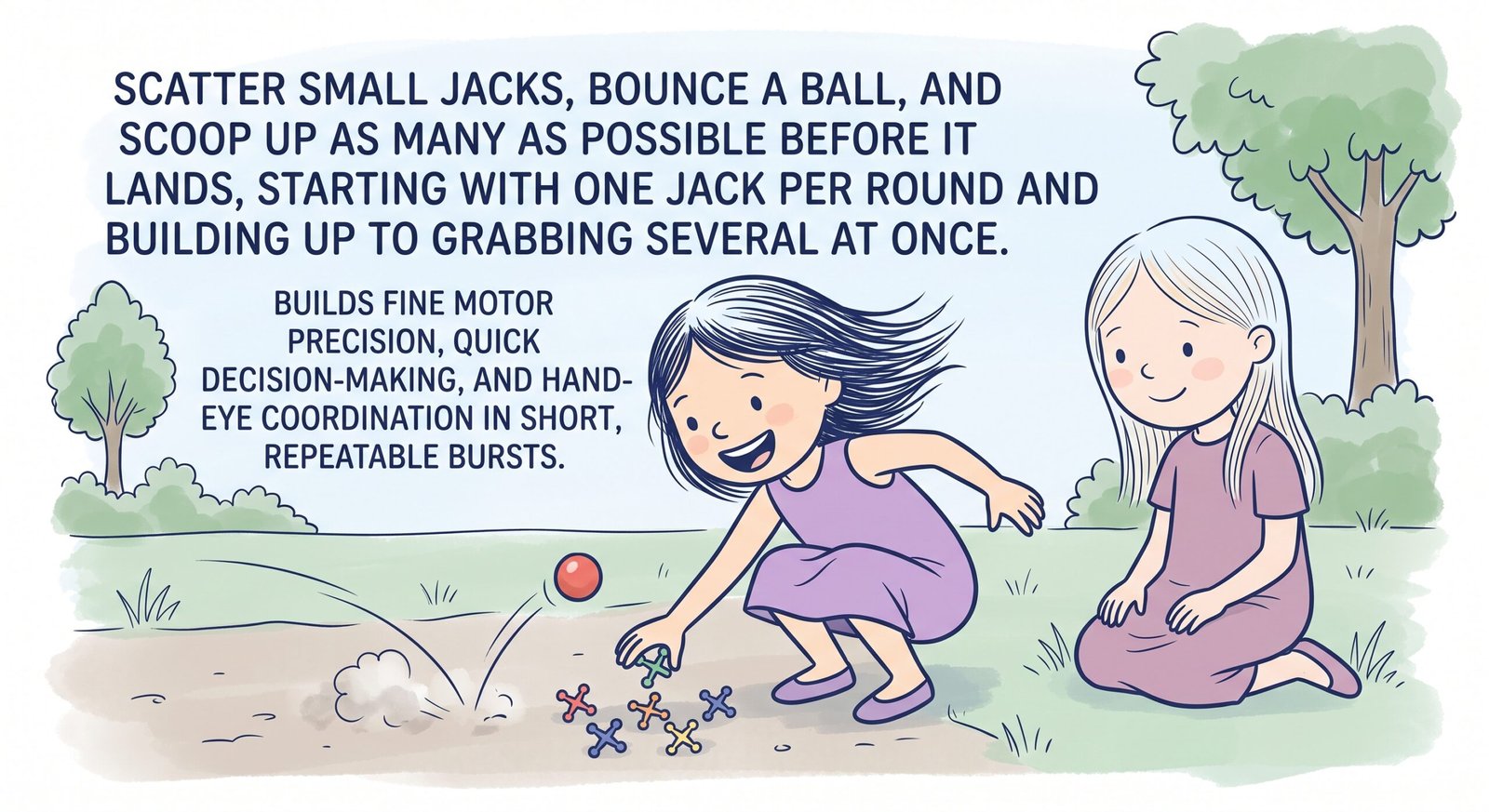
Scatter small metal or plastic jacks onto a smooth surface, toss a bouncy rubber ball into the air, scoop up one jack, and catch the ball before its second bounce. The game advances by scooping up two jacks, then three, then four on a single bounce.
Jacks develops lightning-fast visual reflexes, hand-eye coordination, and in-hand manipulation in brief, repeatable bursts of intense focus.
Best for: Ages five and up, once a child can catch a small bouncing ball reliably with one hand.
Tip: A slightly softer, larger rubber ball makes the catch more forgiving while the scooping hand movement is still new.
7. Simon says
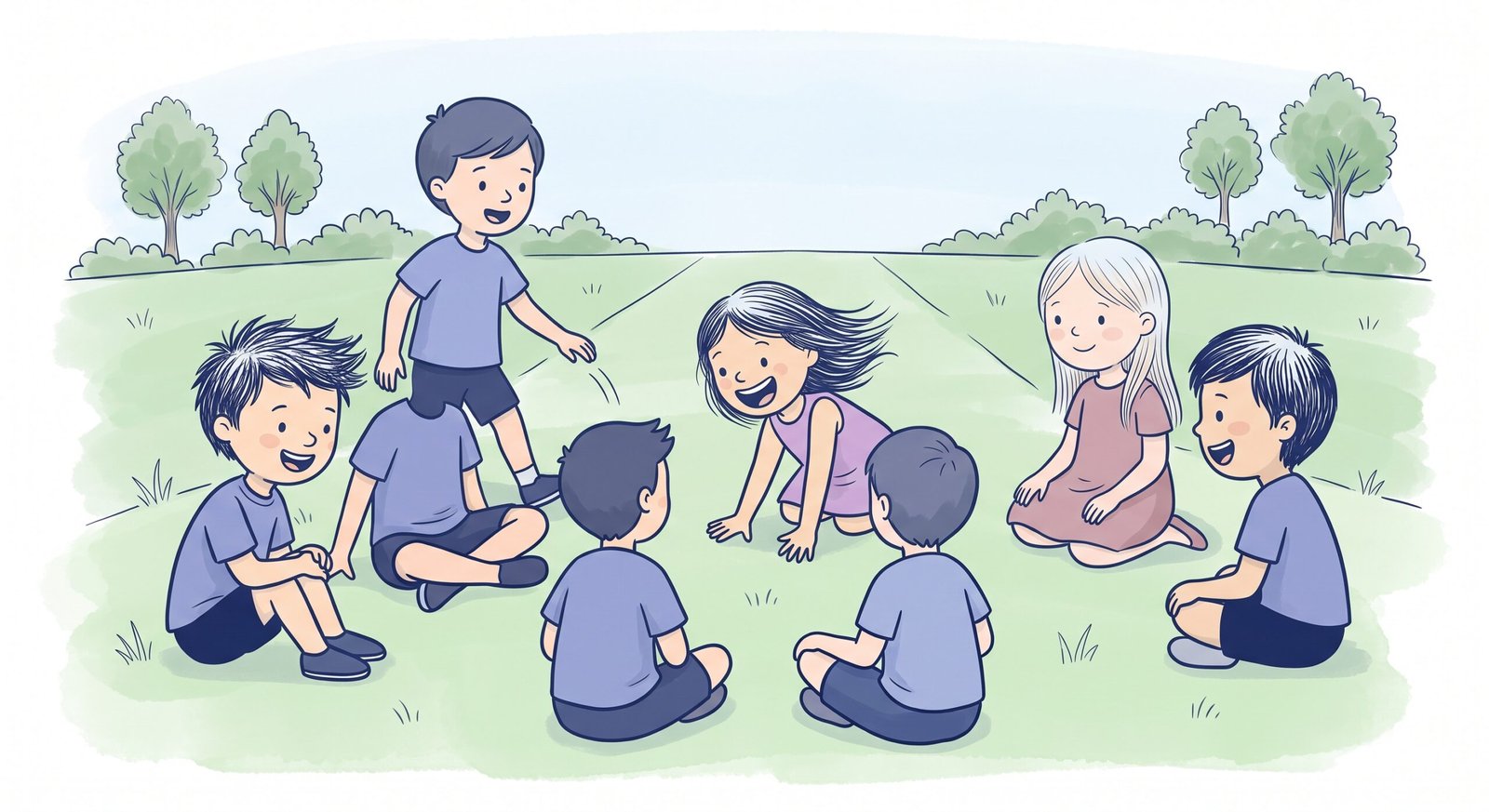
An auditory listening game with a clever cognitive catch: players must only obey the physical action if the leader prefaces the prompt with the exact phrase “Simon says”.
It is one of the most effective playground games for developing inhibitory control and working memory. Children must listen intently, suppress their instinctive impulse to move on an unverified command, and react swiftly when the phrase is spoken.
Best for: Ages three and up, scaling naturally by increasing the speed of prompts or introducing multi-step physical directions.
Tip: Giving children regular turns to be Simon lets them practice formulating clear instructions rather than solely responding to adult commands.
8. Red light, green light
Players race forward across the grass when the leader turns their back and calls “green light”, and must freeze instantly when the leader turns around and announces “red light”. Anyone caught moving after the call is sent back to the starting line.
Stopping mid-run provides an exceptional workout for the brain’s physical braking system, helping children practice gross motor self-regulation under conditions of high excitement.
Best for: Ages four and up, once running and sudden deceleration can be executed safely without falling forward.
Tip: Calling “yellow light” to prompt a slow-motion tiptoe walk between stops adds an enjoyable layer of motor planning and bodily awareness.
9. Duck, duck, goose
A traditional circle game where children sit cross-legged while the leader walks around the outside, gently tapping each head and saying “duck”. When the leader chooses a runner, they tap their head, shout “goose”, and sprint around the outside of the circle to steal the empty spot before the tagged player catches them.
Duck duck goose builds anticipatory patience, explosive sprinting, and turn-taking in large groups, providing an ideal outdoor game for school classrooms and birthday gatherings.
Best for: Ages three and up in supervised group play, since the rules are simple and intuitive for young preschoolers.
Tip: For very young or hesitant toddlers, making the chase non-competitive keeps circle time calm and welcoming.
10. Cat’s cradle
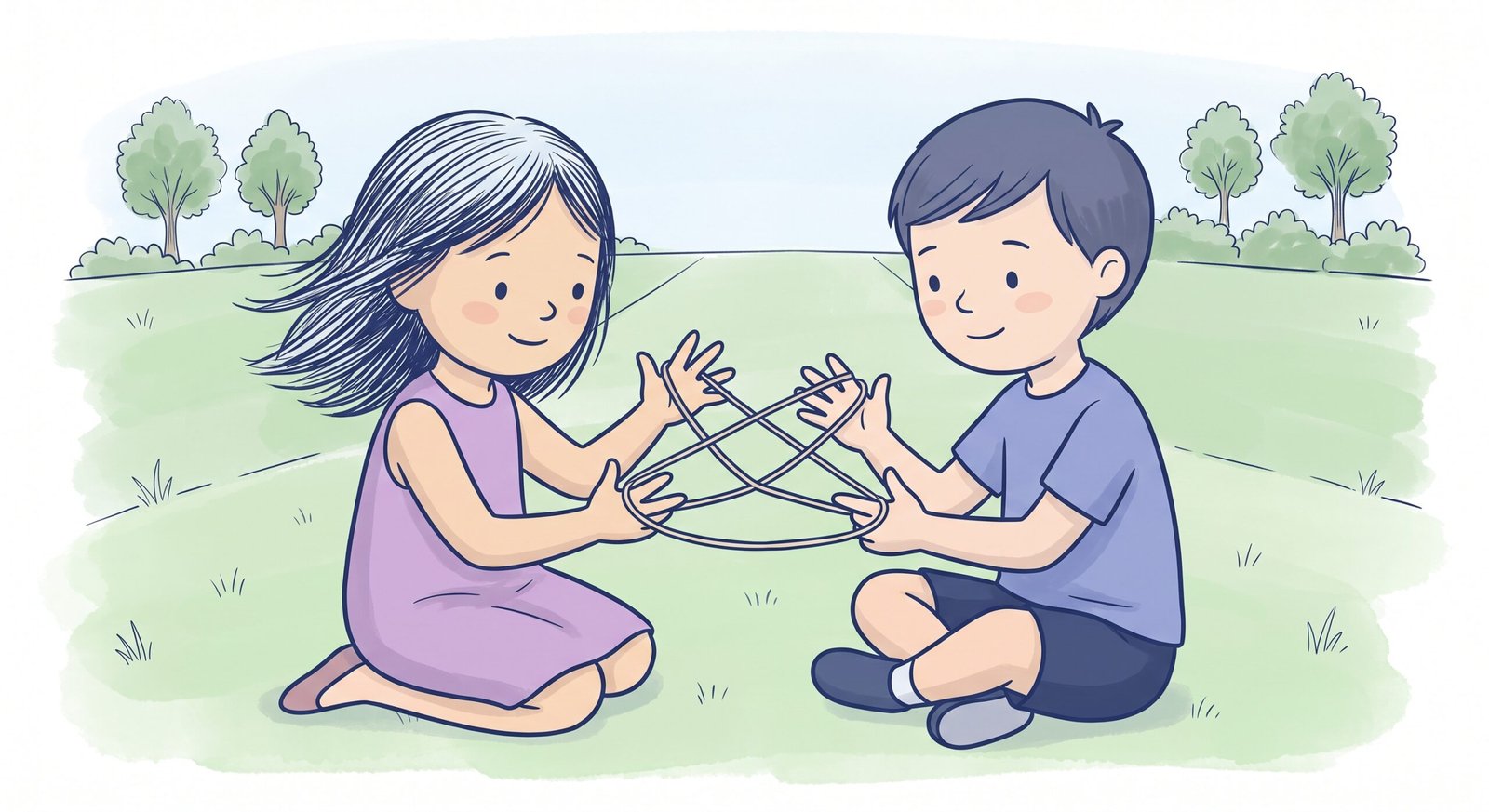
A continuous loop of soft string woven between two players’ hands to create shifting geometric figures, with each player pinching, lifting, and transferring string patterns across their fingers.
Cat’s cradle develops finger isolation, bilateral hand coordination, and spatial planning, linking directly to the hand strength required for scissor cutting and early writing.
Best for: Ages six and up, as the finger dexterity needed is more advanced than running games.
Tip: Using brightly coloured cotton yarn that is not too slippery makes it easier for small fingers to grasp individual strands without the cradle collapsing.
Supporting Sensory & ADHD Needs on the Playground
While classic games appear effortless from the sidelines, an open schoolyard or neighbourhood park can feel intensely overwhelming for children with ADHD, autism, or sensory processing differences.
The combination of shouting voices, sudden unpredictable movements, complex social hierarchies, and rapid rule changes can push a sensitive nervous system straight into fight, flight, or shutdown.
When an ADHD or autistic child melts down during playground games, the cause is rarely bad sportsmanship. In most cases, their sensory cup has filled to overflowing, or their executive functioning has run out of fuel during an abrupt social transition.
An open playground lacks physical boundaries. For a child who struggles with proprioceptive awareness, running across an open oval without clear markers can feel disorienting. Providing small, predictable movement anchors gives their nervous system the heavy resistance it needs to stay grounded.
To help neurodivergent children enjoy outdoor playground games without crashing into sensory overload, these two targeted supports make a genuine difference:
- Grounding Muscle Resistance with Heavy Work: Before stepping into fast chase games like tag, give restless bodies deep joint input. Our printable pocket heavy work cards offer portable, child-led exercises, such as wall pushes, bear walks, and firm arm squeezes, that soothe an overstimulated sensory system and restore physical focus in the playground.
- Predictable Play Sequences: Leaving free play open-ended often triggers intense transition anxiety. Using our structured visual routine cards for ADHD kids provides clear, visual finish lines, helping children anticipate when playtime ends, when outdoor shoes go back on, and how the class transitions smoothly back indoors.
When you pair traditional playground rules with intentional sensory anchors, outdoor play transforms from an exhausting obstacle course into a place of joyful social connection.
Quick Guide to Classic Playground Games for Kids (Skills & Ages)
| Game | Main Skill Built | Typical Starting Age | Equipment Needed |
|---|---|---|---|
| Hopscotch | Counting, single-leg balance | 3+ | Chalk, small marker stone |
| Jump rope | Rhythm, cardiovascular endurance | 4+ | Skipping rope |
| Hide and seek | Spatial awareness, patience | 3+ | None |
| Tag | Speed, evasive reaction time | 4+ | None |
| Marbles | Fine motor aim, hand-eye coordination | 5+ | Marbles, chalk circle |
| Jacks | Reflexes, fine motor precision | 5+ | Jacks, small bouncy ball |
| Simon says | Working memory, inhibitory control | 3+ | None |
| Red light, green light | Physical braking, self-regulation | 4+ | None |
| Duck, duck, goose | Turn-taking, sprinting anticipation | 3+ | None |
| Cat’s cradle | Finger dexterity, bilateral coordination | 6+ | Tied string loop |
How to run a screen-free afternoon without over-planning it
None of these activities require an adult to act as a strict whistle-blowing referee. Children learn best when games emerge naturally through curiosity and peer negotiation:
- Focus on One Game: A single round of hopscotch or tag played with joy for twenty minutes beats a rigid schedule that rushes through four different activities.
- Let the Gear Invite Play: Leaving a bucket of sidewalk chalk or a skipping rope beside the garden path often starts a game without an adult speaking a word.
- Encourage Independent Exploration: Solo games like hopscotch and jacks allow an only child or a quiet preschooler to build skills independently on quiet afternoons.
- Welcome Natural Repetition: Children do not tire of good games quickly; repeating the same course across consecutive afternoons builds deep motor mastery and lasting confidence.
Safety basics worth keeping in mind
- Inspect Running Surfaces: Fast pursuit games like tag and red light green light should be played on flat turf or smooth paving clear of garden tools, curbs, and loose gravel.
- Supervise Small Playing Pieces: Marbles and jacks involve small glass and metal pieces; store them securely away from younger toddlers who still mouth objects.
- Pack Away Long Ropes: Always store skipping ropes and string loops safely out of reach when play sessions conclude.
Adapting these games for a classroom or daycare
These traditional games transition effortlessly from suburban driveways into early childhood centres, preschool playgrounds, and primary school yards.
Activities with built-in turn taking, such as duck duck goose, hopscotch, and group skipping, work well during outdoor learning sessions because only a few children move vigorously while the rest cheer and prepare for their turn.
Wide running games like tag, red light green light, and Simon says scale seamlessly to whole-group outdoor gross motor time, helping children clear pent-up energy before returning indoors for table-based learning.
Quiet precision activities like marbles, jacks, and cat’s cradle serve as calming, small-group stations on shaded verandahs.
Frequently asked questions
What are the best classic playground games for kids?
The top classic playground games for kids include hopscotch, jump rope, tag, hide and seek, red light green light, Simon says, and duck duck goose, all offering timeless outdoor fun with minimal gear.
What are good screen-free games for preschoolers?
Hopscotch, tag, Simon says, and red light green light are ideal starting points for preschoolers, since each has simple rules and builds gross motor control and self-regulation through physical play.
Do classic playground games have real developmental benefits?
Yes. Movement games reinforce gross motor balance, executive function (inhibitory control), and peer cooperation, aligning directly with early childhood developmental frameworks.
What equipment do you need for classic playground games?
Very little. Chalk for hopscotch, a rope for skipping, string for cat’s cradle, and marbles or jacks for floor games; most traditional playground games need only one simple item or none at all.
A final thought
Bringing classic playground games for kids back into your family rhythm is not about rejecting modern technology; it is simply recognising that a piece of chalk, a skipping rope, and an open footpath still deliver deep joy, physical stamina, and sensory wellbeing that digital screens cannot match.
Step outside, draw a numbered grid on the pavement, and enjoy the timeless pleasure of watching children jump, laugh, and play together in the open air.
Related activities and resources
- Hopscotch for Kids: 4 Brilliant Ways This Classic Game Builds Real Skills
- Number line jumping game for early math skills
- Hands-on pattern activities for preschoolers
- Pocket Heavy Work Cards: 6 Calming Sensory Exercises for Meltdowns
- Visual Routine Cards for ADHD Kids: Calming Home Schedules
- Daily Routine for Neurodivergent Children: 4 Grounding Stages That Work
- Creative cardboard box activities at home
References
- World Health Organization. (2019). Guidelines on Physical Activity, Sedentary Behaviour and Sleep for Children under 5 Years of Age. World Health Organization. Available at: WHO Guidelines.
- Opie, I., & Opie, P. (1969). Children’s Games in Street and Playground. Oxford University Press. [Authoritative historical documentation of traditional street games and pavement play].