
Toddler Sleep Resistance & ADHD: Navigating Bedtime When Traditional Advice Fails
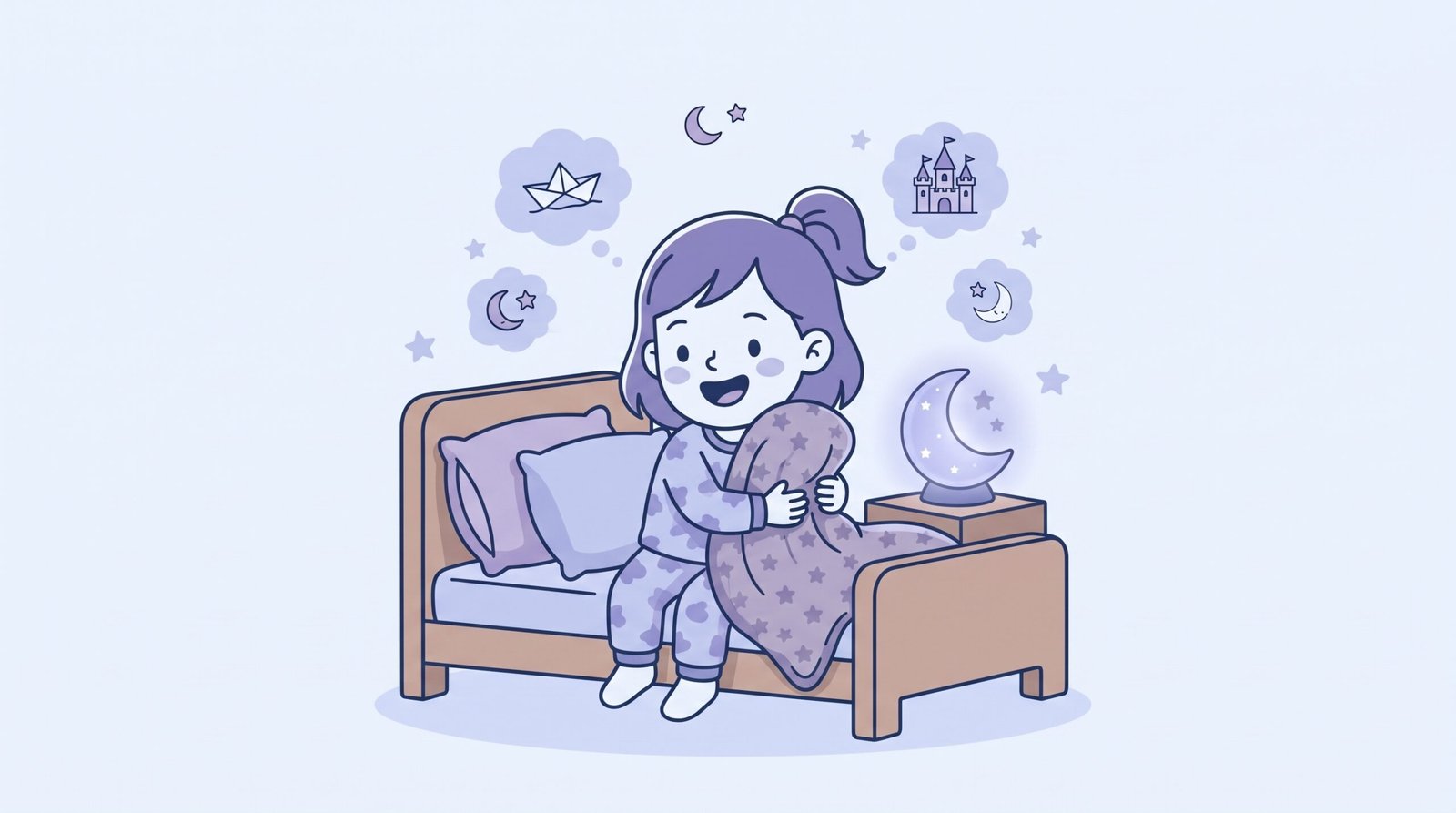
It is twenty past eight on a Tuesday night, and I am lying sideways across a single bed with my neck bent at an unnatural angle, staring at a glow-in-the-dark star peeling off the ceiling.
Under my left arm, my three year old is vibrating. Not metaphorically. Her small, warm body is literally humming with kinetic momentum, kicking rhythmically against the skirting board while her fingers twist the seam of her pyjamas. She has been through the bath, the lavender lotion, the quiet story about the sleepy bear, the white noise machine, and two sips of water. She is utterly exhausted. Her eyes are glazed, her speech has collapsed into a string of frantic, disjointed syllables about garbage trucks and dinosaurs, and yet every fibre of her nervous system is screaming that sleep is a trap.
Meanwhile, my own brain is unravelling. The repetitive thud-thud-thud of her foot on the plaster is setting off sirens behind my eyes. The kitchen sink is still full of porridge crusts from breakfast, my nervous system is entirely raw, and the silence I desperately need to restore my own baseline feels a million miles away.
Back then, I had no diagnosis. No medication. No support team, and no language for why simple daily rhythms felt like wading through wet cement. I did not find out I had ADHD until my forties. When you spend the early years of parenting undiagnosed, you do not realise you are operating with an empty tank and a different neurological wiring; you just assume you are fundamentally terrible at the thing everyone else seems to manage on autopilot.
If you have ever found yourself sitting in a dark hallway at nine o’clock at night, head in your hands, feeling like an absolute failure because the entire world told you that children fall asleep after a warm bath and a story, I want you to know you are not alone.
Sleep resistance in the toddler years is hard enough for any family. But when you are looking at it through the lens of a neurodivergent household, where bedtime is an unmedicated, unsupported clash of sensory overloads, it stops being a calm transition. It turns into an endurance event.
A quick note before we go any further: I spent years studying early childhood education at a postgraduate research level, so I understand the developmental literature reasonably well. I am also a neurodivergent mother who raised a wildly imaginative, neurodivergent little girl without a map, discovering my own ADHD well after the toddler years had passed. This is based on my experience and understanding, not clinical advice. Every nervous system is unique, and what keeps a household afloat might look entirely different to yours.
Understanding toddler sleep resistance & ADHD: what I noticed early
When my daughter was an infant, people told me she was just alert.
“Oh, she is so engaged with the world,” they would say while she stared wide-eyed at a ceiling fan instead of drifting off in the pram. But by the time she hit eighteen months and stepped into toddlerhood, bedtime felt like entering a battle zone where neither of us wanted to fight, yet neither of us could surrender.
Standard parenting books talk about toddlers testing boundaries at night. They tell you that a child who gets out of bed four times is simply seeking power, or that they need a firmer boundary, or that you just have to use a gentle sleep training method to teach them self-soothing.
I tried to apply that logic. Because of my academic background, I thought I could out-think and out-structure the chaos. I made visual charts. I kept the lighting amber. I timed wake windows with obsessive precision.
None of it touched the core problem, because it was not a behavioural choice. It was a nervous system mismatch.
- The second wind that felt like lightning: Instead of yawning and slowing down when tired, she would hit a sudden, frantic peak of energy. Her pupils would dilate, she would start running into walls on purpose, and her laughter had a brittle, frantic edge to it.
- The physical restlessness: She could not lie still without discomfort. If I held her close, she squirmed as if her clothes were made of sandpaper. If I let go, she bounced off the mattress.
- Sensory hyper-vigilance: A car door shutting down the street, the refrigerator hum cycling on, or a speck of lint inside her sock would reset her brain back to full alertness.
- Separation panic at twilight: The moment the light faded, her anxiety spiked. It was as though the transition from day to night felt like stepping off a cliff into the dark.
For a child with an ADHD profile, sleep is rarely a simple off-switch. As researchers at the Harvard Center on the Developing Child explain, the executive function system is responsible for regulating attention, shifting focus, and managing emotional transitions.[1]
Down-regulating to sleep requires executive control: filtering out ambient noise, stilling physical impulses, and turning down racing internal monologues. Furthermore, as clinical research by Cortese and colleagues demonstrates, intrinsic circadian rhythm shifts and dopamine deficits are deeply intertwined with sleep disturbances in ADHD.[2]
If your brain produces dopamine at lower baseline levels or struggles with transition states, lying still in a pitch-black room is under-stimulating to the point of being physically distressing. She was not refusing to sleep to make my life hard; she was refusing to sleep because lying still in the dark felt uncomfortable, boring, and overwhelming all at once.
- Executive Function: The suite of mental processes coordinated by the frontal lobe, including working memory, flexible thinking, and inhibitory control. Bedtime demands heavy executive function to quiet internal chatter and transition away from high stimulation.
- Proprioceptive System: The sensory system located in our muscles, tendons, and joints that tells our brain where our body parts are positioned in space. Neurodivergent toddlers often seek intense proprioceptive input to feel grounded and physically calm.
- Sensory Gating Deficits: The neurological difficulty in filtering out repetitive, irrelevant environmental stimuli (such as ticking clocks, clothing tags, or distant hums), keeping the child in a persistent state of sensory hyper-vigilance.[3]
- Co-Regulation: The warm, responsive process through which a caregiver’s grounded nervous system helps an overwhelmed child stabilise their own biological state, serving as the biological foundation for eventual self-regulation.[4]
What didn’t work for toddler sleep resistance & ADHD
When you are running on empty without help, medication, or answers, you will try almost anything out of sheer desperation. Looking back, half of the standard advice I attempted actually made the bedtime friction worse, largely because it was designed for children whose nervous systems naturally down-shift when things get quiet.
1. The rigid, multi-step bedtime routine
The internet loves a routine. Bath at 6:30, teeth at 6:45, books at 7:00, lights out at 7:15. For our household, this was an absolute disaster. An undiagnosed ADHD adult brain struggles enormously with sustained linear execution. Trying to hold a rigid timeline together while managing a sensory-seeking toddler felt like trying to balance spinning plates on a windy afternoon. If the bath ran late by six minutes, I felt an inward spiral that the whole night was ruined.
More importantly, it placed immense pressure on my daughter. She could feel the artificial urgency rolling off me in waves. Every step became a negotiation because she knew where the conveyor belt was heading: the lonely, quiet dark.
2. Complete darkness and silence
Every conventional sleep guide recommends blackout curtains and white noise. For us, pitch darkness was terrifying. Her brain, desperate for stimulation, started inventing things in the shadows. And standard white noise, that static, hissing sound, drove her completely mad. She would sit up and tell me the sound was “itchy”.
3. Leaving the room before she was fully settled
The advice to put them down “drowsy but awake” remains, in my opinion, one of the greatest myths ever sold to parents of neurodivergent kids. For my daughter, the second my foot crossed that doorway, her sympathetic nervous system kicked into high gear. Her heart rate would leap, cortisol would flood her body, and any drowsiness she had achieved was instantly wiped out. Trying to force independent sleep before her nervous system was mature enough to handle it just left us both sobbing on either side of a closed door.
| Conventional Advice | What Actually Happened | Neurodivergent Reality |
|---|---|---|
| Strict 15-minute intervals | Parental panic, clock-watching, escalation. | Executive dysfunction in parent clashes with child’s transition resistance. |
| Pitch-black room | Intense panic, shadows, visual distress. | Under-stimulating environment triggers anxiety and dopamine-seeking. |
| Standard white noise | Sensory agitation, complaining noise is “itchy”. | Acoustic sensitivity interprets static frequencies as irritating rather than soothing. |
| “Drowsy but awake” | Immediate cortisol surge, screaming at door. | Lack of co-regulatory anchor triggers separation panic and sympathetic flight. |
| Ignoring requests for water/hugs | Escalating physical meltdowns lasting hours. | Requests are bids for connection and nervous system co-regulation, not manipulation. |
What actually helped: scaffolding toddler sleep resistance & ADHD
Once I stopped treating bedtime like a discipline problem and started treating it like a regulation transition, things slowly began to shift. We still had messy nights. We still had evenings where sleep did not arrive until nine or ten. But the panic and the anger slowly started draining out of the room.
Here are the messy, imperfect things that made a tangible difference for our family.
Prioritising co-regulation over early independence
I had to give up the cultural fantasy that my toddler needed to fall asleep completely alone in a room by age two or three.
Children with developing, neurodivergent brains rely heavily on our physical presence to tether their own dysregulated energy. In clinical developmental literature, Dr Bruce Perry and the Neurosequential Model Network explain that the brain regulates from the bottom up: sensory rhythm and relational safety must precede any cognitive calming.[5] If she was spinning out, she could not regulate down using sheer willpower; she had to borrow my body’s stillness.
That meant I stayed. I lay on the floor, or I sat beside the bed with my hand resting firmly on her back. That deep, steady pressure gave her proprioceptive system the feedback it needed to feel anchored. Yes, it took time. Yes, it meant my evenings disappeared. But spending forty-five minutes quietly resting on the floor was vastly better than spending two hours yelling, negotiating, and feeling sick with guilt.
Heavy work before the wind-down
If an ADHD child has spent all day trying to navigate sensory inputs at childcare or preschool, their physical body is often loaded with residual tension and under-stimulated joint receptors.
About an hour before we started any winding down, we did heavy work. We piled cushions in the lounge room and she crashed into them. We played wheelbarrows across the rug. We pushed laundry baskets full of books across the floorboards.
Pediatric occupational therapy frameworks from sources like the Child Mind Institute consistently show that heavy work provides proprioceptive input that organises the central nervous system, calming the physical restlessness before they lie down.[6] It sounded counterintuitive to get her moving when I wanted her to sleep, but without that release, her limbs felt like they were fizzing under the sheets.
Low-demand sensory bridges
Instead of stripping away all sensory input, we swapped in regulated, rhythmic inputs:
- Audiobooks and quiet stories: Instead of silence, we used familiar audio stories playing at a very low volume. A soothing, predictable voice talking about everyday things gave her racing thoughts something gentle to latch onto, preventing her brain from looking for chaos to keep itself occupied.
- Warm amber lighting: Pitch darkness felt like sensory deprivation. A soft, dim amber lamp stayed on in the corner all night. As highlighted by the Sleep Health Foundation Australia, keeping lighting low and amber avoids disrupting natural melatonin production while preserving spatial safety.[7]
- Compression and weight: She did not like heavy blankets over her feet, but she loved a tight, stretchy sheet pulled firmly across her torso. It acted like a steady, continuous hug that told her body where its boundaries were in space.
Dropping the bedtime battles
I stopped fighting over the small things. If she insisted on wearing her gumboots into bed, we negotiated them off after ten minutes, or sometimes I let her wear clean ones until she dozed off and slid them off later. If she wanted to sleep at the foot of the bed with her head resting where her feet usually went, I let her.
The goal was rest, not compliance. The more I turned sleep into a point of friction, the more her nervous system associated bedtime with threat.
The emotional reality: managing toddler sleep resistance with undiagnosed ADHD
There is an aspect of this journey that people rarely talk about honestly, especially for those of us who spent decades parenting without knowing we had ADHD ourselves.
When you are undiagnosed and unmedicated, your sensory and emotional bandwidth at the end of the day is not just low; it is entirely spent. You have pushed through the day running on sheer adrenaline, masking your disorganisation, compensating for memory lapses, and white-knuckling your way through life. By seven o’clock, your own sensory cup is not just full; it is overflowing.
Then comes bedtime.
You need quiet. You need to not be touched. You need to sit on the floor and stare into the distance so your overloaded circuits can cool down.
Instead, your daughter is touching your arm, wriggling, asking twelve questions about whether pelicans sleep with their eyes open, and kicking the wall. It can feel like physical torture.
Back then, before I had my diagnosis in my forties, I did not know that my brain was starving for dopamine and screaming from sensory overload. Clinical resources from ADHD Australia highlight how emotional dysregulation and sensory overload are central components of adult ADHD, yet in the absence of a diagnosis, parents simply absorb these challenges as personal failings.[8]
I just felt an intense, burning wave of rage rise up in my chest, followed immediately by sickening shame. I thought I was a cold, impatient parent. I thought I was broken because other mothers seemed to read bedtime stories with serene, gentle smiles while I felt like I was crawling out of my own skin.
If you are raising a child without medication, without professional therapies, or without a community that understands, the isolation is suffocating.
The shift began the day I stopped judging the sensory overload as a character defect. Even without medication, simply learning to recognise that physical tipping point changed the script in my head from “Why can’t I just be patient?” to “My nervous system is overloaded, and this is pure fight-or-flight.”
When that heat rose in my chest, I learned to say out loud: “I am overstimulated. This is not an emergency. She is not doing this to hurt me.”
Sometimes, I had to step into the hallway for three minutes. I leaned my forehead against the cool plaster, took five deep breaths, shook the tension out of my hands, and walked back in. It was messy, and it was certainly not the polished parenting portrayed on television. But it was survival.
Rethinking toddler sleep resistance & ADHD: what success really looks like
In early childhood spaces, we talk endlessly about milestones. When do they drop the nap? When do they sleep through? When do they settle independently?
We create these tidy developmental boxes, and then we carry enormous grief and self-blame when our neurodivergent kids refuse to fit neatly inside them.
My daughter was never the child who got tucked in at seven, smiled, closed her eyes, and drifted off without a word. Her brain was wired to explore, to question, to seek patterns, and to feel things with extraordinary intensity. That made bedtime an uphill climb, but it also made her the wonderfully vibrant, curious human she is today.
I spent years believing that if I were only more patient, or more organised, or better at sticking to a routine, bedtime would have looked easy. Finding out I had ADHD in my forties gave me the grace to rewrite that history. We were not failing. We were two sensitive, intense people navigating a world not built for our nervous systems, completely unassisted, doing the very best we could with the tools we had at the time.
A successful bedtime is not one where a child falls asleep in ten minutes flat. A successful bedtime is one where they feel safe enough to finally close their eyes. It is an evening where, even if it took two hours of resting on the floorboards, we made it to the other side intact.
Tonight, the foot tapping against the skirting board has finally slowed. The breath under her ribcage is lengthening, shifting from the shallow, hurried rhythm of an overwhelmed toddler into the heavy, rhythmic sigh of deep sleep.
I carefully disentangle my arm from her pyjamas, stretch my stiff neck, and step quietly out onto the floorboards. The kitchen is still a mess, the dishes are still waiting, and the day was far from perfect. But she is resting, she is safe, and tomorrow we will wake up and meet the day as it comes.
Need Gentle, Calming Activities for Restless Afternoons?
When young minds are overflowing with energy before bedtime, low-demand, quiet tracing sheets and sensory-friendly printable activities help down-regulate the nervous system with ease.
Explore Calm Story Tracing PrintablesReferences
- Center on the Developing Child at Harvard University. (2014). Enhancing and Practicing Executive Function Skills with Children from Infancy to Adolescence. Harvard University.
- Cortese, S., Faraone, S. V., Konofal, E., & Lecendreux, M. (2009). Sleep in children with attention-deficit/hyperactivity disorder: Meta-analysis of subjective and objective studies. Journal of the American Academy of Child & Adolescent Psychiatry, 48(9), 894–908.
- Micoula-Gondek, W. A., & Gondek, T. M. (2019). Sensory processing sensitivity and neurodevelopmental patterns in early childhood. Psychiatric Annals, 49(7), 312–318.
- Siegel, D. J. (2020). The Developing Mind: How Relationships and the Brain Interact to Shape Who We Are (3rd ed.). Guilford Press.
- Perry, B. D. (2009). Examining child maltreatment through a neurodevelopmental lens: Clinical application of the Neurosequential Model of Therapeutics. Journal of Loss and Trauma, 14(4), 240–255.
- Biel, L., & Peske, N. (2018). Raising a Sensory Smart Child: The Definitive Handbook for Helping Your Child with Sensory Processing Issues. Penguin Books.
- Sleep Health Foundation Australia. (2022). Light and Sleep: Understanding Circadian Rhythms and Sleep Health. Sleep Health Foundation.
- Barkley, R. A. (2015). Emotional Dysregulation Is a Core Component of ADHD. ADHD Australia & The ADHD Report, 23(4), 1–8.